Connect with us

Business

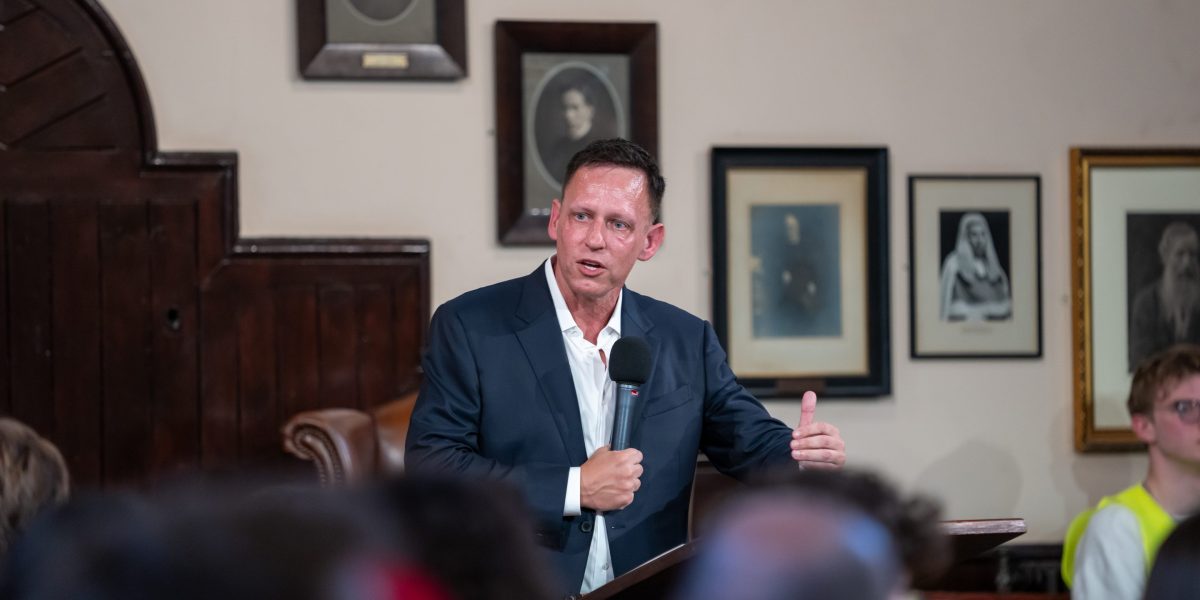
Peter Thiel is hosting 4 private sold-out lectures about the Antichrist at a club in San Francisco

Published

on


PayPal and Palantir co-founder Peter Thiel is embarking on an unusual intellectual journey this fall—delivering a sold-out four-part lecture series on the biblical figure of the Antichrist. The private lectures, hosted by The Commonwealth Club in San Francisco, represent the latest evolution in Thiel’s increasingly public theological interests, which intertwine his Christian faith with his concerns about technology’s potential to enable authoritarian control.

The series, organized by the nonprofit Acts 17 Collective, will explore “the theological and technological dimensions of the Antichrist” in four sessions across September and October. The lectures remain off-the-record, with no transcripts or recordings made public, but they draw upon the work of René Girard, the French philosopher who profoundly influenced Thiel during his Stanford undergraduate years, along with thinkers like Francis Bacon and Carl Schmitt.

Thiel’s theological preoccupations might seem incongruous with his business empire, but they reflect a consistent worldview shaped by Girard’s “mimetic theory“—the idea that human desires are learned through imitation, often leading to conflict and violence. This philosophical framework reportedly influenced Thiel’s $500,000 angel investment in Facebook in 2004, which he credits to recognizing the mimetic nature of social media.

The 57-year-old billionaire, worth an estimated $20.8 billion according to Forbes, built his fortune through a series of contrarian investments that challenged conventional Silicon Valley wisdom. His investment philosophy centers on identifying monopoly-like businesses and backing transformative technologies before they gain mainstream recognition. This approach led to early successes with PayPal, which sold to eBay for $1.5 billion in 2002, and later investments in companies like Palantir Technologies, the data-analytics firm he co-founded in 2003.

Palantir has emerged as perhaps Thiel’s most controversial venture, providing surveillance and data analysis tools to government agencies including Immigration and Customs Enforcement, the Department of Defense, and intelligence services. The company’s “Gotham” platform enables law enforcement to connect vast datasets, creating detailed profiles of individuals by combining everything from DMV records to social media activity. Recent Trump administration contracts have expanded Palantir’s reach across federal agencies, raising concerns about potential misuse for political targeting.

A theory of technological apocalypse

Thiel’s fascination with the Antichrist concept stems from his belief that such a figure would rise to power not through overt evil, but by exploiting technological fears to impose global control. In a recent New York Times interview, Thiel said his “speculative thesis” about how the Antichrist might emerge: “The way the Antichrist would take over the world is you talk about Armageddon nonstop. You talk about existential risk nonstop.”

This theory positions the Antichrist as someone who would offer “peace and safety” while using fear of catastrophic technological risks—artificial intelligence dangers, nuclear war, climate change—to justify unprecedented surveillance and control measures. The irony, as some critics note, is that Thiel himself frequently discusses apocalyptic scenarios while building the very surveillance technologies that could enable such control.

Thiel has previously suggested that modern technology provides the “mechanism” that fictional depictions of the Antichrist lacked: the ability to achieve global dominance through data integration and surveillance rather than traditional conquest. Thiel’s company Palantir exemplifies this capability, with its platforms designed to synthesize disparate information sources into comprehensive intelligence systems.

Thiel’s theological interests have grown more public in recent years, coinciding with his increased political influence. He was an early Trump supporter and delegate at the 2016 Republican National Convention, where he made history as the first openly gay speaker to declare his sexuality from the stage. His support for political figures like J.D. Vance, whom he helped launch into politics, reflects his belief that technological stagnation requires disruptive political change.

The Acts 17 Collective—which organized Thiel’s Antichrist lecture series and takes its name from Acts 17, where the apostle Paul preached to cultural elites in Athens and other intellectual centers—targets wealthy tech leaders by recognizing that traditional evangelical approaches often fail to resonate in secular tech culture. For Thiel, who grew up Lutheran but describes himself as having complicated religious views, his interpretation draws heavily on Girard’s work on sacrifice, violence, and social order, seeing Christianity as uniquely equipped to diagnose the dangers of society that technology can amplify.

The big picture

The timing of Thiel’s Antichrist lectures coincides with growing scrutiny of Palantir’s expanding role in government surveillance. Under the Trump administration, the company has secured over $113 million in federal contracts, with its technology now deployed across at least four major agencies. The company’s ability to integrate data from multiple sources has raised concerns among civil liberties advocates and even some Republicans about the potential for abuse.

Critics argue that Thiel’s warnings about the Antichrist ring hollow given his role in building the very surveillance infrastructure that could enable authoritarian control. Thirteen former Palantir employees recently signed a letter urging the company to cease its work with the Trump administration, citing concerns about how the technology might be misused for political targeting.

These tensions reflect broader questions about the role of technology companies in democratic governance. As Palantir’s tools become increasingly sophisticated, the line between legitimate security applications and potential authoritarian abuse becomes harder to define. Thiel’s theological framework offers one lens for understanding these risks, but whether his Antichrist lectures represent genuine concern about technological overreach or an attempt to deflect criticism of his own companies remains an open question.

Palantir did not immediately respond to Fortune‘s request for comment.

For this story, Fortune used generative AI to help with an initial draft. An editor verified the accuracy of the information before publishing.


Source link

Continue Reading

Business

Selling America is a ‘dangerous bet,’ UBS CEO warns as markets panic

Published

on


Investors are “selling America” in spades Tuesday: The 10-year Treasury yield is at its highest point since August; the U.S. dollar slid; and the traditional safe-haven metal investments—gold and silver—surged once again to record highs.

The CEO of UBS Group, the world’s largest private bank, thinks this market is making a “dangerous bet.”

“Diversifying away from America is impossible,” UBS Group CEO Sergio Ermotti told Bloomberg in a television interview at the World Economic Forum in Davos, Switzerland, on Tuesday. “Things can change rapidly, and the U.S. is the strongest economy in the world, the one who has the highest level of innovation right now.” 

The catalyst for the selloff was fresh escalation from U.S. President Donald Trump, who has threatened a 10% tariff on eight European allies—including Germany, France, and the U.K.—unless they cede to his demands to acquire Greenland.

Trump also threatened a 200% tariff on French wine and Champagne to pressure French President Emmanuel Macron to join his Board of Peace. Trump’s favorite “Mr. Tariff” is back, and bond investors are unhappy with the volatility.

But if investors keep getting caught up in the volatility of day-to-day politics and shun the U.S., they’ll miss the forest for the trees, Ermotti argued. While admitting the current environment is “bumpy,” he pointed to a statistic: Last year alone, the U.S. created 25 million new millionaires. For a wealth manager like UBS, that is 1,000 new millionaires a day. To shun that level of innovation in U.S. equities for gold would be a reactionary move that ignores the long-term innovation of the U.S. economy. 

“We see two big levers: First of all, wealth creation, GDP growth, innovation, and also more idiosyncratic to UBS is that we see potential for us to become more present, increase our market share,” Ermotti said. 

But if something doesn’t give in the standoff between the European Union and Trump, there could be potential further de-dollarization, this time, from Europe selling its U.S. bonds, George Saravelos, head of FX research at Deutsche Bank, wrote in a note Sunday. Indeed, on Tuesday, Danish pension funds sold $100 million in U.S. Treasuries, allegedly owing to “poor” U.S. finances, though the pension fund’s chief said of the debacle over Greenland: “Of course, that didn’t make it more difficult to take the decision.” 

Europe owns twice as many U.S. bonds and equities as the rest of the world combined. If the rest of Europe follows Denmark’s lead, that could be an $8 trillion market at risk, Saravelos argued. 

“In an environment where the geo-economic stability of the Western alliance is being disrupted existentially, it is not clear why Europeans would be as willing to play this part,” he wrote. 

Back in the U.S., the markets also sold off as the Nasdaq and S&P both fell 2% Tuesday, already shedding the entirety of Greenland’s value on Trump’s threats, University of Michigan economist Justin Wolfers noted. Analysts and investors are uneasy, given the history of Trump declaring a stark tariff before negotiating with the country to take it down, also known as the “TACO”—Trump always chickens out—effect. Investors have been “burnt before by overreacting to tariff threats,” Jim Reid of Deutsche Bank noted. That’s a similar stance to the UBS bank chief: If you react too much to headlines, you’ll miss the great innovation that’s pushed the stock market to record highs for the past three years.

“I wouldn’t really bet against the U.S.,” he said.


Source link

Continue Reading

Business

Trump added $2.25 trillion to the national debt in his first year back in charge, watchdog says

Published

on


Trump’s first year back in the White House closed with the U.S. national debt roughly $2.25 trillion higher than when he retook the oath of office, showing how fast Washington’s red ink is piling up even amid DOGE hype and promises to pay it down. Over the calendar year 2025, the growth in the national debt was even higher, some $2.29 trillion.

The acceleration in borrowing, with the national debt standing at $38.4 trillion and growing as of January 9, is sharpening warnings from budget watchdogs and Wall Street alike that the country’s fiscal path is becoming a growing vulnerability for the economy.​ The total national debt has grown by $71,884.09 per second for the past year, according to Congressman David Schweikert’s Daily Debt Monitor.

Over the 12 months from the close of trading on Jan. 17, 2025, to the end of day Jan. 15, 2026, the federal government added approximately $2.25 trillion to the national debt, according to calculations shared exclusively with Fortune by the Peter G. Peterson Foundation. That period roughly captures President Donald Trump’s first year back in office, as it is the last business day before last year’s Inauguration Day and the most recent day for which data are available. The jump from $37 trillion to $38 trillion in just two months between August and October was particularly notable, with the Peterson Foundation calculating at the time that it was the fastest rate of growth outside the pandemic. Michael A. Peterson, CEO of the nonpartisan watchdog dedicated to fiscal sustainability, told Fortune at the time that “if it seems like we are adding debt faster than ever, that’s because we are.”

As for how these figures compare to recent presidencies, the Peterson Foundation provided calculations (below) for each calendar year over the last quarter-century, revealing that President Joe Biden owns the highest year of national debt growth outside the pandemic, with almost $2.6 trillion in 2023. President Trump far and away holds the record, with nearly $4.6 trillion of national-debt growth occurring during the pandemic year of 2020, when massive federal spending occurred in the form of economic relief measures.

Trump and Biden together own the top five highest-debt-incurring years, two for Trump and three for Biden, across five of the last six years. While the figures are not adjusted for inflation, by and large, Trump and Biden have roughly doubled the rate of debt accumulation under President Barack Obama and tripled, even quadrupled the rate of growth under President George W. Bush, depending on which term you’re looking at. To be sure, both Bush and Obama presided over the aftermath of the Great Recession of 2008, with experts still debating whether their fiscal responses were large enough.

Interest costs explode

The surge in debt is landing just as interest costs on that debt become one of Washington’s fastest‑growing expenses. The specific line item for net interest in the federal budget totaled $970 billion for fiscal year 2025, but the Congressional Budget Office (CBO) calculated that, including spending for net interest payments on the public debt, this broke the $1 trillion barrier for the first time. The Committee for a Responsible Federal Budget, another nonpartisan watchdog, projects $1 trillion per year in interest payments from here on out.

Trump has repeatedly argued that his ambitious tariff program will be enough to tame the debt burden, casting duties on imports as a kind of magic revenue source for Washington. Treasury data show tariffs are bringing in significantly more money than before—likely in the $300 billion to $400 billion‑a‑year range—but even optimistic projections suggest those sums only cover a fraction of annual interest costs and an even smaller slice of total federal spending.​ As Trump retreated from many of his tariff threats—before the January 2026 spike that he threatened in relation to his desire for U.S. possession of Greenland—the CBO calculated that $800 billion of projected deficit reduction had also vanished.

At the same time, the administration has promised to share some of that tariff revenue directly with households through a proposed $2,000 “dividend” for every American, a pledge that independent analysts estimate could cost around $600 billion per year and further widen the deficit unless offset elsewhere. Economists say that the combination—more borrowing, high interest rates, and new permanent commitments—risks locking in structural deficits that keep the debt rising faster than the overall economy.​

Markets and America’s ‘Achilles’ heel’

Financial markets are taking notice. As Washington auctions hundreds of billions of dollars in new Treasury securities each week, yields on longer‑term notes and bonds have moved higher, reflecting both tighter monetary conditions and investor unease about the sheer volume of U.S. borrowing. Recent analysis from Deutsche Bank and others has described America’s mounting debt load as an “Achilles heel” that could leave the dollar and broader economy more vulnerable to shocks, particularly as geopolitical tensions and tariff fights escalate.​

Those worries are amplified by the prospect of future recessions or emergencies that could force the government to borrow even more heavily on top of today’s already‑elevated baseline. Rating agencies and international lenders have not sounded any immediate alarm about U.S. solvency, but they have increasingly highlighted fiscal risks in their outlooks, pointing to widening deficits and a political system that has struggled to impose discipline.​

Voters are paying attention

If there is one thing Americans still broadly agree on, it is that the debt problem matters. Recent polling sponsored by the Peterson Foundation found that roughly 82% of voters say the national debt is an important issue for the country, even as they remain divided over which programs to cut or taxes to raise.

Trump first won office vowing to erase the national debt over time; a decade later, after his return to power, that figure has instead climbed to record highs. As the administration prepares for another year of governing—and another season of fiscal showdowns on Capitol Hill—the question is shifting from whether the debt is growing too fast to how long the world’s largest economy can keep outrunning its own balance sheet.

For this story, Fortune journalists used generative AI as a research tool. An editor verified the accuracy of the information before publishing.


Source link

Continue Reading

Business

Gen Z’s nostalgia for ‘2016 vibes’ reveals something deeper: a protest against the world and economy they inherited

Published

on


Gen Z’s “2016 vibes” fixation is less about pastel Instagram filters and more about an economic and cultural shift: they are coming of age in a world where cheap Ubers, underpriced delivery, and a looser-feeling internet simply no longer exist. What looks like a lighthearted nostalgia trend is something more structural: a reaction to coming of age against the backdrop of a fully mature internet economy.

On TikTok and Instagram, “2016 vibes” has become a full-blown aesthetic, with POV clips, soundtracks of mid‑2010s hits, and filters that soften the present into a memory. Searches for “2016” on TikTok jumped more than 450% in the first week of January, and more than 1.6 million videos celebrating the year’s look and feel have been uploaded, according to creator‑economy newsletter After School by Casey Lewis. Lewis noted that only a few months ago, “millennial cringe” was rebranded as “millennial optimism,” with Gen Zers longing to experience a more carefree era. Lin-Manuel Miranda’s Hamilton, although it debuted in 2015, arguably has a 2016 vibe, for instance. Some millennial optimism is downright bewildering to Gen Z, such as what it calls the “stomp, clap, hey” genre of neo-folk pop music, recalling millennials’ own rediscovery (and new naming) of “yacht rock.”

Meanwhile, Google Trends reports that the search hit an all-time high in mid-January, with the top five trending “why is everyone…” searches all being related to 2016. The top two were “… posting 2016 pics” and “... talking about 2016.”

Creators caption posts “2026 is the new 2016” and stitch side‑by‑side footage of house parties, festivals, and mall hangs, inviting viewers to imagine a version of young adulthood that feels more spontaneous and frictionless.​ At the risk of being too self-referential, the difference can be tracked in Fortune covers, from the stampeding of the unicorns, the billion-dollar startup that defined the supposedly carefree days of 2016, to the bust a decade later and the dawn of the “unicorpse” era.

And while the comparison may feel ridiculous to anyone who actually lived through 2016 as an adult and can remember the stresses and anxieties of that particular time, there is something going on here, with economics at its core. In short, millennials were able to enjoy the peak of a particular Silicon Valley moment in 2016, but 10 years later, Gen Z is late to the party, finding the price of admission is just too high for them to get in the door.

Everyone used to love Silicon Valley

For millennials, 2016 marked a time when technology expanded opportunity rather than eliminating it. Venture capital was cheap, platforms were underpriced, and software functioned to your personal advantage, with aforementioned unicorns flush with cash and willing to offer millennials a crazy deal. The early iterations of the gig-economy ecosystem—Uber, Airbnb, TaskRabbit—were at their peak affordability, lowering the cost of living and making urban life feel frictionless. And at work, new digital tools helped young employees do more, faster, standing out from the pack.

For older millennials, 2016 evokes a very specific consumer reality: Ubers that were often cheaper than cabs and takeout that arrived in minutes for a few dollars in fees. Both were the product of what The New York Times‘ Kevin Roose labeled the “millennial lifestyle subsidy” in 2021, looking back on the era “from roughly 2012 through early 2020, when many of the daily activities of big-city 20- and 30-somethings were being quietly underwritten by Silicon Valley venture capitalists.” Because Uber and Seamless were not really turning a profit all those years while they gained market share, as on a grander scale Amazon and Netflix were underpriced for years before cornering the market on ecommerce and streaming, these subsidies “allowed us to live Balenciaga lifestyles on Banana Republic budgets,” as Roose put it.

Gen Z never really knew what it felt like to take a practically free late-night ride across town, or feast on $50 worth of Chinese takeout while paying half that. And they certainly never knew what it felt like to see unlimited movies in theaters each month, for the flat rate allowed by one MoviePass app. For the generation seeking the 2016 vibe, $40 surge‑priced trips and double‑digit delivery fees are standard, not a shocking new inconvenience, and the frictionless urban lifestyle of the millennial heyday, before they entered their 40s, had (a declining number of) kids, and fought their way into the suburban housing market amid the pandemic housing boom, reads more like historical fiction than a realistic blueprint.​

Tech and digital culture was also just fun. Gen-Z remembers the heyday of Pokemon Go, the only app that somehow forced the youth outside and interacting with each other. Viral trends felt collective rather than segmented by algorithmic feeds. Back then, Vine jokes, Harambe memes, and Snapchat filters could sweep through timelines in a way that made the internet feel weirdly communal, even as politics darkened the horizon.

That helps explain why The New York Times‘ Madison Malone Kircher recently framed the new 2016 nostalgia as part of a broader reexamination of millennial optimism on social media. Celebrities like Kylie Jenner, Selena Gomez, and Karlie Kloss have joined in, uploading 2016 throwbacks that signal a desire to rewind to an era when influencer culture felt less high‑stakes and more experimental.

The moment tech stopped being fun

Then, something shifted. The attitude towards tech companies as nerdy but general do-gooders who “move fast and break things” for the sake of the world faded into a “techlash.” The Cambridge Analytica scandal rocked what was then called Meta and fueled panic around data privacy. Former tech insiders like Tristan Harris started popularizing the idea that the algorithms were addictive.

Thus, when Silicon Valley entered another boom cycle after the release of ChatGPT in 2022—producing a new generation of young, ambitious entrepreneurs and icons like Sam Altman and Elon Musk with a new breed of unicorns to go along with them—the moment was met with skepticism from Gen Z. Where millennials once found a quite literal free lunch, Gen Z increasingly sees threat.

The entry-level work that once functioned as a professional apprenticeship—research, synthesis, junior coding, coordination—is now being handled by autonomous systems. Companies are no longer hiring large cohorts of juniors to train up, often citing AI as the reason. Economists describe this as a “jobless expansion,” with data showing that the share of early-career employees at major tech firms has nearly halved since 2023. The result is a generation of so-called “digital natives” left to wonder whether the very skills they were told would future-proof them have instead been commoditized out of their reach.

Instead of innovation making technology feel communal and fun, as it did in 2016, generative AI has flooded platforms with low-quality content—what users now call “slop”—while raising alarms about addictive chatbots dispensing confident but dangerous advice to children. The promise of technology hasn’t vanished, but its emotional valence has flipped from something people used to get ahead to something they increasingly feel subjected to.

Gen Z’s view from the present

Commentators stress that this is largely a millennial‑led nostalgia wave—but Gen Z is the audience making it go massively viral. Many were children or young teens in 2016, old enough to remember the music and memes but too young to fully participate in the nightlife and freedom the year now symbolizes. For those now juggling college debt, precarious work, and a cost‑of‑living crisis, the grainy clips of suburban parking lots, festival wristbands, and crowded Ubers feel like evidence of a slightly easier universe that just slipped out of reach.​

In that sense, “2016 vibes” is a way for Gen Z to process a basic unfairness: they inherited the platforms without the perks. Casey Lewis argues that, even if Gen Z may be driving this trend’s surge to prominence, even a new kind of monocultural moment, it’s by definition a “uniquely millennial trend,” part of an ongoing reexamination of what is emerging with time as a culture created by the millennial generation. Lewis argues that 2016 has an “economic” hold on the cultural imagination, representing “a version of modern life with many of today’s technological advancements but greater financial accessibility.”

Chris DeVille, managing editor of the (surviving millennial-era) music blog Stereogum, tracked a similar trajectory in his introspective cultural history of indie rock, released in August 2025. He documented, at times with lacerating self-criticism, how the underground musical genre grew out of Gen X’s alternative music scene of the 1990s and turned into something that openly embraced synthesizers, arena sing-alongs and countless sellouts to nationally broadcast car commercials.

And that may be what the “2016 vibes” trend represents more than anything: an acknowledgement that the internet is fully professionalized and corporatized now, and the search for something organic, indie, and authentic will have to take place somewhere else.

This story was originally featured on Fortune.com


Source link

Continue Reading

Trending

Copyright © Miami Select.