U.S. Rep. Maxwell Frost doesn’t represent a district that normally gets attention from House Republicans.
But the National Republican Congressional Committee (NRCC) this year sent out repeated attacks on other members of Florida’s U.S. House delegation for associating with the Orlando Democrat.
The most recent smear followed a Unidos US roundtable Frost attended with U.S. Rep. Darren Soto, a Kissimmee Democrat and one of two Florida Democrats being targeted by the NRCC in 2026. Frost posted a phots online of himself and Soto together discussing negative impacts of a GOP-crafted budget deal signed by President Donald Trump.
“Working families deserve better,” Frost posted on social media. “We’re fighting back to reverse these reckless policies and help hardworking families breathe easier.”
But the photo soon appeared in an NRCC email blast bearing the subject line: “Partners in Lies: Darren Soto and Maxwell Frost.
“Out of touch Darren Soto continues to show Floridians that his allegiance lies with radical lunatics like Maxwell Frost who want to dismantle public safety and life-saving programs at the expense of Florida families,” read a statement by NRCC spokesperson Maureen O’Toole. “Voters are ready to show Soto next fall that their allegiance doesn’t lie with him.”
It’s the latest press release sent out by the political arm of House Republicans this year that targets Soto based on his work with Frost. Soto and Frost represent neighboring districts in Central Florida. Nearly as many email blasts slammed U.S. Rep. Jared Moskowitz, a Parkland Democrat who is also in the NRCC’s sights this election cycle.
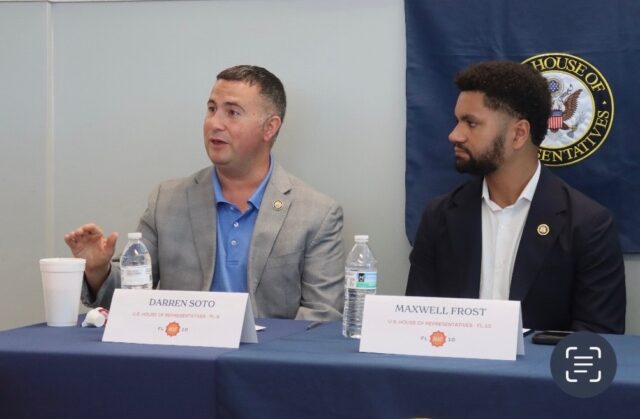
Darren Soto and Maxwell Frost at a Central Florida town hall. Image via NRCC
Soto’s campaign, for its part, has dismissed attacks.
“Trump’s mass deportations are trashing Florida’s economy, raising prices, and destroying local families. His tariffs will make costs go up even more, while his Big Ugly Law cuts Obamacare, Medicaid, SNAP, and Pell grants for local families. These harmful policies are why Trump is now so deeply unpopular. Rep. Soto will continue to support Central Floridians and push back against them,” reads a statement from the Soto campaign.
“Central Floridians are also outraged seeing their loved ones deported, TPS and parole cancelled for Cubans, Venezuelans, Haitians and others, and hearing about the civil rights violations taking place at detention centers, like ‘Alligator Alcatraz.’ Rep. Soto will continue to conduct rigorous oversight over ICE (Immigrations and Customs Enforcement) along with the rest of the Florida Democratic Delegation, including Rep Frost. His constituents demand it.”

But Republicans House Democrats in battlegrounds work with Frost at their own peril. They say Frost, the youngest member of Congress, represents the fringe of his own party. GOP sources note that while moderate Republicans show no reluctance in distancing themselves from the most extreme members of the Republican caucus, Frost has been embraced as a national surrogate for all House Democrats.
Both Soto and Moskowitz were part of a contingent of Democratic lawmakers, along with Frost, who took a high-profile tour in July of the soon-to-close Alligator Alcatraz facility in South Florida. And all of the Democrats have frequently co-signed letters from all Florida Democrats in Congress on issues including public education funding and Medicaid expansion. So there hasn’t been any significant effort to distance from Frost explicitly.
Moskowitz declined to comment for this story. But he and Frost hold a key bond as classmates, the only two Democrats newly elected to Congress in the 2022 election cycle. Shortly after being sworn in, both were named as Vice Chairs for the Democratic caucus’ Gun Violence Prevention Task Force.
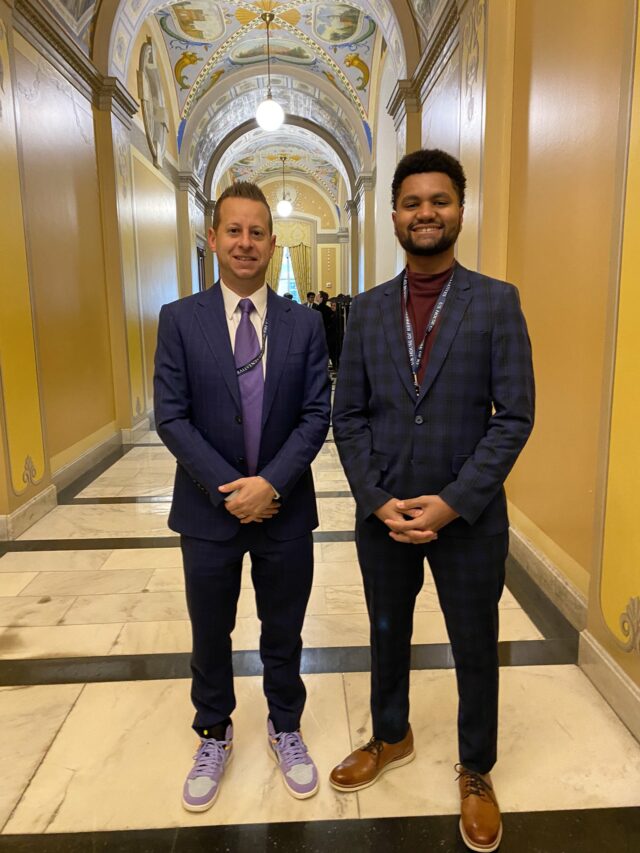
Jared Moskowitz, Maxwell Frost hope to make a dent in the country’s gun violence crisis. Image via Twitter.
As Moskowitz seeks a third term in a district that appears increasingly competitive, Republicans have tried to paint him as an ideological compatriot. Shortly after Trump signed an executive order against cashless bail, the NRCC sent out a release calling Frost the poster child for the progressive justice policy priority and labeling him “Moskowitz’s BFF” (best friend forever).
“Dangerous Democrat Jared Moskowitz is more interested in protecting criminals than Floridians. His outrageous pro-crime, anti-law enforcement agenda is wildly out of touch with voters, and they won’t forget it when they head to the polls next November,” O’Toole said.
For his part, Frost self-describes as a progressive, and has the voting record to prove it. The advocate website ProgressivePunch, which grades lawmakers positively for a liberal voting record, gives Frost an ‘A’ and ranks him as the 8th most progressive member of Congress with a 98.92% lifetime score.
The same site gives Soto a ‘B’ and Moskowitz a ‘D’, ranking them the 136th and 198th most progressive members of Congress respectively.
Frost told Florida Politics he thinks little of the attacks against his more moderate Democratic colleagues.
“This is the same group working to elect politicians who cut Medicaid and kicked two million Floridians off their healthcare,” Frost said. “I’m focused on tackling the affordability crisis, while Republicans are focused on tax breaks for billionaires and mega corporations.”
But his record includes tackling some issues long considered third rails with Florida Politics even for Democrats.
Frost voted last year against military aid for Israel, and issued a statement blaming Prime Minister Benjamin Netanyahu for a “seemingly endless war in Gaza that has claimed the lives of countless innocent Palestinian civilians.” Both Moskowitz and Soto voted for the funding, and Moskowitz has been an outspoken defender of Israel, but the NRCC hit both for Frost’s various Israel criticisms anyway.
“Radical anti-Israel, pro-Hamas Maxwell Frost puts our enemies first while our allies suffer,” O’Toole wrote in a statement this month. “And out of touch Democrat Jared Moskowitz stands shoulder to shoulder with him and his dangerous agenda.”
Similarly, as Republicans work to win over Hispanic voters across the country, the NRCC cast House Democrats as soft on crime, including acts tied to international crime organizations based in South America. After Frost and Soto held a joint town hall in July, the NRCC connected both to gang.
“Radical lunatic Maxwell Frost has it backwards,” O’Toole said in a statement. “Instead of fighting for Floridians, he cares about letting criminals run free and putting illegal aliens ahead of his law-abiding constituents. And Darren Soto is standing right there with him.”
And when Frost in April flew to El Salvador to draw attention to the deportation of a Maryland man Trump alleged was an MS-13 member, the NRCC offered to buy plane tickets for Moskowitz and Soto as well.
The interest in Frost doesn’t signal a belief his Orlando district will be in play next year. Nearly 61% of voters in Florida’s 10th Congressional District supported Democrat Kamala Harris for President in November, according to MCI Maps, even as Trump won more than 56% of the vote statewide.
But only about 51% of voters in Soto’s district favored Harris, and the Democratic presidential nominee barely won half the vote in Moskowitz’s jurisdiction.
The NRCC believes Florida will continue trending more conservative, and a recent analysis of national voter registration trends by The New York Times bolsters that view. And outside of the Orlando area represented by Frost, nowhere in Florida has elected a member of Congress with as liberal a voting record as the 28-year-old progressive champion.
The question now will be if voters feel like punishing members of Congress who work even on issues of regional interest with a Florida colleague from the left-most faction of the party.
As data centers fuel the digital economy, powering everything from artificial intelligence to cloud storage, states across the country are grappling with an uncomfortable question: who pays for the massive energy demands these facilities bring with them?
In several markets across the U.S., consumer advocates and regulators have warned that the rapid growth of large-scale data centers can drive up electricity costs for everyday customers, forcing households and small businesses alike to subsidize large-scale industrial users. Those concerns have become more pressing as utilities face decisions about new generation, transmission upgrades, and long-term system planning.
Florida has so far avoided the data center boom seen elsewhere, but that may not last. With population growth continuing and interest in Florida-based projects increasing, Florida Power & Light Company says it has used the benefit of time — and lessons learned in other states — to put guardrails in place before high-load customers arrive.
Scott Bores serves as president of Florida Power & Light Co., the prime subsidiary of multistate operator NextEra Energy, which supplies power to more than half of Florida’s population. Florida Politics sat down with Bores to discuss how FPL plans to protect its customers from rising costs if data centers take off in Florida.
We’ve seen countless reports in other states claiming that data centers raise power bills for everyday consumers. Will that happen here?
No. Last year, FPL proposed, and the Florida Public Service Commission (PSC) approved, the most forward-looking and strict consumer protections in America to ensure what you just described does not happen here.
Thanks to the PSC’s approval, we now have special rates that will apply to any large-load customer who requests service from FPL. Those rates are designed to ensure that data centers pay their own way — and Florida’s households do not subsidize the energy needs of these power-intensive projects.
When designing these protections, how did FPL approach the problem?
These big data centers haven’t yet made it to Florida. So, we fortunately have the benefit of time to learn from the experiences of other utilities who have seen heavy data center growth.
We all know data centers are energy-intensive. To serve them, FPL will need to build new power generation — power generation we wouldn’t otherwise need to build.
There’s a simple principle in utility ratemaking, which is that the cost-causer (or the data center in this case) should be the cost payer. So, for example, one of the protections we put in place is called an incremental generation charge. That charge requires the data centers to fund 100% of the cost of new power generation needed to serve their project.
But will FPL be spending to upgrade its system to accommodate these data centers?
We can keep system network upgrades to a minimum by steering data center projects toward areas that are already near our large (500 kV) transmission facilities and have land suitable for incremental generation capacity. We have already identified the first of three geographic zones that fit this description. These locations would allow the data center facilities to be built with minimal impact to infrastructure.
What other protections are in place?
We’ve also established requirements on the front-end designed to ensure the only data center projects that move forward are from mature, creditworthy companies that intend to stay in Florida. For example, if one of these large load customers wants FPL to serve their data center, they have to fund an engineering study to evaluate, among other things, the project’s feasibility and how much it would cost to connect to the grid. They have to pay the project cost to connect to our system. If they want to reserve capacity on FPL’s system, they must be able to meet strict collateral requirements tied to their credit. Not to mention, they also must be willing to agree to a minimum contract term of 20 years and be willing to pay the incremental generation charge we discussed earlier.
What about once the project is in service?
Once in service, the data center is subject to a minimum bill to ensure they pay for the capacity they reserve — even if they don’t end up needing all of it — as well as an exit fee for early termination. That exit fee would amount to an accelerated payment of the remaining 20-year incremental generation charge.
So they have to stand by their commitments, right?
Right – if they leave early, they’re still on the hook. So, we have protections on the front end to weed out bad projects before they move forward. We have protections during the planning phase that will keep network upgrades to a minimum. We have protections that keep the cost-causer — the data center — the cost payer. And once in service, we have protections to ensure data centers pay for the capacity they reserved and also ensure no one can cut and run without paying their fair share.
All of these combine to make up the strictest consumer protections in America as far as data centers are concerned.
FPL has an obligation to serve all customers, including any data centers that request our service. But we have designed these rates to ensure we can serve data centers in a responsible and thoughtful manner, and in a way that protects our existing customers.
As the 2026 Session ramps up, Red Hills Strategies is shuffling its roster with a couple of promotions and a pair of new hires.
The political communications and strategy firm is bumping Maggie Gahan up to director and Caroline Hamon to creative project manager. Team Red Hills is also adding Anna Stallworth and Charlotte Roberts to its strategic communications team.
Gahan, a Florida Politics 2025 Rising Star, led the successful communications program behind “Lucy’s Law,” 2025 legislation to strengthen safety on Florida’s waterways. She also works for Tampa General Hospital and supports elected officials while managing high-profile events, including TGH Day at the Capitol and Robinhood’s Financial Education Fair.
“Maggie is an asset to this team in every way. She’s an incredible leader, a strategic thinker and a hard worker,” said Red Hills founder and President Amanda Bevis. “She has proven indispensable to many of our initiatives, and she handles high-pressure moments with a lot of grace — like a swan.”
Hamon’s promotion, meanwhile, comes as Red Hills expands its in-house creative operation. Her designs drive many of the brands and initiatives Red Hills has launched, appearing on digital platforms, collateral materials and billboards across Florida.
“Caroline brings ideas to life with smart, compelling visuals that move people to act,” said Brittany Clark, Vice President and Creative Strategist. “Our clients trust her to translate complex policy goals into clear, beautiful, creative.”
Stallworth, a recent graduate of Troy University, comes aboard as creative coordinator. Before joining Red Hills, she handled creative needs for local businesses, from hardware stores to boutiques, as well as university-affiliated organizations and events. She recently completed an internship with BowStern in Tallahassee, where she supported marketing efforts for regional clients.
Roberts joined the firm earlier this month, bringing depth to Red Hills’ strategic communications bench. She holds a master’s degree in mass communications from the University of Florida, where she was a member of Florida Blue Key and a Reitz Scholar. Her internship experience ranges from Comcast in Atlanta to Lakeland EDC near her hometown.
“The team at Red Hills Strategies is distinguished for its proactive efforts, high-quality work and meaningful results,” Bevis said. “We’re energized by the expansion of this team, which not only boosts our capacity but also brings fresh perspectives and creative thinking. More bright minds working together will lead to more dynamic campaigns that help our clients stand out in a crowded space.”
Exactly one year ago, DonaldTrump was sworn in for his second term while promising the American public that help was on the way, particularly regarding affordability.
The issue had already been creating major challenges for lower- and middle-income earners across the nation. One year in, Trump continues to claim the nation is enjoying an “economic boom.” But the Democratic National Committee (DNC) wholly disagrees, especially for Floridians.
“The numbers don’t lie: Trump’s first year back in office has been a complete disaster for Florida families. Trump broke his promise to lower costs on Day One and instead has made life far more expensive for Florida families,” said TimHogan, the DNC’s senior advisor for messaging, mobilization and strategy.
“Because of Trump’s Big Ugly Bill and failed economic policies, unemployment in Florida is up, families are paying$1,060 more a year, and 1,500,000Floridians will be kicked off their health care after Trump let premiums skyrocket. While Donald Trump may think affordability is a hoax, Florida families know better, which is why they are putting their trust in Democrats who will keep fighting to lower costs and protect health care.”
A DNC study last week found Florida is one of 26 states where unemployment has risen since Trump took office, at a 0.7-percentage-point increase. The $1,060 figure is the approximate amount Florida households are losing through higher costs related to Trump’s tariffs and his “One Big Beautiful Bill” package, which the DNC and other Democratic groups have taken to calling the “Big Ugly Bill.”
The same study estimated that expiring premium tax credits under the Affordable Care Act would lead to 1.5 million Floridians losing health coverage, one of the highest numbers in the nation behind only California.
But the DNC’s critique does not stop there. Democrats point to a Joint Economic Committee Minority report this month finding that families paid $310 more for groceries during Trump’s first year in office than they did in 2024.
The DNC’s own study found that working American families have lost $585 to inflation and that nearly 4.5 million Floridians who rely on the Affordable Care Act’s marketplace for health coverage are seeing premiums skyrocket, which the DNC attributes to Trump’s refusal to extend tax credits. It’s worth noting that while Trump opposed extending the credits, Congress declined to pass an extension.
Additionally, cuts under the One Big Beautiful Bill to the Supplemental Nutrition Assistance Program, colloquially known as food stamps, will mean more than 1.6 million Floridians lose some or all of their food benefits, according to the DNC analysis. The Harvard Kennedy School found that the legislation is cutting about $186 billion from the program over 10 years, a 20% cut that is the largest in the program’s history.
And what the DNC describes as failures seem to be also resonating with the American public, with new polling on Trump’s first year in office showing twice as many Americans say Trump is focused on the wrong priorities as the right ones. The AP-NORC poll also shows 60% of U.S. adults think Trump has done more to hurt than help the cost of living in his second term.
Meanwhile, the poll finds only 4 in 10 approve of Trump’s job performance. While Trump is far underwater in his approval rating, it has improved slightly since December, when his disapproval was at 61%, compared to 59% now. Even at his highest approval since March, Trump was still underwater, with 53% disapproving of his job performance.