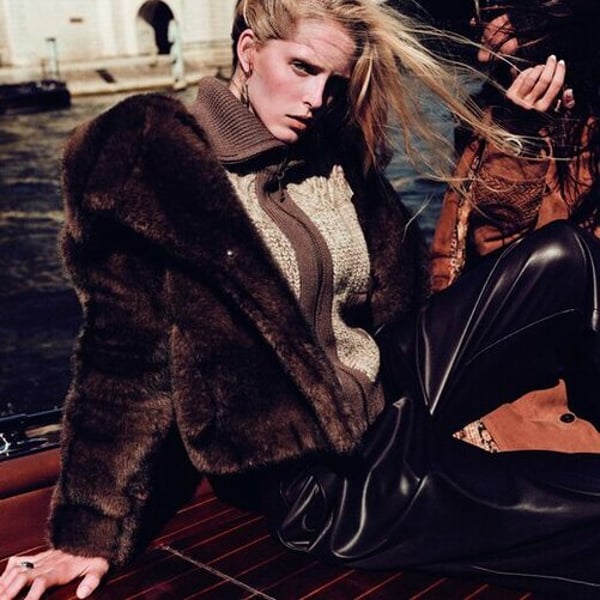
This fall, Ba&sh is revisiting the aesthetics of the Swinging Sixties with a collection that draws on the energy of this mythical decade. Founders Barbara Boccara and Sharon Krief chose Abby Champion as their muse, described as “a woman of her time, committed, spontaneous, luminous.” The American model, a rising figure on the international fashion scene, embodies “unfiltered beauty” and “a form of freedom.”
The photographic campaign, entrusted to Bryan Liston, adopts an intimate, cinematic style. Shot in the Saint-Germain-des-Prés district, the shoot features Paris as a living backdrop, with visual references to sixties icons such as Marianne Faithfull and Anita Pallenberg.
Between structure and casualness
The Autumn-Winter 2025 collection plays on superimpositions and contrasting materials. Ba&sh relies on deep velvet, brown leather, mocha suede, and light chiffon. The wardrobe mixes structured tailoringand maximal layering, combining faux fur and soft denim. This approach aims to meet the needs of “women on the move,” according to the brand’s philosophy.
Suede plays an important role in the new collection – ba&sh
The collection features a range of accessories emblematic of a revamped sixties spirit. Western boots in beige suede with heels reveal decorative embroidery on the upper, while flat ballerinas in nude suede are adorned with ties to be tied around the ankle, evoking dance and grace. Flat brown leather sandals unfurl criss-cross straps in a casual bohemian style, complemented by a natural woven raffia tote bag with cognac leather handles that combines traditional craftsmanship with contemporary elegance. Each piece bears the engraved “Ba&sh” logo.
YouYou, the new it-bag
The centerpiece of the collection, the YouYou bag is a reinterpretation of the classic tote bag. Measuring 19×25.5×85 cm, it features a long drop and a wide handle adorned with a signature buckle. Designed for everyday use, it can be worn on the shoulder or across the body.
The YouYou was unveiled on August 28. – ba&sh
The YouYou is offered in three versions: suede for 475 euros, vintage leather certified by the Leather Working Group for 495 euros, and a multi-pocket version for 550 euros. Available colors are black, cognac, and mocha.
Ba&sh targets international markets
Founded in 2003 by Barbara Boccara and Sharon Krief, Ba&sh boasts a presence in over 70 countries via 320 boutiques. The brand, which was awarded B Corp certification in 2024, is banking on its “smart-fashion” positioning.
Since 2015, the company has been backed by the L Catterton fund and the Arnault group, joined in May 2022 by the French fund HLD. This shareholding structure supports the brand’s international expansion, notably in Europe, China, and North America.
This article is an automatic translation. Click here to read the original article.
Bloomingdale’s has appointed Russ Patrick as its new general merchandise manager of home.
Bloomingdale’s names Russ Patrick GMM of home. – Bloomingdale’s
Patrick joins Bloomingdale’s after a 33-year career at Neiman Marcus, where he most recently served as senior vice president, general merchandise manager and head merchant of men’s, gifts, home and children’s. He departed the Dallas-based retailer in 2023, and has since acted as an industry consultant.
“The strength of the team, the clarity of the vision and the opportunity ahead make Bloomingdale’s the destination,” Patrick said. “I’m energized to take on this next chapter as GMM of Home, contributing to the continued evolution of such an iconic company, and to do so in New York — the center of retail energy.”
In his new role, Patrick succeeds Dan Leppo, who transitioned last March to sister company Macy’s as senior vice president and general merchandise manager of men’s and kids’.
Long regarded as a core pillar of corporate strategy, DE&I (diversity, equity and inclusion) is now going through a turbulent period. Under intensifying political, economic and social pressures, it has reached a pivotal moment. The sixth White Paper from the International Association of Department Stores (IADS) examines whether inclusion remains a fundamental priority or risks being pushed into the background.
Inclusion in the United States is under strain amid pressure from the presidential administration – Shutterstock
The 2025 edition looks at DE&I at a time when commitments are being put to the test. The year 2024 saw heightened scrutiny of inclusion programmes. In January 2025, the signing of a controversial US presidential executive order entitled “Ending Radical and Costly Government Diversity, Equity and Inclusion Programs and Preferences” prompted immediate reactions from major North American companies fearing legal reprisals, according to IADS.
The myth that inclusion penalises businesses
The 2025 report draws on a set of concrete observations from an analysis of the practices of leading retailers worldwide. It highlights four dimensions in which DE&I, when embedded in day-to-day operations, serves as a measurable driver of performance. Firstly, organisations with diverse leadership teams report stronger decision-making and greater strategic agility.
Secondly, companies that value inclusion see improved employee retention, thereby reducing turnover costs in a historically volatile sector. Thirdly, inclusion fosters more effective communication within teams, which reduces operational errors and strengthens cohesion.
DE&I is a legacy of civil rights struggles
Finally, retailers note that some of the most relevant ideas come directly from frontline teams who, thanks to their diverse experiences, contribute significantly to innovation and to adapting to varied customer expectations. These findings show that DE&I is not only an ethical value, but also a concrete driver of organisational effectiveness.
Despite conservative rhetoric, inclusion and diversity are an asset for companies, says IADS – Shutterstock
The report also notes that DE&I forms part of a longer legacy, rooted in the civil rights movement and in the historic demands of retail frontline teams for fair treatment and safer working conditions. However, contemporary expectations, often unclear or poorly defined, have given rise to what some stakeholders describe as “DE&I fatigue”, fuelled by doubts about the sincerity of commitments rather than by clear strategic thinking.
Inclusion, between intention and ‘strategic advantage’
The White Paper further points out that DE&I cannot be one-size-fits-all: priorities vary by region — from gender parity, ethnicity and disability to socio-economic background and national integration — and expectations regarding language and transparency differ considerably. For international groups, tailoring local approaches while upholding universal principles of equity is a major operational challenge.
Finally, IADS sets out the conditions that enable inclusion to take root for the long term: listening to employees, setting clear behavioural expectations, fostering collaboration between stores and headquarters, and ensuring fairness in recruitment and development processes. Beyond intention, these capabilities help retailers turn DE&I into a tangible strategic advantage, strengthening resilience, engagement and relevance in a constantly evolving environment.
Founded in 1928, IADS coordinates exchanges between department stores worldwide and publishes an annual White Paper on a key industry issue. Previous publications have focused on the Covid-19 pandemic, digital transformation, sustainability, retail media and the role of middle management.
Lululemon founder Chip Wilson is trying to excise private equity firm Advent from the apparel maker’s board as part of an ongoing proxy fight, Semafor reported on Monday, citing people familiar with the matter.
Lululemon
Wilson had launched a proxy fight in late December by nominating three independent directors to the company’s board.
Wilson is one of Lululemon’s largest independent shareholders, with a 4.27% stake as of December 2025, according to data compiled by LSEG.
While Wilson has said he does not want a board seat, he is making it clear that he will not consider any settlement with Lululemon unless two legacy directors, including chair David Mussafer, resign, Semafor reported.
The yogawear maker founder’s frustrations have been compounded by Advent’s spotty record in the consumer space, according to the Semafor report.
Lululemon also faces activist pressure from Elliott Management, which took a $1 billion stake in the company earlier in December and has been working closely with former Ralph Lauren executive Jane Nielsen for a potential CEO role.
Reuters could not immediately verify the report. Lululemon and Advent did not immediately respond to requests for comment.