Connect with us

Business

What would the Fed do in a tie vote? It’s not clear, and the BoE had to break a deadlock this month

Published

on


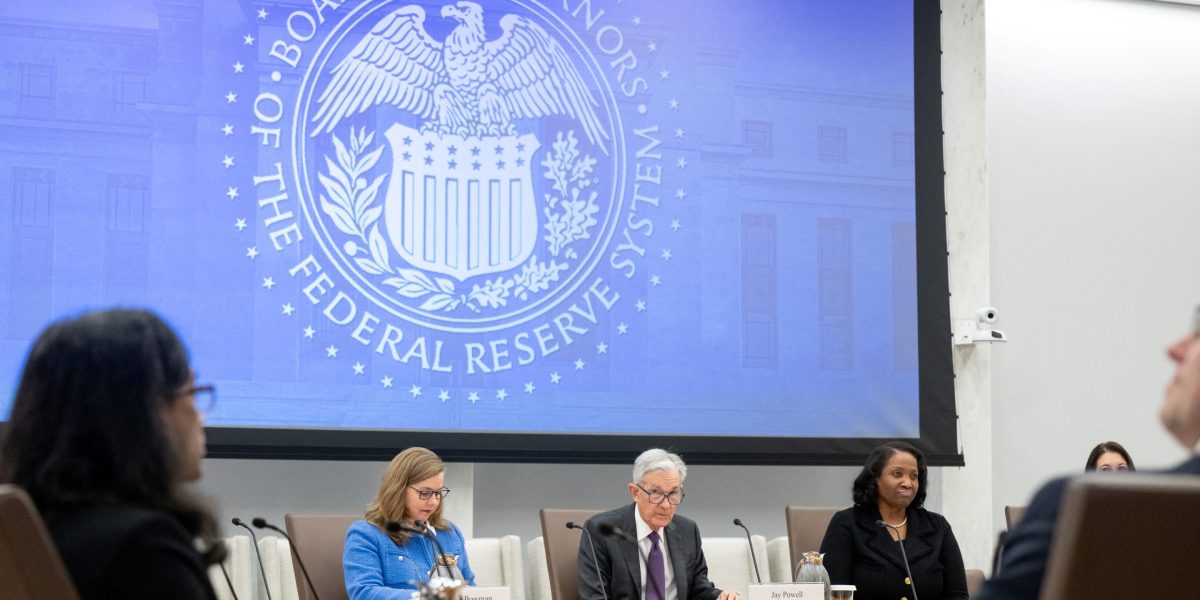
There has never been a tie vote on the rate-setting Federal Open Market Committee, but the Federal Reserve has also never been under attack like it is now.

That’s after President Donald Trump took the unprecedented step Monday to fire Fed Governor Lisa Cook, who has sued to block the move. A judge heard arguments in the case on Friday but didn’t issue a ruling.

Meanwhile, the composition of the Fed is changing, tilting the central bank more dovish. Trump has named Stephen Miran to fill a vacancy on the board left by Adriana Kugler, who left before her term was due to expire in January.

Miran would join Trump-appointed governors Christopher Waller and Michelle Bowman, who cast dissenting votes at the last Fed meeting as they sought to lower rates. And Jerome Powell’s term as Fed chairman expires in May, though it’s uncertain if he plans to remain on the board of governors until his term in that seat expires in 2028.

If Trump is able to replace Cook, that would shift the balance even more toward easing—and potentially clear the way for a reshuffle of the Fed’s regional bank presidents, who take turns serving on the FOMC. But even if the Fed cuts rates in September like Trump wants, it’s unlikely to quiet the president as he has said rates should be more than 300 basis points lower than they are now.

It sets up a possible new era of more contentious meetings at the Fed, which typically has been driven by consensus with even one dissenting vote being rare. Votes may be closer. And given that the FOMC has an even number of 12 members, that raises the question of what would happen in a tie vote.

It’s not a far-fetched possibility. According to a note last month from Christopher Hodge, chief U.S. economist at Natixis CIB Americas, there have been three occasions when a decision on the FOMC passed by a one-vote majority, though the last time it occurred was in 1973.

The FOMC’s rules and procedures don’t discuss a tie scenario, and the Fed didn’t provide a comment.

Robert Eisenbeis, who previously served as director of research at the Atlanta Fed, told Fortune that in the event of a tie vote, the federal funds rate would stay the same.

There is no override provision, meaning the chair doesn’t have the ability to force a different decision, he explained via email. It’s also not clear if policymakers would take another vote during that same meeting or wait until the next scheduled meeting to vote.

“There is no precedent here,” Eisenbeis said. “I would presume there would be the option for a revote, but if not, then no change in the funds rate. If there is no change in the rate, then the next meeting is where another review and vote would take place.”

Hodge, who previously served as principal economist at the New York Fed, told Fortune via email that the question of a tie hasn’t been covered in any official public documents explicitly.

Still, the chair has significant authority in guiding meetings and decisions, he said, noting that the FOMC is also a self-governing committee that has the ability to alter its rules.

“In the absence of an explicit tie-breaking rule, the chair is generally understood to have the ability to cast a deciding vote or guide the committee toward resolution, as is common in other deliberative bodies with a presiding officer,” Hodge explained. “This is not made explicit in any document I have seen and is more of a custom than a rule.”

Eisenbeis believes Alan Greenspan always voted last when he served as Fed chairman to prevent a tie vote on the FOMC.

As the Fed faces more turnover, there is plenty of fodder for debate, potentially leading to more split votes. Inflation has edged further above the Fed’s 2% target amid Trump’s tariffs, but it’s unclear if the uptick will be short-lived or more prolonged. Meanwhile, the job market is cooling off, though there’s disagreement on Wall Street over whether that’s a demand issue or a supply issue caused by Trump’s immigration crackdown.

Similar crosscurrents produced a 4-4-1 deadlock at the Bank of England earlier this month, as four policymakers voted to keep rates steady, four voted to cut by a quarter point, and one voted to cut by a half point.

That prompted the bank’s Monetary Policy Committee to hold a decisive revote for the first time since it was created in 1997. The subsequent 5-4 decision lowered rates a quarter point to 4% from 4.25%.

The FOMC’s next meeting is on Sept. 16-17, and exactly who will show up remains in doubt. Even if Cook wins in court, it’s not guaranteed that she would be allowed to return to her duties immediately while the government further appeals the case, JPMorgan said in a note Friday. It’s also not certain if Miran will be confirmed by the Senate in time for the next meeting.

And even though Powell has opened the door to a rate cut next month, other policymakers remain more hawkish, while further weakness in the labor market could make some doves even more dovish.

In a speech Thursday, Waller said he wouldn’t back a cut of more than a quarter point next month, but that could change if new jobs data come in worse.

“While there are signs of a weakening labor market, I worry that conditions could deteriorate further and quite rapidly, and I think it is important that the FOMC not wait until such a deterioration is under way and risk falling behind the curve in setting appropriate monetary policy,” he said.


Source link

Continue Reading

Business

The rise of AI reasoning models comes with a big energy tradeoff

Published

on


Nearly all leading artificial intelligence developers are focused on building AI models that mimic the way humans reason, but new research shows these cutting-edge systems can be far more energy intensive, adding to concerns about AI’s strain on power grids.

AI reasoning models used 30 times more power on average to respond to 1,000 written prompts than alternatives without this reasoning capability or which had it disabled, according to a study released Thursday. The work was carried out by the AI Energy Score project, led by Hugging Face research scientist Sasha Luccioni and Salesforce Inc. head of AI sustainability Boris Gamazaychikov.

The researchers evaluated 40 open, freely available AI models, including software from OpenAI, Alphabet Inc.’s Google and Microsoft Corp. Some models were found to have a much wider disparity in energy consumption, including one from Chinese upstart DeepSeek. A slimmed-down version of DeepSeek’s R1 model used just 50 watt hours to respond to the prompts when reasoning was turned off, or about as much power as is needed to run a 50 watt lightbulb for an hour. With the reasoning feature enabled, the same model required 7,626 watt hours to complete the tasks.

The soaring energy needs of AI have increasingly come under scrutiny. As tech companies race to build more and bigger data centers to support AI, industry watchers have raised concerns about straining power grids and raising energy costs for consumers. A Bloomberg investigation in September found that wholesale electricity prices rose as much as 267% over the past five years in areas near data centers. There are also environmental drawbacks, as Microsoft, Google and Amazon.com Inc. have previously acknowledged the data center buildout could complicate their long-term climate objectives

More than a year ago, OpenAI released its first reasoning model, called o1. Where its prior software replied almost instantly to queries, o1 spent more time computing an answer before responding. Many other AI companies have since released similar systems, with the goal of solving more complex multistep problems for fields like science, math and coding.

Though reasoning systems have quickly become the industry norm for carrying out more complicated tasks, there has been little research into their energy demands. Much of the increase in power consumption is due to reasoning models generating much more text when responding, the researchers said. 

The new report aims to better understand how AI energy needs are evolving, Luccioni said. She also hopes it helps people better understand that there are different types of AI models suited to different actions. Not every query requires tapping the most computationally intensive AI reasoning systems.

“We should be smarter about the way that we use AI,” Luccioni said. “Choosing the right model for the right task is important.”

To test the difference in power use, the researchers ran all the models on the same computer hardware. They used the same prompts for each, ranging from simple questions — such as asking which team won the Super Bowl in a particular year — to more complex math problems. They also used a software tool called CodeCarbon to track how much energy was being consumed in real time.

The results varied considerably. The researchers found one of Microsoft’s Phi 4 reasoning models used 9,462 watt hours with reasoning turned on, compared with about 18 watt hours with it off. OpenAI’s largest gpt-oss model, meanwhile, had a less stark difference. It used 8,504 watt hours with reasoning on the most computationally intensive “high” setting and 5,313 watt hours with the setting turned down to “low.” 

OpenAI, Microsoft, Google and DeepSeek did not immediately respond to a request for comment.

Google released internal research in August that estimated the median text prompt for its Gemini AI service used 0.24 watt-hours of energy, roughly equal to watching TV for less than nine seconds. Google said that figure was “substantially lower than many public estimates.” 

Much of the discussion about AI power consumption has focused on large-scale facilities set up to train artificial intelligence systems. Increasingly, however, tech firms are shifting more resources to inference, or the process of running AI systems after they’ve been trained. The push toward reasoning models is a big piece of that as these systems are more reliant on inference.

Recently, some tech leaders have acknowledged that AI’s power draw needs to be reckoned with. Microsoft CEO Satya Nadella said the industry must earn the “social permission to consume energy” for AI data centers in a November interview. To do that, he argued tech must use AI to do good and foster broad economic growth.


Source link

Continue Reading

Business

SpaceX to offer insider shares at record-setting valuation

Published

on


SpaceX is preparing to sell insider shares in a transaction that would value Elon Musk’s rocket and satellite maker at a valuation higher than OpenAI’s record-setting $500 billion, people familiar with the matter said.

One of the people briefed on the deal said that the share price under discussion is higher than $400 apiece, which would value SpaceX at between $750 billion and $800 billion, though the details could change. 

The company’s latest tender offer was discussed by its board of directors on Thursday at SpaceX’s Starbase hub in Texas. If confirmed, it would make SpaceX once again the world’s most valuable closely held company, vaulting past the previous record of $500 billion that ChatGPT owner OpenAI set in October. Play Video

Preliminary scenarios included per-share prices that would have pushed SpaceX’s value at roughly $560 billion or higher, the people said. The details of the deal could change before it closes, a third person said. 

A representative for SpaceX didn’t immediately respond to a request for comment. 

The latest figure would be a substantial increase from the $212 a share set in July, when the company raised money and sold shares at a valuation of $400 billion.

The Wall Street Journal and Financial Times, citing unnamed people familiar with the matter, earlier reported that a deal would value SpaceX at $800 billion.

News of SpaceX’s valuation sent shares of EchoStar Corp., a satellite TV and wireless company, up as much as 18%. Last month, Echostar had agreed to sell spectrum licenses to SpaceX for $2.6 billion, adding to an earlier agreement to sell about $17 billion in wireless spectrum to Musk’s company.

Subscribe Now: The Business of Space newsletter covers NASA, key industry events and trends.

The world’s most prolific rocket launcher, SpaceX dominates the space industry with its Falcon 9 rocket that launches satellites and people to orbit.

SpaceX is also the industry leader in providing internet services from low-Earth orbit through Starlink, a system of more than 9,000 satellites that is far ahead of competitors including Amazon.com Inc.’s Amazon Leo.

SpaceX executives have repeatedly floated the idea of spinning off SpaceX’s Starlink business into a separate, publicly traded company — a concept President Gwynne Shotwell first suggested in 2020. 

However, Musk cast doubt on the prospect publicly over the years and Chief Financial Officer Bret Johnsen said in 2024 that a Starlink IPO would be something that would take place more likely “in the years to come.”

The Information, citing people familiar with the discussions, separately reported on Friday that SpaceX has told investors and financial institution representatives that it is aiming for an initial public offering for the entire company in the second half of next year.

A so-called tender or secondary offering, through which employees and some early shareholders can sell shares, provides investors in closely held companies such as SpaceX a way to generate liquidity.

SpaceX is working to develop its new Starship vehicle, advertised as the most powerful rocket ever developed to loft huge numbers of Starlink satellites as well as carry cargo and people to moon and, eventually, Mars.


Source link

Continue Reading

Business

U.S. consumers are so strained they put more than $1B on BNPL during Black Friday and Cyber Monday

Published

on


Financially strained and cautious customers leaned heavily on buy now, pay later (BNPL) services over the holiday weekend.

Cyber Monday alone generated $1.03 billion (a 4.2% increase YoY) in online BNPL sales with most transactions happening on mobile devices, per Adobe Analytics. Overall, consumers spent $14.25 billion online on Cyber Monday. To put that into perspective, BNPL made up for more than 7.2% of total online sales on that day.

As for Black Friday, eMarketer reported $747.5 million in online sales using BNPL services with platforms like PayPal finding a 23% uptick in BNPL transactions.

Likewise, digital financial services company Zip reported 1.6 million transactions throughout 280,000 of its locations over the Black Friday and Cyber Monday weekend. Millennials (51%) accounted for a chunk of the sizable BNPL purchases, followed by Gen Z, Gen X, and baby boomers, per Zip.

The Adobe data showed that people using BNPL were most likely to spend on categories such as electronics, apparel, toys, and furniture, which is consistent with previous years. This trend also tracks with Zip’s findings that shoppers were primarily investing in tech, electronics, and fashion when using its services.

And while some may be surprised that shoppers are taking on more debt via BNPL (in this economy?!), analysts had already projected a strong shopping weekend. A Deloitte survey forecast that consumers would spend about $650 million over the Black Friday–Cyber Monday stretch—a 15% jump from 2023.

“US retailers leaned heavily on discounts this holiday season to drive online demand,” Vivek Pandya, lead analyst at Adobe Digital Insights, said in a statement. “Competitive and persistent deals throughout Cyber Week pushed consumers to shop earlier, creating an environment where Black Friday now challenges the dominance of Cyber Monday.”

This report was originally published by Retail Brew.


Source link

Continue Reading

Trending

Copyright © Miami Select.