Connect with us

Business

Streaming has Americans more glued to their screens than ever, but it could all come crashing down in the case of a ‘content recession,’ BofA says

Published

on


Americans are watching more television than ever, but the screen they turn to increasingly isn’t wired for cable. According to Bank of America Institute, streaming platforms officially overtook traditional “linear” television in viewership share this spring, marking a historic shift in how people spend their downtime. It’s almost as large as linear TV and radio combined.

The change is more about delivery than demand. The Bureau of Labor Statistics’ American Time Use Survey shows Americans still devote about five hours a day to leisure, with more than half of that time spent watching TV.
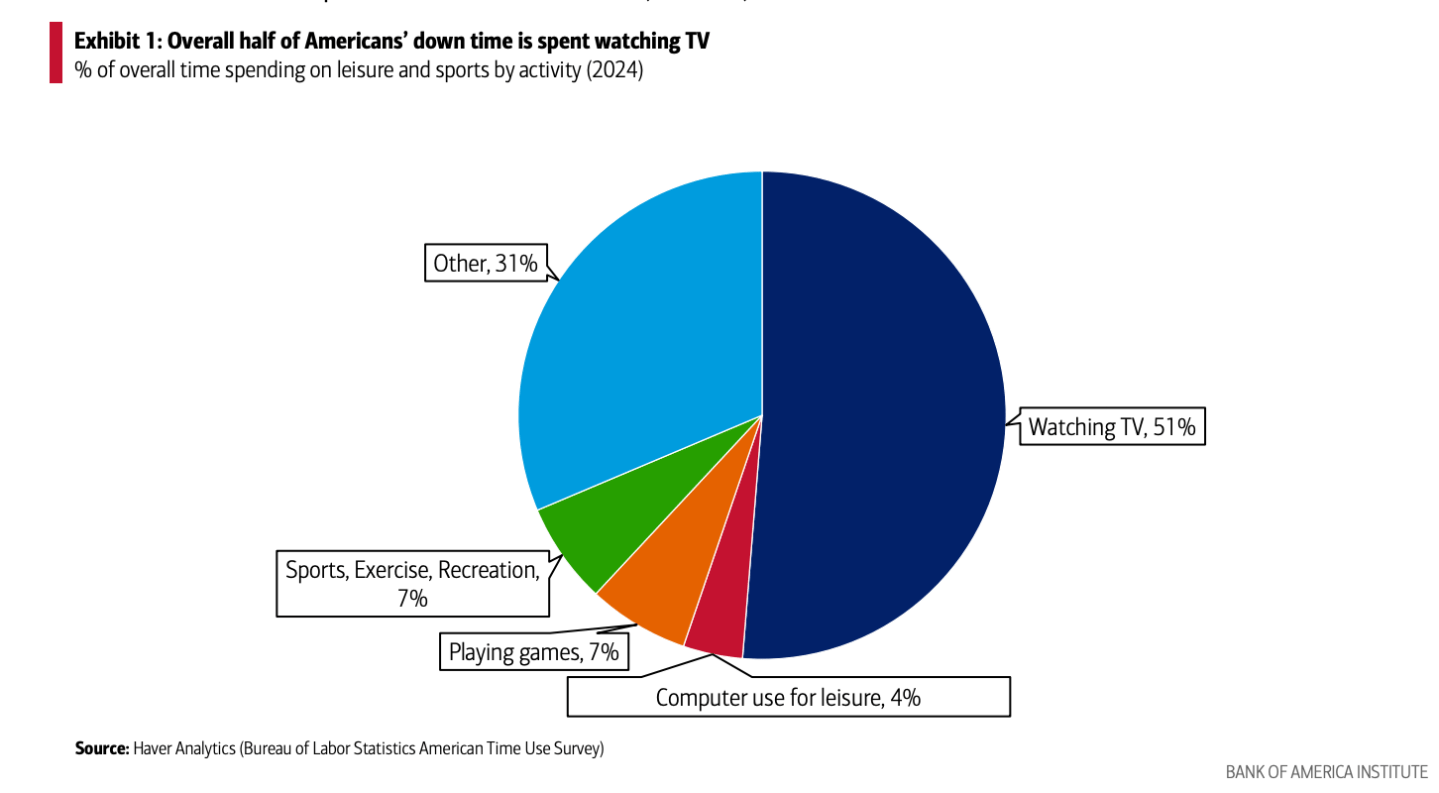
But instead of flipping through cable channels, more households are paying monthly for on-demand services. Internal BofA payments data shows streaming video and audio represented more than 10% of spending across all income cohorts as of July, and since 2023, it has outpaced other entertainment categories such as live events, theaters, and theme parks. Yet even as consumer appetite grows, the industry faces a new challenge, writes the BofA team led by senior economist David Michael Tinsley: a possible “content recession.” In recent years, providers have dialed back the sheer volume of original shows and films, shifting instead to fewer projects with higher production values.

The content recession could be seen in two ways: either a pullback in the number of shows being commissioned, an emphasis on “quality over quantity” play that may keep subscribers loyal to franchise hits, or a recession in terms of the number of must-watch shows being made as streamers embrace a cheaper, mass production, more linear-TV-like model. As long ago as late 2023, former Amazon Studios chief Roy Price wrote a New York Times opinion piece declaring the era of prestige TV was ending as streaming underwent a fundamental change. BofA analysts caution this could stall growth if viewers feel there isn’t enough fresh material to justify rising monthly bills.

Signs of churn and inequality

BofA’s internal card-spending data shows two-thirds of households are still paying less than $40 a month for streaming. But the bills are creeping up: Roughly one in six households now spends more than $80 per month, and nearly 10% are shelling out over $100.
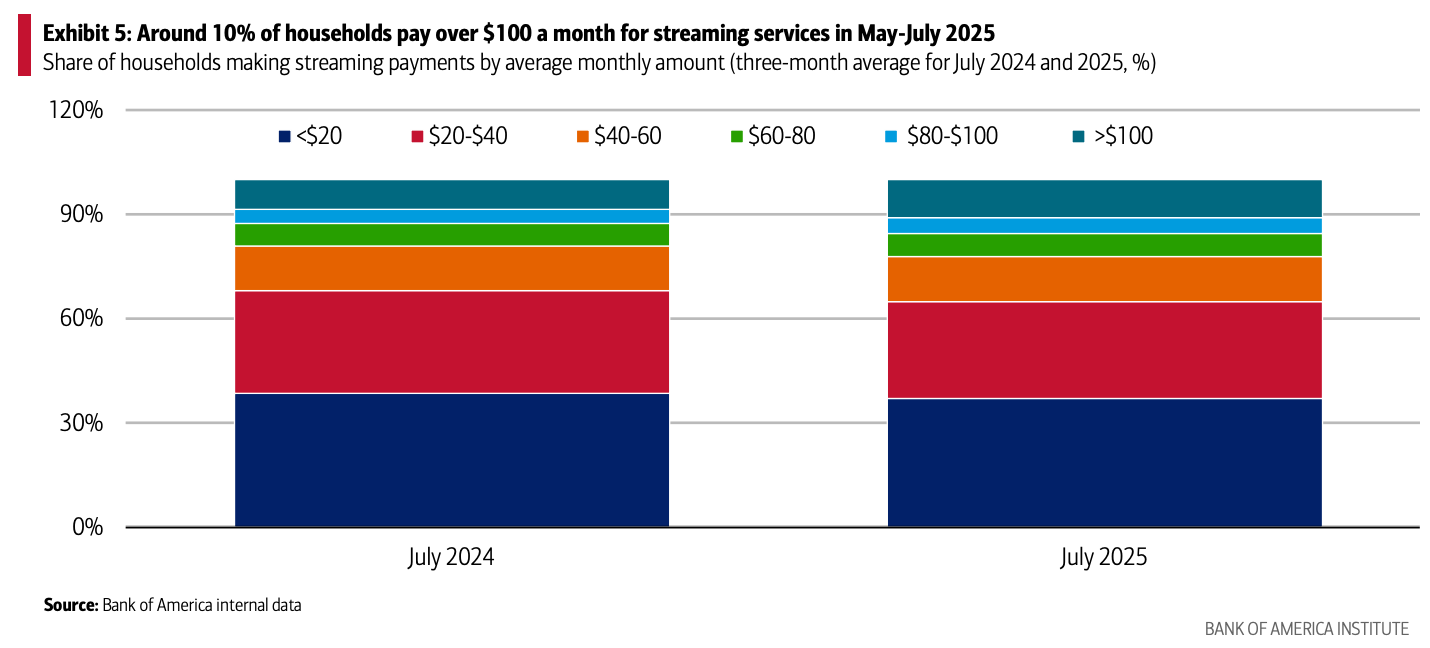
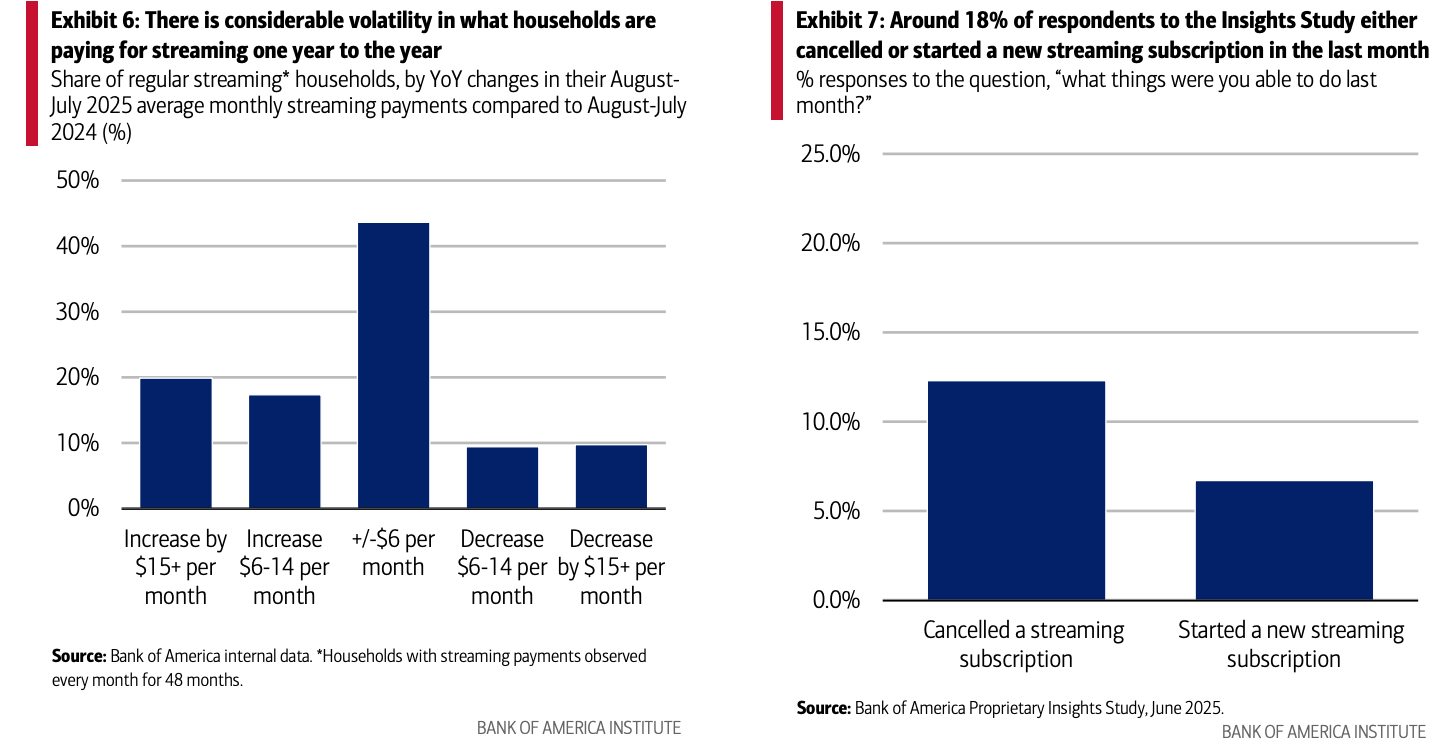
At the same time, loyalty isn’t a given. Nearly one in five Americans canceled or started a streaming subscription in July. That “churn” means households are nimble, signing up when a hot new series or sporting event arrives, then abandoning platforms when the buzz fades. A content recession materializing could supercharge this dynamic, which could mean the difference between feeling like streaming is an affordable alternative or a runaway expense that rivals old cable bundles. Streaming’s solution to this appears to be reinventing that old bundle in a new form.
Sports, music—and AI—as the next frontier

For now, streamers are betting big on two growth drivers: live sports and music tie-ins. Exclusive sports rights continue to draw subscribers, with CivicScience finding more than a third of fans are willing to sign up for a new service this fall just to watch games. Exclusive rights to football, basketball, and soccer games, plus premium offerings in music and audiobooks, are seen as the next big moneymakers. Women’s sports are seen as an untapped growth area, while music platforms are experimenting with higher-priced tiers and crossover into live events.

The wild card is artificial intelligence. AI could allow streamers to generate content and effects faster and more cheaply, but it also lowers the barriers for new entrants. In the long run, viewers themselves may even use AI tools to create personalized content, potentially disrupting the very model streaming companies are betting on.

Americans aren’t giving up screen time anytime soon. But whether streamers can keep those screens tuned in will depend less on technology than on storytelling. If the content recession deepens, streaming’s dominance could be tested by its own shrinking pipeline.

For this story, Fortune used generative AI to help with an initial draft. An editor verified the accuracy of the information before publishing. 

Introducing the 2025 Fortune Global 500, the definitive ranking of the biggest companies in the world. Explore this year’s list.


Source link

Continue Reading

Business

25-year DEA veteran charged with helping Mexican drug cartel launder millions of dollars, secure guns and bombs

Published

on


A former high-level agent with the U.S. Drug Enforcement Administration and an associate have been charged with conspiring to launder millions of dollars and obtain military-grade firearms and explosives for a Mexican drug cartel, according to an indictment unsealed Friday in New York.

Paul Campo, 61, of Oakton, Virginia, who retired from the DEA in 2016 after a 25-year career, and Robert Sensi, 75, of Boca Raton, Florida, were caught in sting involving a law enforcement informant who posed as a member of the Jalisco New Generation Cartel, prosecutors said.

The cartel, also know as CJNG, was designated as a foreign terrorist organization by the U.S. in February.

U.S. Attorney Jay Clayton said Campo betrayed his DEA career by helping the cartel, which he said was responsible for “countless deaths through violence and drug trafficking in the United States and Mexico.”

Campo and Sensi appeared Friday afternoon before a magistrate judge in New York, who ordered them detained without bail. Their lawyers entered not guilty pleas on their behalf.

Campo’s lawyer, Mark Gombiner, called the indictment “somewhat sensationalized and somewhat incoherent.” He denied the two men had agreed to explore obtaining weapons for the cartel.

Prosecutors say pair talked of laundering money, obtaining weapons

Over the past year, Campo and Sensi agreed to launder about $12 million in drug proceeds for the cartel and converted about $750,000 in cash to cryptocurrency, thinking it was going to the group when it really went to the U.S. government, the indictment said. They also provided a payment for about 220 kilograms of cocaine they were told would be sold in the U.S. for about $5 million, thinking they would get a cut of the proceeds, prosecutors said.

The two men also said they would look into procuring commercial drones, AR-15 semiautomatic rifles, M4 carbines, grenade launchers and rocket-propelled grenades for the cartel, the indictment said.

Campo boasted about his law enforcement experience during conversations with the informant and offered to be a “strategist” for the cartel, authorities said. He began his career as a DEA agent in New York and rose to become deputy chief of financial operations for the agency, the indictment said.

Evidence in the case includes hours of recordings of the two men talking with the informant, as well as cellphone location data, emails and surveillance images, Assistant U.S. Attorney Varun Gumaste said in court Friday.

Sensi’s attorney, Amanda Kramer, unsuccessfully argued that Sensi should be freed while he awaits trial, saying he wouldn’t flee partly because he has multiple health problems, including injuries from a fall two months ago, early-stage dementia and Type II diabetes.

Sensi was convicted in the late 1980s and early 1990s of mail fraud, defrauding the government and stealing $2.5 million, said the prosecutor, Gumaste. He said evidence shows Sensi also was engaged in a scheme to procure military-grade helicopters for a Middle East country.

Other criminal cases have roiled the DEA

DEA Administrator Terrance Cole said in a statement that while Campo is no longer employed by the DEA, the allegations undermine trust in law enforcement.

The DEA has been roiled in recent years by several embarrassing instances of misconduct in its ranks. The Associated Press has tallied at least 16 agents over the past decade brought up on federal charges ranging from child pornography and drug trafficking to leaking intelligence to defense attorneys and selling firearms to cartel associates, revealing gaping holes in the agency’s supervision.

Starting in 2021, the agency placed new controls on how DEA funds can be used in money laundering stings, and warned agents they can now be fired for a first offense of misconduct if serious enough, a departure from prior administrations.

Campo and Sensi are charged with four conspiracy counts related to narcoterrorism, terrorism, narcotics distribution and money laundering.

____

Collins reported from Hartford, Connecticut. Associated Press writer Joshua Goodman in Miami contributed to this report.


Source link

Continue Reading

Business

‘You have an entire culture, an entire community that is also having that same crisis’: Colorado coal town looks anxiously to the future

Published

on


The Cooper family knows how to work heavy machinery. The kids could run a hay baler by their early teens, and two of the three ran monster-sized drills at the coal mines along with their dad.

But learning to maneuver the shiny red drill they use to tap into underground heat feels different. It’s a critical part of the new family business, High Altitude Geothermal, which installs geothermal heat pumps that use the Earth’s constant temperature to heat and cool buildings. At stake is not just their livelihood but a century-long family legacy of producing energy in Moffat County.

Like many families here, the Coopers have worked in coal for generations — and in oil before that. That’s ending for Matt Cooper and his son Matthew as one of three coal mines in the area closes in a statewide shift to cleaner energy.

“People have to start looking beyond coal,” said Matt Cooper. “And that can be a multitude of things. Our economy has been so focused on coal and coal-fired power plants. And we need the diversity.”

Many countries and about half of U.S. states are moving away from coal, citing environmental impacts and high costs. Burning coal emits carbon dioxide that traps heat in the atmosphere, warming the planet.

President Donald Trump has boosted coal as part of his agenda to promote fossil fuels. He’s trying to save a declining industry with executive orderslarge sales of coal from public landsregulatory relief and offers of hundreds of millions of dollars to restore coal plants.

That’s created uncertainty in places like Craig. As some families like the Coopers plan for the next stage of their careers, others hold out hope Trump will save their plants, mines and high-paying jobs.

Matt and Matthew Cooper work at the Colowyo Mine near Meeker, though active mining has ended and site cleanup begins in January.

The mine employs about 130 workers and supplies Craig Generating Station, a 1,400-megawatt coal-fired plant. Tri-State Generation and Transmission Association is planning to close Craig’s Unit 1 by year’s end for economic reasons and to meet legal requirements for reducing emissions. The other two units will close in 2028.

Xcel Energy owns coal-fired Hayden Station, about 30 minutes away. It said it doesn’t plan to change retirement dates for Hayden, though it’s extending another coal unit in Pueblo in part due to increased demand for electricity.

The Craig and Hayden plants together employ about 200 people.

Craig residents have always been entrepreneurial and that spirit will get them through this transition, said Kirstie McPherson, board president for the Craig Chamber of Commerce. Still, she said, just about everybody here is connected to coal.

“You have a whole community who has always been told you are an energy town, you’re a coal town,” she said. “When that starts going away, beyond just the individuals that are having the identity crisis, you have an entire culture, an entire community that is also having that same crisis.”

Phasing out coal

Coal has been central to Colorado’s economy since before statehood, but it’s generally the most expensive energy on today’s grid, said Democratic Gov. Jared Polis.

“We are not going to let this administration drag us backwards into an overreliance on expensive fossil fuels,” Polis said in a statement.

Nationwide, coal power was 28% more expensive in 2024 than it was in 2021, costing consumers $6.2 billion more, according to a June analysis from Energy Innovation. The nonpartisan think tank cited significant increases to run aging plants as well as inflation.

Colorado’s six remaining coal-fired power plants are scheduled to close or convert to natural gas, which emits about half the carbon dioxide as coal, by 2031. The state is rapidly adding solar and wind that’s cheaper and cleaner than legacy coal plants. Renewable energy provides more than 40% of Colorado’s power now and will pass 70% by the end of the decade, according to statewide utility plans.

Nationwide, wind and solar growth has remained strong, producing more electricity than coal in 2025, as of the latest data in October, according to energy think tank Ember.

But some states want to increase or at least maintain coal production. That includes top coal state Wyoming, where the Wyoming Energy Authority said Trump is breathing welcome new life into its coal and mining industry.

Planning for the future

The Coopers have gone all-in on geothermal.

“Maybe we’ll never go back to coal,” Matt Cooper said. “We haven’t (gone) back to oil and gas, so we might just be geothermal people for quite some time, maybe generations, and then eventually something else will come along.”

While the Coopers were learning to use their drill in October, Wade Gerber was in downtown Craig distilling grain neutral spirits — used to make gin and vodka — on a day off from the Craig Station power plant. Gerber stepped over his corgis, Ali and Boss, and onto a stepladder to peer into a massive stainless steel pot where he was heating wheat and barley.

Gerber’s spent three decades in coal. When closure plans were announced four years ago, he, his wife Tenniel and their friend McPherson brainstormed business ideas.

“With my background in plumbing and electrical from the plant it’s like, oh yeah, I can handle that part of it,” Gerber said about distilling. “This is the easy part.”

He used Tri-State’s education subsidies for classes in distilling, while other co-workers learned to fix vehicles or repair guns to find new careers. While some plan to leave town, Gerber is opening Bad Alibi Distillery. McPherson and Tenniel Gerber are opening a cocktail bar next door.

Everyone in town hopes Trump will step in to extend the plant’s life, Gerber said. Meanwhile, they’re trying to define a new future for Craig in a nerve-wracking time.

“For me, my products can go elsewhere. I don’t necessarily have to sell it in Craig, there’s that avenue. For someone relying on Craig, it’s even scarier,” he said.

Questioning the coal rollback

Tammy Villard owns a gift shop, Moffat Mercantile, with her husband. After the coal closures were announced, they opened a commercial print shop too, seeing it as a practical choice for when so many high-paying jobs go away.

Villard, who spent a decade at Colowyo as administrative staff, said she doesn’t understand how the state can throw the switch to turn off coal and still have reliable electricity. She wants the state to slow down.

Villard describes herself as a moderate Republican. She said political swings at the federal level — from the green energy push in the last administration to doubling down on fossil fuels in this one — aren’t helpful.

“The pendulum has to come back to the middle,” she said, “and we are so far out to either side that I don’t know how we get back to that middle.”

___

The Associated Press’ climate and environmental coverage receives financial support from multiple private foundations. AP is solely responsible for all content.


Source link

Continue Reading

Business

Netflix’s $5.8 billion breakup fee for Warner among largest ever

Published

on


Netflix Inc.’s $72 billion acquisition of Warner Bros. Discovery Inc. includes one of the biggest breakup fees of all time — a $5.8 billion penalty that Netflix has agreed to pay its target if the deal falls apart or fails to win regulatory approval.

At 8% of the deal’s equity value, the fee is well above the average even in big-ticket dealmaking, signaling Netflix executives’ confidence they can convince global antitrust watchdogs to let the transaction go ahead. The average breakup fee in 2024 was equal to about 2.4% of the total transaction value, according to a report from Houlihan Lokey.

Netflix’s multibillion-dollar pledge is also a sign of how heated the bidding war got for control of the iconic Hollywood studio. As part of a sweetened proposal earlier this week, rival suitor Paramount Skydance Corp. had more than doubled the proposed breakup fee in its offer to $5 billion.

Warner Bros., meanwhile, would have to pay a $2.8 billion reverse breakup fee if its shareholders vote down the deal. If Warner Bros. were to accept a rival offer, the new buyer, in effect, would be on the hook for that fee.

Here are some of the biggest breakup fees in M&A history, according to data compiled by Bloomberg:

AOL/Time Warner Inc.

Deal value: $160 billion 

America Online Inc. agreed to pay a fee of about $5.4 billion if it backed out of its agreement to buy Time Warner Inc. Time Warner would pay about $3.9 billion if it broke up the transaction under certain conditions.

Percentage of deal value: 3.4%

Outcome: Completed

Pfizer/Allergan

Deal value: $160 billion

The breakup fee could have been as high as $3.5 billion, but the merger had a contingency that it would be lower if there were changes to tax law. Pfizer ended up paying just $150 million after the US cracked down on corporate tax inversions 

Percentage of deal value: 2.2% (but paid less than 0.1%)

Outcome: Terminated

Verizon/Verizon Wireless

Deal Value: $130 billion

Breakup Fee: This deal for Vodafone’s stake in Verizon Wireless was complicated. Verizon promised to pay a breakup fee to Vodafone of $10 billion if it couldn’t get financing for the deal, or $4.64 billion if its board changed its recommendation to shareholders to vote in favor of the transaction. Meanwhile, Vodafone would have owed $1.55 billion to Verizon if its board changed its mind, and either side would have had to pay $1.55 billion to the other if shareholders turned down the transaction. Vodafone also would have had to pay that $1.55 billion if an unfavorable tax ruling made it too onerous to complete the deal. 

Percentage of deal value: 7.7%

Outcome: Deal completed

AB InBev/SAB Miller

Deal value: $103 billion

Breakup fee: AB InBev agreed to pay a breakup fee of $3 billion if it failed to get approval from regulators or shareholders and instead walked away from what was then the biggest corporate takeover in UK history. 

Percentage of deal value: 2.9% 

Outcome: Completed

AT&T/T-Mobile USA

Deal Value: $39 billion 

Breakup fee: AT&T agreed to pay Deutsche Telekom a $3 billion breakup fee in cash, as well as transferring radio spectrum to T-Mobile and striking a more favorable network-sharing agreement. 

Percentage of deal value: 7.7%

Outcome: Withdrawn after regulatory opposition

Google/Wiz

Deal value: $32 billion

The companies agreed that Google would pay a breakup fee of about $3.2 billion — a huge chunk of the transaction value — if the deal didn’t close.

Percentage of deal value: 10% 

Outcome: Completed


Source link

Continue Reading

Trending

Copyright © Miami Select.