Connect with us

Politics

Florida far exceeds other states in using federal dollars for beach restoration
Published

on


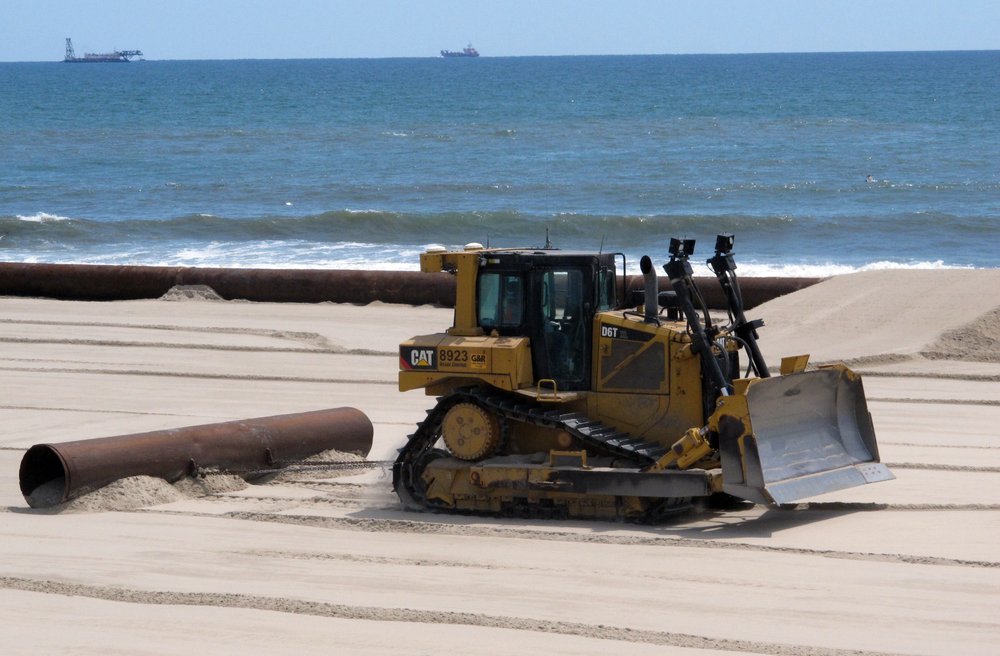
A new analysis published by Warwick Group Consultants shows Florida uses more federal money than any other state on beach renourishment and replenishing projects.

The Washington, D.C.-based firm, which specializes in beach replenishing projects, compiled federal funding figures on those projects between 2000 and 2025.

The federal government spent $773.49 million in Florida during that time frame. New Jersey was the only state that was even close to Florida, using about $733.73 million.

Other states with coastal areas used significantly less federal dollars on beach renourishment. Illinois, with its shores on the Great Lakes, used about $150 million, with New York and Virginia just behind.

Howard Marlowe, President of Warrick Group, said his company contracts with local coastal governments that often get federal funding for beach replenishing projects. The business has handled about a dozen of those projects in Florida.

Marlowe said it’s not surprising the Sunshine State outpaced all other states.

“First of all, Florida has the largest coast of all those states mentioned there,” Marlowe said. “That’s a lot of beaches and a lot of erosion because of hurricanes.”

Florida engages in massive beach renourishment projects, as the beach is an economic engine for the tourist-rich state. This year, Gov. Ron DeSantis signed legislation (SB 1622) that repeals limits on beach access.

Gov. Rick Scott signed the previous legislation limiting public access and barring local governments from passing ordinances regarding customary use.

“By repealing the law, we return the authority back to local communities,” DeSantis said.

Meanwhile, there have been several massively expensive projects that have cost hundreds of millions of dollars combined to restore some shorelines. In March, the U.S. Army Corps of Engineers, Jacksonville District, approved a $20 million contract for the work of beach restoration in Nassau County.

That came on the heels of $32.4 million in federal, state and local funds on a beach replenishing project that ran along Duval County’s Atlantic Ocean beachfront and another $70 million project on beach renourishment in St. Johns County in the past year, which used federal dollars in addition to state and local money.

Not everyone is a fan of those beach restoration projects.

Stop the Beach Renourishment,” an environmentalist organization, has filed several legal challenges to Florida’s projects on the coast. At the same time, many critics say the money thrown at beach renourishment projects is akin to throwing money in the ocean because beaches are made of sand that will eventually erode back into the water.

But Marlowe said that’s short-sighted, especially in Florida, where the beach is often the defining feature to drawing visitors.

“It brings in hundreds of billions of dollars into the local, state and federal treasuries” through sales and property taxes, Marlowe said. “People who live along the coast deserve protection. Not only those who live along the coast but those who vacation along the coast. … The best means of protection is to put sand along the coast.”


Post Views: 0


Source link

Continue Reading

Politics

Monica Matteo-Salinas, Monique Pardo Pope square off in Miami Beach Commission runoff

Published

on


Early voting is underway in Miami Beach ahead of a Dec. 9 runoff that will decide the city’s only open Commission seat — a head-to-head contest between Monica Matteo-Salinas and Monique Pardo Pope for the Group 1 seat.

Matteo-Salinas, a Democrat and longtime City Hall aide, finished first last month with 23.2% of the vote. Pardo Pope, a Republican lawyer, advanced with 20.1%.

They outpaced four other candidates competing to succeed outgoing Commissioner Kristen Rosen Gonzalez last month, but neither captured a large enough share of the vote — more than 50% — to win outright.

The runoff has sharpened into a choice between two contrasting résumés, platforms and campaign narratives along with a late-cycle revelation about Pardo Pope that has drawn national headlines.

Voters are heading to the polls for the second time in just over a month as Miami Beach faces turbulence on multiple fronts, from state scrutiny over finances and charges that a local ordinance conflicts with Florida’s homelessness law to the removal of cultural landmarks due to their so-called “woke” significance and accusations of pay-for-play policymaking.

Matteo-Salinas, 46, has consolidated establishment support for her campaign, which centers on a promise to work on expanding trolley service, increasing the city’s affordable housing index and establishing a new “water czar” position in the city, paid by resort taxes.

She’s earned endorsements from several local pols, including Miami-Dade County Mayor Daniella Levine Cava, Miami Beach Commissioners Alex Fernandez, Laura Dominguez and Tanya Bhatt; and former Miami Beach Dan Gelber.

Groups backing her bid include the Miami Beach Fraternal Order of Police, LGBTQ groups SAVE Action PAC and Equality Florida Action PAC, and the public-safety-focused neighborhood group SOBESafe.

Pardo Pope, 45, has centered her messaging on public safety, investing in mental health, backing school choice initiatives, supporting homelessness services, encouraging “smart, thoughtful development” that preserves Miami Beach’s character while addressing flooding and roadway congestion, and alleviating cost-of-living issues for longtime residents and first-time homebuyers through “fair taxation.”

Though she has touted her guardian ad litem work as evidence of her temperament and commitment to service, that part of her record has drawn renewed scrutiny in recent weeks. A review of Pardo Pope’s case records with the Miami-Dade Clerk’s Office shows her listed as a guardian ad litem on just three cases — one of which she was discharged from after trying to get the mother in the case jailed.

She’s also been the subject of negative attention for omitting that her father was the convicted, Nazi-adoring serial killer Manuel Pardo, to whom she wrote several loving social media posts.

Pardo Pope has said that she forgave him in order to move forward with her life and asked voters to judge her on her own life and work.

Her backing includes the Miami-Dade Republican Party, Miami-Dade Commissioner René García, state Rep. Alex Rizo, former Miami Beach City Attorney Jose Smith, Miami Realtors PAC, the Venezuelan American Republican Club and Teach Florida PAC, a Jewish education group.

Two of her former Group 1 opponents, Daniel Ciraldo and Omar Gimenez, are also backing her.

Matteo-Salinas raised about $133,000 and spent $82,000 by Dec. 4. Pardo Pope raised about $190,000 — of which 29% was self-given — and spent close to $170,000.

Early voting runs through Sunday at four locations citywide. Election Day is Monday, Dec. 9.


Source link

Continue Reading

Politics

Hialeah voters head to polls as City Commission runoffs test new Mayor’s political clout

Published

on


Early voting is underway in Hialeah as two Council runoff contests will decide who rounds out a markedly different dais at City Hall.

The Group 3 and Group 4 races — featuring Jessica Castillo versus Gelien Perez and William “Willy” Marrero versus Javier Morejon, respectively — also stand to determine whether new Mayor Bryan Calvo gains early influence over the Council.

Perez and Castillo advanced to the Group 3 runoff in last month’s General Election with 40.5% and 36% of the vote, respectively, leaving one third-place candidate behind.

In Group 4, Marrero narrowly led the field with 24.8%, followed by Morejon at 23.3%. They outpaced three others in the contest.

To win outright, a candidate had to capture more than half the vote in their respective races.

The runoffs present one of the first real tests of how much sway Calvo, who made history last month as the youngest person ever elected Hialeah Mayor, will have as he prepares to take office.

He has endorsed Perez and Marrero — a strategic pairing that blends rival factions from the mayoral contest into his new governing coalition. Both ran with political slates opposing him. He told the Miami Herald last month that he’s aiming to create “a coalition to approve the agenda,” without an expectation that Perez and Matteo “will vote with (him) 100% of the time.”

If both candidates win, Calvo could enter January with a working majority on the seven-member Council and greater control over the upcoming appointment to fill Jesus Tundidor’s soon-to-be-vacant seat. Tundidor ran unsuccessfully for Mayor.

In Group 3, Perez, 35, a former city Human Resources Director and one-time mayoral aide, has campaigned on supporting first responders and small businesses, improving infrastructure and parks, expanding senior services and rejecting millage rate increases.

But her tenure as HR director drew scrutiny: a two-year Miami-Dade ethics investigation found employees under her influence received sizable raises while she acted as their real estate agent. She has not publicly responded to inquiries about the probe.

(L-R) Jessica Castillo and Gelien Perez are competing in Group 3. Images via the candidates.

Castillo, 37, has run as an independent voice focused on transparency, accountability, traffic relief, infrastructure upgrades and lower taxes. She has kept her campaign largely offline, with no website and minimal social media activity.

In Group 4, Marrero, 23, a Florida International University public administration student and former Council aide, has emphasized affordability, issues facing working families and seniors, and support for first responders.

Earlier this year, three Council members attempted to appoint him to the same seat he now seeks, but opposition from others blocked the move.

(L-R) William “Willy” Marrero and Javier Morejon aim to take the City Council’s Group 4 seat. Images via LinkedIn and Javier Morejon.

Morejon, 34, a land-use specialist with an extensive volunteer résumé, is running on infrastructure repairs, government transparency, beautification and reducing the cost of city services.

Election Day is Monday, Dec. 9. Because Hialeah elects Council members at-large, all voters can cast ballots in both races.


Source link

Continue Reading

Politics

Soon no Pearl Harbor survivors will be alive. People turn to other ways to learn about the bombing

Published

on


About 2,000 survivors attended the 50th anniversary event in 1991. A few dozen have showed in recent decades. Last year, only two made it. That is out of an estimated 87,000 troops stationed on Oahu that day.

Many survivors were jovial despite the occasion, happy to catch up with old friends and pose for photographs. Even so, harrowing recollections were seldom far from their minds.

In 2023, Harry Chandler gazed across the water while telling an Associated Press reporter how he was raising the flag at a mobile hospital in the hills above the base when he saw Japanese planes fly in and drop bombs. Chandler and his fellow Navy hospital corpsmen jumped in trucks to help the injured.

He spoke of seeing the Arizona explode, and of hearing sailors trapped on the capsized USS Oklahoma desperately tapping on their ship’s hull to summon rescue. He helped care for Oklahoma sailors after crews cut holes in the battleship.

“I can still see what was happening,” Chandler said. He died the next year at a senior living center in Tequesta, Florida.

The bombing has long held different meanings for different people, the historian Emily S. Rosenberg wrote in her book “A Date Which Will Live: Pearl Harbor in American Memory.”

Some say it highlights the need for a well-prepared military and a vigilant foreign policy. To some it evokes then-President Franklin D. Roosevelt administration’s “ineptitude or deceit” and the unfair scapegoating of the military. Others focus on the “treachery” of Japan or the heroic acts of individual troops, she wrote.

Asked what he wanted Americans to know about Pearl Harbor, Chandler said: “Be prepared.”

“We should have known that was going to happen. The intelligence has to be better,” he said.

Lou Conter, who was the Arizona’s last living survivor when he died last year at 102, told the AP in 2019 he liked to attend to remember those who lost their lives.

“It’s always good to come back and pay respect to them and give them the top honors that they deserve,” Conter said.

Heinrichs’ father has been six times since 2016. The former tuba player on the USS Dobbin likes to go not only to remember those killed but also in place of his late band mates; his three brothers who fought in World War II; and the now-deceased Pearl Harbor survivors he has met.

Retired National Park Service Pearl Harbor historian Daniel Martinez said the circumstances resemble the early 20th century when Civil War veterans were dying in increasing numbers. Awareness grew that soon they wouldn’t be able to share their stories of Gettysburg and other battles, he said.

Martinez knew something similar could happen with Pearl Harbor survivors and recorded their oral histories. During a 1998 convention, he conducted interviews 12 hours a day for three days. The Park Service today has nearly 800 interviews, most on video.

“They remain as a part of the national memory of a day that changed America and changed the world,” Martinez said.

The Park Service shows some in its Pearl Harbor museum and aims to include more after renovations, said David Kilton, the agency’s Pearl Harbor interpretation, education and visitor services lead.

The Library of Congress has collections from 535 Pearl Harbor survivors, including interviews, letters, photos and diaries. Over 80% are online. They are part of the library’s Veterans History Project of firsthand recollections of veterans who served in World War I onward. Many were recorded by relatives, Eagle Scouts and other amateurs interested in documenting history.

The Sons and Daughters of Pearl Harbor Survivors gives presentations in schools and marches in parades to share the stories of their families. The California chapter has added six new members this year, including two great-grandchildren of survivors.

“When they’re all gone, we’re still going to be here,” said Deidre Kelley, the group’s president. “And it’s our intent to keep the memory alive as long as we’re alive.”

___

Republished with permission of The Associated Press.


Source link

Continue Reading

Trending

Copyright © Miami Select.