
Business
Inside the debt-heavy sand trap of Trump’s U.K. golf course finances
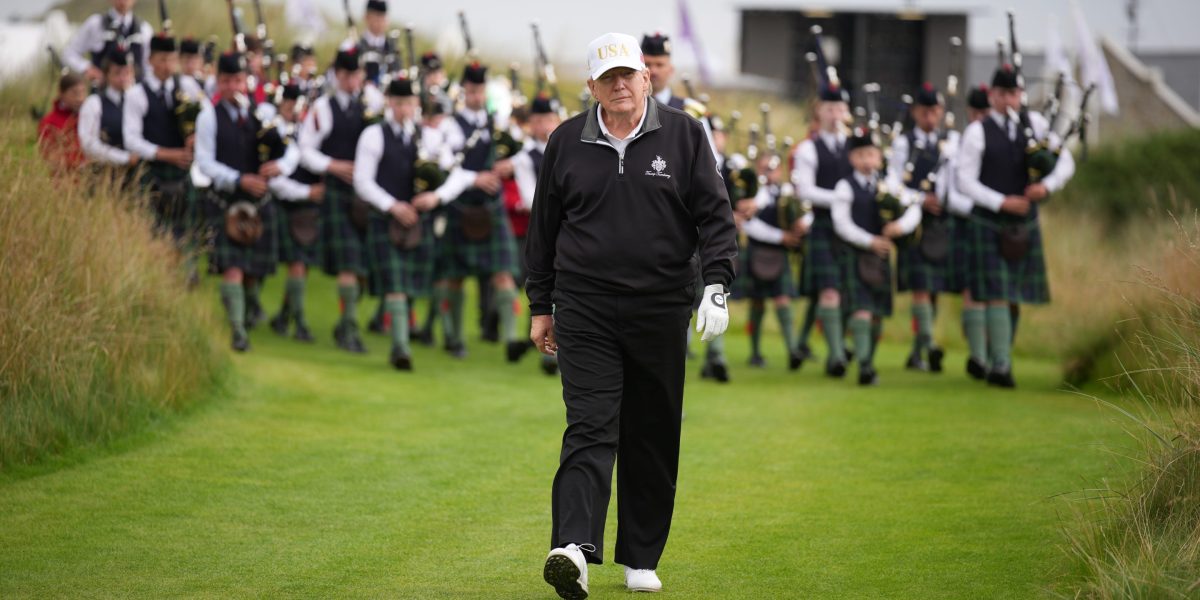
When President Donald Trump went to Scotland in July, he did so not only as commander-in-chief but as the controversial proprietor of some of Britain’s most scrutinized golf resorts. His three-day stop at Trump Turnberry, a hotel and golf resort that is one of the president’s two properties in the country, drew attention when U.K. Prime Minister Keir Starmer joined him to discuss a trade deal between the nations and the ongoing wars in Ukraine and Gaza. He was followed by European Commission President Ursula von der Leyen, who announced the framework of a trade deal with the E.U. from the luxurious property.
Trump hosting Starmer at Turnberry broke with diplomatic tradition. American presidents are usually invited to foreign countries by their leaders and hosted at diplomatic residences. But it follows his pattern of abandoning presidential norms, especially when it comes to his family business. According to Michael Cohen, former vice president of the Trump Organization and Trump attorney, the president’s habit of hosting at his properties plays into having a home court advantage. Not only is Trump most comfortable at his properties, where everyone around him is “at his beck and call,” but it also offers Trump the opportunity to show off his brand’s visible presence, Cohen told Fortune.
“The name Trump is plastered everywhere, whether it’s inside of an elevator, whether it’s on a wall with photos of him, whether it’s pulling up to the facility where it says Trump Turnberry. The same holds true, whether it’s Doral, whether it’s Aberdeen, whether it’s Bedminster, Briarcliff, it makes no difference,” he said. “So there’s definitely a power play. It’s an impressive place, and so anybody pulling up sees the value of the property.”
Both of Trump’s Scottish resorts—Turnberry and Trump International Scotland near Aberdeen—are run by Eric Trump and held in a trust managed by the president’s children.
“There is an old expression that land can neither be created nor destroyed, and it’s what made kingdoms, kingdoms. Donald clearly sees himself in that role.”
Michael Cohen, former vice president of the Trump Organization and Trump attorney
Beneath Turnberry and Aberdeenshire’s manicured fairways and breathtaking seascapes, however, lies a perplexing story. Despite being among the most prestigious courses in the world—Turnberry is a four-time host of the Open Championship—this has not translated into meaningful profits. A similar fate has befallen Trump’s other international golf courses, all 15 of which lost over $315 million in the two decades prior to 2021.
And combined, the two courses in Scotland, as of 2023, were carrying a debt-load that dwarfs the size of their underlying businesses: $239.32 million between them. This debt is owned by and contained within the Trump Organization.
Despite the properties’ meager profits—as shown on the financial statements filed with the U.K. regulator Companies House—Cohen explained that the value of Trump’s golf businesses aren’t exclusive to the sport itself. “There’s also a future land value that gets assigned to the properties,” he said, “Take Turnberry as an example. What’s the chance that you’re ever going to be able to build another golf course like Turnberry? The answer is, you’re not.”
A resort buoyed less by golfers than by favorable forex
Trump Turnberry was one of Trump’s most expensive properties. He spent $67 million to purchase the resort in 2014 and a further $144 million on renovations. In the decade since being acquired, the business has struggled to turn a profit. The most recent period for which financials have been disclosed is 2023, which is the first fiscal year that it did not report substantial losses (prior to 2019, however, Turnberry’s revenue showed consistent growth). During the pandemic, the enterprise reported more than $27 million in losses when the hospitality industry took a beating due to COVID-19 restrictions. Since then, the resort’s finances appear to have stabilized. Turnberry’s parent company, Golf Recreation Scotland, reported $28.6 million in sales, and $5.15 million in profits for the 2023 financial year, according to U.K. government filings. In 2022, turnover at the company was $29.56 million but profits reached just $252,582. Figures for 2024 are expected soon.
Eric Trump told Fortune that these rebounding figures are evidence of Turnberry’s rise and success, namely the course becoming the U.K.’s most expensive game of golf, costing over $1,286 for a round on the property’s famed Ailsa green during peak times. A night at the property is similarly pricey—rooms start at $527 per night.
Despite sales falling in 2023, the company’s operating costs rose by approximately $2.03 million. Eric, in the filings, attributed strained profitability, in part, to “rising regional utility costs, supplier expenses and minimum wage increases.” Scotland’s national living wage (the minimum hourly rate for those 23 and older) rose from $12.08 in 2021 to $14.13 in 2023. When speaking with Fortune, Eric further explained rising operating expenses as part of the business’ expansion.
CHRISTOPHER FURLONG—Getty IMAGES
Meanwhile, Turnberry has sizable debt. The parent company owes $168.15 million in zero-interest loans to an unnamed creditor. Eric told Fortune, however, that all of this debt is owed to the Trump Organization, not an external source.
“When we bought Turnberry, we bought the note that they had, and we bought the assets that they had. So it’s just a structure, but that’s all within the Trump Organization,” he explained.
Turnberry’s debt decreased in 2023, from $177.24 million. Alan Jagolinzer, co-director of the Centre for Financial Reporting and Accountability at the University of Cambridge told Fortune, this reduction was “reportedly from favorable exchange rate changes” rather than debt paydown.
Exchange rate fluctuations, Jagolinzer noted, play a large role in the golf resort’s earnings year-to-year. “As a whole, it seems exposed to foreign currency risk,” he said, namely exposure to the weakening U.S. dollar on the business’s loans.
Debt risk has seldom fazed Trump, who once dubbed himself the “king of debt” and has spent his career building businesses using troves of borrowed cash.
Bogeys on the balance sheet
Trump’s second golf course in Aberdeenshire is a significantly smaller operation than its Turnberry sister. The president bought the property in 2006, but it only began operating fully in 2012 after drawn-out spats with local residents and environmentalists. As of 2023, the resort had only ever operated at a loss. Its current profitability remains unknown. Aberdeenshire reported $5.02 million in revenues in 2023, according to disclosures by its parent company Trump International Golf Club Scotland Limited. Its losses were $1.9 million, up from around $1 million the financial year prior. And while revenue was up slightly in 2023, Trump International’s operating costs, much like at Turnberry, were significantly higher—up approximately $1 million.
Despite these losses in 2023, Eric pointed to consecutive increases in sales across all revenue streams, especially retail and food and beverage, of the business. And while operating costs rose, Trump’s son said in the filings that the sizable increase in tournament and marketing expenditures are expected to “deliver elevated levels of revenue performance in 2024 and beyond.” Future factors, such as the property’s unveiling of its newest course in July 2025, stand to further drive the financial future of the Aberdeenshire club. The new course, he told Fortune, would also add to operating costs.
For Eric, Trump International’s growing pains are par for the course in cultivating a property from the ground up. “A property this size is a massive, long-term commitment. A project like that could take two decades to fully develop,” he told Fortune.

JEFF J MITCHELL—Getty Images
Trump International’s debt is similarly large. The parent company owes upwards of $71.19 million in interest-free loans as of 2023. These loans are owed to US-entities tied directly to the Trump family and Trump himself. According to the filings, $55.06 million of the Aberdeenshire course’s debt is owed to Trump, with an unspecified rolling repayment term, and $16 million of the debt is owed to DJT Holdings LLC. DJT Holdings also advanced $6.37 million in funding to Trump International’s parent company in 2023.
Its previous lack of profitability, according to Jagolinzer, suggests the course “appears to be operating on an assumption it can continue to borrow.”
“It’s not clear how this operation can continue without persistent debt funding available,” he added.
These factors, Jagolinzer said, could become a basis for auditors to offer a negative opinion on “going concern,” meaning the auditor has substantial doubt about the company’s ability to continue operating as a business entity for a reasonable period of time, typically one year after the financial statement date. Of course, the fact that the debt is owed to the Trump Organization softens that risk considerably.
Currently, both of Trump’s Scotland properties are audited by BDO’s Ireland branch. However, prior to 2021, both businesses were audited by the firm Johnston Carmichael.
Forensic accountant Paul Barnes told Fortune the change in auditors raised a potential red flag for him. Changing auditors, he explained, can indicate deeper financial issues, disagreements on accounting principles, or a lack of transparency in a company’s financial reporting.
A spokesperson for Johnston Carmichael refused to comment on why they no longer represent the golf properties. “As a regulated organisation, the firm adheres to its obligations and does not discuss client business, whether past or present,” they said in a written statement to Fortune.
According to Eric, the company moved auditing firms to BDO to consolidate their business. The Trump Organization’s Ireland property was already a BDO client prior to 2021. He dismissed any other explanation for the change.
But ultimately, the only creditor that Trump International has to answer to is Trump, making the debt risk low and squarely in the Trump family’s purview. “If they were borrowing from banks in the U.K., the politicians and the government may well put pressure on the banks to call in the money. But the money has come from him in the US. And so he’s got full control,” Barnes said.
Developments stuck in the rough
The strategy behind Trump’s golf ventures may very well be unrelated to his beloved sport. In 2016, the then-presidential candidate told Reuters his resorts were real-estate “development deals” rather than golf investments.
“It’s pretty simple,” he said. “My golf holdings are really investments in thousands, many thousands of housing units and hotels. At some point the company will do them.”
These promised developments have yet to fully materialize.
Cohen predicted that the Trump Organization is likely in no rush to complete all of the promised projects. “There’s only so many projects that they want to handle at any given time right now,” he said.
Since purchasing the 1,400-acre Menie Estate in Aberdeenshire, Trump has made sweeping promises for residential and job development including a 450-room luxury hotel (scaled back to just 19 rooms), 950 holiday apartments, 500 single-family residences, 36 golf villas, 6,000 jobs, an additional golf course, and a total promised investment of $1.36 billion. But today the property only employs 84 people and the investment was reduced to around $1 billion.
“A property this size is a massive, long-term commitment. A project like that could take two decades to fully develop.”Eric Trump
Despite receiving outline planning permission in 2008 and detailed approval in 2010, only two golf courses have been completed, the newest of which opened in July 2025.
In February 2022, Aberdeenshire Council granted permission in principle for up to 550 residential properties. Under this arrangement, Trump’s organization agreed to pay $1.04 million toward affordable housing in the area for the first 77 homes, with payments increasing by $135,601 for each additional home. While Eric Trump acknowledged in the 2023 filings that these housing plans “remain a big priority,” he claimed they would come only after completion of a second golf course at the site. He estimated the full development could take up to 10 years to complete.
He told Fortune that he remains committed to seeing the project through. “I’ve been buying and buying and buying,” he said. “I just bought 300 acres that connect to the property. In the last year, I’ve probably bought 10 to 12 houses on the surrounding property.” These purchases, he explained, are part of expanding the property and completing the promised projects.
“Aberdeen is something we’re really proud of,” he added.
Trump’s acquisition of Turnberry came with similarly ambitious residential development plans—87-200 luxury properties, including shops and cafes, holiday cottages and retirement homes across 48-120 hectares, and properties described as providing “permanent tranquillity and respite.” Local authorities, however, have repeatedly pushed back on these initiatives, consistently citing environmental concerns, infrastructure limitations, and lack of demonstrated housing need as reasons for the rejections. (The course sits on an isolated, rural coastline where the nearest town of any size, Ayr, is a 30-minute drive away.) Eric, however, rejected any potential roadblocks in developing Turnberry when speaking to Fortune. A Turnberry executive promised that the company would continue to pursue development applications “in due course.”
These development promises have reported financial implications for the businesses and were showcased in the New York civil fraud case against the president, in which he was found liable for using inflated valuations to obtain favorable loan terms. (On Aug. 21, a New York appeals court removed the nearly half-billion-dollar penalty levied on Trump.) Court documents alleged that the Trump Organization made the misleading claim that 2,500 homes could be developed, despite having approval for fewer than 1,500 units. The $267 million valuation attributed to residential development accounted for more than 80% of the total property valuation, the documents said. Trump has repeatedly denied any wrongdoing and previously called the case against him a political “witch hunt.”
Regardless of the Scotland golf properties’ development prospects, both businesses face an almost insurmountable battle to make a dent in their sizable debts. But without the threat of banks and government pressure, Barnes said, “they may just carry on, but they’re not going to make a great deal of money for Donald Trump.”
Regardless, Cohen argued that it’s not simply about the money for Trump. The president’s net worth, according to the New York Times, is upwards of $10 billion, and as Cohen noted, his financial prosperity has put him in a position where he is no longer dependent upon banks for his real estate empire, his golf properties included.
“So you can’t look at these as merely just golf courses,” said Cohen. “There is an old expression that land can neither be created nor destroyed, and it’s what made kingdoms, kingdoms. Donald clearly sees himself in that role.”