Business
Neuralink’s first study participant says his whole life has changed
Published
4 months agoon
By
Jace Porter
It was February 2024 when Noland Arbaugh, the first person to get Elon Musk’s experimental brain chip, rolled across the stage in a wheelchair during a Neuralink “all hands” meeting, revealing his identity for the first time.
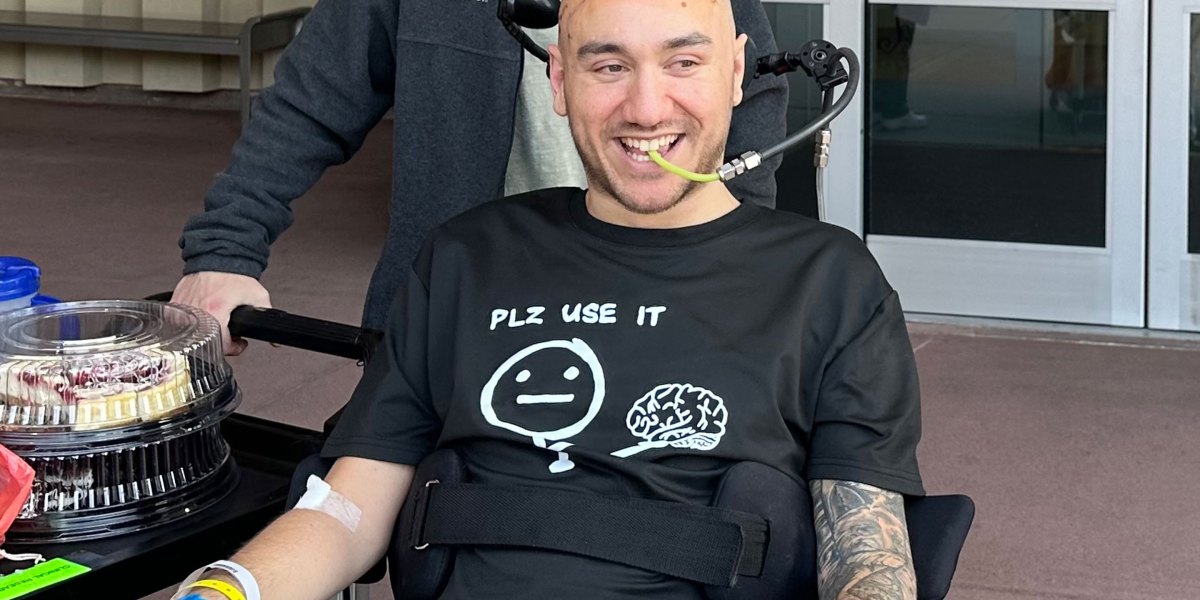
The room, filled with Neuralink employees, erupted in applause as Arbaugh—who dislocated two of his vertebrae in a swimming accident in 2016 and has since lost sensation and movement below his shoulders—smiled ear-to-ear in his chair, a red Texas A&M hat planted on his head. He grinned as he began to speak: “Hello, humans.”
About a month before that town hall, Arbaugh had undergone surgery at the Barrow Neurological Institute in Phoenix, about 2.5 hours from his home in Yuma, to get an experimental chip embedded into his brain which Neuralink had been working on and testing on animals for the past nine years. Arbaugh was anesthetized and, in a surgery that lasted just under two hours, a Neuralink-made robotic surgery device implanted the chip and connected tiny threads with more than 1,000 electrodes to the neurons in his brain. Now the device can measure electrical activity, process signals, then translate those signals into commands to a digital device. In layman’s speak, the BCI , or brain-computer interface, allows Arbaugh to control a computer with his mind. As a result, Arbaugh can do things like play Mario Kart, control his television, and turn his Dyson air purifier on and off without physically moving his fingers or any other part of his body.
The first day that Arbaugh used his device, he beat the 2017 world record for speed and precision in BCI cursor control. “It was very, very easy to learn how to use,” he tells me in an interview.
When Arbaugh became Participant 1—or “P1” as he is often referred to by Neuralink employees and subsequent study participants—he joined a list of about 80 people to ever receive such a device. Brain chip interfaces have been a focus of neurological study for more than 50 years, and there’s a dozen companies in the U.S. and China that have been conducting limited human trials since 1998.
But becoming the first patient to get a Neuralink implant, in particular, is its own right of passage. For one, Neuralink’s device has threads with more than 1,000 electrodes, giving the device a much higher connectivity rate than most of the BCIs currently being studied in humans in the market. But Neuralink also places its electrodes in the motor cortex, the part of the brain that controls movement—a more invasive approach than competitors like Synchron or Precision Neuroscience, which also have ongoing studies of multiple patients. Neuralink’s device is also wireless, versus competitors like Blackrock Neurotech that require a wired connection from the implant through the skull to an external receiver for signal capture and decoding (BlackRock Neurotech sells a wireless processor that has been used for research). That means Neuralink participants can go cordless—but the device is battery powered because of it and does need to be charged: around every five hours or so, Arbaugh says. Neuralink heat treats the charger, a coil, into some of Arbaugh’s hats, so that he can recharge it while wearing a hat. In the beginning, Arbaugh couldn’t use the device while it charged, though that’s since been updated.
Of course, there is also the fact that Neuralink is Elon Musk’s brain chip company, which draws an entirely different level of scrutiny and attention to any study participant. Since Arbaugh revealed himself as “P1,” he has become a public figure, frequently invited on podcasts and having journalists show up at his home. His X account has been hacked, and he told me that a SWAT team showed up with AR15s after someone gave a false tip to the local sheriff’s office that Arbaugh was in danger.
When I first reached out to Arbaugh in early June to see how the BCI had changed his day-to-day 1.5 years in, it took a couple months for us to finally pin down a time. When we finally did hop on the phone, he laughed. “I’m just so busy all the time,” he says. “That is so different than what life was like before… I feel like I’m playing catch-up for eight years of not doing anything—kind of lying around, staring at walls.”
Since Arbaugh became the first Neuralink patient in January 2024, there have been eight more individuals, including one woman, to enroll in the company’s ongoing clinical trials, which are now open in the U.S., Canada, Great Britain, and the United Arab Emirates. So far, all of the surgeries have taken place at hospitals in the U.S., with two of the participants receiving the implant on the same day at the end of July. All of the study participants suffer from either paralysis or ALS, a nervous system disease that causes loss of muscle control. “Our goal is to really build a whole brain interface,” Neuralink cofounder and president DJ Seo, said during Neuralink’s summer update meeting.
For Arbaugh, the Neuralink device has been entirely transformative, he says. He uses it about 10 hours a day to control his computer so he can study, read, and game—and to handle things like scheduling an interview with me. Arbaugh enrolled in classes at his community college in Arizona, where he has started taking prerequisites he needs for a degree in neuroscience, and, as he tells Fortune, he’s working on starting his own business—paid professional speaking engagements and live talks.
As he talks about all of it with me, his excitement—and a newfound sense of purpose—is palpable. Before his surgery, “I would stay up all night and sleep all day, and I didn’t really [want to] bother anyone or ruin any plans or get in the way of anything,” he says. “I just had no purpose… I was just kind of going through the motions, waiting for something to happen.”
Arbaugh never lost the ability to think or speak due to his accident. But in the last year and a half, he has regained more of the autonomy he lost with his disability, and is able to do more things for himself. “I feel like I have potential again. I guess I always have had potential, but now I’m finding a way to fulfill that potential in meaningful ways. It’s a lot different.”
‘Never doubted for a second’
When you talk to Arbaugh, he makes all of it seem rather simple. He had never heard of a “BCI,” or Neuralink for that matter—until his friend from military school, an Elon Musk buff, learned of the first Neuralink clinical trial while researching SpaceX at the end of 2023, Arbaugh recalls. The friend, Greg Bain, reached out to Arbaugh, who signed up to join the very same day (though Bain spelled his name wrong on the application).
Apu Gomes/Getty Images
“I never doubted for a second that it would work,” Arbaugh, who personally didn’t have strong opinions of Elon Musk one way or another, says.
Arbaugh says he received an email from the Barrow Neurological Institute the day after he applied, and started going through the process. There was a screening call and an interview, and then about a month later, he was going into the nearby hospital for a full day of scans and testing. About three months after he applied, Arbaugh found out that he was going to be the first participant, and his surgery was scheduled a few weeks later. While Arbaugh is not paid, Neuralink covers the cost of the surgery and the implant, and the company reimburses him for travel to and from his check-ups or for expenses directly related to the study. (Arbaugh says that, with FDA approval, Neuralink did pay him for two talks he gave at Neuralink, including the February 2024 talk where he revealed his identity for the first time)
Despite the risks of being the first participant of an experimental clinical trial, Arbaugh says it was an easy decision for him. “I decided that, even if it didn’t work—even if something went terribly wrong—I knew that it would help someone down the road,” Arbaugh says. “And I knew that good or bad, they would learn something and push this technology forward.”
Technically I am a cyborg because I have been enhanced by a ‘machine’, but I still see myself as a regular guy
Noland Arbaugh, Neuralink’s first study participant
As you may imagine, it was a little harder for his parents. Arbaugh says he remembers sending his mother the consent forms he had to sign for her to read over, which contained a laundry list of potential risks associated with the surgery—and every imaginable thing that could go wrong with the experimental device. He said she read one or two items and then put them away, unable to read any further. But ultimately, both his parents supported his decision, he says, and never showed that the decision was hard on them. “I hadn’t really been excited about many things before that point, so they were just happy to help in any way they could,” he says.
Arbaugh was also extremely decisive in his choice to go public with his identity. He says he wanted to show people that he believed this device was safe, and what could be possible for those who used it.
“I wanted to share it with people, because I thought it was huge, and I still do,” Arbaugh says. “I think it’s one of the biggest leaps in technology that we’ve had in a really long time, and I think that it’s going to keep growing.”
Arbaugh insists that Neuralink has never tried to dictate what he can or can’t say publicly, and he says he has never been asked to sign any kind of non-disclosure agreement. It’s been the opposite, he says: Neuralink staffers have encouraged him to disclose whatever he’d like to. But he has voluntarily chosen not to talk about some things on occasion. For example, shortly after his surgery, some of the threads retracted, causing him to lose much of the control he had over the device. The incident was later published in the Wall Street Journal, and Neuralink published a blog post about it. It was a big deal, Arbaugh says, but he decided to wait for the team to figure out what had happened and how to repair it, which they did.
Revealing something like that at the time would have been “extremely rash of me, and it would have absolutely made people lose faith in the product,” he says. “That’s not what I want. I love this thing. I love what Neuralink is doing. I love all of it, and I’m really proud of it.”
Next up at Neuralink
In the summer update meeting Neuralink published publicly, Seo laid out what the company is focused on next. Neuralink is starting a trial in the United Arab Emirates, called “Blindsight,” that would help restore sight to the blind. Neuralink is already developing robotic arms for participants, and, during the presentation, Musk said that the company wants to give them sensory control to where they could essentially “inhabit an Optimus robot” and control it with their minds, or attach an Optimus arm or leg to a person to give them full control again of that part of their body.
“The future is going to be weird, but pretty cool,” he said.

Stanislav Kogiku/SOPA Images/LightRocket via Getty Images
As of right now, Neuralink is still adding patients to its various trials. At the end of July, Neuralink announced it had received approval to introduce a trial in Great Britain via University College London Hospitals and Newcastle Hospitals.
Neuralink still has plenty of critics for its more-invasive BCI approach and—true to form for all of Elon Musk’s companies—the high employee expectations and long work hours have led to high turnover as a result. Neuralink has also been accused of poor treatment of the monkeys it’s used to test its Link devices. (Regarding treatment of its animals, Neuralink says it works with animals in “the most humane and ethical way possible.” Several of the Neuralink study participants that I spoke also contested the claim of animal mistreatment).
While some of Musk’s other companies, including SpaceX and the Boring Company, have been accused of being lax when it comes to safety precautions, Musk is adamant that Neuralink is moving slowly and carefully as Neuralink tests its brain chips.
“We’re very cautious with the Neuralinks in humans,” Musk said during the summer update. “That’s the reason we’re not moving faster than we are is because we are taking great care with each individual to make sure we never miss.”
As more Neuralink patients become vocal about the Neuralink BCI and the company, Neuralink is garnering more global recognition, and investors are pouring in hundreds of millions of capital.
Indeed, there is something uniquely compelling about the vision at Neuralink and its mission to help those with disabilities. And there’s something uniquely compelling about Arbaugh, too. Perhaps it’s his sense of humor, his earnestness, or his humility—but it’s hard not to like him at once.
He speaks about his three conversations with Musk—once via FaceTime the day of his surgery, in person post-surgery, then later at the Austin Gigafactory—nonchalantly, saying Musk is a “cool dude” who “has done a lot of his life and is super impressive, but at the end of the day is just another guy.”
After our interview, I asked Arbaugh if he considers himself a “cyborg”—the scifi term coined in the ’60s to describe a human being who has been enhanced by a technological body part or device. “Technically I am a cyborg because I have been enhanced by a ‘machine,’” he says. “But I still see myself as a regular guy… But it’s fun to play around with.”
A year-and-a-half after his surgery, Arbaugh still has so much to say about all of it: about neuroscience, about his faith, and about what technology is making possible for paralysis. This whole ordeal has given him a new appreciation for what’s possible, he says: “I always thought that [paralysis was] going to be fixed through drugs, or some sort of new surgery, or something they discovered in science—stem cells or something of that nature.”
But now that he has been thrust into the tech world, Arbaugh says he’s thinking about it differently. “I see how the advancements in tech at this point are going to solve so many things. They are, I think, the future of medicine. I think a lot of disabilities, cures, and answers that we’ve been searching for a long time will come through tech—and that kind of surprised me.”
In the meantime, there is a lot for him to soak up in this new way of life—where he can play Mario Kart with his dad, go back to college, and build a business: “I definitely didn’t expect for this to ever happen,” he says.
You may like
Business
Why the worst leaders sometimes rise the fastest
Published
16 minutes agoon
December 8, 2025By
Jace Porter
History is crowded with CEOs who have flamed out in very public ways. Yet when the reckoning arrives, the same question often lingers: How did this person keep getting promoted? In corporate America, the phenomenon is known as “failing up,” the steady rise of executives whose performance rarely matches their trajectory. Organizational psychologists say it’s not an anomaly. It’s a feature of how many companies evaluate leadership.
At the core is a well-documented bias toward confidence over competence. Studies consistently show that people who speak decisively, project certainty, and take credit for wins—whether earned or not—are more likely to be perceived as leadership material. In ambiguous environments, boards and senior managers often mistake boldness for ability. As long as a leader can narrate failure convincingly—blaming market headwinds, legacy systems, or uncooperative teams—their upward momentum may continue.
Another driver is asymmetric accountability. Senior executives typically oversee vast, complex systems where outcomes are hard to tie directly to individual decisions. When results are good, credit flows upward. When results are bad, blame diffuses downward, and middle managers, project leads, and market conditions become convenient shock absorbers. This allows underperforming leaders to survive long enough to secure their next promotion.
Then there’s the mobility illusion. In many industries, frequent job changes are read as ambition and momentum rather than warning signs. An executive who leaves after short, uneven tenures can reframe each exit as a “growth opportunity” or a strategic pivot. Recruiters and boards, under pressure to fill top roles quickly, often rely on résumé signals, like brand-name firms, inflated titles, and elite networks, rather than deep performance audits.
Ironically, early visibility can also accelerate failure upward. High-profile roles magnify both success and failure, but they also increase name recognition. An executive who runs a troubled division at a global firm may preside over mediocre results, yet emerge with a reputation as a “big-company leader,” making them attractive for a CEO role elsewhere.
The reckoning usually comes only at the top. As CEO, the buffers disappear. There is no one left to blame, and performance is judged in the blunt language of earnings, stock price, profitability, or layoffs. The traits that once fueled ascent, such as overconfidence, risk-shifting, and narrative control, become liabilities under full scrutiny.
The central lesson for aspiring CEOs is that the very system that rewards confidence, visibility, and narrative control on the way up often masks weak execution until the top job strips those protections away. Future leaders who want to avoid “failing upward” must deliberately build careers grounded in verifiable results and direct ownership of outcomes because at the CEO level, there is no narrative strong enough to substitute for performance.
Ruth Umoh
ruth.umoh@fortune.com
Smarter in seconds
Big biz buy-in. Anthropic is all in on ‘AI safety’—and that’s helping the $183 billion startup win over big business
Old guard upgrade. How the bank founded by Alexander Hamilton is transforming for the future of finance
Pressure test. Inside the Fortune 500 CEO pressure cooker: surviving is harder than ever and requires an ‘odd combination’ of traits
Rank racing. The one-upmanship driving CEOs
Leadership lesson
Anthropic’s Dario Amodei on when a startup gets too big to know all employees: “It’s an inevitable part of growth.”
News to know
Investors are questioning OpenAI’s profitability amid its massive spending while increasingly viewing Alphabet as the deeper-pocketed winner in the AI race. Fortune
Trump warned that Netflix’s $72 billion bid for Warner Bros. Discovery could face antitrust scrutiny, suggesting it would create an overly dominant force in streaming. Fortune
An etiquette camp is trying to help Silicon Valley shed its sloppy image by teaching tech elites how to dress and behave as their influence grows. WaPo
IBM is reportedly in advanced talks to buy data-infrastructure firm Confluent for about $11 billion, bolstering its AI data capabilities. WSJ
Even as women reach top roles in politics and business at record levels, public confidence in their leadership is stagnating or declining. Bloomberg
Terence “Bud” Crawford, the undefeated 38-year-old boxing champion, has earned more than $100 million and even turned Warren Buffett into a fan. Forbes
Big Tech leaders now warn that artificial intelligence is advancing to the point where it could begin replacing even CEOs, reshaping the very top of corporate leadership. WSJ
Business
The workforce is becoming AI-native. Leadership has to evolve
Published
48 minutes agoon
December 8, 2025By
Jace Porter
One of the most insightful conversations I have had recently about artificial intelligence was not with policymakers or peers. It was with a group of Nokia early-careers talents in their early 20s. What stood out was their impatience. They wanted to move faster in using AI to strengthen their innovation capabilities.
That makes perfect sense. This generation began university when ChatGPT launched in 2022. They now account for roughly half of all ChatGPT usage, applying it to everything from research to better decision-making in knowledge-intensive work.
Some people worry that AI-driven hiring slowdowns are disproportionately impacting younger workers. Yet the greater opportunity lies in a new generation of AI-native professionals entering the workforce equipped for how technology is transforming roles, teams, and leadership.
Better human connectivity
One of the first tangible benefits of generative AI is that it allows individual contributors to take on tasks once handled by managers. Research by Harvard Business School found that access to Copilot increased employee productivity by 5% in core tasks. As productivity rises and hierarchies flatten, early-career employees using AI are empowered to focus on outcomes, learn faster, and contribute at a higher level.
Yet personal productivity is not the real measure of progress. What matters most is how well teams perform together. Individual AI gains only create business impact when they align with team goals and that requires greater transparency, alignment, and accountability.
At Nokia, we ensure that everyone has clear, measurable goals that support their teams’ objectives. Leaders need to be open about their goals to their managers and to their reports. And everyone means everyone. Me included. That way goals are not only about recognition and reward. They become an ongoing dialogue between leaders and their teams. It’s how we’re building a continuous learning culture that thrives on feedback and agility, both essential in the AI era.
Humans empowered with AI, not humans versus AI
AI’s true power lies in augmenting human skills. Every role has a core purpose – whether in strategy, creativity, or technical problem-solving – and AI helps people focus on that.
During the COVID-19 pandemic, more than 60 chatbots were deployed in 30 countries to handle routine public health queries, freeing up healthcare workers to focus on critical patient care. Most health services never looked back.
The same pattern applies inside companies. Some of the routine tasks given to new hires are drudge work and not a learning experience. AI gives us a chance to rethink the onboarding, training, and career development process.
Take an early-career engineer. Onboarding can be a slow process of documentation and waiting for reviews. AI can act as an always-on coach that gives quick guidance and helps people ramp up. Mentors then spend less time on the basics and more time helping engineers solve real problems. Engineers can also have smart agents testing their designs, ideas, and simulating potential outcomes. In this way, AI strengthens, rather than substitutes, the human connection between junior engineers and their mentors and helps unlock potential faster.
Encourage experimentation and entrepreneurship
During two decades of the Internet Supercycle (1998-2018), start-ups created trillions of dollars in economic value and roughly half of all new jobs in OECD countries.
As AI lowers the barriers to launching and scaling ventures, established companies must find new ways to encourage experimentation, nurture innovation through rapid iterations, and give employees the chance to commercialize and scale their ideas.
There is a generational shift that increases the urgency: more than 60% of Gen Z Europeans hope to start their own businesses within five years, according to one survey. To secure this talent, large organizations must provide the attributes that make entrepreneurship attractive. Empowering people with agility, autonomy, and faster decision-making creates an edge in attracting and keeping top talent.
At Nokia, our Technology and AI Organization is designed to strengthen innovation capabilities, encourage entrepreneurial thinking, and give teams the support to turn ideas into real outcomes.
More coaching, less managing
Sporting analogies are often overused in business as the two worlds don’t perfectly align, yet the evolution of leadership in elite football offers useful lessons. Traditionally, managers oversaw everything on and off the pitch. Today, head coaches focus on building the right team and culture to win.
Luis Enrique, the manager of Paris-St. Germain football club, last season’s UEFA Champion’s League winner, exemplifies this shift. He transformed a team of stars into a star team, while also evolving his coaching style, elevating both individual and collective potential.
Of course, CEOs must switch between both roles (as I said, the worlds don’t perfectly align) – setting vision and strategy while also cultivating the right team and culture to succeed. AI can help leaders do both with more focus. It gives us quicker insight into what is working, what is not, and where teams need support.
I have been testing these tools with my own leadership team. We are using generative AI to help us evaluate our decisions and to understand how we work together. It has revealed patterns we might have missed, and it has helped us get to the real issues faster. It does not replace judgment or experience. It supports them.
Yet the core of leadership does not change. AI cannot build trust. It cannot set expectations. It cannot create a culture that learns, improves, and takes responsibility. That still comes from people. And in a world shaped by AI, the leaders who succeed will be the ones who coach, who listen, and who help teams move faster with confidence.
Nokia’s technology connects intelligence around the world. Inside the company, connecting intelligence is about how people work together. It means giving teams the tools, support and culture they need to grow and perform with confidence. Connecting intelligence is how teams win.
The opinions expressed in Fortune.com commentary pieces are solely the views of their authors and do not necessarily reflect the opinions and beliefs of Fortune.
Business
Procurement execs often don’t understand the value of good design, experts say
Published
3 hours agoon
December 8, 2025By
Jace Porter
Behind every intricately designed hotel or restaurant is a symbiotic collaboration between designer and maker.
But in reality, firms want to build more with less—and even though visions are created by designers, they don’t always get to see them to fruition. Instead, intermediaries may be placed in charge of procurements and overseeing the financial costs of executing designs.
“The process is not often as linear as we [designers] would like it to be, and at times we even get slightly cut out, and something comes out on the other side that wasn’t really what we were expecting,” said Tina Norden, a partner and principal at design firm Conran and Partners, at the Fortune Brainstorm Design forum in Macau on Dec. 2.
“To have a better quality product, communication is very much needed,” added Daisuke Hironaka, the CEO of Stellar Works, a furniture company based in Shanghai.
Yet those tasked with procurement are often “money people” who may not value good design—instead forsaking it to cut costs. More education on the business value of quality design is needed, Norden argued.
When one builds something, she said, there are both capital investment and a lifecycle cost. “If you’re spending a bit more money on good quality furniture, flooring, whatever it might be, arguably, it should last a lot longer, and so it’s much better value.”
Investing in well-designed products is also better for the environment, Norden added, as they don’t have to be replaced as quickly.
Attempts to cut costs may also backfire in the long run, said Hironaka, as business owners may have to foot higher maintenance bills if products are of poor design and make.
AI in interior and furniture design
Though designers have largely been slow adopters of AI, some luminaries like Daisuke are attempting to integrate it into their team’s workflow.
AI can help accelerate the process of designing bespoke furniture, Daisuke explained, especially for large-scale projects like hotels.
A team may take a month to 45 days to create drawings for 200 pieces of custom-made furniture, the designer said, but AI can speed up this process. “We designed a lot in the past, and if AI can use these archives, study [them] and help to do the engineering, that makes it more helpful for designers.”
Yet designers can rest easy as AI won’t ever be able to replace the human touch they bring, Norden said.
“There is something about the human touch, and about understanding how we like to use our spaces, how we enjoy space, how we perceive spaces, that will always be there—but AI should be something that can assist us [in] getting to that point quicker.”
She added that creatives can instead view AI as a tool for tasks that are time-consuming but “don’t need ultimate creativity,” like researching and three-dimensionalizing designs.
“As designers, we like to procrastinate and think about things for a very long time to get them just right, [but] we can get some help in doing things faster.”
Matalan says revamped store see higher sales, names director of international
Why the worst leaders sometimes rise the fastest
Skechers partners with Mohammed Siraj and Alaya F to launch ‘Go Walk’ collection in India
Trending
-
Politics8 years agoCongress rolls out ‘Better Deal,’ new economic agenda
-
Entertainment8 years agoNew Season 8 Walking Dead trailer flashes forward in time
-
Politics8 years agoPoll: Virginia governor’s race in dead heat
-
Entertainment8 years agoThe final 6 ‘Game of Thrones’ episodes might feel like a full season
-
Entertainment8 years agoMeet Superman’s grandfather in new trailer for Krypton
-
Politics8 years agoIllinois’ financial crisis could bring the state to a halt
-
Business8 years ago6 Stunning new co-working spaces around the globe
-
Tech8 years agoHulu hires Google marketing veteran Kelly Campbell as CMO
