Connect with us

Business

An MIT report finding 95% of AI pilots fail spooked investors. It should have spooked C-suite execs instead.


Published

on


Hello and welcome to Eye on AI…In this edition: DeepSeek drops another impressive model…China tells companies not to buy Nvidia chips…and OpenEvidence scores an impressive result on the medical licensing exam.

Hi, it’s Jeremy here, just back from a few weeks of much needed vacation. It was nice to be able to get a little distance and perspective on the AI news cycle. (Although I did make an appearance on Rana el Kaliouby’s “Pioneers of AI” podcast to discuss the launch of GPT-5. You can check that out here.)

Returning this week, the news has been all about investor fears we’re in an “AI bubble”—and that it is about to either pop or deflate. Nervous investors drove the shares of many publicly-traded tech companies linked to AI-related trades, such as Nvidia, CoreWeave, Microsoft, and Alphabet down significantly this week.

To me, one of the clearest signs that we are in a bubble—at least in terms of publicly-traded AI stocks—is the extent to which investors are actively looking for reasons to bail. Take the supposed rationale for this week’s sell-off, which were Altman’s comments that he thought there was an AI bubble in venture-backed, privately-held AI startups and that MIT report which found that 95% of AI pilots fail. Altman wasn’t talking about the public companies that stock market investors have in their portfolios, but traders didn’t care. They chose to only read the headlines and interpret Altman’s remarks broadly. As for that MIT report, the market chose to read it as an indictment of AI as a whole and head for the exits—even though that’s not exactly what the research said, as we’ll see in a moment.

I’m going to spend the rest of this essay on the MIT report because I think it is relevant for Eye on AI readers beyond its implications for investors. The report looked at what companies are actually trying to do with AI and why they may not be succeeding. Entitled The GenAI Divide: State of AI in Business 2025, the report was published by MIT Media Lab’s NANDA Initiative. (My Fortune colleague Sheryl Estrada was one of the first to cover the report’s findings. You can read her coverage here.)

NANDA is an acronym for “Networked-Agents and Decentralized AI” and it is a project designed to create new protocols and a new architecture for an internet full of autonomous AI agents. NANDA might have an incentive to suggest that current AI methods aren’t working—but that if companies created more agentic AI systems using the NANDA protocol, their problems would disappear. There’s no indication that NANDA did anything to skew its survey results or to frame them in a particular light, but it is always important to consider the source.

Ok, now let’s look at what the report actually says. It interviewed 150 executives, surveyed 350 employees, and looked at 300 individual AI projects. It found that 95% of AI pilot projects failed to deliver any discernible financial savings or uplift in profits. These findings are not actually all that different from what a lot of previous surveys have found—and those surveys had no negative impact on the stock market. Consulting firm Capgemini found in 2023 that 88% of AI pilots failed to reach production. (S&P Global found earlier this year that 42% of generative AI pilots were abandoned—which is still not great).

You’re doing it wrong

But where it gets interesting is what the NANDA study said about the apparent reasons for these failures. The biggest problem, the report found, was not that the AI models weren’t capable enough (although execs tended to think that was the problem.) Instead, the researchers discovered a “learning gap—people and organizations simply did not understand how to use the AI tools properly or how to design workflows that could capture the benefits of AI while minimizing downside risks.

Large language models seem simple—you can give them instructions in plain language, after all. But it takes expertise and experimentation to embed them in business workflows. Wharton professor Ethan Mollick has suggested that the real benefits of AI will come when companies abandon trying to get AI models to follow existing processes—many of which he argues reflect bureaucracy and office politics more than anything else—and simply let the models find their own way to produce the desired business outcomes. (I think Mollick underestimates the extent to which processes in many large companies reflect regulatory demands, but he no doubt has a point in many cases.)

This phenomenon may also explain why the MIT NANDA research found that startups, which often don’t have such entrenched business processes to begin with, are much more likely to find genAI can deliver ROI.

Buy, don’t build

The report also found that companies which bought-in AI models and solutions were more successful than enterprises that tried to build their own systems. Purchasing AI tools succeeded 67% of the time, while internal builds panned out only one-third as often. Some large organizations, especially in regulated industries, feel they have to build their own tools for legal and data privacy reasons. But in some cases organizations fetishize control—when they would be better off handing the hard work off to a vendor whose entire business is creating AI software.

Building AI models or systems from scratch requires a level of expertise many companies don’t have and can’t afford to hire. It is also means that companies are building their AI systems on open source or open weight LLMs—and while the performance of these models has improved markedly in the past year, most open source AI models still lag their proprietary rivals. And when it comes to using AI in actual business cases, a 5% difference in reasoning abilities or hallucination rates can result in a substantial difference in outcomes.

Finally, the MIT report found that many companies are deploying AI in marketing and sales, when the tools might have a much bigger impact if used to take costs out of back-end processes and procedures. This too may contribute to AI’s missing ROI.

The overall thrust of the MIT report was that the problem was not the tech. It was how companies were using the tech. But that’s not how the stock market chose to interpret the results. To me, that says more about the irrational exuberance in the stock market than it does about the actual impact AI will have on business in five years time. 

With that, here’s the rest of the AI news.

Jeremy Kahn
jeremy.kahn@fortune.com
@jeremyakahn

FORTUNE ON AI

Why the NFL drafted Microsoft’s gen AI for the league’s next big play—by John Kell

OpenAI’s chairman says ChatGPT is ‘obviating’ his own job—and says AI is like an ‘Iron Man suit’ for workers—by Marco Quiroz-Gutierrez

Meta wants to speed its race to ‘superintelligence’—but investors will still want their billions in ad revenue—by Sharon Goldman

AI IN THE NEWS

China moves to restrict Nvidia H20 sales after Lutnick remarks. That’s according a story in the Financial Times that said Beijing had found U.S. Commerce Secretary Howard Lutnick’s comments that the U.S. was withholding its best technology from China to be “insulting.” CAC, China’s internet regulator, issued an informal notice to major tech companies such as ByteDance and Alibaba, asking them to halt new orders for Nvidia H20s. MIIT, the country’s telecom and software regulator, and the NDRC, the state planning agency which is leading a drive for tech independence, have also issued guidance telling companies not to purchase Nvidia chips. The agencies have cited security concerns as the rationale for their stance, but unnamed Chinese officials told the newspaper that Lutnick’s comments also played a role.

DeepSeek launches its V3.1 model to enthusiastic reviews. The Chinese frontier AI company released an updated version of its powerful V3 LLM open source AI model. V3.1 features a larger context window than its predecessor, meaning it can handle longer prompts and more data. It also uses a hybrid architecture that only activates a fraction of its 685 billion parameters for each prompt token, making it faster and more efficient than some rival models. It also features better reasoning and agentic capabilities than the original V3, which was the underlying model DeepSeek then used to create its wildly successful R1 reasoning model. On benchmark tests so far, the V3.1 is competitive with proprietary models from OpenAI, Google, and Anthropic at a much lower price point—just over $1 for some coding tasks compared to $70 for rivals. Read more from Bloomberg here.

Google unveils its latest Pixel phones full of AI features. Google unveiled its Pixel 10 smartphone lineup, heavily centered on its Gemini AI assistant. The phones have features such as “Magic Cue” that provides suggested next actions based on contextual information, an AI “Camera Coach” for smarter photography, and Gemini Live for real-time screen interactions. The new AI features may allow Google to gain some marketshare from Apple, which has delayed the roll-out of many AI features for its iPhones until 2026. You can read more from CNBC here.

OpenAI considers renting AI infrastructure to others. OpenAI CFO Sara Friar told Bloomberg that the company is considering renting out AI-optimized data centers and infrastructure to other companies in the future, similar to Amazon’s AWS—even though OpenAI currently struggles to find enough data center capacity for its own operations. Friar also said the company is exploring financing options beyond debt as it faces immense costs, with CEO Sam Altman predicting trillions of dollars in future data center spending. Friar also confirmed in an interview with CNBC that the company recently hit $1 billion in monthly revenue for the first time, while Bloomberg reported that secondary share sales have valued the company at $500 billion.

AI CALENDAR

Sept. 8-10: Fortune Brainstorm Tech, Park City, Utah. Apply to attend here.

Oct. 6-10: World AI Week, Amsterdam

Oct. 21-22: TedAI San Francisco. Apply to attend here.

Dec. 2-7: NeurIPS, San Diego

Dec. 8-9: Fortune Brainstorm AI San Francisco. Apply to attend here.

EYE ON AI NUMBERS

100%

That’s the score medical AI startup OpenEvidence says its new AI model achieved on the U.S. Medical Licensing Exam (USMLE), the three-part exam all new doctors must take before they can practice. This beats the 90% its model scored two years ago as well as the 97% that OpenAI’s GPT-5 recently scored. OpenEvidence says its model offers case-based, literature-grounded explanations for its answers and the startup is offering the model to medical students as a free educational tool through a partnership with the American Medical Association, its associated journal, and the New England Journal of Medicine. You can read more from the healthcare-focused publication Fierce Healthcare here.

This is the online version of Eye on AI, Fortune’s weekly newsletter on how AI is shaping the future of business. Sign up for free.


Source link

Continue Reading

Business

What’s the top concern among billionaires? Not a financial crash or debt crisis. It’s tariffs

Published

on


Money can’t buy you love, but surely billions of dollars ought to be enough to insulate you from global uncertainty and provide some peace of mind, right? Maybe not.

According to the latest UBS Billionaire Ambitions Report, which surveyed superrich clients around the world, only 1% said, “I am not worried about any economic, market, or policy factors negatively impacting the market environment over the next 12 months.”

Meanwhile, the most widely cited concern by billionaires was tariffs, with 66% saying it will most likely harm market conditions over the coming year. Close behind was “major geopolitical conflict” at 63% and policy uncertainty at 59%.

And while Wall Street is worried about soaring U.S. debt, other sovereign borrowers, and AI hyperscalers issuing more bonds, a comparatively low 34% of billionaires flagged a debt crisis as the biggest thing keeping them up at night.

Other risks that are top-of-mind elsewhere but were lower on the list for billionaires were global recession (27%), a financial market crisis (16%), and climate change (14%).

To be sure, UBS pointed out there are regional differences in what billionaires are worried about. For example, 75% of billionaires in the Asia-Pacific region cited tariffs, compared with 70% in the Americas citing higher inflation or major geopolitical conflict.

That’s as President Donald Trump’s trade war has hit China and Southeast Asia with steep duties, while Japan and South Korea face lower but still historically high tariffs.

On the other end of the trade war, importers in the U.S. are passing along some tariff costs to American consumers, who are increasingly anxious about high prices and affordability.

In fact, Trump’s tariffs may actually cool inflation for the rest of the global economy while keeping price pressures sticky at home.

The president and the White House insist costs are lower, but the consumer price index has seen its annual rate accelerate steadily since Trump’s “Liberation Day” shocker in April.

Of course, billionaires are not as bound by international borders as most, making any regional differences among them more fluid.

The UBS report found 36% have relocated at least once, with another 9% saying they are considering it. The top reasons given were seeking a better quality of life (36%), geopolitical concerns (36%), and the ability to organize tax affairs more efficiently (35%).


Source link

Continue Reading

Business

The U.S. has over 900 billionaires and their wealth soared by 18% to $6.9 trillion this year: UBS

Published

on


The United States remains the clear leader in global wealth creation, with its billionaire population expanding and their combined fortunes soaring over the past year, according to UBS Global Wealth Management’s Billionaire Ambitions Report for 2025. It reveals that U.S. billionaires’ wealth increased by almost a fifth (18% year on year) to a staggering $6.9 trillion in 2025.

This massive surge helped lift the global billionaire population to 2,919 individuals, holding a total record wealth of $15.8 trillion. The U.S. now hosts 924 billionaires, representing nearly a third (31.7%) of the global billionaire population. The growth in the Americas region, which was led by the U.S., saw overall billionaire wealth climb 15.5% to $7.5 trillion.

The dramatic increase in U.S. wealth was largely driven by an exceptional year for innovation and rising financial asset prices, the Swiss bank concluded. The United States welcomed 109 fresh entrants to the billionaire ranks, vastly outnumbering the 18 who dropped below the threshold or passed away. The growth was heavily buoyed by self-made success, as 87 new U.S. residents became self-made billionaires, contributing $171.9 billion to the Americas’ total new wealth.

The technology sector played a crucial role in this growth, UBS added, with tech billionaires globally seeing their assets increase by 23.8% to $3 trillion. This surge in tech wealth is closely linked to the appreciating values of companies driving the artificial intelligence revolution, such as Nvidia, Oracle, and Meta.

Six U.S. tech billionaires alone saw their wealth increase by a combined $171 billion compared with the previous year. This wave of entrepreneurship means that 2025 recorded the second-highest number of self-made individuals becoming billionaires in the history of the report, behind the remarkable year for markets that was 2021, demonstrating widespread business creation across diverse sectors.

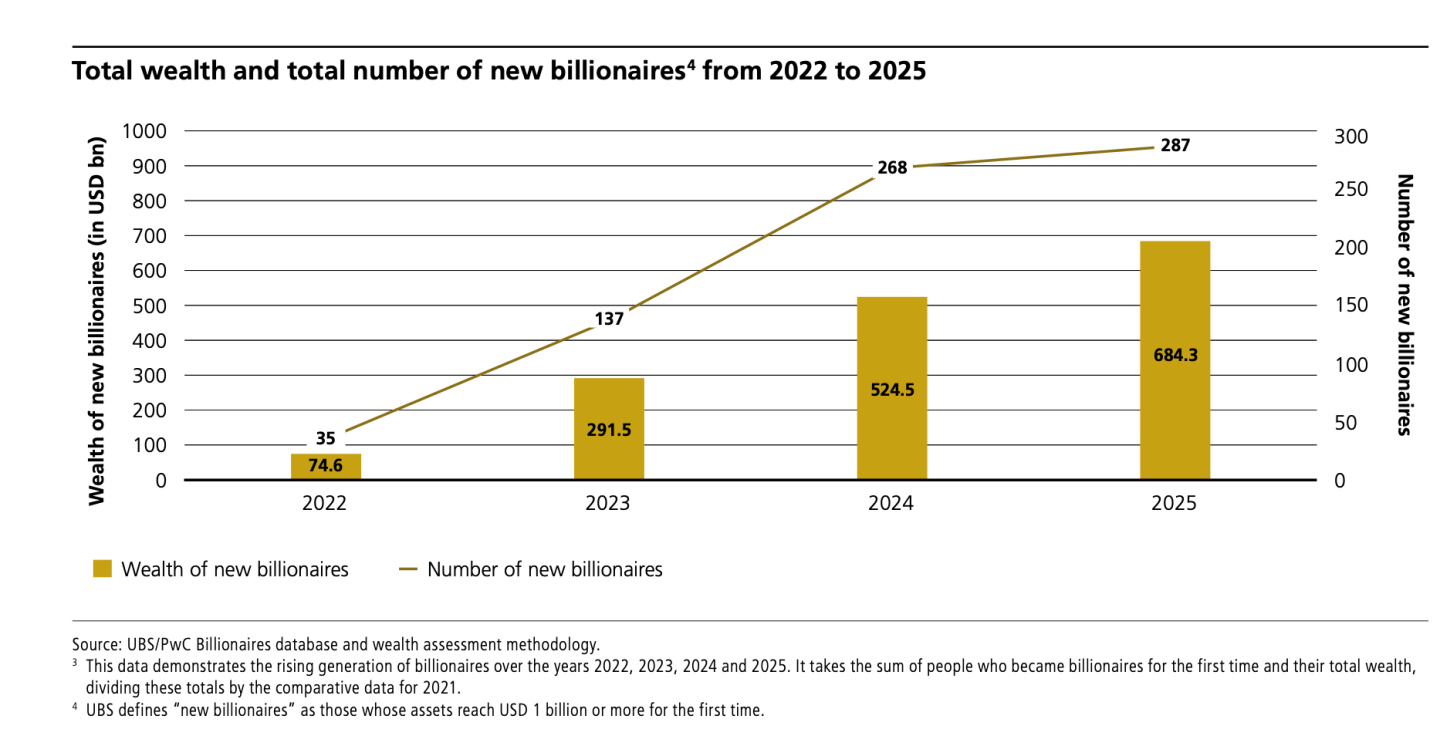
That year, 360 self-made billionaires accounted for $782 billion, an “exceptional rise [that] resulted from asset price appreciation in a period of ample financial liquidity following the COVID-19 pandemic.” The result in 2025 was more down to “widespread business creation,” UBS added. The report found the number of new billionaires minted annually increased roughly eightfold from 35 in 2022 to 287 in 2025, while their assets have grown by roughly ninefold, from $74.6 billion to $684.3 billion.
The coming transfer of wealth

While U.S. entrepreneurs are busy creating new wealth, the long-anticipated “great wealth transfer” is accelerating. Globally, at least $5.9 trillion is expected to be inherited by billionaire children over the next 15 years. Of that amount, at least $2.8 trillion will pass to U.S. heirs over this period. This calculation is likely conservative as it does not factor in future appreciation of asset values.

The report highlights that families are becoming increasingly international as the wealth transfer intensifies, yet the inheritance itself is set to be concentrated in a small number of markets, with the U.S. leading the way.

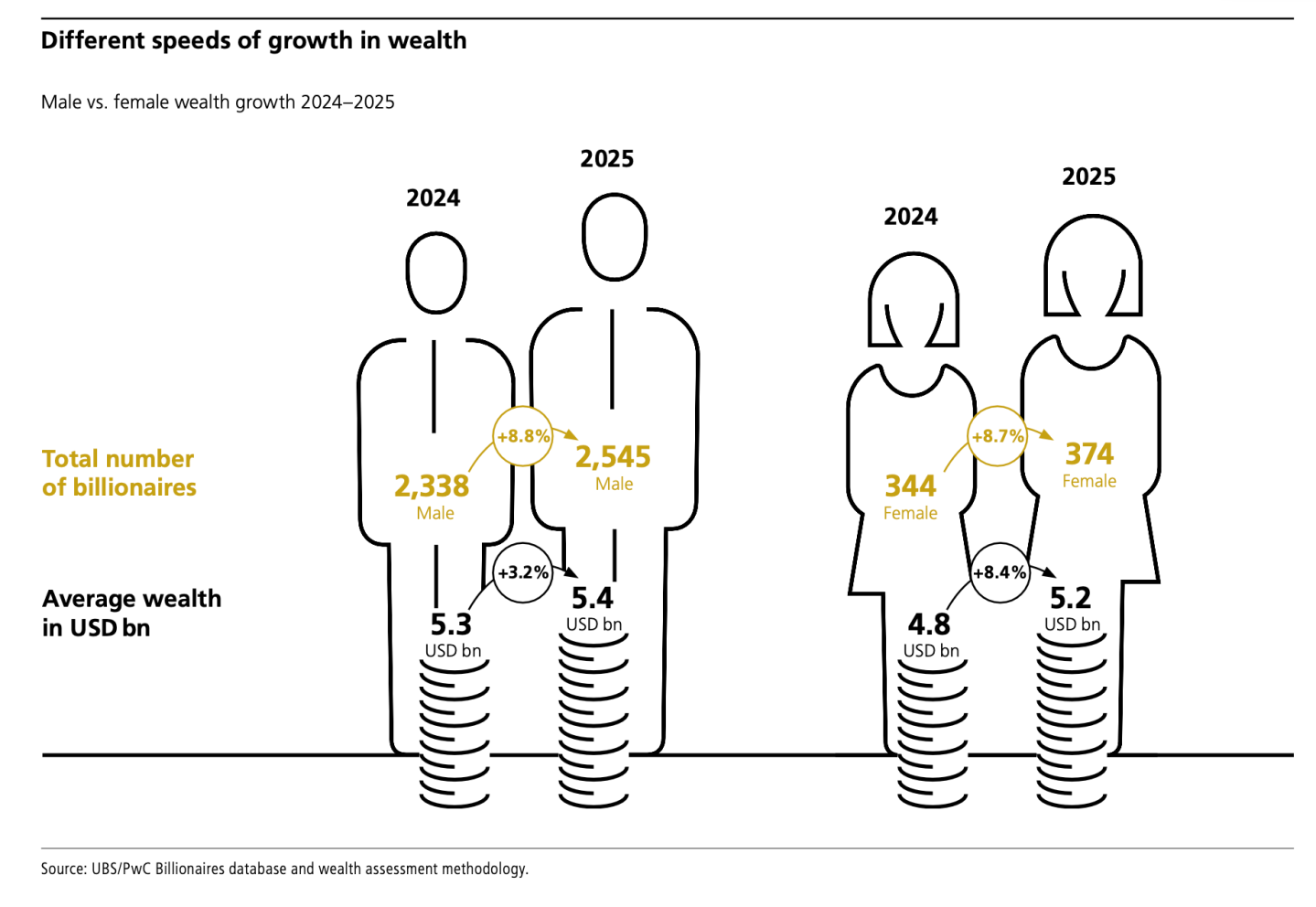
Female billionaires made notable progress in 2025, according to the report. While there are only 374 female billionaires globally, compared with 2,545 male, their average wealth grew by 8.4% to $5.2 billion in 2025, more than twice the 3.2% average growth rate for men. This is part of a trend, with the average wealth of female billionaires rising at a faster rate for each of the four years since 2022. In part, this is driven by inheritance, with more women becoming billionaires through inheritance than any other way in 2025. Of the 43 women who became billionaires in the year, UBS found that 27 inherited while 16 were self-made.
Despite the vast sums set for inheritance, surveyed billionaires expressed a strong desire for their children to achieve success independently. More than eight in 10 (82%) of those surveyed hope their children will develop the necessary skills and values to succeed without relying solely on the inherited fortune. Over half (55%) also want their heirs to use their wealth to make a positive impact on the world.

Furthermore, billionaires are highly mobile, with 36% of those surveyed having relocated at least once, and a further 9% considering a move. The top three reasons for relocation are linked to better quality of life (36%), geopolitical concerns (36%), and organizing tax affairs more efficiently (35%). This high level of mobility could potentially alter the geographic picture of where wealth is ultimately transferred.

The report was generated in part through an online survey of 87 billionaire clients as well as in-depth interviews which took place over several weeks in September and October.


Source link

Continue Reading

Business

‘This isn’t what Walt and Roy would have wanted’: Disney fans with disabilities sue over new ride restrictions


Published

on


Changes that Disney made to a popular program that lets qualifying disabled people skip long lines at its California and Florida theme parks are too restrictive, disabled fans contend in a federal lawsuit and shareholder proposal that seek to expand eligibility.

The battle over who can skip long lines on popular rides because of their disabilities marks the latest struggle by Disney to accommodate disabled visitors while cracking down on past abuses. But some Disney fans say the company has gone too far and has no right to determine who is disabled.

“This isn’t right. This isn’t what Walt and Roy would have wanted,” said Shannon Bonadurer, referring to the Disney brothers who founded the entertainment empire. Despite being unable to wait for long periods of time in the heat because she uses an ileostomy bag, Bonadurer was denied a pass for the disability program.

In a statement, Disney said it was committed to providing a great experience to all visitors, particularly those with disabilities who may require special accommodations.

Here’s a look at changes to Disney parks’ policies for disabled visitors.

What is the disability program?

The Disability Access Service, or DAS, program allows pass-holders and their immediate family members to make an online reservation for a ride while in the park and then get into an expedited line that typically takes about 10 minutes when it’s their time to go on the ride. DAS guests never have to wait in normal standby lines, which on the most popular attractions can be two hours or more.

The DAS program started in 2013 in response to past abuses by disabled “tour guides” who charged money, sometimes hundreds of dollars, to accompany able-bodied guests, enabling such guests to go to the front of lines. Disney says the DAS program needed changing because it had grown fourfold. Before last year’s changes, the percentage of guests having DAS passes jumped from around 5% to 20% over the past dozen years “and showed no signs of slowing,” the company said in court papers.

Disney parks make other accommodations for disabled visitors, including maps in Braille, a device that helps transfer visitors from wheelchairs to ride seats, quiet break locations and American Sign Language interpreters for some live shows. The parks permit some service animals on rides and allow some disabled guests to leave a line and rejoin their party before boarding a ride.

Who qualifies now?

Disney narrowed the scope from people with a wider range of disabilities to mostly guests who “due to a developmental disability such as autism or similar” have difficulties waiting in a long line. Under the changes, guests seeking a DAS pass must be interviewed via video chat by a Disney worker and a contracted medical professional who determine if the person is eligible. Visitors found to have lied can be barred from the parks.

Some people with disabilities who have been denied say the new policy is too restrictive. Not only was Bonadurer denied a pass, but so was her 25-year-old son, who is blind and has cerebral palsy and autism.

“They are making a determination about whether you’re disabled enough,” said Bonadurer, a professional travel adviser from Michigan. “I would love to wait in line with everyone else, and so would my son, since that would mean he has a normal life. But we don’t, and unfortunately for us, we need adaptations to how we wait.”

Disney says the Americans with Disabilities Act doesn’t require equal treatment of people with varying disabilities. The company accommodates those visitors who don’t meet the new DAS criteria with alternatives, Disney said in court filings responding to a federal lawsuit in California.

“For example, in a crowded movie theater, a person using a wheelchair may be entitled to priority seating even if they arrive shortly before the movie starts, while a deaf person may only be entitled to a seat with closed captioning,” the company said.

At Disney’s main theme park rival, Universal, disabled visitors can get shorter lines if they have a card issued by an international board that certifies venues for their accessibility.

What’s next?

A shareholder proposal submitted on behalf of DAS Defenders, an advocacy group of Disney fans opposed to the DAS changes, calls on the company next year to commission an independent review of its disability policies and publicly release the findings. The shareholder proposal claims the change to the DAS program has contributed to lower park attendance.

Disney’s attorneys told the Securities and Exchange Commission in a November letter that it intends to block the proposal ahead of the company’s 2026 shareholder meeting, saying it was false and misleading about the reasons for an attendance decline, which the company attributed to hurricanes. The company also argued the shareholder proposal amounts to micromanaging day-to-day operations.


Source link

Continue Reading

Trending

Copyright © Miami Select.