
Politics
Evan Power at RNC meeting calls for Florida’s election integrity laws to be adopted nationwide
The days of weekslong recounts and razor-thin statewide margins seem to be a thing of the past for the Republican Party of Florida (RPOF). But as the party holds maybe its greatest level of influence ever, state GOP Chair Evan Power said the party’s work is far from done.
At a meeting of the Republican National Committee (RNC) in Atlanta, Power, shortly before leading the Pledge of Allegiance at a luncheon with Vice President JD Vance, discussed the role of the Sunshine State in national politics. Power will cast a vote Friday to make Florida Republican National Committeeman Joe Gruters the new Chair of the RNC, but that one vote represents but a piece of the influence now enjoyed by the Florida GOP.
“We’ve been given a little more influence and given a lot of respect,” Power said. “People see what we’ve done in Florida, and the Florida model works, and they want to replicate that. We have a lot of people who ask for our advice in some of these states that are trying to replicate what we did, and we’re happy to do it.”
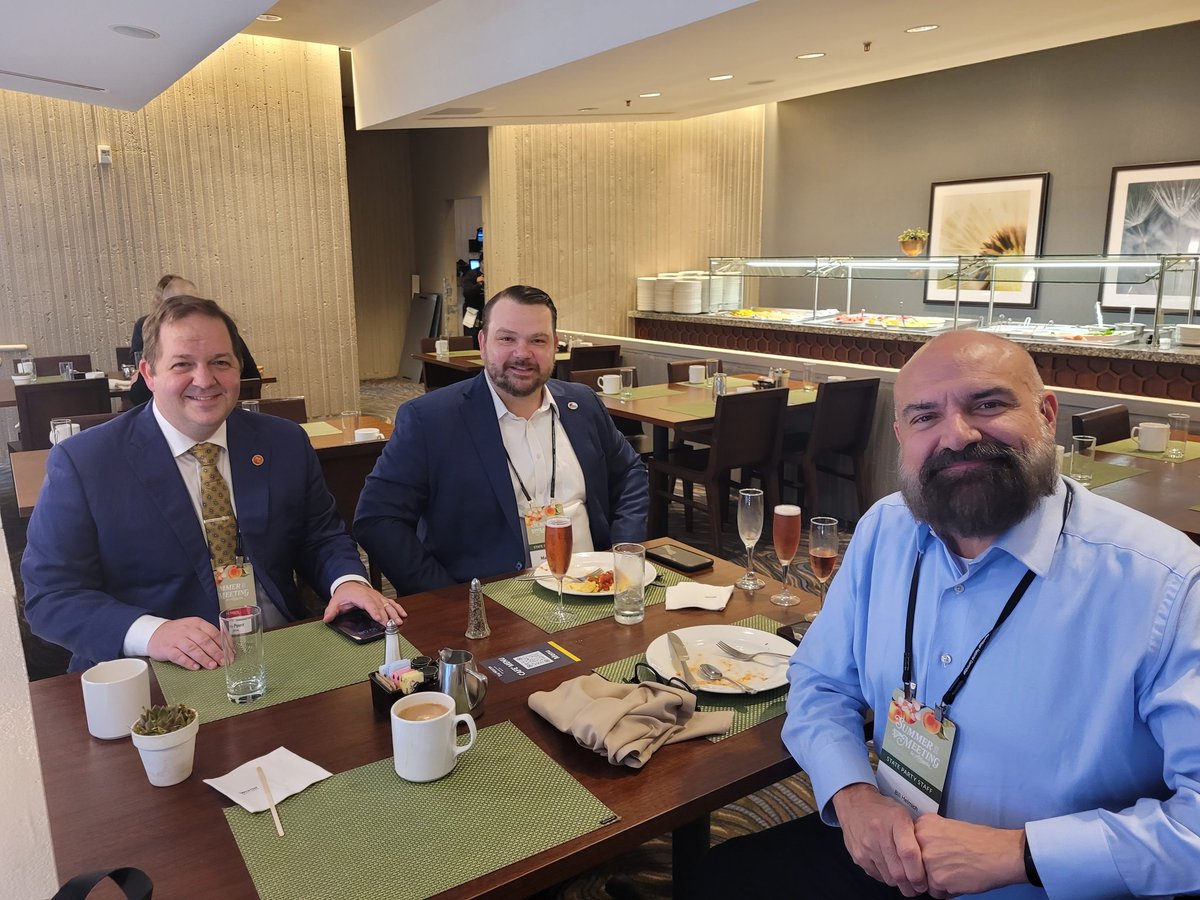
At an Atlanta hotel breakfast bar, Power shared a table with RPOF Executive Director Bill Helmich and Illinois Republican Party Executive Director Matt James. While James faces a different environment in deep-blue Prairie State, he said he has been eager to import Sunshine State policies to Chicago. The party there recently brought in U.S. Rep. Byron Donalds, a candidate for Florida Governor, to raise money for the Illinois GOP.
It’s not just booming voices but solid practices that James hopes to imitate.
“After talking with the Florida team and some of these other states here at the RNC, our fundraising has gone up, I won’t say exponentially, but it has gone up at a much more rapid rate than I had anticipated,” James said.
Florida Republicans, of course, haven’t hurt for money in many years. The party as of July had more than $238 million in cash on hand while the Florida Democratic Party’s most recent fundraising report showed the party in the red $5 million.
But Power also sees the party leading in other ways. A quarter century after the infamous 2000 Presidential Election, Power and Helmich both point to Florida’s election integrity statutes as a “gold standard” other states should follow. Power notes that many of the election laws were passed since 2018, when Gruters served as RPOF Chair and as a member of the Florida Senate.
“In 2018, for instance, we all thought Governor (Ron) DeSantis won, and we won Matt Caldwell’s (Agriculture Commissioner) race too, and we saw over the course of the next 24 hours those votes dwindle, and all tended to be from two counties that were run by Democrat Supervisors of Elections,” Power recalled. “So we have strengthened the Florida law based on that.”
Ultimately, DeSantis won his election by some 30,000 votes while Caldwell that year lost to Democrat Nikki Fried by about 7,000 votes.

Does Power believe that Fried, now the Florida Democratic Party Chair, won the election illegitimately?
“I think that there was fraud. I think that’s why two Supervisors ended up getting removed. They weren’t following the rules,” Power said, referencing the removal of Palm Beach Supervisor of Elections Susan Bucher and resignation of late Broward Supervisor of Elections Brenda Snipes.
“So I think, you know, obviously that was a close race. I don’t know if she (Fried) would have won or not won, but there were places we needed to clean up, because there’s evidence in court cases that things were not followed in the law.”
The most important reforms since, Power said, involved timely reporting, which became law after that election.
“The most important piece of our election integrity is the fact that the Supervisors, within 30 minutes, have to turn over the full number of ballots that they have on hand,” he said. “When those ballots come in late, I understand the human temptation, but the longer they sit there, the closer the race it is, human nature says, well, I can add those to them. But we have that safeguard in Florida so that you’re not having those problems.”
Helmich said that’s a preferable system to many blue states like California, where close elections routinely take weeks to call.
“In California, they’re taking one, two, three, four weeks to tell you who wins a congressional race. And oftentimes it seems, the longer these things go on and the more ballots that magically appear, it often seems to favor one party over another,” Helmich said.
“It’s inherently obvious to the most casual observer. So literally, we think most states, if not the entire nation, should take Florida’s election laws and just transpose them into their statutes, and then we’ll have fair elections, and then let the candidates have the battles and let the voters decide.”
President Donald Trump has also railed about election security, most recently calling for an end to mail-in voting. Those ballots in recent years have favored Democrats, and in states where those can be collected days after Election Day, that often has helped to swing the elections in California and other places.
But Power said Florida does vote-by-mail right as well. Indeed, the Florida GOP pioneered the practice of chasing absentee votes, even if Democrats now have adopted the practice as well. Florida notably doesn’t accept ballots by mail after polls close on Election Day, even if they are postmarked before polls open.
“I understand the President’s frustration, because you look at places like California and Arizona, they count for weeks. And I’m not saying there is or isn’t, but even if there is not fraud, just the counting for several weeks and the results changing in the last couple of days raises suspicion and makes people question the integrity of that ballot,” Power said.
“In Florida, we’ve been doing it correctly. But I understand the President’s frustration from a party standpoint. I’m going to chase voters by the rules that are in place. And so that’s a legislative decision, and I’ll deal with the ramifications of whatever the Legislature decides to do.”
The meeting in Atlanta also takes place as multiple states, including Florida, consider a mid-decade redistricting of congressional lines. Power sees potential gains from that.
“I think we’re going to get to a fairer map than we have now that the courts have ruled that we don’t have to gerrymander to get Democrat outcomes, and we can reject the Democrat maps drawn by judges. We can get to fairer maps, which mean more Republicans,” he said.
While the Florida Supreme Court in 2015 threw out a map drawn by the Legislature and put in place one with more competitive seats, the current congressional map was drawn by DeSantis’ Office. It was recently upheld by a more conservative court. But is that GOP-crafted map unfair to Republicans?
“It could be improved on. It’s a fair map. But there are still some of those gerrymanders in South Florida that are drawn to create districts for the liberals,” Power said.
“South Florida is a key area where there are districts that do not look like they’re not drawn for (racial) intent, and I think we could straighten those out. It’s more like when you draw those fair, it puts (Democratic U.S. Rep. Jared) Moskowitz in play. It puts (Democratic U.S. Rep.) Debbie Wasserman Schultz in play. Because they really don’t represent the people that are in their district. It’s really more Republican there than you would think.”
Post Views: 0