Connect with us

Politics

Miami Beach officials say they’ll fight state order to remove rainbow crosswalk

Published

on


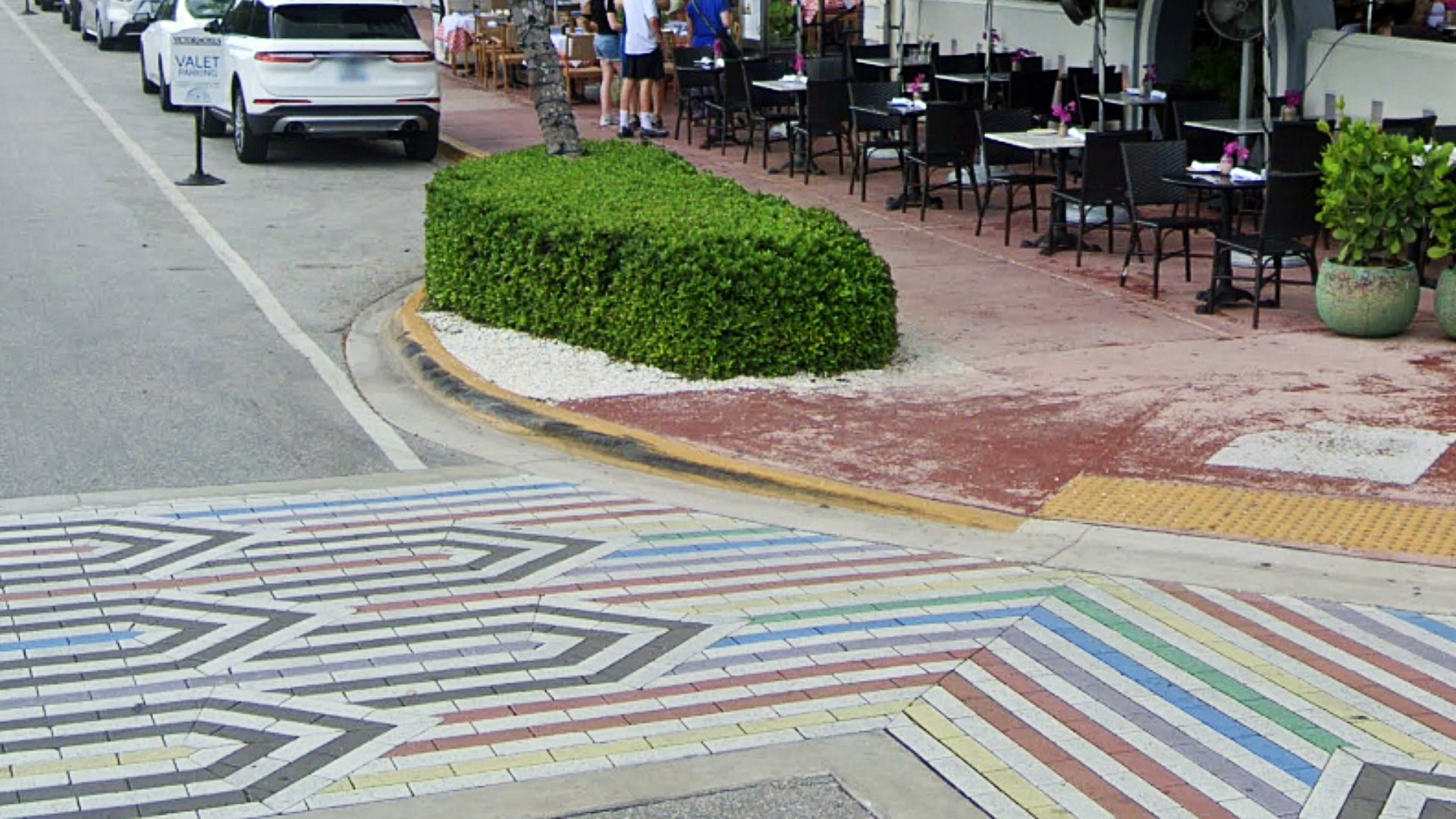
Miami Beach is expected to soon become the latest locality to receive a Florida Department of Transportation (FDOT) order to remove its rainbow roadway markings recognizing the LGBTQ community.

City officials say they won’t comply easily.

Commissioner Joseph Magazine said on Facebook that FDOT informed Miami Beach that the city “must remove all ‘artistic crosswalks,’ specifically the rainbow colored crosswalk on Ocean Drive and 12th Street, which has for so long stood as a welcoming sign to our LGBT community.”

“This is complete and utter bullshit that the state has no business getting involved in,” he said. “I am unequivocal in my support and championing of our LGBT community and that crosswalk was a welcome sign for everyone. It bothered no one.”

Commissioner Alex Fernandez, Miami Beach’s only openly gay elected local official, said he and others at City Hall anticipate receiving formal notice from the state to remove the crosswalk, which was installed in 2018.

The state gave similar orders recently to Delray Beach and Key West, which also plan to fight the mandate.

FDOT has warned that noncompliance beyond Sept. 3 could lead to state funding cuts or direct removal of the markings by the agency.

“As I’ve repeatedly stated, we must appeal this order once it is received and resist. Our Pride crosswalk was properly approved, it is safe, and it reflects the values of inclusion that define Miami Beach,” Fernandez said. “At a time when Floridians face real challenges, this is a distraction and a solution in search of a problem.”

Miami Beach Republican Rep. Fabián Basabe, who voted in 2023 to expand Florida’s restrictions on classroom LGBTQ inclusion to all public school grades, sent Purdue a letter Tuesday requesting a public hearing on the matter.

“My LGBTQ community in particular has expressed that they constantly feel under attack,” he wrote. “It is important to me that the State listen to these voices directly, in a fair and transparent process that respects everyone who calls Miami Beach home.”

In a separate statement, Basabe called debate over the crosswalk “performative politics … Miami Beach leaders have chosen (to use as) another staged distraction.”

“Instead of working on affordability, safety, and accountability … they want to fight over symbols rather than do the work of fixing what is broken,” he said, adding that the city’s Pride Park is “the appropriate place” for rainbow markings, “not the middle of an active roadway.”

The relatively new state rules stem from a June 30 memo by FDOT Assistant Secretary Will Watts, who wrote that “non-standard surface markings, signage, and signals that do not directly contribute to traffic safety” could jeopardize driver and pedestrian safety.

“Examples of non-compliant surface pavement would include any pavement markings … associated with social, political, or ideological message or images and does not serve the purpose of traffic control,” Watts wrote.

Sharing the memo on X two days later, FDOT Secretary Jared Perdue noted that the rules are supported by guidance President Donald Trump’s administration released July 1 that roads “are for safety, not political messages or artwork” and that Governors should remove any such markings from their streets.

“Great to now have our federal partners also aligned behind this same common-sense policy,” he said.

Other cities are bracing for similar scrutiny. Fort Lauderdale Mayor Dean Trantalis said he expects that FDOT will question his city’s street art, while Wilton Manors officials argue their rainbow bridge artwork shouldn’t be considered noncompliant, since it’s only on the side of the structure.

There are also rainbow crosswalks in Orlando and St. Petersburg. Others in Boynton Beach, Gainesville and West Palm Beach have complied, or are complying, with FDOT’s order.

Magazine said he will file a resolution next month to accept two benches for Lummus Park near the city’s crosswalk for residents to paint “in the same rainbow design.” He vowed to pay for the benches.

“As I will be purchasing the benches, NO taxpayer dollars will be used,” he said. “I already want to take that talking point away.”


Post Views: 0


Source link

Continue Reading

Politics

Gov. DeSantis proposes handing all USF Sarasota-Manatee facilities to New College of Florida

Published

on


Gov. Ron DeSantis is supporting a plan that boots the University of South Florida from its Sarasota-Manatee campus and shifts every building, dorm and facility to New College of Florida, which would mark a dramatic reshaping of Sarasota’s higher education landscape.

The measure, pitched as part of the Governor’s 2026-27 budget proposal, would create a new section of Florida law directing the two institutions to shift all real property, buildings, leaseholds and related liabilities associated with the Sarasota-Manatee campus from USF to New College.

The conforming bill specifies that no students, employees, fund balances, research contracts or grants would be part of the transfer, which applies only to real estate, fixed capital facilities, certain furnishings and any outstanding debts tied to those facilities. It would also guarantee that current USF Sarasota-Manatee students can continue finishing their degrees for up to four more years.

If approved, New College would be required to assume full legal and financial liability for the campus’s outstanding facility debt no later than Oct. 30, 2026. Until that assumption is complete, New College would make monthly payments of $166,617 to USF to cover the debt service. Failure by New College to make those payments would void the transfer and return the facilities to USF.

The real property transfer would need to be completed by July 1, 2026, with specific assets and liabilities identified in a joint agreement approved by both schools’ Boards of Trustees and submitted to the Board of Governors.

The bill includes guiding principles for determining what moves to New College and what remains with USF. Permanently affixed buildings and general classroom furnishings would transfer, while movable equipment, intellectual property, computers assigned to USF personnel, fund balances and items of historical significance to USF would remain with USF.

The bill also requires that existing residential contracts on the Sarasota-Manatee campus be honored by New College through at least Aug. 15, 2027. If the two universities disagree on any aspect of the transfer, the Board of Governors must resolve outstanding issues by Sept. 30, 2026.

The measure includes teach-out protections for USF students who enrolled before the bill takes effect. Those students must receive priority access to classroom and support space in the transferred facilities for up to four academic years to allow them to complete their degrees locally. New College would be required to make that space available to USF free of charge. USF would also be barred from assigning newly admitted students to the Sarasota-Manatee campus as their home campus going forward.

The bill provides civil immunity to both institutions, and their Trustees and employees, for actions taken to comply with the act.

Representatives from New College of Florida and University of South Florida Sarasota-Manatee did not immediately return requests for comment.


Source link

Continue Reading

Politics

Dean Black bill abolishing Nassau County board advances in House

Published

on


This could save the county money.

Nassau County’s government is about to become a bit more streamlined, as an appointed board dormant since 2002 is potentially subject to be wiped off the books completely.

Rep. Dean Black’s legislation (HB 4017) would terminate Nassau County Recreation & Water Conservation & Control Districts on the books since the 1960s, when the Legislature created them by a special act.

There is one such district in ordinance.

Though the board hasn’t done anything in 23 years, removing it from the books purportedly would reduce administrative costs, and would transfer all assets and liabilities of the district to the Nassau County Board of County Commissioners, and protect taxpayers.

“The county has established a municipal service benefit unit, or MSBU, to address drainage issues subsequently. Therefore, the district is no longer functioning or necessary. In a word, it is now obsolete,” Black said.

“The district does not own any land, the district does not have any assets. The district does not currently levy any taxes. It has been inactive since 2002. The repeal of this district would prevent a future board of county commissioners from levying millage rates for what is now a defunct and unnecessary district against the taxpayers of Nassau County.”

The State Affairs Committee is the final committee stop before the House floor.


Source link

Continue Reading

Politics

Gov. DeSantis prioritizes road projects, infrastructure improvements in budget plan

Published

on


Gov. Ron DeSantis is looking to prioritize road construction projects and beef up infrastructure in his 2026-27 budget proposal.

DeSantis is calling for $15.4 billion for the Florida Department of Transportation (FDOT) in addition to $14.3 billion for the State Transportation Work Program, which handles construction and maintenance of Florida’s roads, bridges, rails, seaports and other public transportation systems.

Speaking at a budget press conference in Orlando, DeSantis said his proposal provides “major support for infrastructure and transportation.”

“Over $14 billion for our state work program — that more than funds everything we need to do,” DeSantis said as he unveiled a $117 billion proposed spending plan ahead of the upcoming Legislative Session.

The fully released budget plan gives more detail on how DeSantis wants to carry out his priorities.

The Governor wants to allocate $4.9 billion for highway construction and maintenance. That entails constructing 181 new lane miles, $1.4 billion for resurfacing 2,622 lane miles, about $873 million for repairing 38 bridges and replacing 21 others. In addition, DeSantis wants to allocate about $204 million for community trail projects.

DeSantis is also pushing for investments to be made at the state’s airports and seaports.

Under DeSantis’ plan, aviation improvements would get nearly $389 million and seaports could receive nearly $156 million for infrastructure upgrades.

“I don’t think you’re going to find another state that’s doing more meaningful things on transportation” and other issues while also maintaining a “stable budget,” DeSantis said at his budget press conference.

The state’s growing space industry would also benefit from DeSantis’ budget proposal which allocates $93 million through the FDOT Spaceport Improvement Program and $10 million for the Aerospace Investment Fund to help recruit companies to the state.

“As Florida’s space industry continues to reach new heights, infrastructure needs along the Space Coast will continue to be a priority, which is why the budget includes $5 million in startup funding to Space Florida to work alongside state agencies to establish additional wastewater capacity for Florida’s commercial launch providers,” DeSantis’ budget proposal added.

“These proposed investments are in addition to the nearly $700 million in funding through the FDOT Work Program to improve community infrastructure in Brevard, Indian River, and Volusia counties.”


Source link

Continue Reading

Trending

Copyright © Miami Select.