Connect with us

Business

‘This is the Cuban Missile Crisis in space’: Russia is building a space nuke that could wipe out every satellite in orbit, U.S. warns

Published

on


As Russia held its Victory Day parade this year, hackers backing the Kremlin hijacked an orbiting satellite that provides television service to Ukraine.

Instead of normal programing, Ukrainian viewers saw parade footage beamed in from Moscow: waves of tanks, soldiers and weaponry. The message was meant to intimidate and was an illustration that 21st-century war is waged not just on land, sea and air but also in cyberspace and the reaches of outer space.

Disabling a satellite could deal a devastating blow without one bullet, and it can be done by targeting the satellite’s security software or disrupting its ability to send or receive signals from Earth.

“If you can impede a satellite’s ability to communicate, you can cause a significant disruption,” said Tom Pace, CEO of NetRise, a cybersecurity firm focused on protecting supply chains.

“Think about GPS,” said Pace, who served in the Marines before working on cyber issues at the Department of Energy. “Imagine if a population lost that and the confusion it would cause.”

Satellites are the short-term challenge

More than 12,000 operating satellites now orbit the planet, playing a critical role not just in broadcast communications but also in military operations, navigation systems like GPS, intelligence gathering and economic supply chains. They are also key to early launch-detection efforts, which can warn of approaching missiles.

That makes them a significant national security vulnerability, and a prime target for anyone looking to undermine an adversary’s economy or military readiness — or deliver a psychological blow like the hackers supporting Russia did when they hijacked television signals to Ukraine.

Hackers typically look for the weakest link in the software or hardware that supports a satellite or controls its communications with Earth. The actual orbiting device may be secure, but if it’s running on outdated software, it can be easily exploited.

As Russian forces invaded Ukraine in 2022, someone targeted Viasat, the U.S.-based satellite company used by Ukraine’s government and military. The hack, which Kyiv blamed on Moscow, used malware to infect tens of thousands of modems, creating an outage affecting wide swaths of Europe.

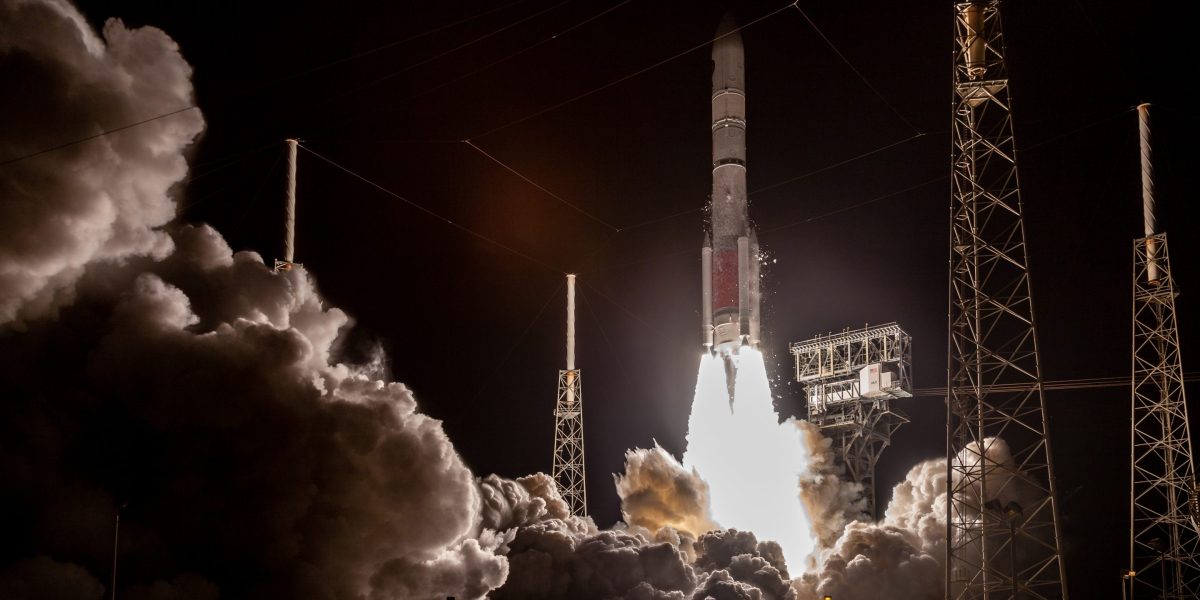
National security officials say Russia is developing a nuclear, space-based weapon designed to take out virtually every satellite in low-Earth orbit at once. The weapon would combine a physical attack that would ripple outward, destroying more satellites, while the nuclear component is used to fry their electronics.

U.S. officials declassified information about the weapon after Rep. Mike Turner, R-Ohio, issued a public warning about the technology. Turner has pushed for the Department of Defense to provide a classified briefing to lawmakers on the weapon, which, if deployed, would violate an international treaty prohibiting weapons of mass destruction in space.

Turner said such a weapon could render low-Earth orbit unusable for satellites for as long as a year. If it were used, the effects would be devastating: potentially leaving the U.S. and its allies vulnerable to economic upheaval and even a nuclear attack.

Russia and China also would lose satellites, though they are believed to be less reliant on the same kinds of satellites as the U.S.

Turner compared the weapon, which is not yet ready for deployment, to Sputnik, the Russian satellite that launched the space age in 1957.

“If this anti-satellite nuclear weapon would be put in space, it would be the end of the space age,” Turner said. “It should never be permitted to go into outer space. This is the Cuban Missile Crisis in space.”

Mining the moon and beyond

Valuable minerals and other materials found on the moon and in asteroids could lead to future conflicts as nations look to exploit new technologies and energy sources.

Acting NASA Administrator Sean Duffy announced plans this month to send a small nuclear reactor to the moon, saying it’s important the U.S. does so before China or Russia.

“We’re in a race to the moon, in a race with China to the moon,” Duffy said. “To have a base on the moon, we need energy and some of the key locations on the moon. … We want to get there first and claim that for America.”

The moon is rich in a material known as helium 3, which scientists believe could be used in nuclear fusion to generate huge amounts of energy. While that technology is decades away, control over the moon in the intervening years could determine which countries emerge as superpowers, according to Joseph Rooke, a London-based cybersecurity expert who has worked in the U.K. defense industry and is now director of risk insights at the firm Recorded Future.

The end of the Cold War temporarily halted a lot of investments in space, but competition is likely to increase as the promise of mining the moon becomes a reality.

“This isn’t sci-fi. It’s quickly becoming a reality,” Rooke said. “If you dominate Earth’s energy needs, that’s game over.”

China and Russia have announced plans for their own nuclear plants on the moon in the coming years, while the U.S. is planning missions to the moon and Mars. Artificial intelligence is likely to speed up the competition, as is the demand for the energy that AI requires.

Messages left with Russia’s Embassy in Washington were not returned.

Despite its steps into outer space, China opposes any extraterrestrial arms race, according to Liu Pengyu, a spokesperson for China’s Embassy in Washington. He said it is the U.S. that is threatening to militarize the final frontier.

“It has kept expanding military strength in space, created space military alliances, and attempted to turn space into a war zone,” Liu said. “China urges the U.S. to stop spreading irresponsible rhetoric, stop expanding military build-up in space, and make due contribution to upholding the lasting peace and security in space.”

What the US is doing about security in space

Nations are scrambling to create their own rocket and space programs to exploit commercial prospects and ensure they aren’t dependent on foreign satellites. It’s an expensive and difficult proposition, as demonstrated last week when the first Australian-made rocket crashed after 14 seconds of flight.

The U.S. Space Force was created in 2019 to protect American interests in space and to defend U.S. satellites from attacks from adversaries.

The space service is far smaller than the more well-established services like the Army, Navy or Air Force, but it’s growing, and the White House is expected to announce a location for its headquarters soon. Colorado and Alabama are both candidates.

The U.S. military operates an unmanned space shuttle used to conduct classified military missions and research. The craft, known as the X-37B, recently returned to Earth after more than a year in orbit.

The Space Force called access to space a vital national security interest.

“Space is a warfighting domain, and it is the Space Force’s job to contest and control its environment to achieve national security objectives,” it said in the statement.

American dominance in space has been largely unquestioned for decades following the end of the Cold War and the fall of the Soviet Union. But the new threats and competition posed by Russia and China show the need for an aggressive response, U.S. officials say.

The hope, Turner said, is that the U.S. can take steps to ensure Russia and China can’t get the upper hand, and the frightening potential of space weapons is not realized.

“You have to pay attention to these things so they don’t happen,” Turner said.


Source link

Continue Reading

Business

Craigslist founder signs the Giving Pledge, and some of his fortune will go to a pigeon rescue

Published

on


Of the wealthiest people in the world, about 250 have pledged to give away the majority of their fortune—an effort coined the Giving Pledge. It was started by Bill Gates, Melinda French Gates, and Warren Buffett in 2010, and billionaires including Mark Zuckerberg, Elon Musk, Larry Ellison, and Bill Ackman have signed on. 

Although it’s often also referred to as the “Billionaire’s Pledge,” other wealthy donors have committed to the endeavor. One of the latest signatories is Craigslist founder Craig Newmark, who announced on LinkedIn this weekend he’s officially joining the Giving Pledge.

“Okay, I’ve formally signed up for the Giving Pledge, sometimes considered the Billionaire’s Pledge, though I’ve never been a billionaire, particularly after I gave away all my Craigslist equity to my charitable foundation,” Newmark wrote. “Seems like a good way to officially enter my middle seventies, which I’ve done today.”

Newark built his fortune by founding popular online marketplace Craiglist in 1995. It started as an email list for local San Francisco residents, but turned into an online classifieds page the following year. Today, Craigslist is estimated to be worth about $3 billion

“This all feels like a follow up to my decision in early 1999 to monetize Craigslist as little as possible,” Newmark said of signing Giving Pledge. “The best estimate so far is that I turned down around $11B that bankers and VCs wanted to throw at me. I still made plenty after that.”

In 2020, Forbes estimated Newmark’s net worth at $1.3 billion, although in 2022 he said he’d give away most of his fortune to charitable causes. There aren’t more recent estimates of his net worth, but he emphasized in his LinkedIn post he is not a billionaire.

His foundation, Craig Newmark Philanthropies, mostly supports cybersecurity and veterans causes. And in his post committing to the Giving Pledge, Newmark said he’d continue making similar donations. 

“My focus is where I can do some actual good in neglected areas, like for military families and vets, like fighting cyberattacks and preventing scams,” he wrote. “Also, a little for pigeon rescue.”

Wait, what?

Newmark is also dedicated to rescuing pigeons. 

“I love birds, have a sense of humor, and I suspect that pigeons may become our replacement species,” he told the Associated Press in 2023.

His favorite neighborhood pigeon is named Ghostface Killah, who is featured in a painting on his mantle at home. 

He said he developed his love for pigeons in the mid-1980s when he lived in Detroit. Pigeons are “the underdog,” he told NYU’s student newspaper Washington Square News

“They’re the grassroots, most prominent bird and possibly our successor species,” Newmark said. “But pigeons are, well, I identify with them as well. I grew up with no money, living across the street from a junkyard.”

Early this year, Newmark donated $30,000 to San Francisco-based pigeon rescue Palomacy, which was the largest donation the organization had ever received. 

“Craig Newmark is many things: the founder of craigslist, an ‘accidental entrepreneur,’ a self-proclaimed old-school nerd, a full-time philanthropist and a life-long lover of pigeons,” Palomacy said in January. “We so appreciate the support they provide our feathered friends.”

With Newmark’s donation, Palomacy can continue to “save hundreds of pigeons and doves through hands-on rescue, rehabilitation, and rehoming in Northern California,” according to the organization. “We are reversing the unfair stigma against pigeons and showing the world they deserve our respect and protection.”

Recent criticisms of the Giving Pledge

Although there undoubtedly are some billionaires and other high-net-worth individuals who are genuinely committed to the Giving Pledge, there has been recent criticism many of the signatories aren’t living up to the pledge. Even Melinda French Gates, one of its founders, recently said people could be doing more. 

“Have they given enough? No,” she said in a recent interview with Wired.

Treasury Secretary Scott Bessent last week also called the Giving Pledge a failure—but for different reasons. He said it was “well intentioned,” but was “very amorphous” and claimed wealthy people made the commitment out of fear that the public would “come at it with pitchforks.” Bessent also pointed out that not many billionaires have actually delivered on their promise to donate their fortunes. 

Warren Buffett, another Giving Pledge founder, also recently admitted he had to rethink some of his original philanthropic plans.

“Early on, I contemplated various grand philanthropic plans. Though I was stubborn, these did not prove feasible,” he wrote in a recent letter to shareholders. “During my many years, I’ve also watched ill-conceived wealth transfers by political hacks, dynastic choices, and, yes, inept or quirky philanthropists.” 

Several studies have also poked holes in the Giving Pledge, showing how it’s benefitted billionaires by presenting themselves as generous and public‑spirited, but doesn’t question inequalities and tax rules that led to such massive wealth in the first place.

The Institute for Policy Studies (IPS) argues the Giving Pledge is “unfulfilled, unfulfillable, and not our ticket to a fairer, better future.” 

To be sure, many wealthy signatories like Newmark appear to be genuinely committed to the cause. 

“Like I say, a nerd’s gotta do what a nerd’s gotta do, and a nerd should practice what he preaches,” Newmark wrote over the weekend.


Source link

Continue Reading

Business

Nvidia CEO Jensen Huang urges a return to factory careers: ‘Not everyone needs a PhD’

Published

on


“We want to re-industrialize the United States. We need to be back in manufacturing,” Huang said recently on theJoe Rogan Experience podcast. “Every successful person doesn’t need to have a PhD. Every successful person doesn’t have to have gone to Stanford or MIT.”

Huang believes more Americans need to take on manufacturing gigs—not just to pivot to where the work will be in the age of AI, but also because the entire industry could be at risk. As much as the thought of U.S. citizens heading back into factories may seem like a back-track, he said it impacts the nation’s ability to remain prosperous and build AI companies like his.

“If [the] the United States doesn’t grow, we will have no prosperity,” Huang continued. “We can’t invest in anything domestically or otherwise—we can’t fix any of our problems. If we don’t have energy growth, we can’t have industrial growth. If we don’t have industrial growth, we can’t have job growth. It’s as simple as that.”

“If not for [Trump’s] pro-growth energy policy, we would not be able to build factories for AI, not be able to build chip factories, we surely won’t be able to build supercomputer factories. None of that stuff would be possible without all of that. Construction jobs would be challenged, electrician jobs—all of these jobs that are now flourishing, would be challenged.”

Lutnick’s intergenerational manufacturing push amid talent shortages

As the cofounder and leader of the world’s most valuable company, Huang has a peek under the hood of America’s changing workforce dynamic. The CEO of the $4.53 trillion chip giant has a direct line to U.S. President Donald Trump and Secretary of Commerce Howard Lutnick, who are determined to bring U.S. manufacturing back to its glory days. 

The Trump administration is pressing for American self-reliance while curbing immigration, leading officials like Lutnick to push for an intergenerational manufacturing boom. He even framed it as a step into the future, not a stumble back into the past. 

For example, Lutnick claimed that technician jobs are promising gigs with a low barrier to entry, that can pay anywhere between $70,000 to $90,000 at the onset—no college degree required. 

“It’s time to train people not to do the jobs of the past, but to do the great jobs of the future,” Lutnick toldCNBC earlier this year. “This is the new model, where you work in these plants for the rest of your life, and your kids work here, and your grandkids work here.”

It’s an appealing proposition: avoid college debt and earn more than the average U.S. worker, all while having stability during an AI jobs wipeout. Yet many manufacturing roles have been left unfilled, despite the sector continuing to grow. 

Employment in the manufacturing surpassed pre-pandemic levels, standing at about 13 million jobs as of January 2024, according toDeloitte. It was estimated that the need for human workers in manufacturing could stand at around 3.8 million, but over half of these jobs—around 1.9 million—could remain unfilled if skill gaps aren’t addressed and the tune on the jobs doesn’t change. 

After all, only 14% of Gen Zers said they’d consider industrial work as a career, according to a 2023 study from Soter Analytics. There are a few concerns holding them back: they believe the industry doesn’t offer work flexibility, and the conditions are unsafe.

Huang even believes robots will create new jobs for humans

Huang has hope for the future of jobs, even as robot employees step onto the scene—and it’ll give yet another boost to factory jobs. 

Some tech leaders, like Tesla CEO Elon Musk, are already developing their own fleets of autonomous workers; Musk predicted his company’s Optimus humanoid robots will be used internally within Tesla by the end of 2025, and the following year, other companies will have the tech in their hands. 

It’s assumed that these robots will take over the work of employees, leaving humans high and dry—but Huang is optimistic that the tech will create new opportunities, especially for technicians.

“I’m super excited about the robots Elon’s working on. It’s still a few years away. When it happens, there’s a whole new industry of technicians and people who have to manufacture the robots,” Huang explained in the podcast. 

“You’re going to have a whole apparel industry for robots. You’re going to have mechanics for robots. And you have people who come to maintain your robots.”


Source link

Continue Reading

Business

Mike Bloomberg’s new $50 million mayor bootcamp trains local leaders not to ‘play it safe’

Published

on


Michael R. Bloomberg has believed mayors have plenty to teach each other since he was mayor of New York City and supported the effort to share good municipal ideas through his nonprofit Bloomberg Philanthropies since he left office in 2013.

However, as more nations get bogged down in what the media entrepreneur and philanthropist calls “ideological battles and finger-pointing,” Bloomberg says mayors can do even more. He is expanding his support for them internationally, with the Bloomberg LSE European City Leadership Initiative, a collaboration with the London School of Economics and Political Science and the Hertie School in Berlin. And other philanthropists are investing in building stronger municipal governments to strengthen urban communities.

“Mayors are more important than ever because cities are more important than ever,” Bloomberg told The Associated Press in a statement. “For the first time in the history of the world, a growing majority of the world’s people live in cities – and cities lie at the heart of many of the biggest challenges facing countries, including expanding economic opportunity.”

The new international initiative, established by a $50 million investment from Bloomberg Philanthropies, brings together 30 mayors and 60 senior officials from 17 countries, representing over 21 million residents.

After one meeting in October, some already see the potential.

Oliver Coppard, mayor of South Yorkshire, England, jumped at the chance to work with Bloomberg Philanthropies again. Coppard learned much at the Bloomberg Harvard City Leadership Initiative, which focuses on training American mayors, but offers 25% of its seats to international mayors. And even he was surprised by how much he had in common with the first international class of mayors. They all look for ways to get their organizations to move faster, deal with social media, and communicate better with their communities.

“It was actually really surprising,” Coppard said. “There are a bunch of areas where, we all felt, despite the very different context that we work in, we were facing very similar challenges.”

A ‘show me, not trust me’ moment for mayors

Despite the varying political ideologies and viewpoints from a wide range of countries, Coppard said what united the mayors was a desire to serve their communities better through health care, transportation, and communication.

It’s exactly what James Anderson, head of Government Innovation programs at Bloomberg Philanthropies, hoped they would find. But he says tackling those issues has broader implications that require more philanthropic involvement.

“All of these mayors are recognizing that local governments have become the bulwark for democratic legitimacy,” Anderson said. “They feel the burden of that. And they want new and better ways to rebuild trust and a sense amongst their citizenry that government — local government, in particular — sees them and can respond to their needs in impactful ways.”

Anderson said the mayors also understand they have to show how government works for its community. Public safety, trash pickup and snow plowing have taken on new significance.

“We are in a moment where trust in institutions is very low,” he said. “This is a ‘Show me, not trust me’ moment. And mayors recognize that means they need to govern differently.”

Joseph Deitch, founder of the Elevate Prize Foundation, believes that philanthropy also has to support mayors and their cities differently.

“These days, there’s so much polarization,” he said. “Everyone is defending their corner. So where can we have common ground? I think one of those places is love of our cities.”

Launching Elevate Cities in Miami

To cultivate a stronger bond to those places, Deitch has launched Elevate Cities, a new initiative that both celebrates what makes cities special and convenes community leaders to make them better. The initiative will start in Deitch’s current home with Elevate Miami, though he hopes to expand it quickly to other cities.

In November, Elevate Miami awarded $25,000 unrestricted grants to three different Miami nonprofits to increase their impact on the city. Later this month, there will be a citywide scavenger hunt to introduce Miami residents to nonprofits in the area. And in January, Elevate Miami will launch a contest to write a love song to the city.

Kim Coupounas, Elevate Cities CEO, says that getting people to recognize all the positive things happening around them in their city makes it easier to cultivate civic pride. It also makes it easier for municipal leaders to get support from the community.

“We’re really trying to engage all of the city,” she said. “There’s so much potential and possibility that can come to life because we join hands and recognize what a good place we live in and what more can happen here.”

Bloomberg said he hopes the new Bloomberg LSE European City Leadership Initiative and other programs supporting municipal leaders will help spread good ideas and the diversity of viewpoints needed to try new strategies for their cities.

“If mayors want to do big things, they can’t afford to play it safe,” he said.

_____

Associated Press coverage of philanthropy and nonprofits receives support through the AP’s collaboration with The Conversation US, with funding from Lilly Endowment Inc. The AP is solely responsible for this content. For all of AP’s philanthropy coverage, visit https://apnews.com/hub/philanthropy.


Source link

Continue Reading

Trending

Copyright © Miami Select.