Connect with us

Business

A millennial couple grew their side hustle into a business bringing in $4.5 million a year—here’s how the cofounder would start it again, with nothing
Published

on


Like many Gen Zers today, Audrey Finocchiaro and her then-boyfriend, Sam Lancaster, graduated from college a decade ago and were suddenly struck with harsh reality. The millennials had no money and no career direction—taking up serving and bartending jobs at local restaurants to make ends meet while crashing on her parents’ futon.

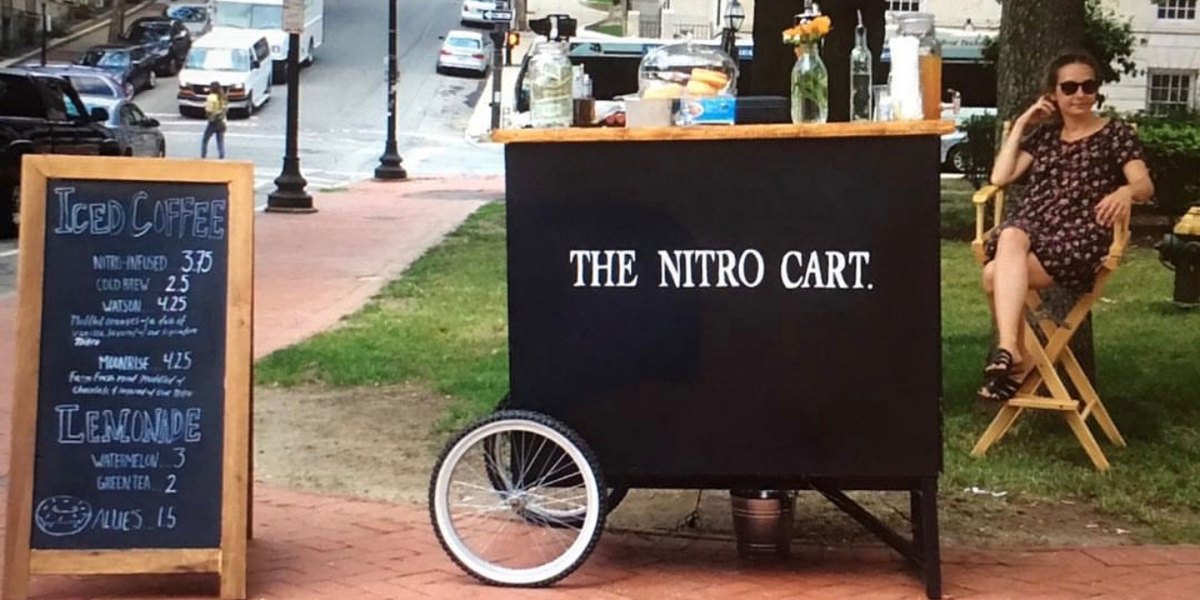
But they soon hatched a plan to get out of their 9-to-5 jobs: start a business by building a coffee cart with nitrogen-infused cold brew.  So they started their own company, The Nitro bar, by maxing out a credit card to get things off the ground.

It was 2016 when the couple leveraged a $1,500 credit limit and scrap wood from Audrey’s parents’ basement to create a “glorified box” that would serve as their prototype. The cofounders packed into the back of Finocchiaro’s Subaru Outback and took off to Providence, Rhode Island. Their first makeshift cart had no electricity, only being able to hold the equipment used to make the cold brew.

To start reeling in customers, the couple would park the cart on city streets and at community events—often unsolicited—to sell their nitrogen-infused cold brew. In those early days, the business brought in $20 to $60 as the couple stood out there for eight hours daily. 

Audrey Finocchiaro

At first, they became disheartened, as it was hard to make any profit at all. After weeks of little business, the couple was ready to throw in the towel. 

But then Lancaster had an epiphany: he realized that they hadn’t brought the cart to Brown University yet. That fall, when college students flocked back to campus, they struck gold. They realized their key audience was a gaggle of Ivy League kids. 

“‘Dude, you’ll never believe it!’” Finocchiaro tells Fortune, recalling what she reported to her boyfriend over the phone. “We just had a line of people. There were all these students, and I remember that day, I think we made like, $600 which was life-changing for us at the time.”

From that day forward, the couple popped up at Brown University every day, as coffee-chugging undergraduates huddled around their cold brew business. From then on, The Nitro Cart started gaining a following on social media, amassing 500,000 followers, while continuing to pop up at events.

But everything changed in the spring of 2017. When Finocchiaro and Lancaster were set up at a farmers’ market in Providence, they were approached by a pair of investors asking how much money they needed to grow. Finnochairo hadn’t thought the cart would turn into a business with bigger potential until that day.

The couple and investors created a spreadsheet together and calculated what The Nitro Cart could grow into based on a projected number of stands and accounts for wholesale customers. They crunched the numbers and said they needed about $150,000.

“The next day, we got that money, which was crazy,” says Finocchiaro. 

Line outside The Nitro Bar coffee shop in Rhode Island

Audrey Finocchiaro

Until then, they’d been brewing their cold brew coffee every night in Audrey’s uncle’s diner. But once the funding rolled in, they immediately set up a production facility and pivoted into wholesale, figuring it was the only way to survive the slow winter months. The money disappeared quickly—largely spent buying a $1,200 kegerator (a small refrigerator designed or adapted to hold a keg from which the cold brew could be dispensed) for each of the 60 wholesale accounts they got on board during their first year.

But The Nitro Cart got its second wind when a local bike shop in Providence offered them 200 square feet of space for $400 a month. They jumped on it, funding their first storefront by taking a steep 30% interest loan through Square.

Business skyrocketed after the loan, and now the Rhode Island coffee company brings in $4.5 million a year in revenue. It also has 80 employees working at its three brick-and-mortar coffee shops, production facility, and small coffee trailer. The company’s cold brew is available on tap at more than 50 other locations across Rhode Island and Massachusetts. 

How TikTok helped turn a coffee cart into a multimillion-dollar business

With over 500,000 followers on TikTok and 130,000 on Instagram, there’s no question social media has been one of the key factors in The Nitro Bar’s continued success—but it didn’t happen overnight. 

“We just threw a ton of things at a wall and kept going until we found something that stuck,” Finocchiaro says. “And for us, that took I think it was seven years until we really started to gain a significant following online.”

But today, she admits building out a following on social media is more important than ever. Her advice for new creators is simple: make a running list of ideas in your notes app, post multiple times a day, and stick to a routine to build momentum.

“I think it’s an incredible time to start a business, because it can cost $0 to start,” Finnochario says. “ You can have no money and start a TikTok or start an Instagram account. That was monumental for us.”

The Nitro Bar’s posts include trends of trying different coffee combinations, hacks on what to order, and sampling their favorite menu items. “How lucky are we to be alive at the same time as blueberry banana lattes,” one of the videos is captioned. It’s racked up 80,000 likes.

Ignoring boomers and friends helped get the business off the ground

Finocchiaro learned quickly who she wanted to share her business ideas with. “Ignore the boomers or your friends in sales,” she explained on TikTok. 

“The second you tell someone who isn’t an entrepreneur what you want to do, they start questioning everything—‘Why a coffee shop? There’s already a million of them,’ or ‘If it were that easy, everyone would do it,’” she says. 

Instead of letting doubt creep in from people who don’t understand the risks and mindset required to start something from scratch, she advises limiting those conversations altogether and suggests replying that you’re investing in the business for the long game and betting on yourself gives you a higher return.


Source link

Continue Reading

Business

Mike Bloomberg’s new $50 million mayor bootcamp trains local leaders not to ‘play it safe’

Published

on


Michael R. Bloomberg has believed mayors have plenty to teach each other since he was mayor of New York City and supported the effort to share good municipal ideas through his nonprofit Bloomberg Philanthropies since he left office in 2013.

However, as more nations get bogged down in what the media entrepreneur and philanthropist calls “ideological battles and finger-pointing,” Bloomberg says mayors can do even more. He is expanding his support for them internationally, with the Bloomberg LSE European City Leadership Initiative, a collaboration with the London School of Economics and Political Science and the Hertie School in Berlin. And other philanthropists are investing in building stronger municipal governments to strengthen urban communities.

“Mayors are more important than ever because cities are more important than ever,” Bloomberg told The Associated Press in a statement. “For the first time in the history of the world, a growing majority of the world’s people live in cities – and cities lie at the heart of many of the biggest challenges facing countries, including expanding economic opportunity.”

The new international initiative, established by a $50 million investment from Bloomberg Philanthropies, brings together 30 mayors and 60 senior officials from 17 countries, representing over 21 million residents.

After one meeting in October, some already see the potential.

Oliver Coppard, mayor of South Yorkshire, England, jumped at the chance to work with Bloomberg Philanthropies again. Coppard learned much at the Bloomberg Harvard City Leadership Initiative, which focuses on training American mayors, but offers 25% of its seats to international mayors. And even he was surprised by how much he had in common with the first international class of mayors. They all look for ways to get their organizations to move faster, deal with social media, and communicate better with their communities.

“It was actually really surprising,” Coppard said. “There are a bunch of areas where, we all felt, despite the very different context that we work in, we were facing very similar challenges.”

A ‘show me, not trust me’ moment for mayors

Despite the varying political ideologies and viewpoints from a wide range of countries, Coppard said what united the mayors was a desire to serve their communities better through health care, transportation, and communication.

It’s exactly what James Anderson, head of Government Innovation programs at Bloomberg Philanthropies, hoped they would find. But he says tackling those issues has broader implications that require more philanthropic involvement.

“All of these mayors are recognizing that local governments have become the bulwark for democratic legitimacy,” Anderson said. “They feel the burden of that. And they want new and better ways to rebuild trust and a sense amongst their citizenry that government — local government, in particular — sees them and can respond to their needs in impactful ways.”

Anderson said the mayors also understand they have to show how government works for its community. Public safety, trash pickup and snow plowing have taken on new significance.

“We are in a moment where trust in institutions is very low,” he said. “This is a ‘Show me, not trust me’ moment. And mayors recognize that means they need to govern differently.”

Joseph Deitch, founder of the Elevate Prize Foundation, believes that philanthropy also has to support mayors and their cities differently.

“These days, there’s so much polarization,” he said. “Everyone is defending their corner. So where can we have common ground? I think one of those places is love of our cities.”

Launching Elevate Cities in Miami

To cultivate a stronger bond to those places, Deitch has launched Elevate Cities, a new initiative that both celebrates what makes cities special and convenes community leaders to make them better. The initiative will start in Deitch’s current home with Elevate Miami, though he hopes to expand it quickly to other cities.

In November, Elevate Miami awarded $25,000 unrestricted grants to three different Miami nonprofits to increase their impact on the city. Later this month, there will be a citywide scavenger hunt to introduce Miami residents to nonprofits in the area. And in January, Elevate Miami will launch a contest to write a love song to the city.

Kim Coupounas, Elevate Cities CEO, says that getting people to recognize all the positive things happening around them in their city makes it easier to cultivate civic pride. It also makes it easier for municipal leaders to get support from the community.

“We’re really trying to engage all of the city,” she said. “There’s so much potential and possibility that can come to life because we join hands and recognize what a good place we live in and what more can happen here.”

Bloomberg said he hopes the new Bloomberg LSE European City Leadership Initiative and other programs supporting municipal leaders will help spread good ideas and the diversity of viewpoints needed to try new strategies for their cities.

“If mayors want to do big things, they can’t afford to play it safe,” he said.

_____

Associated Press coverage of philanthropy and nonprofits receives support through the AP’s collaboration with The Conversation US, with funding from Lilly Endowment Inc. The AP is solely responsible for this content. For all of AP’s philanthropy coverage, visit https://apnews.com/hub/philanthropy.


Source link

Continue Reading

Business

‘It absolutely matters politically’: Swing-district Republicans alarmed at spiking health insurance premiums tipping midterms

Published

on


Republicans in key battleground U.S. House districts are working to contain the political fallout that may come when thousands of their constituents face higher bills for health insurance coverage obtained through the Affordable Care Act.

For a critical sliver of the Republican majority, the impending expiration of what are called enhanced premium tax credits after Dec. 31 is a pressing concern as they potentially face headwinds in a 2026 midterm election that will be critical to President Donald Trump’s agenda.

One of those is first-term U.S. Rep. Ryan Mackenzie, R-Pa., whose victory for the Allentown-area seat last year was among the narrowest in the nation.

Mackenzie is part of a bipartisan group that has been pressing for an eleventh-hour compromise, advocating for an extension of the tax credits that tries to fix perceived flaws and bring down health care costs. But the push is a long shot due to entrenched GOP opposition to the health overhaul known as “Obamacare.”

“I think that we need to deal with the reality of where we are now and even if you have a broken system, that doesn’t mean that you shouldn’t provide or offer relief to individuals who are dealing with those high costs right now,” Mackenzie said in an interview with The Associated Press.

Democrats have been laying the groundwork, starting with this fall’s shutdown fight, to make the health care issue a focus of next year’s campaigns.

The party’s strategy for capturing the House majority centers on pinning higher bills for groceries, health insurance and utilities on the policies of Trump and Republicans.

Republicans torn over an extension

In Washington, Republicans from competitive House districts have authored or signed onto bills that would temporarily extend the tax credits. A new bipartisan proposal unveiled Thursday has drawn support from roughly 15 Republicans and 20 Democrats so far.

“I have 40,000 people in my district who rely on this health care and doing nothing to prevent a spike in their premiums is wrong,” said U.S. Rep. Jen Kiggans, R-Va., a sponsor of the plan.

Thirteen Republicans — including Mackenzie — signed a letter in late October to the House speaker, Rep. Mike Johnson, R-La., encouraging the temporary extension of the tax credits, saying letting them “lapse without a clear path forward would risk real harm to those we represent.”

Johnson hasn’t committed to a short-term extension vote before Jan. 1 and has dismissed the looming premium increases as affecting a small percentage of Americans.

More than 24 million people have ACA health insurance, including farmers, business owners and other self-employed people who don’t have other health insurance options through their work.

Many benefit from subsidies that lower their out-of-pocket cost. Those subsidies include the enhanced premium tax credits, which were added and then extended under Democratic President Joe Biden when his party was the majority in Congress.

Some Republicans — including Mackenzie — couch their support for an extension with the caveat that changes must be made. One is rooting out insurance broker fraud. Another is backing off subsidies for higher earners.

Time is running out

U.S. Rep. Kevin Kiley, one of the California Republicans whose districts have been redrawn to favor a Democrat, sponsored a bill to extend the tax credits for two years. His bill would also impose an income eligibility cap to exclude higher earners.

Kiley said the current system isn’t working, but there’s not enough time to make systematic reforms before millions of Americans “just suddenly pay double on their premiums.”

U.S. Rep. Jeff Van Drew, R-N.J., also has a bill to temporarily extend the credit, and said letting the subsidy lapse will make it harder for Republicans to retain the majority next year.

“People say, ‘well, it’s not that many people,’” Van Drew said. “The kind of election we’re going to have in the midterms in multiple districts is going to be decided by one or two points. It’s going to be close. It’s going to be tight, and it does matter. It absolutely matters politically.”

U.S. Rep. Richard Hudson of North Carolina, chair of the House Republicans’ campaign arm, said the tax credits won’t be “decisive” in next year’s election when other things are likely to be on voters’ minds.

Democrats will run on affordability

But U.S. Rep. Suzan DelBene of Washington state, who chairs the House Democrats’ campaign arm, said swing-district Republicans won’t be able to distance themselves from the expiration of the tax credits.

“The number one issue across the country is affordability and health care is a key part of that,” DelBene said.

The Congressional Budget Office projects that 3.8 million more people will be uninsured in 2035 if the tax credits aren’t extended. But the tax credits also come with a cost: Extending them would increase the deficit by $350 billion over the next decade.

The expiration of the tax credits means enrollees will see annual premiums more than double — from an average of $888 in 2025 to $1,904 in 2026, according to health care research nonprofit KFF. That’s an increase of 114%.

The size of the increases varies by state, age and income and will be more extreme in Mackenzie’s district, according to state data, which puts the average premium increase at 178%.

A primary field of Democrats is shaping up for the nomination to challenge Mackenzie. They say they’re hearing from people who are struggling to afford rising premiums.

One of those Democrats, Ryan Crosswell, said rising insurance costs are a “breaking of promises” by Trump, Republicans and Mackenzie. Another Democrat, Carol Obando-Derstine, called the impending expiration a “crisis of (Mackenzie’s) own making.”

Mackenzie says he’s made it clear repeatedly that he supports an extension, but that “I am not the speaker, I don’t set the calendar or the agenda. I’m not the leader, I can’t call up bills.”

Enrollees facing hard choices

In Mackenzie’s district, more than 20,000 people received the enhanced tax credits in 2025, according to state data. He won his race last year by 1 percentage point, or about 4,000 votes.

One of those 20,000 people in Mackenzie’s district is Patrick Visconti, who switched to a low-premium, high-deductible plan because he couldn’t afford to keep his plan with a premium that is more than doubling from under $200 to over $500 a month.

Visconti, 59, who works as a self-employed landscaper and a bus driver, said the plan he picked is “crappy coverage.”

“I’d rather pay the $200 a month. But I can’t get anything for $200,” Visconti said.

Lynn Weidner, a home care worker in Mackenzie’s district who works nearly 80 hours a week, said her $400 premium will increase to $680. But, she said, she’s leaning toward selecting the plan because she has various conditions — including an iron deficiency — that require regular medical care.

“So I’m trying to find places where I can cut money so that I can afford my insurance come January, which is stressful,” Weidner said.


Source link

Continue Reading

Business

‘Everybody wants the economy of tomorrow, but paying the bills today is absolutely critical’: Democratic governors huddle on affordability

Published

on


Democratic governors met this weekend in Arizona, looking to parlay last month’s big victories for the party in New Jersey and Virginia into campaigns for next year’s midterms, when a majority of governor’s seats will be up for election.

Those elections helped Democrats zero in on what they see as a strategy to help grow their ranks in office and recover from big losses in 2024, when voters put Donald Trump back in the White House and gave Republicans majorities in both houses of Congress.

The plan is to focus intently on making life more affordable, a message they hope will work even in some conservative-leaning states.

“We have to be laser focused on people’s everyday concerns and how hard life is right now for the American people,” said Kentucky Gov. Andy Beshear, the new chairman of the Democratic Governors Association and a possible candidate for president in 2028. “Everybody wants the economy of tomorrow, but paying the bills today is absolutely critical.”

He and other governors said Democrats can use the affordability message as a cudgel against Trump without making him the central focus of their campaigns.

“Yes, we can judge a president, and we should judge this president,” Beshear said. “But we never judge those voters.”

Democrats hone in on costs

The meeting of Democratic governors comes as blue states have been under fire from the Trump administration, which is exercising power in novel ways against the president’s perceived enemies.

Trump has deployed the National Guard in California, Oregon and Illinois over the objections of their Democratic governors. His administration has demanded detailed voter data and threatened to cut off food assistance for states that don’t provide information to support his immigration crackdown.

Heading into a primary season in which factions will battle over the future of the party, Democratic governors largely sang from the same sheet over the weekend. A dozen candidates and sitting governors all said they plan to talk extensively about the costs of housing, child care, utilities and groceries during Trump’s second term.

But the unified focus on affordability papers over real divisions in the party’s ranks over how aggressively to confront Trump, who won all of the presidential battleground states last year, and how to deal with the rising costs that are squeezing Americans.

On the same day Democratic moderates with national security credentials, Mikie Sherrill in New Jersey and Abigail Spanberger in Virginia, won their governor’s races, Democratic socialist Zohran Mamdani won election as New York mayor. All ran on promises to tackle affordability, but they offered very different visions for how to deliver.

The affordability strategy isn’t without risk. Economic conditions could change, making concerns about prices less salient or urgent.

And Democrats could be setting themselves up for disappointment down the road if they win in 2026 but are unable to bring down costs to voters’ satisfaction, allowing Republicans to capitalize on the same buyer’s remorse Democrats are now seeking to stoke.

For Democratic incumbents seeking reelection, they can’t rest on fighting the Trump administration, said two-term Democratic Gov. Michelle Lujan Grisham of New Mexico. They need to show results.

“Deliver for me. But don’t forget to fight this,” said Lujan Grisham, who is barred by term limits from seeking reelection. “They do want both, and finding ways to cross-cut those and marry that I think is going to be a winning set of messages.”

Affordability also becomes a focal point for Trump

After the New Jersey and Virginia elections last month, the White House began shifting its message to focus more on affordability. Trump, who has not done much domestic travel during his second term, is scheduled to visit Pennsylvania on Tuesday to highlight his efforts to reduce inflation.

The president has talked more about affordability recently, and he reduced tariffs on beef and other commodities that consumers say cost too much. But Trump also has said the economy is better and consumer prices lower than reported by the media.

“The word affordability is a Democrat scam,” he said during a Cabinet meeting last week.

He continues to blame his Democratic predecessor, former President Joe Biden, for the increase nationwide in inflation rates that occurred this year after his return to the White House. Overall, inflation is tracking at 3% annually, up from 2.3% in April when Trump rolled out a sweeping set of import taxes.

Treasury Secretary Scott Bessent on Sunday said the administration will be intent on reducing inflation, after tackling immigration and pushing to have interest rates cut.

“I expect inflation to roll down strongly next year,” he said on CBS’s “Face the Nation.”

Democratic governors and candidates were largely aligned in the conclusion that many voters in 2024 didn’t feel as if their party was focused on their concerns or shared their anger at a system they believe is failing average Americans.

“I think if there was any failure in the presidential election, it’s we forgot what real people care about,” said Oregon Gov. Tina Kotek, who is expected to seek a second term next year.

“We’ve got to listen to people,” said Keisha Lance Bottoms, the former mayor of Atlanta who is running for Georgia governor.

Democrats believe some red states could be in play

Once Spanberger takes office in January, Democrats will control 24 governor’s offices, a significant improvement from the low point of just 16 following the 2016 election but still slightly behind the Republicans’ 26 seats.

Thirty-six states will hold elections for governor next year.

Among the hardest-fought contests will be in swing states that flipped between supporting Biden in 2020 and Trump in 2024. Those include Arizona, where Democratic Gov. Katie Hobbs is seeking a second term, and Nevada, where Republican Gov. Joe Lombardo is up for reelection. Wisconsin, Michigan and Georgia all have open seats that are widely expected to attract a large field of candidates and big spending.

The retirement of Democratic Gov. Laura Kelly in Kansas, an overwhelmingly Republican state in presidential contests, gives the GOP the upper hand there. But Democrats are talking about expanding the field by competing in states such as Iowa or Ohio, where the party used to be competitive but has struggled in the Trump era.

Gina Hinojosa, a Texas lawmaker running for governor in the nation’s second-most populous state, is making the case to Democratic donors that investing in Texas will be crucial to her party’s hopes of winning power in Washington before the 2030 census. Her state is projected to pick up at least four House seats and Electoral College votes at the expense of blue states such as California and Illinois.

“If we don’t flip before the end of the decade, there won’t be Democratic control of Congress or the White House,” Hinojosa said. “Because the math doesn’t work.”


Source link

Continue Reading

Trending

Copyright © Miami Select.