Connect with us

Politics

Ana Maria Rodriguez again seeks $20M for son of ex-DCF foster parent who overdosed on mom’s drugs
Published

on


Doral Sen. Ana Maria Rodriguez isn’t giving up on delivering justice — in the form of $20 million — to a Fort Myers boy who suffered severe brain damage after Florida repeatedly ignored alarming complaints about his drug-addicted mother, who received foster payments from the state.

Rodriguez is again filing legislation (SB 4) to compel the Department of Children and Families (DCF) to compensate the boy, called C.C. in state documents, for the lifelong care he needs after overdosing on his mother’s methadone supply.

This is the fourth consecutive year she has filed the measure. Each of her prior attempts — and those by Montverde Rep. Taylor Yarkosky and former North Fort Myers Rep. Spencer Roach, both fellow Republicans — fell on deaf ears in the Legislature. All died without a hearing.

“Senate Bill 4 addresses the lifelong medical and personal care needs of C.C., who suffered permanent injuries as an infant due to his mother’s drug use during her pregnancy, and thereafter due to the lack of appropriate oversight from DCF,” Rodriguez said in a statement.

SB 4 is classified as a claims bill, a type of legislation intended to compensate a person or entity for injury or loss resulting from the negligence or error of a public officer or agency.

Claims bills arise when the damages a claimant seeks are above the thresholds set in Florida’s sovereign immunity law, which today caps payouts at $200,000 per person and $300,000 per incident.

The state’s position is that it wasn’t responsible for what happened to C.C. a decade ago. He’s now 11 and lives with his paternal grandfather in Lee County, where he wears leg braces to walk and receives private schooling because he can’t keep up with regular studies due to brain damage and permanent hearing, speech and vision loss he suffered, according to the Naples Daily News.

To responsible parents and those who care about children, DCF’s inattention to the many signs that C.C.’s mother, Anna Highland, was unfit to care for others is maddening.

For three years, DCF licensed Highland as a foster parent. Over that stretch, the agency failed to properly investigate seven serious complaints filed against her.
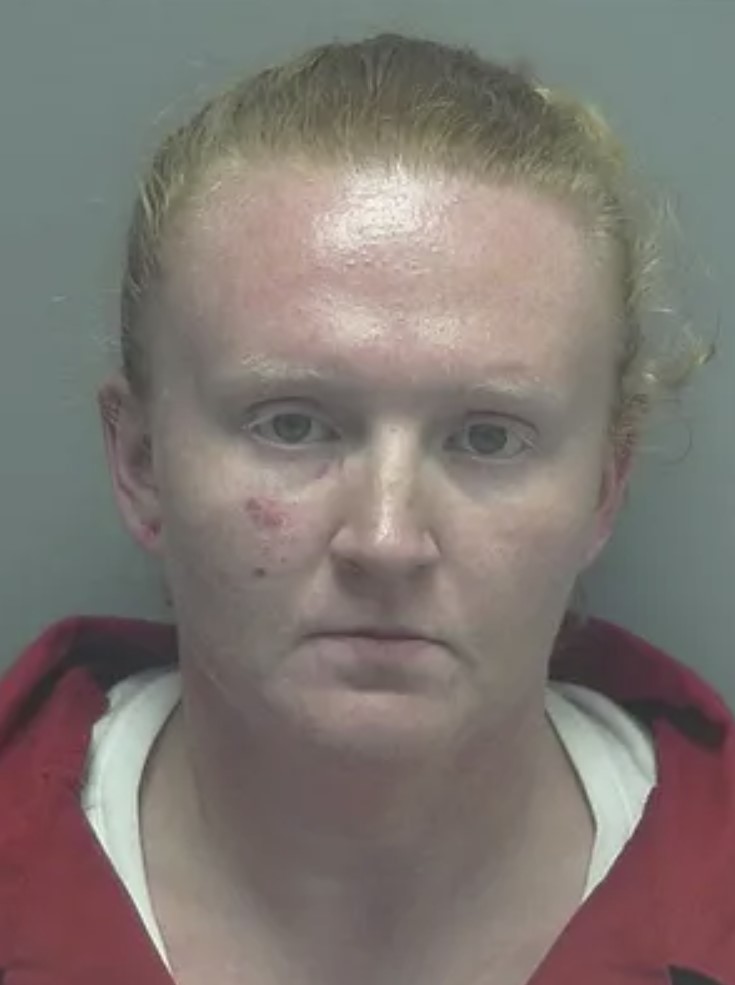
A mug shot taken of Anna Highland in her arrest after C.C.’s methadone overdose. Image via Lee County Sheriff’s Office.

DCF licensed Highland as a foster parent in 2012, and it received little to no complaints about her in the two years after. But in the six months leading to C.C.’s birth on Aug. 12, 2014, the Department received three separate child abuse hotline reports against her, including allegations she was abusing drugs and physically harming children under her care.

C.C. was born addicted to methadone, a narcotic that reduces opiate withdrawal symptoms. Rodriguez’s bill says the drug’s presence in C.C.’s system stemmed from Highland’s use of opiates, cocaine and intravenous drugs.

DCF opened an investigation of Highland the day after a drug test came back positive.

On Sept. 3, 2014, while the investigation was still underway and C.C. remained in intensive care, the Department received two additional hotline reports alleging the same misconduct.

Despite those calls, the three preceding them and C.C.’s condition at birth, DCF advised the hospital that there were no holds on the boy and he was free to be released to Highland. The hospital did so three days later.

Roughly a month after, DCF closed the investigation with “unsubstantiated findings of substance misuse and a determination that Ms. Highland’s methadone use had no implications for child safety,” the bill says.

Things went quiet from there until June 3, 2015, and again on Aug. 6, 2015, when DCF got two new child abuse hotline reports about Highland. DCF investigated neither claim.

Then on Sept. 12, 2015, C.C. overdosed on Highland’s methadone, which he found and drank. He was found “unresponsive and not breathing,” the bill says.

The 13-month-old was rushed to the hospital, where he remained for a month, half of which he was in a drug-induced coma and on a ventilator. Upon his discharge Sept. 28, 2015, he was placed into medical foster care.

A DCF investigation found Highland and her mother, who was present at the time C.C. was found unresponsive, waited five hours before seeking medical attention for the boy. That included a three-hour nap Highland said she took with the baby after finding him on the floor with a methadone bottle. She called 911 after the boy didn’t wake up.

DCF finally removed C.C. from Highland’s care and gave him to his father. Lee County Sheriff’s personnel arrested her on charges of aggravated child neglect. She was 27.

Highland was sentenced in early February 2017 to 60 months in prison and two years of probation after her release. During that period, she was required to perform 120 hours of community service, adhere to a 10 p.m. to 6 a.m. curfew and undergo monthly consultations about at-home methadone use.

Justice for Kids, an offshoot of Fort Lauderdale-based law firm Kelley Kronenberg, sued DCF in August 2017 on behalf of C.C.’s father. A Circuit Judge dismissed the case, granting DCF’s motion for summary judgment and accepting DCF’s argument that it didn’t have the same duty of care for the boy as it had for foster children under his mother’s care.

The 6th District Court of Appeal then affirmed the lower court’s decision, leaving no further legal recourse.

A Judge dismissed the case in 2023, agreeing with DCF’s claim that the agency wasn’t responsible for the boy’s injuries and did not have the same duty of care for him as it had for foster children under his mother’s care.

As such, SB 4 classifies as an equitable claims bill, meaning the case is at the mercy of the Legislature. In most circumstances, claims bills follow court judgments in which the award to plaintiffs against the state is larger than what can be paid under sovereign immunity strictures.

Lawyer Stacie Schmerling, who represents C.C., told Florida Politics last August that the $20 million being sought isn’t an arbitrary sum; it’s based on a life care plan that an expert on caring for people with C.C.’s conditions prepared in anticipation of his future needs.

C.C.’s claims bill has been the first or second measure Rodriguez has filed since 2022.

When Florida Politics asked DCF in 2023 whether anyone in the agency had been reprimanded or punished for their lack of oversight, then-DCF Deputy Chief of Staff Mallory McManus, who is now with the Agency for Health Care Administration, deferred to the court ruling.

“A court has already made a ruling as a matter of law that the Department was not negligent in this case,” she said by email. “The Court also specifically found that the Department did not put the child at risk.”

By approving SB 4 in the 2026 Session, lawmakers would direct Chief Financial Officer Blaise Ingoglia to draw up a warrant in favor of C.C., payable through DCF to an irrevocable trust created exclusively for his benefit, of $20 million from the state General Revenue Fund.

Attorneys fees, lobbying fees and other similar expenses relating to the claim would be paid through the trust, not the state fund, and may not exceed $5 million.


Post Views: 0


Source link

Continue Reading

Politics

Disney World is suing over its property tax bills for Magic Kingdom, Star Wars hotel, more

Published

on


Disney is suing over what it calls “excessive” property tax assessments for its four theme parks, the failed Star Wars hotel and a slew of other properties from the company’s vast real estate portfolio in Orange County.

The multibillion-dollar entertainment giant filed about 15 lawsuits late last week in Orange Circuit Court.

Disney wants to cancel the original 2025 tax bills, be issued new ones for reassessed amounts, then get reimbursed for its legal fees for contesting the property taxes. The Mouse is also asking the court to award “general relief as may be just and equitable,” according to the complaints.

The lawsuits accused Orange County Property Appraiser Amy Mercado’s Office of failing to use “professionally accepted appraisal practices,” although Disney’s complaints don’t provide details about its allegations.

“The assessments do not represent the just value of the Subject Property as of the lien date because they exceed the market value and therefore violates article VII, section 4 of the Florida Constitution,” the lawsuits said.

Disney has sued regularly over its property taxes for years. This time, however, the lawsuits come as state leaders are actively pushing to repeal or lower property taxes for residents.

Some state lawmakers are concerned about senior citizens and average Floridians struggling to afford their property taxes — although so far, officials aren’t specifically advocating for Disney to save money on its property tax bills in the ongoing debate for property tax relief.

The Walt Disney Co. is the most successful theme park operator in the world. Orlando’s Magic Kingdom is the crown jewel as the No. 1 most popular theme park on the planet, with an estimated 17.8 million visitors last year.

The Orange County Tax Collector did not immediately respond to questions from Florida Politics about how much Disney pays in property taxes or provide a breakdown of how much of that money funds local government, schools and the library system.

Disney said Magic Kingdom’s assessed value was at about $622 million, with Epcot at $795 million, Hollywood Studios at $639 million and Animal Kingdom at $495 million.

The site of the ill-fated Star Wars: Galactic Cruiser hotel was assessed at $38 million this year. Disney plans to turn the property into offices for Imagineers after the company shut down the hotel in 2023.

Other hotels being litigated over include the Grand Floridian Resort, accessed at $333 million, the Contemporary, at $243 million, and Coronado Springs, at $350 million.

Disney also did not immediately respond to requests for comment Monday for this story.


Source link

Continue Reading

Politics

North Florida Land Trust publishes book documenting a quarter century of land preservation

Published

on


Floridians can now read all about it when it comes to the North Florida Land Trust (NFLT).

The nonprofit environmental conservation organization has only been around since 1999. But in that time, the NFLT has overseen tens of thousands of acres of land preservation in North Florida. Now, a new book, “Keeping North Florida Wild,” is celebrating the group’s quarter century as one of the most influential conservation organizations in the state.

“This book gives people a way to visualize our accomplishments and impact as well as understand the significant role conservation has in Florida. It showcases why we must continue our mission to preserve these important natural spaces, because it truly is now or never,” said Allison DeFoor, NFLT President and CEO.

“I think our team did an incredible job, and I especially want to thank Sarah Hande, our communications officer, who took the lead on putting this book together. She really did a wonderful job, and I can’t wait for everyone to read it.”

The book includes photo essays and additional commentary from Mark Woods, an opinion columnist with The Florida Times-Union newspaper in Jacksonville. “Keeping North Florida Wild” can be bought online and delivered.

The NFLT has had a productive 2025 in terms of land acquisitions. The organization has added thousands of acres to what’s called the Ocala to Osceola wildlife corridor, which runs through several counties.

The organization also picked up some surprise donations in November. The NFLT announced it received an unexpected $100,000 in donations. Much of that money came from Heather and Herve Devos, while two anonymous donors made up for the remaining portion.

The contribution to the NFLT comes at a critical time, as the environmental preservation organization is engaged in its end-of-year fundraising campaign. The nonprofit group is aiming to raise $500,000 in contributions by Dec. 31. The NFLT is also promising to match each dollar up to $100,000 for those donations, “amplifying the power of every gift to protect North Florida’s natural resources.”

The NFLT operates on donations to cover its operating costs. The year-end fundraising campaign helps the organization expand its land acquisition efforts.


Source link

Continue Reading

Politics

Pudge controls the weather, not Erika Donalds

Published

on


Pudge controls the weather,” is a semi-famous and entirely adorable line from Lilo and Stitch, in which the cartoon little girl feeds Pudge, a fish, a peanut butter sandwich every Thursday to ensure favorable conditions.

As endearing a moment that was in what has become a modern Disney classic, it’s also understood to be complete fiction.

But don’t tell that to CBS, whose team of reporters apparently think it’s actually Erika Donalds who controls the weather.

At issue is a report published last week by CBS reporters Michael Kaplan, Mark Strassmann, and Emma Nicholson, with help from several other CBS reporters, outlining the delayed opening of Optima Classical Academy in Fort Myers. It was supposed to open in late 2024, but didn’t because of ongoing impacts from Hurricane Ian, which struck the area as a Category 5 hurricane, causing catastrophic devastation throughout the community from both wind and flood damage. Recovery efforts led to delays in opening the school this year, too, though it is still authorized under law to open next year.

The CBS piece has the look and feel of a hard-hitting investigative piece — it’s long and has catchy sub-heads — but its findings don’t uncover much.

The headline points to “parents scrambling” after the school didn’t open on time. The main sub-headline says Donalds “defended millions paid to vendors she was tied to.”

But the story itself is mostly just commentary from a couple of parents frustrated with their kids’ lack of options giving the Optima Classical Academy delay, one of whom even acknowledges she “had all our eggs in that basket.” This doesn’t project a problem with choice. Instead, it only punctuates the need for more choice programs — including charter schools like the ones Donalds launches.

Donalds, wife of U.S. Rep. Byron Donalds, has become a leading voice in the school choice movement not just in Florida, but across the nation. She has successfully opened four classical charter schools in the state, a growing trend of schools that emphasize Eurocentric education that begins allowing students to explore primary documents such as the U.S. Constitution much earlier than traditional public curricula allows.

It’s become a popular choice among parents who worry about what many describe as “woke” education in public schools. And yes, it sucks that the early 300 parents in Fort Myers who selected Optima Classical Academy for their children are left waiting.

But assigning blame for that to Donalds rather than to the act of God that created the delay is a stretch at best.

“It is sexist — but not surprising — that CBS would choose to attack an accomplished businesswoman with a strong record of starting successful charter schools and providing thousands of students with an excellent education. Erika Donalds has been a leading voice in advancing school choice nationwide, both through policy and helping launch new schools. Her leadership has helped make Florida’s education landscape a national model for education freedom and innovation, her expertise continues to be sought by policymakers across America, and her dedication and lifelong commitment have expanded access to quality educational opportunities for children who need and deserve them,” said Danielle Alvarez, senior advisor to U.S. Rep. Byron Donalds’ campaign for Governor.

While Hurricane Ian made landfall near Fort Myers in late 2022, the Category 5 storm caused one of the longest and most complex disaster recoveries in U.S. history. Even three years after the storm, news coverage in Southwest Florida was still highlighting recovery challenges and progress, with numerous rebuilding efforts still underway. As anyone with experience recovering from hurricane devastation will tell you, the large-scale recovery affects areas far outside of landfall, with construction resources spread thin and exacerbating timelines.

But despite the CBS story’s failure to accurately portray what has happened with Optima’s delay, the piece actually does get some facts right, even if not in context.

For example, the story notes that “state data shows when it came to academic performance, one of the schools (Donalds opened) quickly excelled.” It also includes important context that the Fort Myers school “had yet to receive any taxpayer funding,” though it is still operating under the parameters of its approved charter agreement allowing it to open by 2026. Even in an example cited outlining areas of concern in academic performance at one Optima-run school, the CBS story correctly notes that academic performance improved after the independent audit, which was commissioned specifically to uncover areas of continued opportunity.

The piece cites a spokesperson for Donalds, who said the school’s improvement shows “how a supportive environment, committed teachers, and high expectations can help children thrive.”

But perhaps worst of all in what amounts to a cleverly disguised hit piece against Donalds, the story attempts to lead readers to believe Donalds made improper financial gain from the charter schools she opened or planned to open, arguing some charter school funds at schools that had already opened were spent on outside firms with ties to Donalds. But the information is framed in a derogatory way, despite later noting the firms “landed the schools a good price on payroll expenses, IT and other back-office services” and that each school “is owned and governed by its own independent nonprofit board, which is responsible for oversight and decision-making.”

Nevertheless, the narrative is framed in such a way that paints Donalds as the villain.

But sure, I guess we’ll just start feeding Donalds peanut butter sandwiches on Thursdays and hope for the best.


Source link

Continue Reading

Trending

Copyright © Miami Select.