Connect with us

Politics

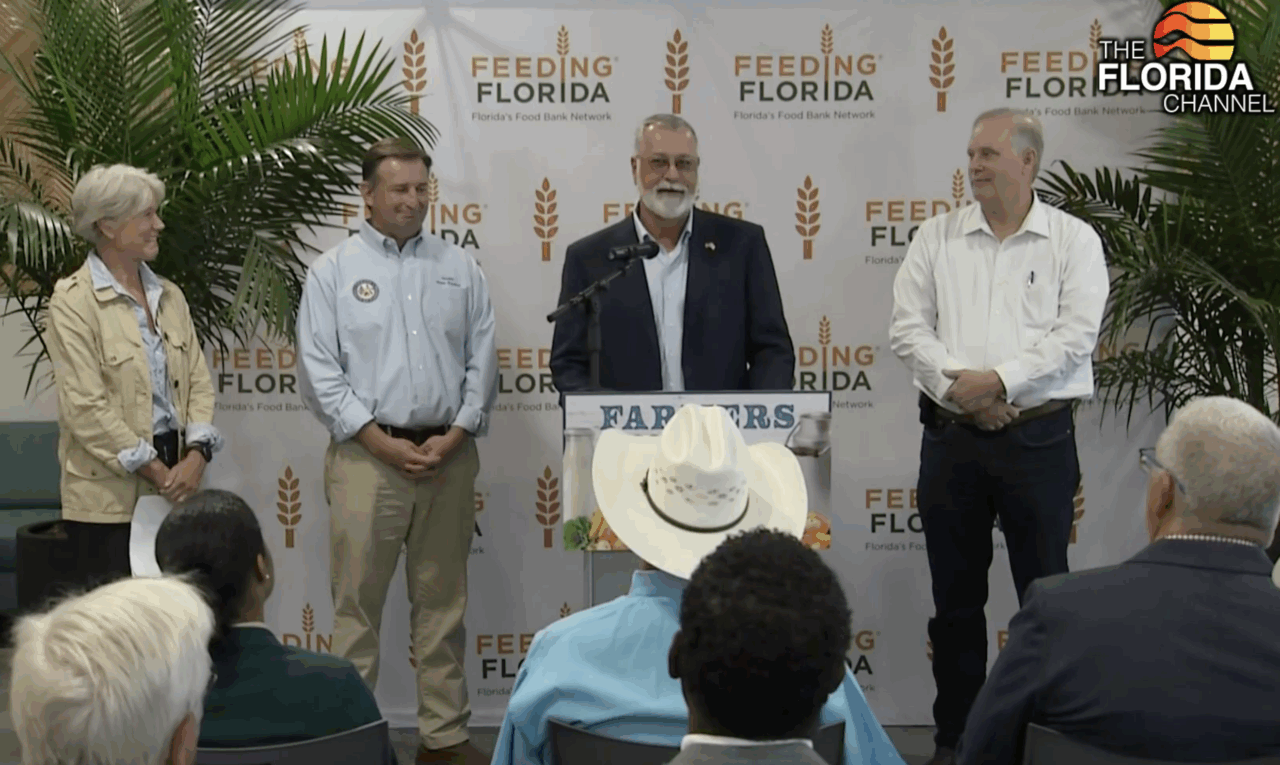
Leaders tout new state program to connect farmers, food banks and hungry Floridians
Published

on


What happens to all the dairy farmers when students are out of school for the Summer and not guzzling milk cartons?

State leaders say a new state program has found the solution by connecting farmers and ranchers dealing with surpluses in the slow season to families struggling to make ends meet.

“This program puts those pieces together.” Agriculture Commissioner Wilton Simpson said. “We could not do this without the Legislature.”

Simpson, Senate President Ben Albritton and Senate President Pro Tempore Jason Brodeur held a joint press conference Thursday to highlight the state’s $38 million investment with the Farmers Feeding Florida initiative that began July 1.

Farmers Feeding Florida expands Florida food bank infrastructure so that fresh produce, meat and other products from the Sunshine State can end up in food banks and help feed hungry people, they said.

Within the past month, about 170,000 gallons of milk — or about 2.7 million cartons — ended up going to needy families, Simpson said.

Albritton called the program a “hand up, not a handout.”

“We’re setting a precedent here, folks,” Albritton said. “We’re setting a precedent that food insecurity is not imaginary. It’s real. It’s real, and most importantly, we can do something about it.”

Brodeur, the Chair of the Agriculture Appropriations Committee, said the project had been in the works for years. 

Breaking down the state’s investment, $10 million is allocated toward transportation and new sites for infrastructure running the program, while the other $28 million is direct assistance to the farmers, he said.

Robin Safley, the CEO of Feeding Florida, said the project will allow her to expand her program working with nine member food banks that covers all 67 counties.

Feeding Florida, which focuses on fresh produce, uses the state funding to cover the pick and pack costs on behalf of the growers, she said.

“That also allows us to get product really, really soon,” she said. “So we’ve become part of the supply chain.”


Post Views: 0


Source link

Continue Reading

Politics

Florida kicks off first black bear hunt in a decade, despite pushback

Published

on


For the first time in a decade, hunters armed with rifles and crossbows are fanning out across Florida’s swamps and flatwoods to legally hunt the Florida black bear, over the vocal opposition of critics.

The state-sanctioned hunt began Saturday, after drawing more than 160,000 applications for a far more limited number of hunting permits, including from opponents who are trying to reduce the number of bears killed in this year’s hunt, the state’s first since 2015.

The Florida Fish and Wildlife Conservation Commission awarded 172 bear hunt permits by random lottery for this year’s season, allowing hunters to kill one bear each in areas where the population is deemed large enough. At least 43 of the permits went to opponents of the hunt who never intend to use them, according to the Florida chapter of the Sierra Club, which encouraged critics to apply in the hopes of saving bears.

The Florida black bear population is considered one of the state’s conservation success stories, having grown from just several hundred bears in the 1970s to an estimated more than 4,000 today.

The 172 people who were awarded a permit through a random lottery will be able to kill one bear each during the 2025 season, which runs from Dec. 6 to Dec. 28. The permits are specific to one of the state’s four designated bear hunting zones, each of which have a hunting quota set by state officials based on the bear population in each region.

In order to participate, hunters must hold a valid hunting license and a bear harvest permit, which costs $100 for residents and $300 for nonresidents, plus fees. Applications for the permits cost $5 each.

The regulated hunt will help incentivize maintaining healthy bear populations, and help fund the work that is needed, according to Mark Barton of the Florida chapter of Backcountry Hunters and Anglers, an advocacy group that supported the hunt.

Having an annual hunt will help guarantee funding to “keep moving conservation for bears forward,” Barton said.

According to state wildlife officials, the bear population has grown enough to support a regulated hunt and warrant population management. The state agency sees hunting as an effective tool that is used to manage wildlife populations around the world, and allows the state to monetize conservation efforts through permit and application fees.

“While we have enough suitable bear habitat to support our current bear population levels, if the four largest subpopulations continue to grow at current rates, we will not have enough habitat at some point in the future,” reads a bear hunting guide published by the state wildlife commission.

___

Republished with permission of the Associated Press.


Source link

Continue Reading

Politics

Early voting underway for Miami Mayor’s runoff between Eileen Higgins, Emilio González

Published

on


Early voting is underway in Miami as former County Commissioner Eileen Higgins and former City Manager Emilio González enter the final stretch of a closely watched Dec. 9 mayoral runoff.

The two candidates rose from a 13-person field Nov. 4, with Higgins winning about 36% of the vote and González taking 19.5%. Because neither surpassed 50%, Miami voters must now choose between contrasting visions for a city grappling with affordability, rising seas, political dysfunction and rapid growth.

Both promise to bring more stability and accountability to City Hall. Both say Miami’s permitting process needs fixing.

Higgins, a mechanical engineer and eight-year county commissioner with a broad, international background in government service, has emphasized affordable housing — urging the city to build on public land and create a dedicated housing trust fund — and supports expanding the City Commission from five to nine members to improve neighborhood representation.

She also backs more eco-friendly and flood-preventative infrastructure, faster park construction and better transportation connectivity and efficiency.

She opposes Miami’s 287(g) agreement with U.S. Immigration and Customs Enforcement, calling recent enforcement “inhumane and cruel,” and has pledged to serve as a full-time mayor with no outside employment while replacing City Manager Art Noriega.

González, a retired Air Force colonel, former Director of U.S. Citizenship and Immigration Services and ex-CEO of Miami International Airport, argues Miami needs an experienced administrator to fix what he calls deep structural problems.

He has made permitting reform a top priority, labeling the current system as barely functioning, and says affordability must be addressed through broader tax relief rather than relying on housing development alone.

He supports limited police cooperation with ICE and wants Miami to prepare for the potential repeal of homestead property taxes. Like Higgins, he vows to replace Noriega but opposes expanding the commission.

He also vows, if elected, to establish a “Deregulation Task Force” to unburden small businesses, prioritizing capital investments that protect Miamians, increasing the city’s police force, modernizing Miami services with technology and a customer-friendly approach, and rein in government spending and growth.

Notably, Miami’s Nov. 4 election this year might not have taken place if not for González, who successfully sued in July to stop officials from delaying its election until 2026.

The runoff has drawn national attention, with major Democrats like Democratic National Committee Chair Ken Martin, Arizona U.S. Rep. Ruben Gallego and Orange County Mayor-turned-gubernatorial candidate Jerry Demings and his wife, former Congresswoman Val Demings, backing Higgins and high-profile Republicans like President Donald Trump, Gov. Ron DeSantis and U.S. Sen. Rick Scott lining up behind González.

For both parties, Miami’s outcome is seen as a bellwether heading into a volatile 2026 cycle, in a city where growth, climate challenges and governance failures remain top concerns for nearly 500,000 residents.

Higgins, a 61-year-old Democrat who was born in Ohio and grew up in New Mexico, entered the race as the longest-serving current member of the Miami-Dade Commission. She won her seat in a 2018 Special Election and coasted back into re-election unopposed last year.

She chose to vacate her seat three years early to run for Mayor.

She worked for years in the private sector, overseeing global manufacturing in Europe and Latin America, before returning stateside to lead marketing for companies such as Pfizer and Jose Cuervo.

In 2006, she took a Director job with the Peace Corps in Belize, after which she served as a foreign service officer for the U.S. State Department under President Barack Obama, working in Mexico and in economic development areas in South Africa.

Since filing in April, Higgins raised $386,500 through her campaign account. She also amassed close to $658,000 by the end of September through her county-level political committee, Ethical Leadership for Miami. Close to a third of that sum — $175,000 — came through a transfer from her state-level PC.

She also spent about $881,000.

If elected, Higgins would make history as Miami’s first woman Mayor.

González, a 68-year-old born in Cuba, brought the most robust government background to the race. A U.S. Army veteran who rose to the rank of colonel, he served as Miami City Manager from 2017 to 2020, CEO of Miami International Airport (MIA) from 2013 to 2017 and as Director of Citizenship and Immigration Services at the U.S. Department of Homeland Security under President George W. Bush.

In private life, he works as a partner at investment management firm RSMD Investco LLC. He also serves as a member of the Treasury Investment Council under the Florida Department of Financial Services.

Since filing to run for Mayor in April, he raised nearly $1.2 million and spent about $1 million.

Election Day is Tuesday.


Source link

Continue Reading

Politics

Paul Renner doubles down on Cory Mills critique, urges more Republicans to join him

Published

on


Mills was a day-one Byron Donalds backer in the gubernatorial race.

A former House Speaker and current candidate for Governor is leading the charge for Republicans as scandal swirls around a Congressman.

Saying the “evidence is mounting” against Rep. Cory MillsPaul Renner says other candidates for Governor should “stand up and be counted” and join him in the call for Mills to leave Congress.

Renner made the call earlier this week.

But on Friday, the Palm Coast Republican doubled down.

He spotlighted fresh reporting from Roger Sollenberger alleging that Mills’ company “appears to have illegally exported weapons while he serves in Congress, including to Ukraine,” that Mills failed to disclose conflicts of interest, “tried to fistfight other Republican members of Congress, and lied about his party stature to bully other GOP candidates out of primaries that an alleged romantic interest was running in,” and lied about his conversion to Islam.

The House Ethics Committee is already probing Mills, a New Smyrna Beach Republican, over allegations of profiting from federal defense contracts while in Congress. More recently, the Committee expanded its work to review allegations that he assaulted one ex-girlfriend and threatened to share intimate photos of another.

Other candidates have been more reticent in addressing the issue, including Rep. Byron Donalds.

“When any other members have been involved and stuff like this, my advice is the same,” said Donalds, a Naples Republican. “They need to actually spend a lot more time in the district and take stock of what’s going on at home, and make that decision with their voters.”

The response came less than a year after Mills, a New Smyrna Beach Republican, spoke at the launch of Donalds’ gubernatorial campaign.

___

Staff writer Jacob Ogles contributed reporting.


Source link

Continue Reading

Trending

Copyright © Miami Select.