Connect with us

Business

AI experts return from China stunned: The U.S. grid is so weak, the race may already be over

Published

on


“Everywhere we went, people treated energy availability as a given,” Rui Ma wrote on X after returning from a recent tour of China’s AI hubs. 

For American AI researchers, that’s almost unimaginable. In the U.S., surging AI demand is colliding with a fragile power grid, the kind of extreme bottleneck that Goldman Sachs warns could severely choke the industry’s growth.

In China, Ma continued, it’s considered a “solved problem.”

Ma, a renowned expert in Chinese technology and founder of the media company Tech Buzz China, took her team on the road to get a firsthand look at the country’s AI advancements. She told Fortune that while she isn’t an energy export, she attended enough meetings and talked to enough insiders to come away with a conclusion that should send chills down the spine of Silicon Valley: in China, building enough power for data centers is no longer up for debate.

“This is a stark contrast to the U.S., where AI growth is increasingly tied to debates over data center power consumption and grid limitations,” she wrote on X.

The stakes are difficult to overstate. Data center building is the foundation of AI advancement, and spending on new centers now displaces consumer spending in terms of impact to U.S. GDP—that’s concerning since consumer spending is generally two-thirds of the pie. McKinsey projects that between 2025 and 2030, companies worldwide will need to invest $6.7 trillion into new data center capacity to keep up with AI’s strain. 

In a recent research note, Stifel Nicolaus warned of a looming correction to the S&P 500, since it forecasts this data-center capex boom to be a one-off build-out of infrastructure, while consumer spending is clearly on the wane.

However, the clear limiting factor to the U.S.’s data center infrastructure development, according to a Deloitte industry survey, is stress on the power grid. Cities’ power grids are so weak that some companies are just building their own power plants rather than relying on existing grids. The public is growing increasingly frustrated over increasing energy bills – in Ohio, the electricity bill for a typical household has increased at least $15 this summer from the data centers – while energy companies prepare for a sea-change of surging demand. 

Goldman Sachs frames the crisis simply: “AI’s insatiable power demand is outpacing the grid’s decade-long development cycles, creating a critical bottleneck.” 

Meanwhile, David Fishman, a Chinese electricity expert who has spent years tracking their energy development, told Fortune that in China, electricity isn’t even a question. On average, China adds more electricity demand than the entire annual consumption of Germany, every single year. Whole rural provinces are blanketed in rooftop solar, with one province matching the entirety of India’s electricity supply. 

“U.S. policymakers should be hoping China stays a competitor and not an aggressor,” Fishman said. “Because right now they can’t compete effectively on the energy infrastructure front.”

China has an oversupply of electricty

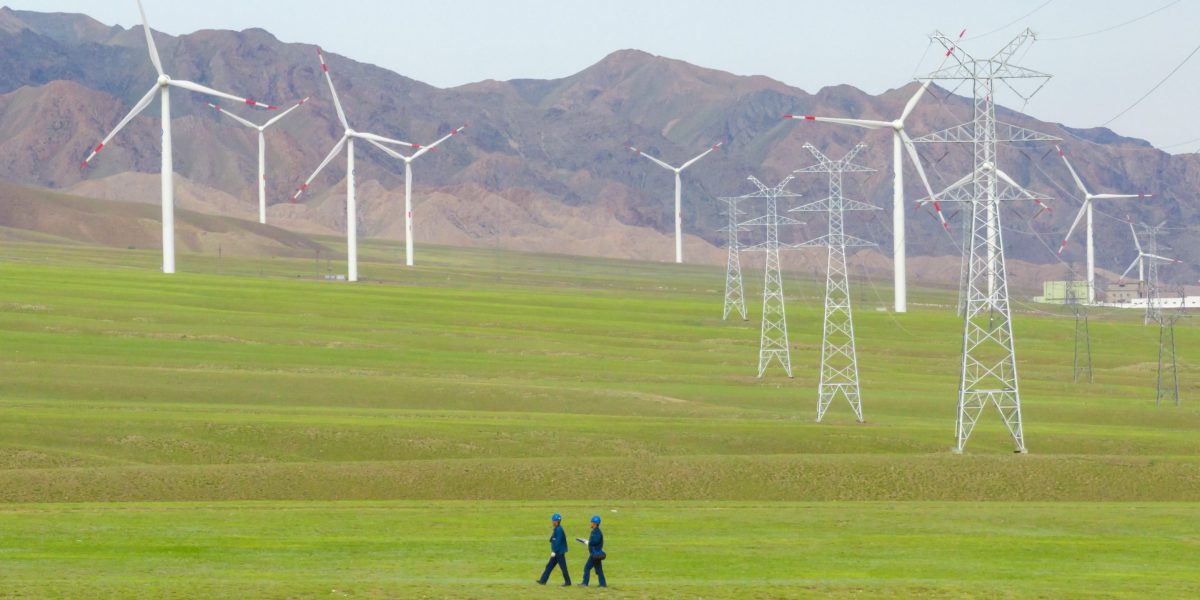
China’s quiet electricity dominance, Fishman explained, is the result of decades of deliberate overbuilding and investment in every layer of the power sector, from generation to transmission to next-generation nuclear.

The country’s reserve margin has never dipped below 80%–100% nationwide, meaning it has consistently maintained at least twice the capacity it needs, Fishman said. They have so much available space that instead of seeing AI data centers as a threat to grid stability, China treats them as a convenient way to “soak up oversupply,” he added.

That level of cushion is unthinkable in the United States, where regional grids typically operate with a 15% reserve margin and sometimes less, particularly during extreme weather, Fishman said. In places like California or Texas, officials often issue warnings about red-flag conditions when demand is projected to strain the system. This leaves little room to absorb the rapid load increases AI infrastructure requires, Fishman ntoed. 

The gap in readiness is stark: while the U.S. is already experiencing political and economic fights over whether the grid can keep up, China is operating from a position of abundance.

Even if AI demand in China grows so quickly renewable projects can’t keep pace, Fishman said, the country can tap idle coal plants to bridge the gap while building more sustainable sources. “It’s not preferable,” he admitted, “but it’s doable.”

By contrast, the U.S. would have to scramble to bring on new generation capacity, often facing years-long permitting delays, local opposition, and fragmented market rules, he said. 

Structural governance differences

Underpinning the hardware advantage is a difference in governance. In China, energy planning is coordinated by long-term, technocratic policy that defines the market’s rules before investments are made, Fishman said. This model ensures infrastructure buildout happens in anticipation of demand, not in reaction to it.

“They’re set up to hit grand slams,” Fishman noted. “The U.S., at best, can get on base.”

In the U.S., large-scale infrastructure projects depend heavily on private investment, but most investors expect a return within three to five years: far too short for power projects that can take a decade to build and pay off.

“Capital is really biased toward shorter-term returns,” he said, noting Silicon Valley has funneled billions into “the nth iteration of software-as-a-service” while energy projects fight for funding. 

In China, by contrast, the state directs money toward strategic sectors in advance of demand, accepting not every project will succeed but ensuring the capacity is in place when it’s needed. Without public financing to de-risk long-term bets, he argued, the U.S. political and economic system is simply not set up to build the grid of the future.

Cultural attitudes reinforce this approach. In China, renewables are framed as a cornerstone of the economy because they make sense economically and strategically, not because they carry moral weight. Coal use isn’t cast as a sign of villainy, as it would be among some circles in the U.S. –  it’s simply seen as outdated. This pragmatic framing, Fishman argued, allows policymakers to focus on efficiency and results rather than political battles.

For Fishman, the takeaway is blunt. Without a dramatic shift in how the U.S. builds and funds its energy infrastructure, China’s lead will only widen.

“The gap in capability is only going to continue to become more obvious — and grow in the coming years,” he said.


Source link

Continue Reading

Business

Nonprofits are solving 21st century problems—they need 21st century tech

Published

on


AI is accelerating progress in almost every sector. But in the social sector, it’s exposing a gap. 

Despite playing a crucial role as the first line of defense for vulnerable communities, nonprofits are at risk of being left behind in the age of AI. Society is asking nonprofits to solve 21st-century problems with 20th-century tech. At the same time, they are up against sociopolitical headwinds, loss of funding, and existential battles. 

We cannot expect nonprofits to invest in technological innovation unless we come together across sectors to provide them the resources. The engineers and the activists, the policymakers and the philanthropists. If AI is to be a force for good, we need to fund the tech, fund the future, and fund together.

An emerging, creative class of entrepreneurs — AI-powered nonprofits — represent one of the most promising fronts in social impact. While for-profit companies are building AI that’s fundamentally changing daily life and the global economy, AI-powered nonprofits are using the same tech to solve humanity’s most urgent challenges. They’re banding together to transform education. To advance economic empowerment. To change health outcomes. They are demonstrating resilience in ways the private sector alone cannot. 

Take CareerVillage. Since 2011, CareerVillage has been on a mission to democratize access to career information and support those who need it most. Rather than shying away from hard questions about how AI will impact the labor market, CareerVillage is leaning in. Their AI-powered “Coach” platform helps job seekers navigate the changing labor market by offering mock interviews, resume support, career navigation, and more. Coach has already delivered personalized guidance to 50,000 learners, the majority of which have been youth from low-income households, students of color, and women.

But that’s just one example. New data from Fast Forward’s 2025 AI for Humanity Report, created with support from Google.org, finds that AI-powered nonprofits like CareerVillage are leading an early-stage transformation of AI in the nonprofit sector. We found that nonprofits are building AI solutions at every size and every stage. 40% of AI-powered nonprofits surveyed have been using AI for a year or less. And nearly a third (30%) have budgets of $500K or less.

It isn’t a surprise that the smallest, nimblest nonprofits are leading the way. Nonprofits have always looked for ways to do more with less. In this way, AI-powered nonprofits are similar to traditional nonprofits — they care about impact and efficiency. But AI-powered nonprofits are organized differently, and they have a different set of needs. 

For one, AI-powered nonprofits need tech expertise in their C-suite and on their staff. Tech and data aren’t extraneous. They’re core program costs. It costs money to build the technology responsibly, and it takes time for impact to follow. This puts a lot of AI-powered nonprofits in a catch-22: needing capital to prove impact, but needing proven impact to unlock capital.

To that end, AI-powered nonprofits need support at every stage of the impact cycle: from research and development, to sustaining mid-stage growth — the point where many nonprofits otherwise stall — to scaling proven models.

Importantly, 84% of AI-powered nonprofit respondents said funding would most help them further develop and scale AI. This insight matters because the data shows a clear relationship between resources and reach. At the smallest budgets, AI-powered nonprofits are serving thousands, a median of just under 2,000 lives. By the time budgets cross $1 million, median reach jumps to half a million people. And at more than $5 million, AI-powered nonprofits are reaching millions of people — a median impact of 7 million lives.

To unlock their full potential, they need the support of coalitions, shared infrastructure, and cross-sector collaboration with technologists, policymakers, and funders. 

There is no better example of this than Karya. The smartphone-based platform employs workers in rural India to complete AI data tasks to train large language models, like translation for less-commonly spoken languages. Karya seized an opportunity to flip the script on the AI economy — improving global technologies while enabling income and upskilling opportunities for over 100,000 workers. 

Karya also licenses its technology to local governments and peer organizations. Using Karya’s Platform-as-a-Service model, Digital Green sourced speech data directly from farmers in Kenya to fine-tune an agricultural AI model. The localized model outperformed leading models on domain-specific tasks, proving that community-generated data can drive smarter, more relevant AI. Karya provided the technology, Digital Green led on-the-ground operations, and philanthropic funding helped bridge the two. 

Partnership, even within the nonprofit sector, acts as a force multiplier. AI can unlock positive benefits for humanity, but we all play a role in making sure that happens.

Every once in a while, history presents us with moments that demand a fundamental shift in approach. This is one of those moments. 

It starts with giving nonprofits a seat at the table.

The opinions expressed in Fortune.com commentary pieces are solely the views of their authors and do not necessarily reflect the opinions and beliefs of Fortune.


Source link

Continue Reading

Business

Citadel’s shot at Andreessen Horowitz points to coming battle over DeFi and U.S. stock trading

Published

on


A quiet fight between two of the most powerful names in finance burst into the open last week. In a letter to the Securities and Exchange Commission, Citadel Securities complained that crypto interests are poised to damage the U.S. stock market and harm consumer protections with a pell-mell rush into decentralized finance (DeFi). The firm didn’t directly say who it regards as responsible for this state of affairs—but it’s enough to guess from the footnotes, which refer to the venture giant Andreessen Horowitz more than 10 times.

The source of the dispute is the fast-growing world of tokenized equities, which let users trade shares of popular companies but in a blockchain wrapper. The likes of Robinhood, Kraken, and even BlackRock are all dabbling in this technology, whose advantages include easy 24/7 trading and instant settlement. Holding stock on a blockchain also reduces middlemen, and expands opportunities to deploy equity-based collateral.

So what’s not to like? According to Citadel, the problem is DeFi platforms like Uniswap. Right now, traders use them to swap billions of dollars of crypto every day—and soon large volumes of tokenized Nvidia or Apple stock could be sloshing around these platforms, too. And if the SEC grants certain exemptions that Andreessen and its DeFi allies are seeking, Uniswap and others will get to operate as de facto brokerages—without taking on the legal responsibilities that go with that. These include displaying the price of every trade or ensuring customers get the best price. Citadel also warns of “fragmenting liquidity” as stock investing gets split between two parallel systems.

In response to the letter, the founder of Uniswap (one of Andreessen’s blue-ribbon portfolio companies) took to X to accuse Citadel of slandering DeFi in order to protect its lucrative role as the “king of shady tradfi market makers.” Other prominent names in crypto piled on as well, accusing the firm of trying to smother innovation.

At first glance, it appears both sides have a point. If tokenized stock trading breaks into the mainstream, it would threaten Citadel’s business model of paying firms like Robinhood for their orders and using that volume to make trading profits. So the company’s letter to the SEC is clearly based in self-interest. That said, Citadel’s concerns about liquidity are not unreasonable—if the pool of U.S. stocks is divided into two separate pools, doesn’t that make trading more expensive for everyone? Likewise, it’s fair to ask if the SEC would be wise to grant exemptions on investor protection rules that have historically served the public very well.

In reading the letter, it’s remarkable to read its claims that the likes of automated AMMs, block builders, validators and layer 2 blockchains are basically brokerages—less for the argument itself, than that Citadel and the SEC are discussing this stuff at all. It wasn’t long ago when only a handful of crypto diehards knew what these terms even meant. Now, they have become mainstream enough to be part of a non-crypto firm’s correspondence with the SEC, and there is no doubt they’re here to stay.

As for which side is going to prevail, it’s worth noting the fight pits two of the most powerful firms in the country against each other. On one side, there is Citadel, which is owned by Ken Griffin, one of the richest and most combative people in the country. On the other is Andreessen, an influential VC firm that doubles as a PR firm and lobbying agency with immense clout in Washington, DC. For now, it feels Griffin may be able to slow down the spread of tokenized equities but, as with any superior technology, he will be unable to stop it.

Jeff John Roberts
jeff.roberts@fortune.com
@jeffjohnroberts

DECENTRALIZED NEWS

Binance’s new look: The world’s biggest cryptocurrency exchange announced Yi He as co-CEO, confirming her status as the most powerful woman in crypto, while also establishing a de facto corporate headquarters for the first time via major licenses in Abu Dhabi. (Fortune)

Alt-coin winter: The recent downturn has battered alts with the sector shedding $200 billion since market peak. Memecoins have been hit particularly hard, due in part to the sheer number of them, but also because they are competing with a growing number of other speculative opportunities like prediction markets. (Bloomberg)

If at first you don’t succeed: Coinbase plans to relaunch in India early next year. It first opened shop in 2022, but was forced to retreat a year later in the face of hostile regulators who blocked its access to the country’s national payments network. (TechCrunch)

Mining mischief: The Malaysian government is using drones and a cross-agency task force to go after thousands of illegal Bitcoin mining operations that hop from place to place, and have stolen over $1 billion of electricity. (Bloomberg)

Saylor selling? The fraught world of DATs got dicier as Strategy said it might sell Bitcoin as a last resort. The move comes as Strategy’s share price fell below mNAV as the firm faces looming dividend obligations—but there is also a case that Saylor’s corporate strategy wizardry means the firm will be just fine. (Fortune)

MAIN CHARACTER OF THE WEEK

Changpeng Zhao, cofounder of Binance.

Samsul Said—Bloomberg/Getty Images

CZ wins the main character title this week as his debate with goldbug Peter Schiff helped drive a flood of social media attention around the Binance founder who looks very much back in the crypto game.

MEME O’ THE MOMENT

Franklin the Turtle loves UDSC and USDT.

@haonan

After the U.S. Treasury Secretary Bessent co-opted beloved children’s character Franklin the Turtle to pitch T-bills, it didn’t take long for CT to expand the meme to stablecoins. 

Fortune Brainstorm AI returns to San Francisco Dec. 8–9 to convene the smartest people we know—technologists, entrepreneurs, Fortune Global 500 executives, investors, policymakers, and the brilliant minds in between—to explore and interrogate the most pressing questions about AI at another pivotal moment. Register here.


Source link

Continue Reading

Business

If you want your employees back in the office, try feeding them, says Gensler executive

Published

on


What do both employees and employers really want in a workplace of the future? It’s a topic that came up last week in my conversations with CEOs, designers, and thought leaders at Fortune’s Brainstorm Design conference in Macau.

If you ask Ray Yuen, office managing director at the design and architecture firm Gensler, the answer is food. A recent Gensler survey asked employees to rank the office spaces that were most important to them. The top three? The office food hall, cafe, or lounge. 

“It’s really about food and wellness,” Yuen said onstage. “They didn’t even mention anything about work. Everybody just picked the stuff that we really want as human beings.”

It’s worth listening to these human desires as companies try to bring people back into the office, Yuen said. He described a project he worked on recently for a large company’s new Tokyo headquarters, where 50% of the company’s employees were working remotely and he was tasked with finding a way to bring them back. One of the biggest successes was a lo-fi vinyl listening bar, where no tech or talking was allowed, he said. 

Flexibility is also key. In the past, Yuen said he used to heavily design about 80% of a company’s headquarters with built in furniture and modules like cubicles, and leave about 20% as “flexible space.” Now, the balance is more 50/50, so companies can transform their office spaces easily when needs arise, such as an office happy hour, he says.

“We’re no longer just designing workplaces. We’re actually designing experiences. Because [employees may] think, ‘Well, if I can work anywhere, why do I want to go to work? I can do it at home,’” Yuen said. “You’ve really got to make the campus or the workplace be more than work, and that’s the fun part of it.”

Kristin Stoller
Editorial Director, Fortune Live Media
kristin.stoller@fortune.com

Around the Table

A round-up of the most important HR headlines.

Employers used to frown on social media posting during work hours, but now employees at companies including Starbucks and Delta are being asked to post on-the-job social media content. Wall Street Journal

The U.S. Equal Employment Opportunity Commission, or EEOC, is reportedly blocking or stalling claims brought by transgender workers. Bloomberg

As automated systems come under fire for potentially allowing discriminating hiring practices, many states are expanding bans on discrimination to AI. Washington Post

Watercooler

Everything you need to know from Fortune.

Meeting shakeup. Instagram’s CEO is calling employees back to the office five days a week, but is canceling all unnecessary recurring meetings —Marco Quiroz-Gutierrez

Earnings report. In the U.K., Gen Z college graduates are earning 30% less than Millennials did at the same stage of life. —Preston Fore

Trade troubles. As Gen Zers opt for trade schools and blue-collar jobs, there is one sector they are hesitant to get involved in: manufacturing. —Emma Burleigh 


Source link

Continue Reading

Trending

Copyright © Miami Select.