Connect with us

Business

‘I am overwhelmed by the need to stay on top of where the deals are’: Back-to-school shopping turns into China tariff-dodging exercise

Published

on


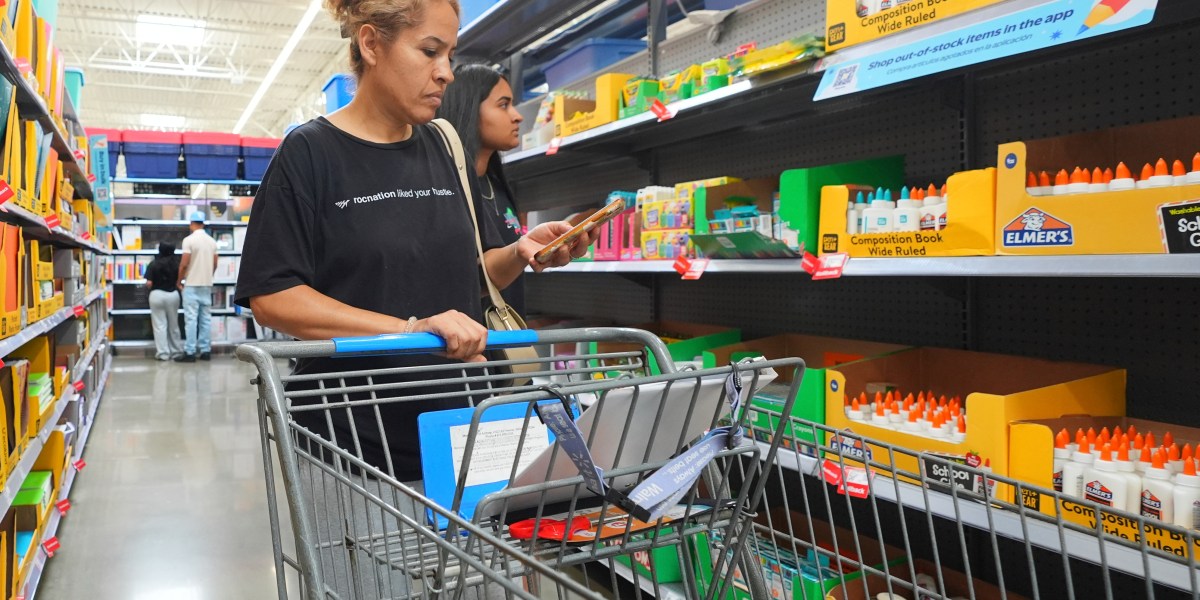
Feeling nostalgic for the days when going back to school meant picking out fresh notebooks, pencils and colored markers at a local drugstore or stationary shop? The annual ritual is both easier and more complicated for today’s students.

Big retail chains generate online lists of school supplies for customers who type in their zip codes, then choose a school and a grade level. One click and they are ready to check out. Some schools also offer busy parents a one-stop shop by partnering with vendors that sell premade kits with binders, index cards, pens and other needed items.

Yet for all the time-saving options, many families begin their back-to-school shopping months before Labor Day, searching around for the best deals and making purchases tied to summer sales. This year, the possibility of price increases from new U.S. tariffs on imports motivated more shoppers to get a jump start on replacing and refilling school backpacks, according to retail analysts.

Retail and technology consulting company Coresight Research estimates that back-to-school spending from June through August will reach $33.3 billion in the U.S., a 3.3% increase from the same three-month period a year ago. The company predicted families would complete about 60% of their shopping before August to avoid extra costs from tariffs.

“Consumers are of the mindset where they’re being very strategic and conscientious around price fluctuations, so for back to school, it prompts them to shop even earlier,” said Vivek Pandya, lead analyst at Adobe Digital Insights, the research division of software company Adobe Inc.

Getting a head start

Miami resident Jacqueline Agudelo, 39, was one of the early birds who started shopping for school supplies in June because she wanted to get ahead of possible price increases from new U.S. tariffs on imported products.

The teacher’s supply list for her 5-year-old son, who started kindergarten earlier this month, mandated specific classroom items in big quantities. Agudelo said her shopping list included 15 boxes of Crayola crayons, Lysol wipes and five boxes of Ticonderoga brand pencils, all sharpened.

Agudelo said she spent $160 after finding plenty of bargains online and in stores, including the crayons at half off, but found the experience stressful.

“I am overwhelmed by the need to stay on top of where the deals are as shopping has become more expensive over the years,” she said.

A lot of the backpacks, lined paper, glue sticks — and Ticonderoga pencils — sold in the U.S. are made in China, whose products were subjected to a 145% tariff in the spring. Under the latest agreement between the countries, general merchandise from China is taxed at a 30% rate when it enters the U.S.

Many companies accelerated shipments from China early in the year, stockpiling inventory at pre-tariff prices. Some predicted consumers would encounter higher prices just in time for back-to-school shopping. Although government data showed consumer prices rose 2.7% last month from a year earlier, strategic discounting by major retailers may have muted any sticker shock for customers seeking school supplies.

Backpacks and lunchboxes, for example, had discounts as deep as 12.1% during Amazon’s Prime Day sales and competing online sales at Target and Walmart in early July, Adobe Insights said. Throughout the summer, some of the biggest chains have advertised selective price freezes to hold onto customers.

Walmart is promoting a back-to-school deal that includes 14 supplies plus a backpack for $16, the lowest price in six years, company spokesperson Leigh Stidham said. Target said in June that it would maintain its 2024 prices on 20 key back-to-school items that together cost less than $20.

An analysis consumer data provider Numerator prepared for The Associated Press showed the retail cost of 48 products a family with two school age children might need — two lunchboxes, two scientific calculators, a pair of boy’s shoes — averaged $272 in July, or $3 less than the same month last year.

Digital natives in the classroom

Numerator, which tracks U.S. retail prices through sales receipts, online account activity and other information from 200,000 shoppers, reported last year that households were buying fewer notebooks, book covers, writing instruments and other familiar staples as students did more of their work on computers.

The transition does not mean students no longer have to stock up on plastic folders, highlighters and erasers, or that parents are spending less to equip their children for class. Accounting and consulting firm Deloitte estimates that traditional school supplies will account for more than $7 billion of the $31 billion it expects U.S. parents to put toward back-to-school shopping.

Shopping habits also are evolving. TeacherLists, an online platform where individual schools and teachers can upload their recommended supply lists and parents can search for them, was launched in 2012 to reduce the need for paper lists. It now has more than 2 million lists from 70,000 schools.

Users have the option of clicking on an icon that populates an online shopping cart at participating retail chains. Some retailers also license the data for use on their websites and in their stores, said Dyanne Griffin, the architect and vice president of TeacherLists.

The typical number of items teacher request has remained fairly steady at around 17 since the end of the coronavirus pandemic, Griffin said. “The new items that had come on the list, you know, in the last four or five years are more the tech side. Everybody needs headphones or earbuds, that type of thing, maybe a mouse,” she said.

She’s also noticed a lot of schools requiring clear backpacks and pencil pouches so the gear can’t be used to stow guns.

Enter artificial intelligence

For consumers who like to research their options before they buy, technology and retail companies have introduced generative AI tools to help them find and compare products. Rufus, the AI-powered shopping assistant that Amazon launched last year, is now joined by Sparky, an app-only feature that Walmart shoppers can use to get age-specific product recommendations and other information in response to their questions.

Just over a quarter of U.S. adults say they use AI for shopping, which is considerably lower than the number who say they use AI for tasks such as searching for information or brainstorming, according to an Associated Press-NORC Center for Public Affairs Research poll in July.

Some traditions remain

Before the pandemic turned a lot more people into online shoppers, schools and local Parent Teacher Associations embraced the idea of making back-to-school shopping easier by ordering ready-made bundles of teacher-recommended supplies. An extra fee on the price helped raise money for the school.

Market data from Edukit, a supplier of school supply kits owned by TeachersList parent company School Family Media, shows that about 40% of parents end up buying the boxes, meaning the other 60% need to shop on their own, Griffin said. She noted that parents typically must commit no later than June to secure a bundle, which focus on essentials like notebooks and crayons.

Agudelo said her son’s school offered a box for $190 that focused on basics like crayons and notebooks but didn’t include a backpack. She decided to pass and shop around for the best prices. She also liked bringing her son along for the shopping trips.

“There’s that sense of getting him mentally prepared for the school year,” Agudelo said. “The box takes away from that.”


Source link

Continue Reading

Business

Netflix CEO shrugs off Paramount bid, says he’s ‘super confident’ about WBD deal

Published

on


After announcing an almost-$83 billion deal to buy most of Warner Bros. Discovery on Friday, Netflix’s top brass projected calm on Monday as Paramount Skydance lobbed a hostile bid to purchase all of WBD,  and investors seemed to recoil at the sheer size of Netflix’s own offer.

“Today’s move was entirely expected,” Co-CEO Ted Sarandos told investors at a UBS conference, brushing off Paramount’s bid just hours earlier. “We have a deal done, and we are incredibly happy with the deal. We think it’s great for our shareholders. It’s great for consumers. We think it’s a great way to create and protect jobs in the entertainment industry.” From Netflix’s perspective, Sarandos added, “We have a deal done, and we’re incredibly happy with the deal.”

Sarandos’s co-CEO, Greg Peters, then walked the audience through Netflix’s three-phase plan to wring value from Warner Bros. and HBO. If the deal goes through, he said, Netflix would turbocharge licensing opportunities, “double down” on the HBO brand, and unlock upsides from Warner Bros’ vast library of IP, which many analysts consider a “crown jewel” in the industry. 

The executives’ comments came after investors sent Netflix stock tumbling down 6% in the two trading sessions since its Warner deal was announced, with some analysts blasting the $82.7 billion deal as “exorbitant” and “very risky.” Netflix stock is down more than 20% over the last six months.

Peters acknowledged that Netflix is known as a builder, not a buyer—generally developing its own intellectual property, rather than purchasing other companies’: “We haven’t done this before,” he said. But the company that started out lending DVDs by mail has pivoted several times to become the more than $400-billion behemoth now challenging Hollywood’s order.

And it’s worth noting that Netflix began streaming other companies’ content before it began producing its own programming. Its licensing operations are still vaunted in the industry, with the famous example of the legal drama Suits becoming a smash hit several years after it stopped airing on cable TV. As Peter put it: “Essentially, we are constantly in the business of evaluating various different licensing opportunities for titles and then trying to figure out, how do we maximize the value of that asset on our platform?” The Warner deal will just make official what Netflix already does, day in and day out.”

Netflix’s deal announcement on Friday rattled many in Hollywood, including creators and their unions, and movie theater owners, whose trade organization called it an “unprecedented threat” to their business

Sarandos, the executive behind the model that made “Netflix and chill” a byword for the millennial dating practice of and binging shows and movies at home, has largely refused to release movies in theaters, except to qualify for awards. At an event earlier this year, Sarandos dismissed going to the movies as “an outmoded idea for most people” and said Netflix was “saving Hollywood” with its stream-at-home model.

But on Monday he extended an olive branch to theater owners, saying of theatrical releases “We didn’t buy this company to destroy that value.” “What we are going to do with this is we’re deeply committed to releasing those movies exactly the way they’ve released those movies today,” he said at the UBS conference. “When this deal closes, we are in that business, and we’re going to do it.” 

Sarandos also discussed his conversations with President Donald Trump—which Bloomberg reported over the weekend began in November. 

President Trump “cares deeply about American industry, and he loves the entertainment industry,” Sarandos said. Jobs were the president’s main concern, according to Sarandos, who reeled off statistics showing that Netflix original productions employed 140,000 people between 2020 and 2024, contributing $125 billion to the U.S. economy. “We are producing in all 50 states,” he said. “We’ve used 500 independent production companies to make content for us, about roughly 1,000 original projects.” 

Sarandos and Peters pointed out that Paramount’s offer might entail more job cuts, because Paramount and Warner have more overlap in their operations than Netflix and Warner. “In the offer that Paramount was talking about today, they also were talking about $6 billion of synergies,” said Sarandos. “Where do you think synergies come from? Cutting jobs. Yeah, so we’re not cutting jobs, we’re making jobs.”

Sarandos also discussed HBO, the premium cable channel turned streamer—Netflix’s former rival and inspiration. Sarandos has famously said of Netflix that “the goal is to become HBO faster than HBO can become us,” comments he later modified to add he wants “CBS and BBC” too. Now that his company is set to become HBO’s parent, he said it can realize its true destiny as the leading light of prestige TV. 

“They’ve been doing gymnastics to make themselves into a general entertainment brand,” Sarandos said of HBO in the HBO Max era overseen by WBD CEO David Zaslav. “Under this transaction, they don’t have to do that anymore.” 

Both Netflix co-CEOs also hammered a message clearly aimed at regulators who might take anti-trust action to halt the deal: The combined company would hardly dominate TV. The Netflix deal spins off CNN, TNT, Discovery, HGTV, the Food Network and the company’s other cable channels, while the Paramount offer keeps the cable assets attached. Using Nielsen viewership data that appeared to include linear TV as well as streaming, Peters said Netflix commands just 8% of U.S. TV hours; adding HBO would raise that to 9%.

“We’d still be behind YouTube,” he noted. “And we’d still be behind a combined Paramount–WBD at 14%.”

BofA Research’s Media & Entertainment team used a different metric—total TV streaming—from Nielsen data to calculate that Warner and Netflix combined would be about 21% of the market, whereas Paramount and Netflix would be 8%. Both would still come in behind YouTube at 28%, however. 

Trump weighed in on Sunday about his relationship with Sarandos and the pending antitrust question. Saying the Netflix co-CEO is a “fantastic person,” Trump added that the Warner-Netflix market share “could be a problem.” At any rate, Trump added, uncharacteristically for a sitting president, he would be involved in what happens next.

Sarandos finished the UBS panel by reiterating to everyone listening and watching, many of whom have been long-term holders of Netflix stock, that he was “excited” about the deal. (The question of whether Netflix would sweeten its bid for WBD wasn’t raised.)

“We think this deal with Warner Brothers is good for shareholders,” he said. “We think it’s good for consumers. We think it’s good for creators. We think it’s great for the entertainment industry as a whole.”

[Editor’s note: one of the authors worked at Netflix from June 2024 through July 2025.]


Source link

Continue Reading

Business

AICPA president pushes back after Education Department reclassifies accounting degrees

Published

on


Are master’s and doctorates in accounting “professional” degrees? Not anymore, according to the Department of Education.

The department’s Reimagining and Improving Student Education (RISE) committee recently released draft regulations that specified which graduate degrees count as “professional” for purposes of federal student loans—and accounting wasn’t on the list. Neither were many graduate degrees commonly considered “professional,” such as nursing, engineering, education, and architecture, Inside Higher Ed reported.

The education department’s decision isn’t merely semantic: If it’s finalized, it will affect how much federal aid students are able to receive. Students in the 11 degree fields designated “professional” will be able to borrow up to $50,000 a year and no more than $200,000 in total. For students in other programs, federal loans will be capped at $20,500 per year and a total of $100,000.

Professions fire back: Numerous professional organizations, including the National Academy of Medicine, the American Nurses Association, the American Association of Colleges of Nursing, the Council on Social Work Education, and the American Institute of Architects, have spoken out against the department’s decision.

Now, accounting organizations have followed suit. The AICPA and state societies of accounting, the National Association of State Boards of Accountancy (NASBA), and the American Accounting Association (AAA), a professional organization representing accounting educators, have all released formal statements in opposition to the decision. Both the AICPA and AAA statements requested that the education department reconsider classifying accounting degrees as professional, and NASBA wrote in its statement that it “will engage policymakers to ensure accounting is restored to the professional degree category.”

Concern for accounting’s reputation: Leaders at the accounting organizations have expressed concerns that the decision could weaken public perception of accounting as a learned profession. In a statement, the Department of Education clarified that the term “professional” is an “internal definition” used for student loan purposes. But Daniel Dustin, president and CEO of NASBA, told CFO Brew that he worries people, and especially young people who might be considering accounting as a career, might miss that context.

“Does that have a negative impact on middle school, high school students who are looking for careers?” he asked. “Does it have the same impact on college students who may not have declared a major yet?” He stressed, as NASBA did in its statement, the longevity of accounting’s professional status. “Certified public accountancy has been a licensed profession in the United States since 1896, the third profession after doctors and lawyers,” he observed.

In a video posted to LinkedIn, AICPA president and CEO Mark Koziel reaffirmed accounting’s status. “Accounting is absolutely a profession, full stop,” he said. “It’s built on trust, integrity, and rigorous standards” and requires a “lifelong commitment to an ethical practice and continuing education,” he said, concluding “These are the hallmarks of a true profession.”

The ruling will go into effect in July 2026, following a comment period. The department stated that it “has not prejudged the rulemaking process and may make changes in response to public comments.” But if accounting continues to be left off its list of professional degrees, leaders of accounting organizations worry that fewer students will choose to pursue graduate degrees in accounting.

Grad degrees could be harder to fund: “We don’t want to provide disincentives for people to move toward further education,” Mark Beasley, president of the AAA and an accounting professor at North Carolina State University, told CFO Brew, noting that the department’s decision could “make it more difficult financially” for students to earn advanced degrees. According to US News and World Report, tuition for a master’s in accounting typically ranges from $25,000 to $70,000. Tuition varies based on whether a student opts for a public or private school, or for an online or in-person program, but at some schools, it’s higher than the federal loan cap the Department of Education proposed. The amount “would not cover NC State” tuition, Beasley said.

If the loan cap remains where it is, students who want to pursue graduate degrees would have to find other ways to fund them. Doctoral students might receive assistantships that come with teaching stipends, Beasley said, and there’s a possibility accounting firms might help students fund their education. Private loans are an option, but they come with drawbacks: Interest rates could be higher than on federal loans, Dustin said, and students might not be able to defer them or consolidate them as readily.

And the private student loan industry may not be able to handle an influx of new borrowers. Only 8% of student loans are private, according to Inside Higher Ed. The industry has dwindled since the Great Recession, per the New York Times.

Accounting education could suffer: The proposal could even be harmful to accounting education on a broader scale. If it lowers demand for graduate education, programs might get smaller, Beasley said. And master’s degree completions in accounting have already dropped 38% between 2017–18 and 2023–24, AICPA data shows. It’s possible that fewer students will pursue master’s degrees in the future, given that candidates no longer need to complete 150 credit hours of schoolwork, or 30 more hours than are necessary for a bachelor’s degree, to sit for the CPA exam.

Having fewer doctoral students in accounting could also lead to fewer accounting faculty further down the road. Both Dustin and Beasley pointed out that many accounting educators are growing older. “We might see a shortage in five to 10 years as retirements increase,” Beasley said.

Ultimately, Beasley said, the department’s ruling “work[s] against the public interest.” It could discourage people from pursuing “the kinds of training and education and knowledge development to really be good at making professional judgments that are critical for the capital market system to be reliable here in the US.”

This report was originally published by CFO Brew.


Source link

Continue Reading

Business

Robinhood launches staking for Ethereum and Solana in ongoing crypto expansion

Published

on


Robinhood is doubling down on crypto offerings. The trading app will launch staking for Ethereum and Solana in New York starting on Tuesday, according to the company, allowing customers to earn yield on cryptocurrency. 

The company will let customers stake in New York and plans to expand across the country. “We’re proud of the momentum we’ve seen with staking and especially excited that staking is now available to customers in New York, which has one of the most rigorous regulatory frameworks in the country,” wrote Johann Kerbrat, senior vice president and general manager of Robinhood Crypto, in a note to Fortune

Staking has been part of the crypto universe for nearly a decade, rewarding users who lock up a stash of tokens in order to help operate a blockchain network. But uncertainty over its legal status has meant it has been mostly experienced crypto users who have engaged in it using their own wallets.

In 2023, the exchange Kraken agreed to pay $30 million to settle allegations that it broke the Securities and Exchange Commission’s rules by offering staking. Robinhood’s launching of crypto stakes reflects a looser regulatory environment under President Donald Trump’s administration. 

“These crypto enhancements are strategic chess moves positioning Robinhood for the anticipated transformation of financial infrastructure through blockchain technology and tokenization—particularly with the regulatory clarity we expect under the current administration,” said Caydee Blankenship, senior equity research analyst at CFRA Research. 

Robinhood also announced a push into global crypto markets. In Europe, it will add perpetual futures contracts on several coins, and it will also enter the Indonesian market, as it agreed to buy a brokerage and crypto platform in the country. 

Robinhood is not new to crypto, as users on the platform have been able to trade Bitcoin and Ethereum since 2018. However, the company has beefed up its crypto arm this year. In June, Robinhood completed a $200 million acquisition of Bitstamp, the world’s longest-running crypto exchange. Crypto transactions accounted for more than 21% of the company’s revenue, as of last month’s earnings report. 

Robinhood’s expansion of their digital assets could help them challenge other crypto exchanges, according to Romeo Alvarez, research analyst at William O’Neil. “Robinhood is stepping up its efforts to compete on a global basis with larger trading platforms like Coinbase, Binance, OKX, and Kraken,” he said.  

The last few days have seen other big banks vie for staking. On Friday, BlackRock filed for a stake Ethereum ETF, the iShares Ethereum Staking Trust (ETHB). The Wall Street giant already has an Ethereum ETF (ETHA), but that one does not have staking components. 


Source link

Continue Reading

Trending

Copyright © Miami Select.