Connect with us

Politics

Donald Trump’s Washington, D.C., takeover begins as National Guard troops arrive
Published

on


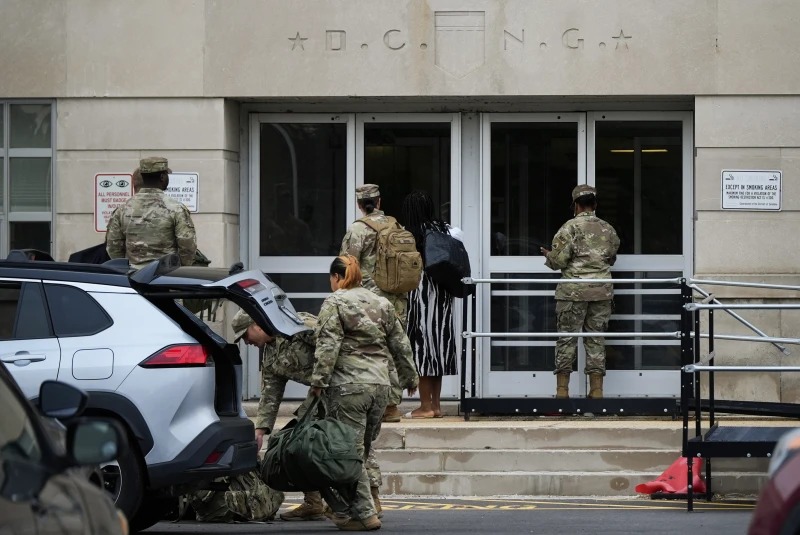
Some of the 800 National Guard members deployed by President Donald Trump began arriving in the nation’s capital on Tuesday, ramping up after the White House ordered federal forces to take over the city’s Police Department and reduce crime in what the President called — without substantiation — a lawless city.

The influx came the morning after Trump announced he would be activating the Guard members and taking over the Department. He cited a crime emergency — but referred to the same crime that city officials stress is already falling noticeably. The President holds the legal right to make such moves — to a point.

The law lets Trump control the Police Department for a month, but how aggressive the federal presence will be and how it could play out remained open questions as the city’s Mayor and Police Chief went to the Justice Department to meet with the Attorney General.

The meeting comes a day after Mayor Muriel Bowser said Trump’s freshly announced plan to take over the Metropolitan Police Department (MPD) and call in the National Guard was not a productive step. She calmly laid out the city’s case that crime has been dropping steadily and said Trump’s perceived state of emergency simply doesn’t match the numbers.

She also flatly stated that the capital city’s hands are tied and that her administration has little choice but to comply. “We could contest that,” she said of Trump’s definition of a crime emergency, “but his authority is pretty broad.”

Bowser made a reference to Trump’s “so-called emergency” and concluded: “I’m going to work every day to make sure it’s not a complete disaster.”

The city and Trump have had a bumpy relationship

While Trump invokes his plan by saying that “we’re going to take our capital back,” Bowser and the MPD maintain that violent crime overall in Washington has decreased to a 30-year low after a sharp rise in 2023. Carjackings, for example, dropped about 50% in 2024 and are down again this year. More than half of those arrested, however, are juveniles, and the extent of those punishments is a point of contention for the Trump administration.

Bowser, a Democrat, spent much of Trump’s first term in office openly sparring with the Republican President. She fended off his initial plans for a military parade through the streets and stood in public opposition when he called in a multi-agency flood of federal law enforcement to confront anti-police brutality protesters in Summer 2020. She later had the words Black Lives Matter painted in giant yellow letters on the street about a block from the White House.

In Trump’s second term, backed by Republican control of both houses of Congress, Bowser has walked a public tightrope for months, emphasizing common ground with the Trump administration on issues such as the successful effort to bring the NFL’s Washington Commanders back to the District of Columbia.

She watched with open concern for the city streets as Trump finally got his military parade this Summer. Her decision to dismantle Black Lives Matter Plaza earlier this year served as a neat metaphor for just how much the power dynamics between the two executives had evolved.

Now that fraught relationship enters uncharted territory as Trump has followed through on months of what many D.C. officials had quietly hoped were empty threats. The new standoff has cast Bowser in a sympathetic light, even among her longtime critics.

“It’s a power play and we’re an easy target,” said Clinique Chapman, CEO of the D.C. Justice Lab. A frequent critic of Bowser, whom she accuses of “over policing our youth” with the recent expansions of Washington’s youth curfew, Chapman said Trump’s latest move “is not about creating a safer D.C. It’s just about power.”

Where the power actually lies

Bowser contends that all the power resides with Trump and that her administration can do little other than comply and make the best of it. The native Washingtonian spent much of Monday’s press conference tying Trump’s takeover to the larger issue of statehood for the District of Columbia. As long as Washington remains a federal enclave with limited autonomy under the 1973 Home Rule Act, she said, it will remain vulnerable to such takeovers.

“We know that access to our democracy is tenuous,” Bowser said. “That is why you have heard me, and many many Washingtonians before me, advocate for full statehood for the District of Columbia.”

Section 740 of the Home Rule Act allows the president to take over Washington’s police for 48 hours, with possible extensions to 30 days, during times of emergencies. No President has done so before, said Monica Hopkins, Executive Director of the American Civil Liberties Union’s D.C. chapter.

“That should alarm everyone,” she said, “not just in Washington.”

For Trump, the effort to take over public safety in Washington reflects an escalation of his aggressive approach to law enforcement. The District of Columbia’s status as a congressionally established federal district gives him a unique opportunity to push his tough-on-crime agenda, though he has not proposed solutions to the root causes of homelessness or crime.

“Let me be crystal clear,” Attorney General Pam Bondi said during Trump’s announcement news conference. “Crime in D.C. is ending and ending today.”

The action fits a presidential pattern

Trump’s declaration of a state of emergency fits the general pattern of his second term in office: He has declared states of emergency on issues ranging from border protection to economic tariffs, enabling him to essentially rule via executive order. In many cases, he has moved forward while the courts sorted them out.

Bowser’s claims about successfully driving down violent crime rates received backing earlier this year from an unlikely source. Ed Martin, Trump’s original choice for U.S. Attorney for the District of Columbia, issued a press release in April hailing a 25% drop in violent crime rates from the previous year.

“Thanks to the leadership of President Trump and the efforts of our ‘Make D.C. Safe Again’ initiative, the District has seen a significant decline in violent crime,” Martin said. “We are proving that strong enforcement, and smart policies can make our communities safer.”

In May, Trump abandoned his efforts to get Martin confirmed for the post in the face of opposition in Congress. His replacement candidate, former judge and former Fox News host Jeanine Pirro, was recently confirmed. On Monday, Pirro — standing next to Trump — called his takeover “the step that we need right now to make criminals understand that they are not going to get away with it anymore.”

___

Republished with permission of The Associated Press.


Post Views: 0


Source link

Continue Reading

Politics

Carlos G. Smith files bill to allow medical pot patients to grow their own plants

Published

on


Home cultivation of marijuana plants could be legal under certain conditions.

Medical marijuana patients may not have to go to the dispensary for their medicine if new legislation in the Senate passes.

Sen. Carlos G. Smith’s SB 776 would permit patients aged 21 and older to grow up to six pot plants.

They could use the homegrown product, but just like the dispensary weed, they would not be able to re-sell.

Medical marijuana treatment centers would be the only acceptable sourcing for plants and seeds, a move that would protect the cannabis’ custody.

Those growing the plants would be obliged to keep them secured from “unauthorized persons.”

Chances this becomes law may be slight.

A House companion for the legislation has yet to be filed. And legislators have demonstrated little appetite for homegrow in the past.


Source link

Continue Reading

Politics

Rolando Escalona aims to deny Frank Carollo a return to the Miami Commission

Published

on


Early voting is now underway in Miami for a Dec. 9 runoff that will decide whether political newcomer Rolando Escalona can block former Commissioner Frank Carollo from reclaiming the District 3 seat long held by the Carollo family.

The contest has already been marked by unusual turbulence: both candidates faced eligibility challenges that threatened — but ultimately failed — to knock them off the ballot.

Escalona survived a dramatic residency challenge in October after a rival candidate accused him of faking his address. A Miami-Dade Judge rejected the claim following a detailed, three-hour trial that examined everything from his lease records to his Amazon orders.

After the Nov. 4 General Election — when Carollo took about 38% of the vote and Escalona took 17% to outpace six other candidates — Carollo cleared his own legal hurdle when another Judge ruled he could remain in the race despite the city’s new lifetime term limits that, according to three residents who sued, should have barred him from running again.

Those rulings leave voters with a stark choice in District 3, which spans Little Havana, East Shenandoah, West Brickell and parts of Silver Bluff and the Roads.

The runoff pits a self-described political outsider against a veteran official with deep institutional experience and marks a last chance to extend the Carollo dynasty to a twentieth straight year on the dais or block that potentiality.

Escalona, 34, insists voters are ready to move on from the chaos and litigation that have surrounded outgoing Commissioner Joe Carollo, whose tenure included a $63.5 million judgment against him for violating the First Amendment rights of local business owners and the cringe-inducing firing of a Miami Police Chief, among other controversies.

A former busboy who rose through the hospitality industry to manage high-profile Brickell restaurant Sexy Fish while also holding a real estate broker’s license, Escalona is running on a promise to bring transparency, better basic services, lower taxes for seniors and improved permitting systems to the city.

He wants to improve public safety, support economic development, enhance communities, provide more affordable housing, lower taxes and advocate for better fiscal responsibility in government.

He told the Miami Herald that if elected, he’d fight to restore public trust by addressing public corruption while re-engaging residents who feel unheard by current officials.

Carollo, 55, a CPA who served two terms on the dais from 2009 to 2017, has argued that the district needs an experienced leader. He’s pointed to his record balancing budgets and pledges a residents-first agenda focused on safer streets, cleaner neighborhoods and responsive government.

Carollo was the top fundraiser in the District 3 race this cycle, amassing about $501,000 between his campaign account and political committee, Residents First, and spending about $389,500 by the last reporting dates.

Escalona, meanwhile, reported raising close to $109,000 through his campaign account and spending all but 6,000 by Dec. 4.

The winner will secure a four-year term.


Source link

Continue Reading

Politics

Florida kicks off first black bear hunt in a decade, despite pushback

Published

on


For the first time in a decade, hunters armed with rifles and crossbows are fanning out across Florida’s swamps and flatwoods to legally hunt the Florida black bear, over the vocal opposition of critics.

The state-sanctioned hunt began Saturday, after drawing more than 160,000 applications for a far more limited number of hunting permits, including from opponents who are trying to reduce the number of bears killed in this year’s hunt, the state’s first since 2015.

The Florida Fish and Wildlife Conservation Commission awarded 172 bear hunt permits by random lottery for this year’s season, allowing hunters to kill one bear each in areas where the population is deemed large enough. At least 43 of the permits went to opponents of the hunt who never intend to use them, according to the Florida chapter of the Sierra Club, which encouraged critics to apply in the hopes of saving bears.

The Florida black bear population is considered one of the state’s conservation success stories, having grown from just several hundred bears in the 1970s to an estimated more than 4,000 today.

The 172 people who were awarded a permit through a random lottery will be able to kill one bear each during the 2025 season, which runs from Dec. 6 to Dec. 28. The permits are specific to one of the state’s four designated bear hunting zones, each of which have a hunting quota set by state officials based on the bear population in each region.

In order to participate, hunters must hold a valid hunting license and a bear harvest permit, which costs $100 for residents and $300 for nonresidents, plus fees. Applications for the permits cost $5 each.

The regulated hunt will help incentivize maintaining healthy bear populations, and help fund the work that is needed, according to Mark Barton of the Florida chapter of Backcountry Hunters and Anglers, an advocacy group that supported the hunt.

Having an annual hunt will help guarantee funding to “keep moving conservation for bears forward,” Barton said.

According to state wildlife officials, the bear population has grown enough to support a regulated hunt and warrant population management. The state agency sees hunting as an effective tool that is used to manage wildlife populations around the world, and allows the state to monetize conservation efforts through permit and application fees.

“While we have enough suitable bear habitat to support our current bear population levels, if the four largest subpopulations continue to grow at current rates, we will not have enough habitat at some point in the future,” reads a bear hunting guide published by the state wildlife commission.

___

Republished with permission of the Associated Press.


Source link

Continue Reading

Trending

Copyright © Miami Select.