Connect with us

Fashion

Lab-grown diamonds are testing the power of markets

Published

on


By

Bloomberg

Published


August 11, 2025

I love markets. I also love diamonds. This helps explain why I am experiencing a kind of existential crisis: The popularity of lab-grown diamonds is making me question the beauty of markets, which is their ability to place a value on pretty much anything.

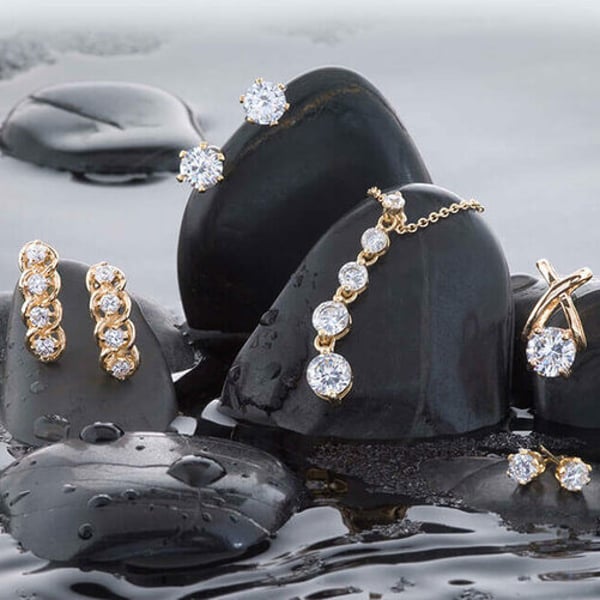
Diamond jewellery by Mini Diamonds – Mini Diamonds India Ltd

And it is not just diamonds. Everything in the economy whose value is predicated on scarcity is suddenly abundant: luxury handbags, music, even currency itself. Why is anything worth anything anymore?

Diamonds hold a special place in my heart, not just as fan of jewellery but also as an economist. When young economists first start to ponder the concept of value and why things cost what they do, we inevitably turn to the OG, Adam Smith. It is remarkable, he observed, that diamonds cost more than water. “Nothing is more useful than water; but it will purchase scarce any thing,” he wrote. “A diamond, on the contrary, has scarce any value in use; but a very great quantity of other goods may frequently be had in exchange for it.”

It is the diamond’s scarcity (as well as some good marketing) that made the market large and valuable. In time, this rare bit of carbon, which takes the earth millions of years to create, came to symbolise eternal love and commitment.

Now diamonds can be made in a lab in not too much time, in just about any quantity. They have no resale value, nor do they signify eternal love.(1) But try telling that to someone who just got (or gave) a perfect 3-carat engagement ring that is 90% cheaper than the “real thing.” Meanwhile, the price of natural diamonds — which always promised to hold their value — is down as much as 40%.

Again, the questions present themselves: If the supply of diamonds is unlimited, what is their value? Can the market put a price on them? More generally, how will markets deal with this crisis of abundance?

After all, pretty much everything in the US (except for housing) is available and on demand in any quantity. Almost all music ever made is available on demand on your phone, for the monthly price of what a single album once cost. Information once available from only a handful of media companies is now virtually everywhere from any source you want, with whatever spin you want. And just as in music, in media no one knows what business model works, because what is valuable seems to change by the minute.

Even the most valuable and scarce commodity of all — intelligence — is becoming abundant. Chess players and finance gurus (some version of them, anyway), can be conjured through the magic of AI, and their talents dispensed for free. What does this mean for the value of human thought, knowledge and discernment?

The markets will eventually sort it all out. At least that’s what I tell myself. After all, food and many now-disposable consumer goods were once scarce too. Now that they no longer are, look how much better off we are. Yes, the process was messy, but in the end the market made the goods that people wanted more abundant. Whether you prefer gourmet potato chips or dinner at a gourmet restaurant, they are available for a price, one of which may actually be worth it.

Consumer goods are also segmented by quality. That may be the future of diamonds. There is an abundance of fake Birkin bags, for example, which can now be bought at Walmart (along with lab-grown diamonds). To an untrained eye these bags are indistinguishable from the real thing — also leather, also look nice, also carry your things — and yet people still desire a real Birkin, for which there is a yearslong waitlist. It could be the mystique, or the valuable resale market, but there are people willing to spend 15,000 dollars on an authentic Birkin.

What Hermes has managed to do is create scarcity out of abundance. It controls the supply of Birkins, and won’t sell that many bags. Not only does this keep demand high, but it diverts demand to other Hermes goods. Other luxury designers battling fakes are less discerning: They sell more bags and are experiencing a fall in demand.

De Beers, one of the world’s largest diamond dealers, faces a difficult problem: The diamond market is too large for De Beers to use the Hermes strategy. It needs diamonds to be rare and special — but also on every engagement ring in America.

This may not be realistic anymore. A likely alternative is a world where natural diamonds are still coveted — they hold their value and have special symbolism — and, like the Birkin, are mainly consumed by an elite segment of the market. The market for smaller, lower quality natural diamonds may well disappear.

If that happens, my faith in both a diamond’s value and the market’s forces will be restored. Which is good, because both things — more beauty and more commerce — make everyone better off. 
This column reflects the personal views of the author and does not necessarily reflect the opinion of the editorial board or Bloomberg LP and its owners.

Allison Schrager is a Bloomberg Opinion columnist covering economics. A senior fellow at the Manhattan Institute, she is author of “An Economist Walks Into a Brothel: And Other Unexpected Places to Understand Risk.”

Opinion with Bloomberg.


Source link

Continue Reading

Fashion

Twinset confirms ex-Stella McCartney CEO Maggio’s appointment as new chief executive

Published

on


Translated by

Nicola Mira

Published


December 15, 2025

Gabriele Maggio has been officially appointed CEO of Twinset, under new owners Borletti Group and Quadrivio (the latter through its Made in Italy Fund II). As first reported by FashionNetwork.com in early December, Maggio has been confirmed as the new helm of the Carpi-based Italian womenswear label, sold in June 2025 by the Carlyle investment fund to the current owners, which share a 100% stake in Twinset.

Gabriele Maggio

Maggio has taken over from Alessandro Varisco, who left Twinset after 10 years in charge, a lengthy tenure during which Varisco was directly involved in the label’s sale, a process that Carlyle had embarked on prior to the pandemic.

Maggio’s appointment is part of the relaunch strategy deployed by Borletti Group and Quadrivio, aimed at consolidating Twinset’s position in the affordable luxury segment. A goal that will also be pursued through marketing and communication initiatives with a focus on digital. The new owners are keen to extend Twinset’s retail footprint, both by boosting its presence in the e-tail channel and by expanding in markets that are key for the label, like Spain, France and Eastern Europe.

“I’m excited to join Twinset at this crucial time in its journey,” said Maggio. “The brand has enormous potential, a unique creative heritage and a highly talented staff. Together with the new partners and the entire team, we will work to promote a new phase of solid, inspired growth, further strengthening the brand’s presence in the Italian and European landscape,” he added.

Maggio has joined Twinset after a stint of over a year and a half at Betty Blue, as the CEO of Elisabetta Franchi. He was formerly the president and CEO of Stella McCartney, spearheading the label’s international expansion and positioning it as a benchmark in sustainable luxury. Before that, he was managing director at Moschino, and held senior roles at Gucci, Bottega Veneta, Giorgio Armani and Prada.

“Gabriele’s arrival marks a crucial stage in Twinset’s new era,” said Maurizio Negro, president of Twinset, adding that “his in-depth industry knowledge, combined with his experience as a leader of international brands, makes him the ideal profile to marshal the company through this growth and transformation phase.”

“[Maggio’s] international experience and ability to lead creative and complex organisational teams make him the ideal leader to steer the company through this new phase, in which we want to fully exploit [Twinset’s] potential,” said Maurizio Borletti, partner and co-founder of Borletti Group. “We are sure that Maggio’s professionalism and vision will enable the brand to further consolidate its positioning and strengthen its presence internationally, in line with the fund’s investment strategy,” stated Alessandro Binello, CEO of Quadrivio.

Copyright © 2025 FashionNetwork.com All rights reserved.


Source link

Continue Reading

Fashion

Christmas-related retail footfall picks up, two sets of data show

Published

on


Published


December 15, 2025

Festive footfall is starting to build nicely as the journey to Christmas already looks being upbeat for retailers, according to data from both global retail solutions portfolio Sensormatic Solutions and MRI Software.

Over the latest weekend (13-14 December) footfall rose 4.4% week-on-week, Sensormatic’s ShopperTrak Analytics data, which captures 40 billion store visits globally each year, showed.

Shopper counts across last week also increased steadily, rising 3.6% on the week before (1-7 December vs 8-14 December).  However, footfall across Saturday and Sunday remained lower than 2024, down 5.7% and 5.4% year-on-year respectively. 

UK shoppers were expected to have made 20.6 million transactions over Friday and Saturday, 6.39% higher than 2024, according to separate figures from Nationwide,

While footfall rose 3.5% week-on-week last Saturday, Sunday was the top performing day for store visits across the weekend, with shopper counts jumping 5.7% on the week prior and High Streets seeing the biggest boost (+12%).

Andy Sumpter, EMEA Retail consultant at Sensormatic Solutions, said: “After a mixed start to Peak Trading and concerns that consumer caution could dampen consumers’ Christmas spirits, retailers will have welcomed the tempered but steady build in festive footfall last week.”

Super Saturday (20 December) is expected to be the busiest day for store footfall of the entire Peak Trading season, according to Sensormatic’s predictions. This year, consumers are expected to make 10.7 million transactions on Super Saturday as they rush to finish their Christmas shopping.

Sumpter added: “All eyes now turn to Super Saturday, undoubtedly one of the highest-stakes shopping days of the Christmas season. And, while a single day can’t carry the entire trading period, retailers will be hoping that early momentum continues to build towards the Christmas crescendo.”

Over at MRI Software, retail footfall remained strong last week (8-14 December) compared to the prior week with a 3.1% rise recorded across all UK retail destinations. This was mainly driven by a 5% rise in high streets and a 2.2% uplift in shopping centres, whereas retail park visits were flat on the week before

While declines were recorded across the board on Sunday (-9.7%) and Tuesday (-6.2%), both mostly down to bad weather, “this did little to hamper overall trends”.

However, footfall rebounded strongly as conditions improved, with visits jumping 10.7% on Monday and 11.5% on Thursday, driven largely by activity on the high street. This could suggest the festive events and attractions drawing visitors in as well as festive parties whether they be work or social led, it said.

This is also reflected in Central London footfall remaining 4.2% higher week-on-week and 7.1% higher year-on-year. However historic and market towns recorded annual declines of -3.3% and -3% respectively.

Shopping centres witnessed similar trends to that of the high street with visits peaking on Thursday by 10%. Retail parks saw sharp declines on Sunday (-8.6%) and Tuesday (-5.7%) but experienced relatively steady growth for the remainder of the week.

Compared to the same week last year, footfall remained 0.5% lower largely influenced by a drop in shopping centre (-3.1%) and retail park (-1.6%) visits. High streets bucked the trend and saw visits rise by +1.3%. 

Copyright © 2025 FashionNetwork.com All rights reserved.


Source link

Continue Reading

Fashion

Puma loses long-serving communications manager

Published

on


Published


December 15, 2025

Puma must fill a key role in the sports company’s global communications as Kerstin Neuber is leaving the Herzogenaurach-based business after a total of 18 years. She most recently served as senior director corporate communications. According to Puma, Robert-Jan Bartunek (team head corporate communications) will assume her duties on an interim basis until a successor is appointed.

Kerstin Neuber is leaving of her own accord to pursue new professional challenges. – PUMA

Neuber is departing of her own accord to pursue new professional challenges. The company thanks her for “her great commitment and significant contribution in recent years.”

Puma said that Kerstin Neuber has played a key role in shaping its corporate communications. Among other responsibilities, she oversaw the strategic development and implementation of communications initiatives, served as corporate spokesperson, and led crisis and reputation management. She also coordinated the company’s international corporate PR activities and advised the Executive Board, management, and subsidiaries on strategic matters.

“We would like to express our sincere gratitude to Kerstin for her dedication, expertise and leadership,” said CEO Arne Freundt. “With her strategic approach and deep understanding of communications, she has helped to strengthen the company’s reputation and public presence. We wish her every success in her future endeavours.”

This article is an automatic translation.
Click here to read the original article.

Copyright © 2025 FashionNetwork.com All rights reserved.


Source link

Continue Reading

Trending

Copyright © Miami Select.