Connect with us

Business

Consumers are already paying two-thirds of tariff costs, says Goldman Sachs

Published

on


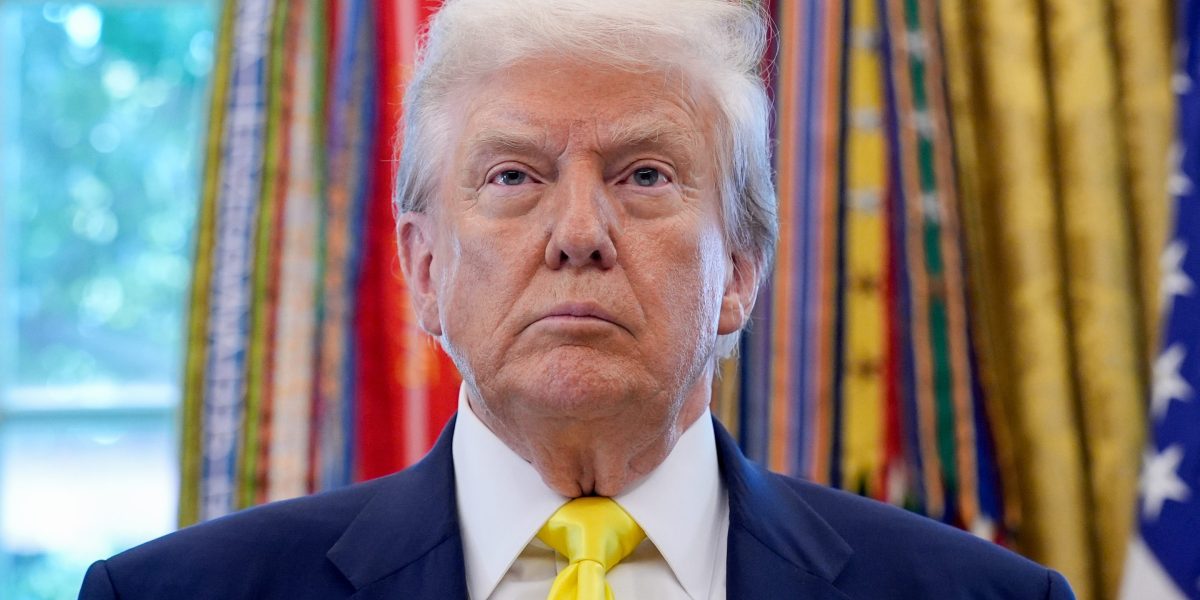
When President Trump announced his tariff agenda, he said it would be foreign companies and consumers that would “eat” the price hikes. That’s a take which may be proved optimistic at best, and misguided at worst.

While tariffs have yet to significantly shift the dial on inflation—prompting individuals like Treasury Secretary Scott Bessent to label them the “dog that didn’t bark”—analysts are widely expecting the hikes to ultimately be paid for by the U.S.

So far the sharpest end of the tariff regime has yet to be felt. President Trump delayed his ‘Liberation Day’ tariffs by three months in order to agree deals with trading partners.

Some negotiations have proved successful, with framework deals done with the U.K., the E.U. and Japan to name a few, drastically lowering tariff rates from Trump’s initial threats back in April. Yet countries which haven’t yet agreed to a deal (who received letters informing them of their new tariff rate) saw their effective export rate rise on the deadline of August 7.

That includes nations like India, which is facing a rate of 25% that may double on August 27 as punishment for buying Russian oil. Likewise, while the Trump administration has touted a deal near-done with China on many occasions, nothing beyond an agreement to delay tit-for-tat price increases until this week has been confirmed.

With a slew of tariffs now effectively in place, Goldman Sachs believes that the cost absorbed by foreign exporters will grow over time, but will remain low.

Economist Elsie Peng wrote in a note yesterday seen by Fortune that Goldman believes exporters absorbed 14% of the costs of all tariffs in June, which will rise to 25% by October if the sanctions follow a similar trajectory to the price hikes administered by the Trump administration in his first term.

But the portion consumers can expect to pay is also on the rise. Peng noted that around 36% of the 2025 tariff costs were passed onto consumer prices after three months of implementation and around 67% were passed on after four months.

The economist added that “although the passthrough rate appears to be increasing rapidly over time, it still remains somewhat below the passthrough rate that we estimate at the same point in time during the 2018-2019 trade war.”

One portion of the economy which intends to reduce its share is U.S. businesses. The Conference Board released its U.S. CEO Confidence report for the third quarter last week, which revealed 64% are certain they’d be passing the price hike onto consumers, and a further 16% said they’re still considering.

This is a higher rate than previously identified (following the prediction of Goldman Sachs) as only in June the New York Fed reported a smaller 45% of services firms were intending to pass on the full extent of their tariff-related increases.

Peng noted that her maths “implies that U.S. businesses have absorbed more than half of the tariff costs so far but that their share would fall to less than 10%. This net impact on U.S. businesses likely masks that some companies have absorbed a larger share of tariff costs, while some domestic producers shielded from import competition have raised their own prices and benefited.”

Inflation passthrough

Of course, if consumers are paying higher prices for goods and services then the Federal Reserve’s job of keeping inflation to 2% will only get more difficult.

Goldman Sachs believes this will be the case, writing: “Our analysis implies that tariff effects have boosted the core PCE price level by 0.20% so far.

“We expect another 0.16% impact in July, followed by an additional 0.5% from August through December. This would leave core PCE inflation at 3.2% year-over-year in December, assuming that the underlying inflation trend net of tariff effects is 2.4%.”

Reflecting on the June CPI report (the latest available at the time of writing), Macquarie’s North America economists David Doyle and Chinara Azizova commented that the data was already showing hints of passthrough inflation.

They wrote last month: “Notable price pressures were apparent in household furnishings and supplies, apparel, video and audio products, sporting goods, and toys. This list suggests impacts from tariffs on the data. One measure that reflects this is core goods ex used cars and trucks. This accelerated to +0.3% MoM, its strongest pace since Feb-23. It also shows an accelerating monthly trend.”

Many economists are hoping Fed chairman Jerome Powell will see through this inflation and lower the base rate, in part to offset an alarming jobs report from the Bureau of Labor Statistics a matter of weeks ago. But analysts can’t hold their breath—after all, Powell made the point at his last press conference that by not raising rates (a move which truly would have upset markets) he is already seeing through such pressures.

Introducing the 2025 Fortune Global 500, the definitive ranking of the biggest companies in the world. Explore this year’s list.


Source link

Continue Reading

Business

SpaceX to offer insider shares at record-setting $800 billion valuation

Published

on


SpaceX is preparing to sell insider shares in a transaction that would value Elon Musk’s rocket and satellite maker at as much as $800 billion, people familiar with the matter said, reclaiming the title of the world’s most valuable private company. 

The details, discussed by SpaceX’s board of directors on Thursday at its Starbase hub in Texas, could change based on interest from insider sellers and buyers or other factors, said some of the people, who asked not to be identified as the information isn’t public. SpaceX is also exploring a possible initial public offering as soon as late next year, one of the people said. 

Another person briefed on the matter said that the price under discussion for the sale of some employees and investors’ shares is higher than $400 apiece, which would value SpaceX at between $750 billion and $800 billion. The company wouldn’t raise any funds though this planned sale, though a successful offering at such levels would catapult it past the record of $500 billion valuation achieved by OpenAI in October.

Elon Musk on Saturday denied that SpaceX is raising money at a $800 billion valuation without addressing Bloomberg’s reporting on the planned offering of insiders’ shares. 

“SpaceX has been cash flow positive for many years and does periodic stock buybacks twice a year to provide liquidity for employees and investors,” Musk said in a post on his social media platform X. 

The share sale price under discussion would be a substantial increase from the $212 a share set in July, when the company raised money and sold shares at a valuation of $400 billion. The Wall Street Journal and Financial Times earlier reported the $800 billion valuation target.

News of SpaceX’s valuation sent shares of EchoStar Corp., a satellite TV and wireless company, up as much as 18%. Last month, EchoStar had agreed to sell spectrum licenses to SpaceX for $2.6 billion, adding to an earlier agreement to sell about $17 billion in wireless spectrum to Musk’s company.

Subscribe Now: The Business of Space newsletter covers NASA, key industry events and trends.

The world’s most prolific rocket launcher, SpaceX dominates the space industry with its Falcon 9 rocket that lifts satellites and people to orbit.

SpaceX is also the industry leader in providing internet services from low-Earth orbit through Starlink, a system of more than 9,000 satellites that is far ahead of competitors including Amazon.com Inc.’s Amazon Leo.

Elite Group

SpaceX is among an elite group of companies that have the ability to raise funds at $100 billion-plus valuations while delaying or denying they have any plan to go public. 

An IPO of the company at an $800 billion value would vault SpaceX into another rarefied group — the 20 largest public companies, a few notches below Musk’s Tesla Inc. 

If SpaceX sold 5% of the company at that valuation, it would have to sell $40 billion of stock — making it the biggest IPO of all time, well above Saudi Aramco’s $29 billion listing in 2019. The firm sold just 1.5% of the company in that offering, a much smaller slice than the majority of publicly traded firms make available.

A listing would also subject SpaceX to the volatility of being a public company, versus private firms whose valuations are closely guarded secrets. Space and defense company IPOs have had a mixed reception in 2025. Karman Holdings Inc.’s stock has nearly tripled since its debut, while Firefly Aerospace Inc. and Voyager Technologies Inc. have plunged by double-digit percentages since their debuts.

SpaceX executives have repeatedly floated the idea of spinning off SpaceX’s Starlink business into a separate, publicly traded company — a concept President Gwynne Shotwell first suggested in 2020. 

However, Musk cast doubt on the prospect publicly over the years and Chief Financial Officer Bret Johnsen said in 2024 that a Starlink IPO would be something that would take place more likely “in the years to come.”

The Information, citing people familiar with the discussions, separately reported on Friday that SpaceX has told investors and financial institution representatives that it’s aiming for an IPO of the entire company in the second half of next year.

Read More: How to Buy SpaceX: A Guide for the Eager, Pre-IPO

A so-called tender or secondary offering, through which employees and some early shareholders can sell shares, provides investors in closely held companies such as SpaceX a way to generate liquidity.

SpaceX is working to develop its new Starship vehicle, advertised as the most powerful rocket ever developed to loft huge numbers of Starlink satellites as well as carry cargo and people to moon and, eventually, Mars.


Source link

Continue Reading

Business

National Park Service drops free admission on MLK Day and Juneteenth while adding Trump’s birthday

Published

on


The National Park Service will offer free admission to U.S. residents on President Donald Trump’s birthday next year — which also happens to be Flag Day — but is eliminating the benefit for Martin Luther King Jr. Day and Juneteenth.

The new list of free admission days for Americans is the latest example of the Trump administration downplaying America’s civil rights history while also promoting the president’s image, name and legacy.

Last year, the list of free days included Martin Luther King Jr Day and Juneteenth — which is June 19 — but not June 14, Trump’s birthday.

The new free-admission policy takes effect Jan. 1 and was one of several changes announced by the Park Service late last month, including higher admission fees for international visitors.

The other days of free park admission in 2026 are Presidents Day, Memorial Day, Independence Day, Constitution Day, Veterans Day, President Theodore Roosevelt’s birthday (Oct. 27) and the anniversary of the creation of the Park Service (Aug. 25).

Eliminating Martin Luther King Jr. Day and Juneteenth, which commemorates the day in 1865 when the last enslaved Americans were emancipated, removes two of the nation’s most prominent civil rights holidays.

Some civil rights leaders voiced opposition to the change after news about it began spreading over the weekend.

“The raw & rank racism here stinks to high heaven,” Harvard Kennedy School professor Cornell William Brooks, a former president of the NAACP, wrote on social media about the new policy.

Kristen Brengel, a spokesperson for the National Parks Conservation Association, said that while presidential administrations have tweaked the free days in the past, the elimination of Martin Luther King Jr. Day is particularly concerning. For one, the day has become a popular day of service for community groups that use the free day to perform volunteer projects at parks.

That will now be much more expensive, said Brengel, whose organization is a nonprofit that advocates for the park system.

“Not only does it recognize an American hero, it’s also a day when people go into parks to clean them up,” Brengel said. “Martin Luther King Jr. deserves a day of recognition … For some reason, Black history has repeatedly been targeted by this administration, and it shouldn’t be.”

Some Democratic lawmakers also weighed in to object to the new policy.

“The President didn’t just add his own birthday to the list, he removed both of these holidays that mark Black Americans’ struggle for civil rights and freedom,” said Democratic Sen. Catherine Cortez Masto of Nevada. “Our country deserves better.”

A spokesperson for the National Park Service did not immediately respond to questions on Saturday seeking information about the reasons behind the changes.

Since taking office, Trump has sought to eliminate programs seen as promoting diversity across the federal government, actions that have erased or downplayed America’s history of racism as well as the civil rights victories of Black Americans.

Self-promotion is an old habit of the president’s and one he has continued in his second term. He unsuccessfully put himself forwardfor the Nobel Peace Prize, renamed the U.S. Institute of Peace after himself, sought to put his name on the planned NFL stadium in the nation’s capital and had a new children’s savings program named after him.

Some Republican lawmakers have suggested putting his visage on Mount Rushmore and the $100 bill.


Source link

Continue Reading

Business

JPMorgan CEO Jamie Dimon says Europe has a ‘real problem’

Published

on


JPMorgan Chase & Co. Chief Executive Officer Jamie Dimon called out slow bureaucracy in Europe in a warning that a “weak” continent poses a major economic risk to the US.

“Europe has a real problem,” Dimon said Saturday at the Reagan National Defense Forum. “They do some wonderful things on their safety nets. But they’ve driven business out, they’ve driven investment out, they’ve driven innovation out. It’s kind of coming back.”

While he praised some European leaders who he said were aware of the issues, he cautioned politics is “really hard.” 

Dimon, leader of the biggest US bank, has long said that the risk of a fragmented Europe is among the major challenges facing the world. In his letter to shareholders released earlier this year, he said that Europe has “some serious issues to fix.”

On Saturday, he praised the creation of the euro and Europe’s push for peace. But he warned that a reduction in military efforts and challenges trying to reach agreement within the European Union are threatening the continent.

“If they fragment, then you can say that America first will not be around anymore,” Dimon said. “It will hurt us more than anybody else because they are a major ally in every single way, including common values, which are really important.”

He said the US should help.

“We need a long-term strategy to help them become strong,” Dimon said. “A weak Europe is bad for us.”

The administration of President Donald Trump issued a new national security strategy that directed US interests toward the Western Hemisphere and protection of the homeland while dismissing Europe as a continent headed toward “civilizational erasure.”

Read More: Trump’s National Security Strategy Veers Inward in Telling Shift

JPMorgan has been ramping up its push to spur more investments in the national defense sector. In October, the bank announced that it would funnel $1.5 trillion into industries that bolster US economic security and resiliency over the next 10 years — as much as $500 billion more than what it would’ve provided anyway. 

Dimon said in the statement that it’s “painfully clear that the United States has allowed itself to become too reliant on unreliable sources of critical minerals, products and manufacturing.”

Investment banker Jay Horine oversees the effort, which Dimon called “100% commercial.” It will focus on four areas: supply chain and advanced manufacturing; defense and aerospace; energy independence and resilience; and frontier and strategic technologies. 

The bank will also invest as much as $10 billion of its own capital to help certain companies expand, innovate or accelerate strategic manufacturing.

Separately on Saturday, Dimon praised Trump for finding ways to roll back bureaucracy in the government.

“There is no question that this administration is trying to bring an axe to some of the bureaucracy that held back America,” Dimon said. “That is a good thing and we can do it and still keep the world safe, for safe food and safe banks and all the stuff like that.”


Source link

Continue Reading

Trending

Copyright © Miami Select.