Connect with us

Business

How Palantir—a company too small to make the Fortune 500—became one of the world’s 25 most valuable companies
Published

on


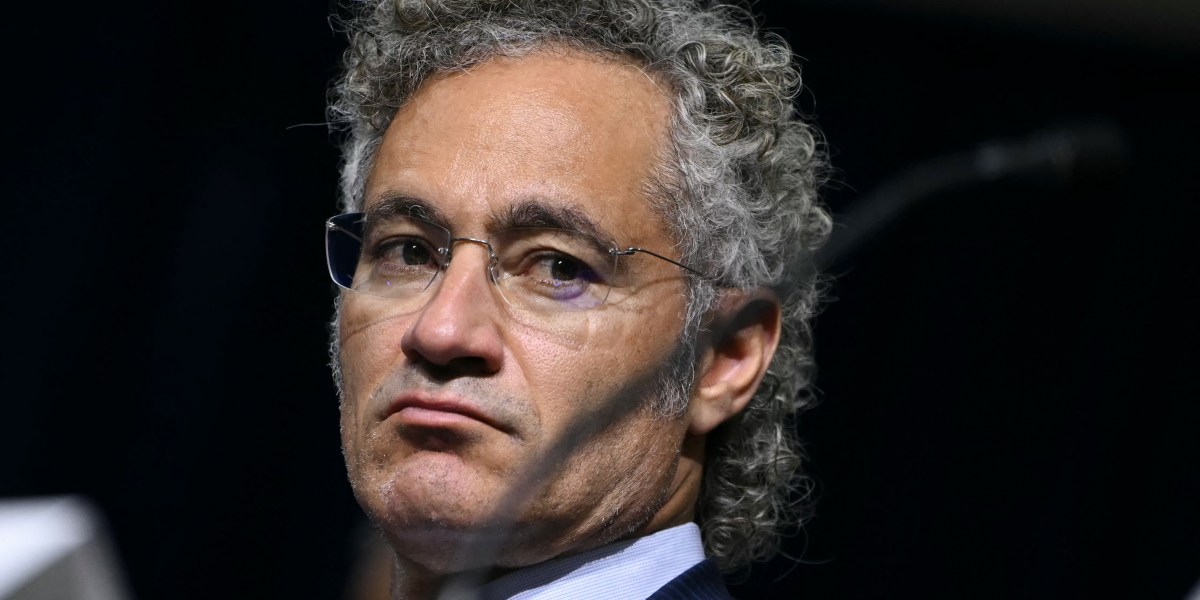
Alex Karp, the frizzy-haired CEO of defense software company Palantir, has become somewhat of a pro at deflecting criticism. As he sat for an interview in April at the tech policy-focused Hill and Valley Forum in Washington D.C. and a heckler started shouting at him from the balcony, Karp retorted rather calmly, telling the audience he believed it was her right to express her views.

But this week—after Palantir reported blockbuster earnings on Monday—Karp took a moment to bask in his company’s meteoric rise and take a jab at his critics.

Palantir, based in Denver, surpassed $1 billion in quarterly revenue for the first time this week, posting growth figures that blew past analyst estimates. Palantir’s stock soared to more than $160 a share, marking a 555% increase from this time last year. By market close on Tuesday, Palantir’s market cap had hit nearly $409 billion, making it the 23rd most valuable company in the world, just behind Johnson & Johnson, a company with more than 23 times Palantir’s revenue and more than 35x the number of employees. 

As he started speaking on Monday’s earnings call, Karp, who has a PhD in neoclassical social theory, was absolutely delighted—and true to form, a bit snarky, too.

“Well, as usual, I’ve been cautioned to be a little modest about our bombastic numbers, but honestly, there’s no authentic way to be anything but have enormous pride and gratefulness about these extraordinary numbers,” Karp said. As he wrapped up the call, he gave a quippy message to retail investors about the analysts that have “been wrong about every quarter.” “Maybe stop talking to all the haters—they’re suffering,” he said.

Palantir, a software company co-founded by Peter Thiel, has many “haters,” as Karp puts it. As a tech company that got its start selling to the U.S. military during the War on Terror, Palantir has been fully embedded in some of the most polarizing political debates of modern geopolitics. Particularly now, Palantir has stirred criticism over its software being used by Immigration and Customs Enforcement, as well as the Israeli military.

On the financial side, there’s a different kind of critic: those who question how such a relatively small company—one whose revenue and profits are so small in comparison to peers that it doesn’t even qualify for the Fortune 500 list—could reasonably become one of the most valuable companies in the world. 

For Palantir, it has been a slow, albeit volatile, climb to where it is now—marked by contentious legal battles, noisy protests and picket lines, and an eccentric leadership team and employee base who sometimes endearingly refer to one another as “hobbits,” in credit to the company’s Lord of the Rings nomenclature (Palantir is in reference to the seeing stones created by Elves that allow people to see far away or communicate with others). And, more recently, in the last two years, Palantir has ridden the generative AI wave.

“They’ve got their feet under them—they’ve got their sales cycle down a little bit more. They’re just making things really, really sticky for large multinational corporations,” says Evan Loomis, a venture capitalist who is close friends with Palantir cofounder Joe Lonsdale and whose construction technology startup, ICON, uses Palantir’s software platform Foundry.

While the company is currently one of the best-performing stocks in the S&P 500, Palantir’s stock has also been known to be incredibly volatile, and sometimes dramatically influenced by retail investor activity. Palantir is undoubtedly having a moment—but will it last?

‘Two times more expensive’

There are a host of near-term data points analysts look at: sales, cash flow, profit, customer retention. If you look at most of these near-term fundamentals, Palantir is trading at a premium.

“They are trading at least two times more expensive on the traditional metrics,” says Mariana Pérez Mora, an equity analyst at Bank of America Securities, who has been following the company since 2022.

But, as we speak, Pérez Mora reminds me about another important, longer-term metric for SaaS companies that Karp has repeatedly reminded onlookers to pay close attention to. That metric is called the “Rule of Forty.”

The Rule of Forty figure is calculated by adding the year-over-year revenue growth rate and adjusted operating margin. If those percentages are collectively higher than 40%, you have sustainable growth. 

If you look at Palantir’s last quarter, Pérez Mora points out, the rule of 40 was 94%

“That is the type of growth they are having. And the reality is that growth is accelerating, and that accelerating growth is not at the expense of profitability. And that is pretty unique,” she says, adding: “Palantir is trading as the company that they are growing into, and this is why it’s more expensive.” 

There are a few key contributors to these numbers. For one, new government contracts. 

Palantir has been working with the government since the beginning—its first customer being the CIA—and government contracts still make up a majority of its business. At the end of July, Palantir signed a 10-year contract worth up to $10 billion with the U.S. Army.  It was one of the largest software contracts the Department of Defense has ever signed and, by far, Palantir’s largest contract to-date. And, ironically, it is the same customer Palantir sued (successfully) almost 10 years ago, accusing the department of unlawfully excluding companies like Palantir from its procurement process. 

There could be more contracts of this scale on the table, too. The Fostering Reform and Government Efficiency Act, or FoRGED Act, currently on the table would reshape the Department of Defense’s procurement process for private contracts, eliminating hundreds of statutes and making it easier for tech companies like Palantir to sell to the government. The legislation, which Palantir has publicly endorsed and which its executives have pushed for in public hearings, would likely cut into the advantage that some of the industry incumbents like Boeing, Lockheed Martin, RTX, and Northrop Grumman have gained over the years. 

The Department of Defense has been making trims to its budget since Trump named Pete Hegseth to the top role. But Palantir is seemingly benefitting from that, too. Only a couple months after the Department of Defense said it had cut more than $5.1 billion in contracts to consulting agencies, including Accenture and Deloitte, both companies announced new strategic partnerships with Palantir to collectively deliver solutions to government clients. 

But the lion share of growth at Palantir over the last year is coming from a newer segment of customers—the commercial side of the business. Revenue for the commercial side rose 93% year-over-year this past quarter. And nearly all of those contracts stem from the generative artificial intelligence platform it released in 2023, called “AIP” (which stands for the ever-original “artificial intelligence platform”). 

Perez Mora says that while a lot of companies are building and offering large language models, Palantir has found a way to help companies make use of them—and drive real results for their businesses. 

On this last earnings call, Karp said that Citibank was onboarding its customers and running the relevant know-your-customer and security checks in seconds, down from nine days. He said that residential mortgage enterprise Fannie Mae is uncovering mortgage fraud in seconds, versus two months. And he said that Lear Corporation is using Palantir’s platform to manage tariff exposure.

Investors seem to have taken note, as there is a direct correlation between the launch of AIP in 2023 and the steady upward trajectory Palantir’s stock has experienced since.

But generative AI is still new—and many companies and industries haven’t fully explored or realized just what jobs AI will be able to replace or make more efficient. Palantir itself doesn’t seem to have it sorted out either. 

CEO Karp said in an interview on CNBC this week that he thinks Palantir could keep growing revenue while reducing headcount by 500 jobs to about 3,600 people. But if you look at Palantir’s headcount, it has been doing the opposite: adding about 200 people between 2023 and 2024, not cutting roles. For all that companies like Alphabet or Salesforce are boasting of the efficiencies they are adding within their ranks by using AI, those same companies have seen their workforces grow.

One of Silicon Valley’s most controversial companies

Palantir’s valuation may be climbing to new heights, but the company is as controversial as ever. They’ve been the target of sit-ins, picketings, and other protests that have pulled in hundreds of people in New York City, Palo Alto, Denver, Seattle, and Los Angeles, condemning Palantir’s contract with the ICE (Palantir has been running a ​​six-month pilot contract “centered on enforcement prioritization and immigration lifecycle management,” the company says.) Palantir has a partnership with the Israeli Defense Forces for “war-related missions,” which has also come under fire. A report submitted to the UN Human Rights Council in June that singled out companies aiding Israel in the war in Gaza, including Lockheed Martin, said there was “reasonable grounds to believe” Palantir was providing automatic predictive policing technology and core defense infrastructure to Israel. 

A Palantir spokeswoman said the company “does not provide the technology for Israel to conduct missile strikes or targeting operations in Gaza and has no involvement in the Lavendar or Gospel systems. These targeting capabilities are entirely independent of and predate our partnership with Israel’s Ministry of Defense.”

Anti-ICE demonstrators gather outside of the Palantir office to protest Palantir Technologies and U.S. Immigration and Customs Enforcement (ICE) in Palo Alto, California on July 14, 2025.

Tayfun Coskun—Getty Images

Karp addressed some of the criticism Palantir has received over the years on the last earnings call. “Palantir gets attacked just because we help make this country even better, because we support the values, because we defend it,” he said. Earlier this year, Karp and Palantir’s head of corporate affairs, Nicholas Zamiska, published The Technological Republic, which criticizes Silicon Valley for spending its time on consumer apps and dodging working with the government and playing a role in defending freedoms and democracy.

But there has also been some notable pushback even from former employees in the last couple years. In May, more than a dozen former Palantir employees signed an open letter to the tech community, alleging that Palantir had violated principles core to the company due to its work with the Trump Administration. 

“Palantir prides itself on [a] culture of fierce internal dialogue and even disagreement on difficult issues related to our work,” a Palantir spokeswoman said. “The small number of former Palantir employees—13 of 4,000—raising concerns are certainly entitled to express their views.”

Despite heightened criticism on the public stage, Silicon Valley has come to not only accept, but embrace defense tech since 2022, when Russia invaded Ukraine. It’s one of the hottest sectors around right now, with companies like drone startup Anduril garnering a $30.5 billion valuation in the private markets.

Indeed, tech companies used to shy away from defense contracts. But under the Trump Administration, there’s been a tidal shift. Meta teamed up with Anduril to start working on helmet and headset projects for the U.S. military. Numerous LLM companies, including OpenAI, xAI, and Anthropic, started working with the Department of Defense on national security. Even Google, which famously stopped working with the government in 2018 after internal upheaval from its employees, has gotten into the military business.

In some ways, Palantir—and SpaceX, too—have been a catalyst for the shift. Palantir had initially been rejected from top Silicon Valley venture capital firms when the founders tried to raise initial capital, as Sequoia Capital and Kleiner Perkins both famously passed on the investment. Cofounder Thiel ended up putting in much of his own money and raising capital from former officials from President George W. Bush’s administration as well as the CIA’s venture capital firm In-Q-Tel.

Now, with Thiel protegee J.D. Vance as Vice President of the United States, and a defense-tech-friendly White House in charge, the company has access to the inner circle at the highest levels of power. And Karp, who pens a “letter to shareholders” that’s published on Palantir’s site in English, German, and French each quarter alongside the financial results, has a lot of thoughts to share. “The United States is not, and should not be permitted to become, a soft compromise and amalgam of global values and tastes,” Karp wrote in his most recent letter, referencing a 1943 work by C.S. Lewis which describes  “men without chests.”

“Such men without chests,” Karp says, “promise to shepherd us forward yet lack much substance and content, even a flicker of an animating worldview or belief structure, other than their own self-preservation and advancement.” For now, at least, Karp’s worldview and Palantir’s business seem to be defying the critics, the haters, and the chestless.


Source link

Continue Reading

Business

‘You have an entire culture, an entire community that is also having that same crisis’: Colorado coal town looks anxiously to the future

Published

on


The Cooper family knows how to work heavy machinery. The kids could run a hay baler by their early teens, and two of the three ran monster-sized drills at the coal mines along with their dad.

But learning to maneuver the shiny red drill they use to tap into underground heat feels different. It’s a critical part of the new family business, High Altitude Geothermal, which installs geothermal heat pumps that use the Earth’s constant temperature to heat and cool buildings. At stake is not just their livelihood but a century-long family legacy of producing energy in Moffat County.

Like many families here, the Coopers have worked in coal for generations — and in oil before that. That’s ending for Matt Cooper and his son Matthew as one of three coal mines in the area closes in a statewide shift to cleaner energy.

“People have to start looking beyond coal,” said Matt Cooper. “And that can be a multitude of things. Our economy has been so focused on coal and coal-fired power plants. And we need the diversity.”

Many countries and about half of U.S. states are moving away from coal, citing environmental impacts and high costs. Burning coal emits carbon dioxide that traps heat in the atmosphere, warming the planet.

President Donald Trump has boosted coal as part of his agenda to promote fossil fuels. He’s trying to save a declining industry with executive orderslarge sales of coal from public landsregulatory relief and offers of hundreds of millions of dollars to restore coal plants.

That’s created uncertainty in places like Craig. As some families like the Coopers plan for the next stage of their careers, others hold out hope Trump will save their plants, mines and high-paying jobs.

Matt and Matthew Cooper work at the Colowyo Mine near Meeker, though active mining has ended and site cleanup begins in January.

The mine employs about 130 workers and supplies Craig Generating Station, a 1,400-megawatt coal-fired plant. Tri-State Generation and Transmission Association is planning to close Craig’s Unit 1 by year’s end for economic reasons and to meet legal requirements for reducing emissions. The other two units will close in 2028.

Xcel Energy owns coal-fired Hayden Station, about 30 minutes away. It said it doesn’t plan to change retirement dates for Hayden, though it’s extending another coal unit in Pueblo in part due to increased demand for electricity.

The Craig and Hayden plants together employ about 200 people.

Craig residents have always been entrepreneurial and that spirit will get them through this transition, said Kirstie McPherson, board president for the Craig Chamber of Commerce. Still, she said, just about everybody here is connected to coal.

“You have a whole community who has always been told you are an energy town, you’re a coal town,” she said. “When that starts going away, beyond just the individuals that are having the identity crisis, you have an entire culture, an entire community that is also having that same crisis.”

Phasing out coal

Coal has been central to Colorado’s economy since before statehood, but it’s generally the most expensive energy on today’s grid, said Democratic Gov. Jared Polis.

“We are not going to let this administration drag us backwards into an overreliance on expensive fossil fuels,” Polis said in a statement.

Nationwide, coal power was 28% more expensive in 2024 than it was in 2021, costing consumers $6.2 billion more, according to a June analysis from Energy Innovation. The nonpartisan think tank cited significant increases to run aging plants as well as inflation.

Colorado’s six remaining coal-fired power plants are scheduled to close or convert to natural gas, which emits about half the carbon dioxide as coal, by 2031. The state is rapidly adding solar and wind that’s cheaper and cleaner than legacy coal plants. Renewable energy provides more than 40% of Colorado’s power now and will pass 70% by the end of the decade, according to statewide utility plans.

Nationwide, wind and solar growth has remained strong, producing more electricity than coal in 2025, as of the latest data in October, according to energy think tank Ember.

But some states want to increase or at least maintain coal production. That includes top coal state Wyoming, where the Wyoming Energy Authority said Trump is breathing welcome new life into its coal and mining industry.

Planning for the future

The Coopers have gone all-in on geothermal.

“Maybe we’ll never go back to coal,” Matt Cooper said. “We haven’t (gone) back to oil and gas, so we might just be geothermal people for quite some time, maybe generations, and then eventually something else will come along.”

While the Coopers were learning to use their drill in October, Wade Gerber was in downtown Craig distilling grain neutral spirits — used to make gin and vodka — on a day off from the Craig Station power plant. Gerber stepped over his corgis, Ali and Boss, and onto a stepladder to peer into a massive stainless steel pot where he was heating wheat and barley.

Gerber’s spent three decades in coal. When closure plans were announced four years ago, he, his wife Tenniel and their friend McPherson brainstormed business ideas.

“With my background in plumbing and electrical from the plant it’s like, oh yeah, I can handle that part of it,” Gerber said about distilling. “This is the easy part.”

He used Tri-State’s education subsidies for classes in distilling, while other co-workers learned to fix vehicles or repair guns to find new careers. While some plan to leave town, Gerber is opening Bad Alibi Distillery. McPherson and Tenniel Gerber are opening a cocktail bar next door.

Everyone in town hopes Trump will step in to extend the plant’s life, Gerber said. Meanwhile, they’re trying to define a new future for Craig in a nerve-wracking time.

“For me, my products can go elsewhere. I don’t necessarily have to sell it in Craig, there’s that avenue. For someone relying on Craig, it’s even scarier,” he said.

Questioning the coal rollback

Tammy Villard owns a gift shop, Moffat Mercantile, with her husband. After the coal closures were announced, they opened a commercial print shop too, seeing it as a practical choice for when so many high-paying jobs go away.

Villard, who spent a decade at Colowyo as administrative staff, said she doesn’t understand how the state can throw the switch to turn off coal and still have reliable electricity. She wants the state to slow down.

Villard describes herself as a moderate Republican. She said political swings at the federal level — from the green energy push in the last administration to doubling down on fossil fuels in this one — aren’t helpful.

“The pendulum has to come back to the middle,” she said, “and we are so far out to either side that I don’t know how we get back to that middle.”

___

The Associated Press’ climate and environmental coverage receives financial support from multiple private foundations. AP is solely responsible for all content.


Source link

Continue Reading

Business

Netflix’s $5.8 billion breakup fee for Warner among largest ever

Published

on


Netflix Inc.’s $72 billion acquisition of Warner Bros. Discovery Inc. includes one of the biggest breakup fees of all time — a $5.8 billion penalty that Netflix has agreed to pay its target if the deal falls apart or fails to win regulatory approval.

At 8% of the deal’s equity value, the fee is well above the average even in big-ticket dealmaking, signaling Netflix executives’ confidence they can convince global antitrust watchdogs to let the transaction go ahead. The average breakup fee in 2024 was equal to about 2.4% of the total transaction value, according to a report from Houlihan Lokey.

Netflix’s multibillion-dollar pledge is also a sign of how heated the bidding war got for control of the iconic Hollywood studio. As part of a sweetened proposal earlier this week, rival suitor Paramount Skydance Corp. had more than doubled the proposed breakup fee in its offer to $5 billion.

Warner Bros., meanwhile, would have to pay a $2.8 billion reverse breakup fee if its shareholders vote down the deal. If Warner Bros. were to accept a rival offer, the new buyer, in effect, would be on the hook for that fee.

Here are some of the biggest breakup fees in M&A history, according to data compiled by Bloomberg:

AOL/Time Warner Inc.

Deal value: $160 billion 

America Online Inc. agreed to pay a fee of about $5.4 billion if it backed out of its agreement to buy Time Warner Inc. Time Warner would pay about $3.9 billion if it broke up the transaction under certain conditions.

Percentage of deal value: 3.4%

Outcome: Completed

Pfizer/Allergan

Deal value: $160 billion

The breakup fee could have been as high as $3.5 billion, but the merger had a contingency that it would be lower if there were changes to tax law. Pfizer ended up paying just $150 million after the US cracked down on corporate tax inversions 

Percentage of deal value: 2.2% (but paid less than 0.1%)

Outcome: Terminated

Verizon/Verizon Wireless

Deal Value: $130 billion

Breakup Fee: This deal for Vodafone’s stake in Verizon Wireless was complicated. Verizon promised to pay a breakup fee to Vodafone of $10 billion if it couldn’t get financing for the deal, or $4.64 billion if its board changed its recommendation to shareholders to vote in favor of the transaction. Meanwhile, Vodafone would have owed $1.55 billion to Verizon if its board changed its mind, and either side would have had to pay $1.55 billion to the other if shareholders turned down the transaction. Vodafone also would have had to pay that $1.55 billion if an unfavorable tax ruling made it too onerous to complete the deal. 

Percentage of deal value: 7.7%

Outcome: Deal completed

AB InBev/SAB Miller

Deal value: $103 billion

Breakup fee: AB InBev agreed to pay a breakup fee of $3 billion if it failed to get approval from regulators or shareholders and instead walked away from what was then the biggest corporate takeover in UK history. 

Percentage of deal value: 2.9% 

Outcome: Completed

AT&T/T-Mobile USA

Deal Value: $39 billion 

Breakup fee: AT&T agreed to pay Deutsche Telekom a $3 billion breakup fee in cash, as well as transferring radio spectrum to T-Mobile and striking a more favorable network-sharing agreement. 

Percentage of deal value: 7.7%

Outcome: Withdrawn after regulatory opposition

Google/Wiz

Deal value: $32 billion

The companies agreed that Google would pay a breakup fee of about $3.2 billion — a huge chunk of the transaction value — if the deal didn’t close.

Percentage of deal value: 10% 

Outcome: Completed


Source link

Continue Reading

Business

A Thanksgiving dealmaking sprint helped Netflix win Warner Bros.

Published

on


The Netflix Inc. plans that clinched the deal for Warner Bros. Discovery Inc. started to shape up around Thanksgiving. 

deadline was looming: Warner Bros. had asked bidders, which also included Paramount Skydance Corp. and Comcast Corp., to have their latest proposals and contracts in by the Monday after the holiday, following a round about a week earlier. The suitors were told to put their best foot forward.

While most Americans were watching football and feasting on turkey, Netflix executives and advisers hunkered down to finalize a binding offer and a $59 billion bridge loan from banks, one of the biggest of its kind. That gave the streaming company the ammunition to make a mostly cash-and-stock bid that helped it prevail over Comcast and David Ellison’s Paramount, according to people familiar with the matter.

The resulting $72 billion deal, announced Friday, is set to bring about a seismic shift in the entertainment business — if it can survive intense regulatory scrutiny and a potential fight from Paramount. This account of Netflix’s surprise victory in the biggest M&A auction of the year is based on interviews with half a dozen people involved in negotiations. They asked not to be identified because the details are confidential.

The sales process had kicked off with several unsolicited bids from Paramount Skydance, itself a newly formed company after a merger this year orchestrated by Ellison. He’s now the studio’s chief executive officer and controlling shareholder, with backing from his father, Oracle Corp. billionaire Larry Ellison. 

Paramount’s early move gave it a head start in the bidding process weeks before other would-be buyers got access to information. But the post-Thanksgiving deadline for second-round bids became a turning point by giving Netflix time to catch up and assemble the documents it needed, some of the people said. And since the streaming giant was bred in the fast-paced ethos of Silicon Valley, it could move quickly. 

When the binding bids arrived that Monday, Netflix’s offer emerged as superior, the people said.

One issue was the Warner Bros. camp had doubts about how Paramount would pay for the company, which owns sprawling Hollywood studios, the HBO network and a vast film and TV library. Paramount’s offer included financing from Apollo Global Management Inc. and several Middle Eastern funds, and it had conveyed that its bid was fully backstopped by the Ellisons. Still, Warner Bros. executives were privately concerned about the certainty of the financing, people familiar with the matter said.

Representatives for Netflix and Warner Bros. declined to comment.

‘Noble’ vs ‘Prince’

In the weeks leading up to the finale, Warner Bros. advisers set up war rooms at various hotels in midtown Manhattan. A core group holed up at the Loews Regency, which has long been a convening spot for the city’s movers and shakers.

Inside Warner Bros., the situation was known as “Project Sterling.” The company called itself by the code name “Wonder.” The team referred to Netflix as “Noble,” while Paramount was “Prince” and Comcast was “Charm.”

At Netflix, Chief Financial Officer Spencer Neumann served as the point man while corporate development head Devorah Bertucci organized people day-to-day. Chief Legal Officer David Hyman and Spencer Wang, vice president of finance, investor relations and corporate development, also were key architects, with all of them reporting into co-CEOs Ted Sarandos and Greg Peters.

The contours of the deal were shaped in a way befitting of a tech company: mostly over video chat or phone rather than in person. Virtual war rooms were set up. While strategizing or discussing diligence on Zoom, participants would raise virtual hands or make suggestions over chat rather than unmuting and slowing down the meeting. Google Docs were used to review and edit documents together in real time.

Talks heated up this week, with Warner Bros. advisers in continuous dialogue with the bidders and negotiating contract language and value. Comcast said it would merge its NBCUniversal division with Warner Bros. Paramount offered to more than double its proposed breakup fee to $5 billion to sweeten its deal and outshine rivals. 

In the end, Warner Bros. determined Netflix had the best offer and the company was the most flexible on key terms. On Wednesday, Paramount lobbed an aggressively worded letter to Warner Bros. board saying the sales process was “tainted.” It also identified what it saw as regulatory risks in the Netflix proposal, one sign that a winning outcome was slipping away for Paramount. 

Netflix found out Thursday evening New York time that it had won. Executives and advisers were assembled on a video call when they got the official word, sparking a moment of jubilation before everyone snapped into action. By 10:25 p.m., Bloomberg News broke the news that a deal was imminent. 

Even Sarandos made it sound like the ending was a twist on a conference call with investors. “I know some of you are surprised that we’re making this acquisition, and I certainly understand why,” he said. “Over the years, we have been known to be builders, not buyers.”

Regardless of whether Paramount reemerges to try and top the bid, Netflix will have work ahead of it. It has agreed to pay a $5.8 billion breakup fee to Warner Bros. if the transaction fails on regulatory grounds. The company also has to digest its largest acquisition ever.

“It’s going to be a lot of hard work,” co-CEO Peters said on the conference call. “We’re not experts at doing large-scale M&A, but we’ve done a lot of things historically that we didn’t know how to do.”


Source link

Continue Reading

Trending

Copyright © Miami Select.