Connect with us

Business

10 finance companies that made the biggest leaps on the 2025 Fortune Global 500 list

Published

on


Good morning. Companies earning a spot on the 2025 Fortune Global 500 demonstrated significant momentum this year—including those in the financial sector.

The corporations on this year’s list, released this week, combined to generate $41.7 trillion in revenue in 2024, up 1.8% from the previous year. Together, they employ 70.1 million people, and their revenue represents more than one-third of the world’s GDP.

For the 12th consecutive year—and the 20th time since 1995—Walmart is No. 1 on the list. The ranking showed a dominant presence of U.S. companies (138). The U.S. remains ahead of Greater China, which has 130 companies (down three from last year). You can view the complete list here.

Overall, the Global 500 earned $2.98 trillion in profit in its second-most-profitable year ever—and $1 trillion of that was generated by finance companies. Landing at No. 10 is Warren Buffett’s Berkshire Hathaway, the leader in the financial sector.

Also notable: several companies in the financial sector made large advances on this year’s list.

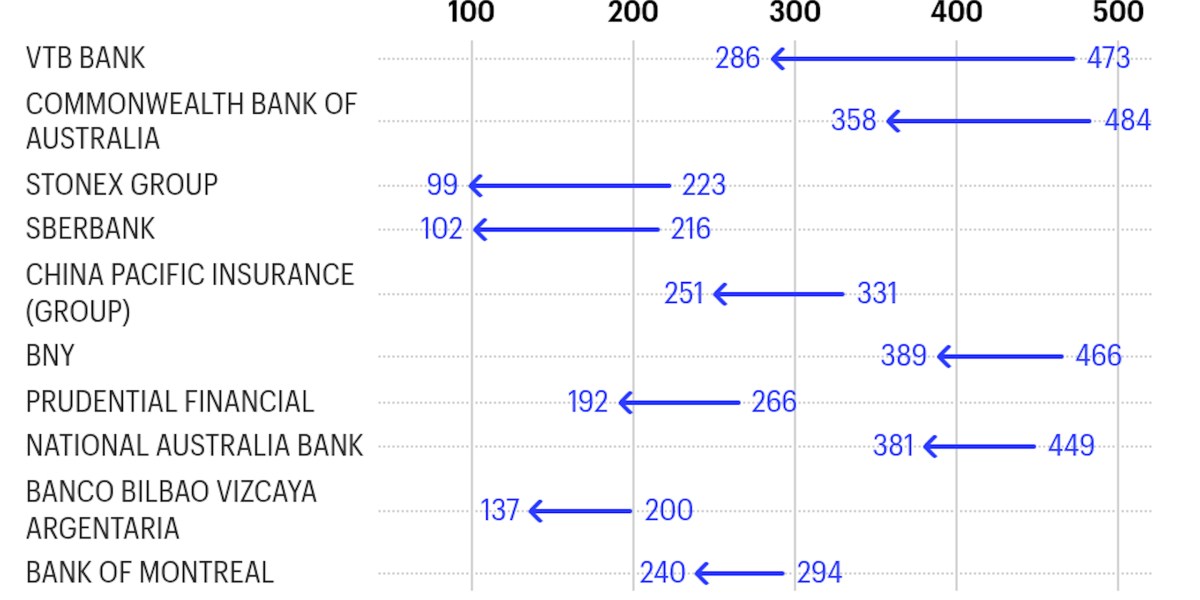
Among U.S.-based companies, banking giant BNY and Prudential Financial made significant jumps on the list. I asked the companies’ CFOs what’s behind this momentum—here’s what they had to say:

Yanela Frias, EVP and CFO of Prudential Financial (No. 192, up 74 spots): “We have seen strong momentum across our market-leading insurance, retirement, and asset management businesses. Our unique combination of global scale, distribution power, brand, and talent sets us apart as we serve 50 million customers worldwide. We are also finding new ways to serve our customers as their needs continue to evolve.

“With more people getting older and facing shifting retirement systems, we are committed to offering flexible retirement solutions that provide protected savings and income strategies to help people live better lives, longer. And, as investors seek a broad range of investment products like private credit and alternatives, we have unified PGIM’s multi-manager model into a single asset management business, including a $1 trillion private and public credit platform. To deliver even stronger performance, we are evolving our strategy, improving execution, and building a high-performing culture.”

Dermot McDonogh, CFO of BNY (No. 389, up 77 spots): “We’re hitting our stride in BNY’s transformation and firing on all cylinders. We’ve built a more connected, agile organization—one that’s breaking down silos and working more closely with clients than ever before. As a company that sits at the center of the global financial system, we have a unique opportunity to help our clients navigate change, unlock opportunity, and operate with greater confidence.

“Our investments in talent, culture, and technology like AI are making us sharper, faster, and more resilient. We’re proud of how far we’ve come, recognize there’s more runway ahead, and focused on continuing to raise the bar.”

Have a good weekend.

Sheryl Estrada
sheryl.estrada@fortune.com

Leaderboard

Fortune 500 Power Moves

Wayne S. DeVeydt was appointed CFO of UnitedHealth Group (No. 3), effective Sept. 2. John F. Rex, who joined the company in 2012 and has been CFO since 2016, will become a strategic advisor to the CEO on the same date. Most recently, DeVeydt, 55, has been a managing director and operating partner at Bain Capital. From 2018-2020, he was chairman and CEO of Surgery Partners, Inc. He joined Anthem, Inc. (now Elevance) in 2005 and served as its CFO from 2007 to 2016. Before joining Anthem, DeVeydt served as a partner with PricewaterhouseCoopers LLP.

Every Friday morning, the weekly Fortune 500 Power Moves column tracks Fortune 500 company C-suite shiftssee the most recent edition

More notable moves this week:

Justin Plouffe was promoted to CFO of global investment firm Carlyle (Nasdaq: CG), effective Jan. 1, 2026. Plouffe most recently served as deputy chief investment officer for Carlyle Global Credit. He has been with Carlyle for more than 18 years. Justin will succeed John Redett, who will continue serving as CFO through the end of the year.

Kristen Actis-Grande, EVP and CFO of MSC Industrial Supply Co. (NYSE: MSM), has decided to step down from her position, effective Aug. 8, to become CFO of a publicly traded company. Greg Clark, MSC’s VP of finance and corporate controller, will assume the position of interim CFO following Actis-Grande’s departure. Clark has held various finance positions with the Company since 2003. MSC will be conducting a search to identify a permanent CFO.

Patricia Cobian was appointed CFO of BT Group plc. Cobian will succeed Simon Lowth, who plans to retire after nine years in the role. Cobian is currently the CFO at Virgin Media O2. She will join the BT Group board and its executive committee in the summer of 2026, with Simon to retire following a transition period.

Raymond Rindone was appointed CFO of Sunwest Bank. Rindone has more than three decades of experience in the financial services and banking industry. Before joining Sunwest Bank, he served as deputy CFO and head of corporate finance at Banc of California. Earlier in his career, he was deputy CFO at City National Bank. 

Eyal Bar was appointed CFO of security startup Chainguard. Bar brings to Chainguard more than 16 years of financial and operational leadership experience from high-growth technology companies. He previously served in senior finance roles at global companies, including Monday.com, steering the company through its Nasdaq IPO, as well as Motorola Solutions, Ernst & Young, and Wix.com.

Jeff Glajch, CFO of Orion S.A. (NYSE: OEC), a global specialty chemicals company, intends to step down early in the fourth quarter of 2025. The company plans to conduct a comprehensive search to identify a successor. Glajch will continue to support Orion through the end of 2025.

Big Deal

On Thursday, President Donald Trump signed an executive order modifying “reciprocal” tariffs on dozens of countries. The updated tariffs now range from 10% to 41%.

While there is a baseline tariff of 10% for countries not listed with a specific rate, some partners face much higher rates. For example, tariffs on Canada have increased to 35% and take effect immediately (Aug. 1) for goods not covered by the US-Mexico-Canada Agreement. Many of the new “reciprocal” rates for other countries, however, will come into effect on Aug. 7, providing U.S. Customs time to implement the changes. Trump granted Mexico, the U.S.’s largest trading partner, a 90-day reprieve from higher tariffs as negotiations continue.

Going deeper

Here are four Fortune weekend reads:

Is eBay actually sexy again as the ecommerce old-timer’s stock surges to an all-time high?” by Jason Del Rey

Beijing officials warm to the idea of a yuan stablecoin, driven by the ‘fear of missing out’” by Cecilia Hult

Inside IBM’s rebound: Can CEO Arvind Krishna bring the tech company back to its former glory?” by Sharon Goldman

Overheard

“AI is the elephant in the room.”

—Wedbush Securities analysts wrote in a Friday morning note regarding Apple Inc. “While Apple is expanding its AI investments internally, the reality is it’s not moving the needle and investors’ patience is wearing thin,” according to the analysts. The tech giant announced its latest earnings on Thursday. Apple set a quarterly revenue record as earnings broadly beat expectations, Fortune reported.


Source link

Continue Reading

Business

What happens to old AI chips? They’re still put to good use and don’t depreciate that fast

Published

on


New AI chips seem to hit the market at a quicker pace as tech companies scramble to gain supremacy in the global arms race for computational power.

But that begs the question: What happens to all those older-generation chips?

The AI stock boom has lost a lot of momentum in recent weeks due, in part, to worries that so-called hyperscalers aren’t correctly accounting for the depreciation in the hoard of chips they’ve purchased to power chatbots.

Michael Burry—the investor of Big Short fame who famously predicted the 2008 housing collapse—sounded the alarm last month when he warned AI-era profits are built on “one of the most common frauds in the modern era,” namely stretching the depreciation schedule. He estimated Big Tech will understate depreciation by $176 billion between 2026 and 2028.

But according to a note last week from Alpine Macro, chip depreciation fears are overstated for three reasons.

First, analysts pointed out software advances that accompany next-generation chips can also level up older-generation processors. For example, software can improve the performance of Nvidia’s five-year-old A100 chip by two to three times compared to its initial version.

Second, Alpine said the need for older chips remains strong amid rising demand for inference, meaning when a chatbot responds to queries. In fact, inference demand will significantly outpace demand for AI training in the coming years.

“For inference, the latest hardware helps but is often not essential, so chip quantity can substitute for cutting-edge quality,” analysts wrote, adding Google is still running seven- to eight-year-old TPUs at full utilization.

Third, China continues to demonstrate “insatiable” demand for AI chips as its supply “lags the U.S. by several generations in quality and severalfold in quantity.” And even though Beijing has banned some U.S. chips, the black market will continue to serve China’s shortfalls.

Meanwhile, not all chips used in AI belong to hyperscalers. Even graphics processors contained in everyday gaming consoles could work.

A note last week from Yardeni Research pointed to “distributed AI,” which draws on unused chips in homes, crypto-mining servers, offices, universities, and data centers to act as global virtual networks.

While distributed AI can be slower than a cluster of chips housed in the same data center, its network architecture can be more resilient if a computer or a group of them fails, Yardeni added.

“Though we are unable to ascertain how many GPUs were being linked in this manner, Distributed AI is certainly an interesting area worth watching, particularly given that billions are being spent to build new, large data centers,” the note said.


Source link

Continue Reading

Business

‘I had to take 60 meetings’: Jeff Bezos says ‘the hardest thing I’ve ever done’ was raising the first million dollars of seed capital for Amazon

Published

on


Today, Amazon’s market cap is hovering around $2.38 trillion, and founder Jeff Bezos is one of the world’s richest men, worth $236.1 billion. But three decades ago, in 1995, getting the first million dollars in seed capital for Amazon was more grueling than any challenge that would follow. One year ago, at New York’s Dealbook Summit, Bezos told Andrew Ross Sorkin those early fundraising efforts were an absolute slog, with dozens of meetings with angel investors—the vast majority of which were “hard-earned no’s.”

“I had to take 60 meetings,” Bezos said, in reference to the effort required to convince angel investors to sink tens of thousands of dollars into his company. “It was the hardest thing I’ve ever done, basically.”

The structure was straightforward: Bezos said he offered 20% of Amazon for a $5 million valuation. He eventually got around 20 investors to each invest around $50,000. But out of those 60 meetings he took around that time, 40 investors said no—and those 40 “no’s” were particularly soul-crushing because before getting an answer, each back-and-forth required “multiple meetings” and substantial effort.

Bezos said he had a hard time convincing investors selling books over the internet was a good idea. “The first question was what’s the internet? Everybody wanted to know what the internet was,” Bezos recalled. Few investors had heard of the World Wide Web, let alone grasped its commercial potential.

That said, Bezos admitted brutal honesty with his potential investors may have played a role in getting so many rejections.

“I would always tell people I thought there was a 70% chance they would lose their investment,” he said. “In retrospect, I think that might have been a little naive. But I think it was true. In fact, if anything, I think I was giving myself better odds than the real odds.”

Bezos said getting those investors on board in the mid-90s was absolutely critical. “The whole enterprise could have been extinguished then,” he said.

You can watch Bezos’ full interview with Andrew Ross Sorkin below. He starts talking about this interview gauntlet for seed capital around the 33-minute mark.

This story was originally featured on Fortune.com


Source link

Continue Reading

Business

Google cofounder Sergey Brin said he was ‘spiraling’ before returning to work on Gemini

Published

on


Google cofounder Sergey Brin thought retiring from Google in 2019 would mean quietly studying physics for days on end in cafés. 

But when COVID hit soon after, he realized he may have made a mistake.

“That didn’t work because there were no more cafés,” he told students at Stanford University’s School of Engineering centennial celebration last week, Business Insider reported.

The transition from president of Google parent company Alphabet to a 40-something retiree ended up not being as smooth as he imagined, and soon after he said he was “spiraling” and “kind of not being sharp” as he stepped away from busy corporate life.

Therefore, when Google began allowing small numbers of employees back into the office, Brin tagged along and put his efforts into what would become Google’s AI model, Gemini. Despite being the world’s fourth-richest man with a net worth of $247 billion, retirement wasn’t for him, he said.

“To be able to have that technical creative outlet, I think that’s very rewarding,” Brin said. “If I’d stayed retired, I think that would’ve been a big mistake.”

By 2023, Brin was back to work in a big way, visiting the company’s office three to four times a week, the Wall Street Journalreported, working with researchers and holding weekly discussions with Google employees about new AI research. He also reportedly had a hand in some personnel decisions, like hiring. 

Skip forward to 2025 and Brin’s plans for a peaceful retirement of quiet study are out the window. In February, he made waves for an internal memo in which, despite Google’s three-day in-office policy, he recommended Google employees go into the company’s Mountain View, Calif. offices at least every weekday, and that 60 hours a week was the “sweet spot” of productivity.

Brin’s newfound efforts at work may have been necessary as OpenAI’s release of ChatGPT in 2022 caught the tech giant off guard, after it had led the field of AI research with DeepMind and Google Brain for years.

To be sure, Google for its part has been rising in the AI race. Analysts raved last month about Gemini 3, the company’s latest update to its LLM, and Google’s stock is up about 8% since its release. Meanwhile, OpenAI earlier this month declared a “code red,” its highest alert level, to improve ChatGPT. 

Brin added in the talk at Stanford that Google has an advantage in the AI arms race precisely because of the foundation it laid over years through its neural network research, its custom AI chips, and its data center infrastructure.

“Very few have that scale,” he said.


Source link

Continue Reading

Trending

Copyright © Miami Select.