Connect with us

Business

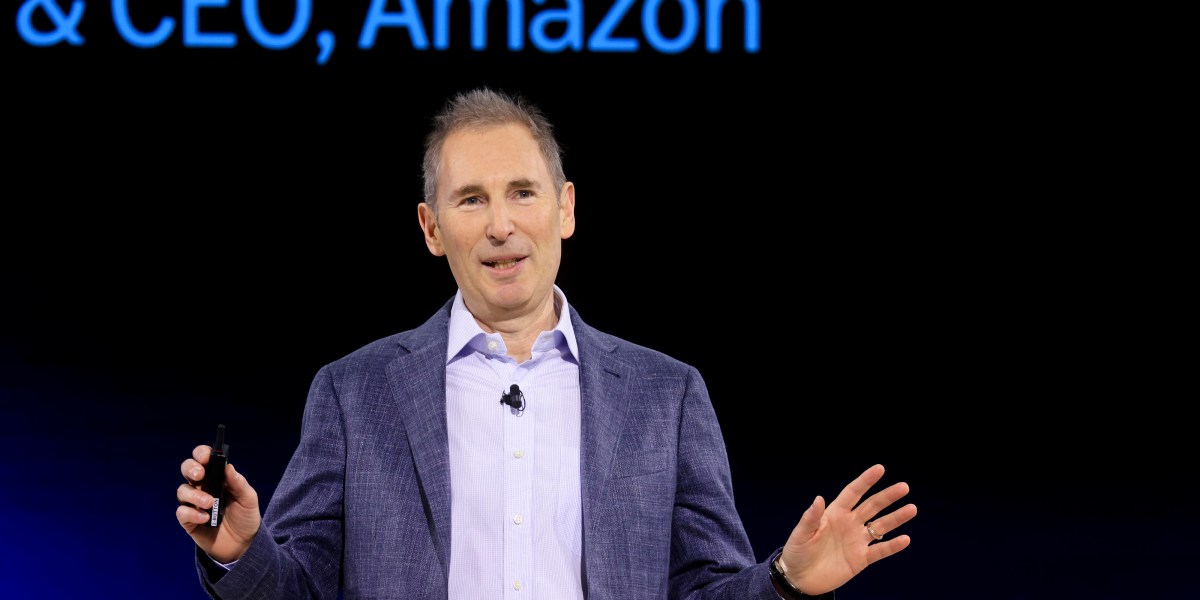
Andy Jassy unleashed an 8-minute defense of Amazon’s AI playbook on earnings call

Published

on


Amazon’s stock price had already been dropping in after-hours trading on Thursday despite better-than-expected results when Morgan Stanley analyst Brian Nowak prefaced his questions on an earnings call with a disclaimer that made it clear this wasn’t going to be a “Congrats on the quarter, guys” type of analyst—CEO interaction.

“I have two [questions] for you on AWS; they’re a little tough but I’m going to throw them at you,” Nowak told Amazon CEO Andy Jassy. “There is a Wall Street finance person narrative right now that AWS is falling behind in Gen AI with concerns about share loss to peers. What is your rebuttal to that and talk to us about your and the team’s most important focal points just to ensure that AWS stays on the knife’s edge of innovation versus hyperscaler peers?”

Nowak also pressed Jassy on why it wouldn’t be fair to assume that AWS’ revenue growth shouldn’t accelerate in the back half of the year given all of AWS’ generative AI offerings and widespread demand from companies of all sizes to cash in on this transformational technology.

Jassy responded by stressing that this is the early stages of a technological transformation that will extend far into the future. While some of the top frontier model providers do use AWS in some capacity, non-AI AWS customers that are rushing to build generative and agentic AI services using AWS are “quite early, and many of them are just smaller in terms of usage relative to some of those top heavy applications I mentioned earlier.” That is bound to change.

So if you follow Jassy’s thinking, as more enterprises figure out what they want to build and how they want to build it, they’re going to start having different needs. For the largest model makers, like Open AI or Anthropic, Jassy foresees their costs shifting from a mix between training their models and the cost associated with “inference,” or the customer-facing part where the model spits out a prediction, answer or action, to mostly inference expenses. And Jassy maintains AWS is positioned well for this transition because of the low-cost AI chip line Trainium.

“It’s about 30% and 40% better price performance than the other GPU providers out there right now, and we’re already working on our third version,” he said.

For others, who want to use another company’s model to create their own generative AI applications, Jassy argued that Amazon Bedrock, which offers models from a wide selection of companies, has become a go-to destination and “is growing very substantially.”

Jassy continued on the this-is-just-the-first-inning thread, by noting that companies are just starting to think about deploying AI agents and that, with its recent agentic AI announcements, AWS will be well-positioned to capitalize.

The Amazon CEO, and former AWS chief, added that AWS cloud leadership position also provides some lock-in as AI “inference” becomes just another component of a company’s cloud services stack.

“[P]eople are going to actually want to run those [AI] applications close to where their other applications are running, where their data is,” Jassy said. “There’s just so many more applications and data running in AWS than anywhere else.”

As for Nowak’s question about the possibility of AWS’ growth rate accelerating in the back half of the year, Jassy wouldn’t directly answer it but stressed his optimism, in part stemming from more AWS starting to deploy more AI products at sale that should continue to ramp in coming quarters.

Earlier in the call, Jassy had defended AWS’ 18% revenue growth rate in light of Microsoft reporting 34% annual revenue growth for its Azure cloud unit and Alphabet recently reporting 32% quarterly growth for Google Cloud. Azure generates around 2/3 the revenue that AWS does, while Google Cloud registers less than half the annual revenue of Amazon’s cloud behemoth.

“You look at the business, it’s a $123 billion annual revenue run rate business and it’s still early,” he said. “How often do you have an opportunity that’s $123 billion in annual revenue run rate where you say it’s still early? It’s a very unusual opportunity that we’ve very bullish about.”


Source link

Continue Reading

Business

Hero bystander who tackled Bondi gunman praised by Trump, Ackman

Published

on


A bystander who rushed and disarmed one of the Bondi Beach attackers has won praise from leaders around the world, including US President Donald Trump and hedge fund billionaire Bill Ackman, who announced a reward program for community heroes.

Extraordinary footage of the civilian’s actions began circulating on social media on Sunday, shortly after two men, later identified as a father and son, started shooting into a crowd gathered to celebrate the first day of Hanukkah. The massacre has left at least 16 people dead in the worst terrorist attack in Australia’s history. 

Read More: Sixteen People Killed in Bondi Beach Hanukkah Terror Attack 

In the mobile-phone video, which has not been verified by Bloomberg News, one of the attackers is standing near a tree and firing. A few meters away, a crouched man emerges from behind a parked car. He grabs the shooter from behind and wrestles the weapon from his hands. Local media named the bystander as Ahmed el Ahmed, a 43-year-old father-of-two from south Sydney. He was shot twice and is being treated in the hospital, according to reports.

He was also soon lauded for his feat. Trump said at the White House that Ahmed had saved many lives and expressed “great respect” for him. In Sydney, New South Wales Premier Chris Minns went further, describing Ahmed’s wrestle with the shooter as “the most unbelievable scene I’ve ever seen.”

“That man is a genuine hero and I’ve got no doubt there are many, many people alive tonight as a result of his bravery,” Minns said at a press conference late Sunday.

Australian Prime Minister Anthony Albanese also praised Ahmed, and other bystanders who helped treat victims in the immediate aftermath of the shooting. 

“People rushing towards danger to show the best of the Australian character,” Albanese told reporters Monday. “That’s who we are, people who stand up for our values.” 

Pershing Square Capital Management’s founder Ackman called Ahmed  “a brave hero” and said his hedge fund firm would establish a reward program for people who had carried out similar acts.

The top donor to a gofundme page set up for the “hero” who tackled the shooter is listed as William Ackman, who gave $99,999. More than $170,000 has been raised so far. 

Salesforce Inc. Founder and Chief Executive Officer Marc Benioff also expressed his gratitude for Ahmed in a post on X.


Source link

Continue Reading

Business

A ‘new era’ in the housing market is about to begin as affordability finally improves

Published

on


Next year should mark a shift in the housing market after years of largely being frozen in place, according to Mike Simonsen, chief economist at top residential real estate brokerage Compass.

Home sales flatlined amid unaffordable conditions after rising demand collided with tepid supply growth, pushing up home prices. Would-be buyers became so discouraged that demand cooled and remains slow.

Prices are now becoming more favorable for house hunters, a trend that should continue in 2026 and change the narrative in the housing market.

“In the next era, that story flips. So sales are starting to move higher, but prices are capped or maybe down. Incomes are rising faster than prices, and so affordability improves for the first time in a bunch of years,” Simonsen told CNBC on Friday. “It’s not a dramatic improvement, but it’s the start of the new era.” 

His view echoes a recent report from Redfin, which also cited stronger income and weaker homes prices as it predicted a “Great Housing Reset” in 2026.

In addition to potential buyers giving up on finding an affordable home, sellers have been giving up on finding someone willing to buy at the price they want.

As a result, the number of homes that were withdrawn from the market jumped this year. In June, these so-called delistings shot up 47% from a year earlier.

Simonsen said listing withdrawals tend to be owner-occupied homes, meaning they could be latent demand as well as supply. That’s because two transactions would be needed: owners want to buy a new home but must sell their current one.

“In an environment where conditions improve a little bit, we actually estimate that that’s a representation of shadow demand—people that want to move, people that have delayed moves for maybe four years now,” he said, adding that there are about 150,000 such homeowners.

His housing market outlook for a new era of improving affordability doesn’t depend on a steep drop in mortgage rates. In fact, a plunge might spur so much demand that prices would overheat.

Simonsen expects rates to stay in the low-6% range, allowing sales to grow while also keeping home prices in check as more inventory comes on the market.

The price environment is already showing auspicious signs for prospective buyers. More than half of U.S. homes have dropped in value over the last year, but homeowners can still sell with a net gain as values are up a median 67% since their home’s last sale, accordion to data from Zillow.

And a separate report fromZillow found that homebuyers are getting record-high discounts. While the typical individual discount remains $10,000, desperate sellers are increasingly offering multiple reductions as muted demand leaves homes on the market for longer. As a result, the cumulative price cut in October hit $25,000.

“Most homeowners have seen their home values soar over the past several years, which gives them the flexibility for a price cut or two while still walking away with a profit,” Zillow Senior Economist Kara Ng said in a statement last month. “These discounts are bringing more listings in line with buyers’ budgets, and helping fuel the most active fall housing market in three years. Patient buyers are reaping the rewards as the market continues to rebalance.”


Source link

Continue Reading

Business

Attacker who killed US troops in Syria was a recent recruit to security forces

Published

on


A man who carried out an attack in Syria that killed three U.S. citizens had joined Syria’s internal security forces as a base security guard two months earlier and was recently reassigned amid suspicions that he might be affiliated with the Islamic State group, a Syrian official told The Associated Press Sunday.

The attack Saturday in the Syrian desert near the historic city of Palmyra killed two U.S. service members and one American civilian and wounded three others. It also wounded three members of the Syrian security forces who clashed with the gunman, interior ministry spokesperson Nour al-Din al-Baba said.

Al-Baba said that Syria’s new authorities had faced shortages in security personnel and had to recruit rapidly after the unexpected success of a rebel offensive last year that intended to capture the northern city of Aleppo but ended up overthrowing the government of former President Bashar Assad.

“We were shocked that in 11 days we took all of Syria and that put a huge responsibility in front of us from the security and administration sides,” he said.

The attacker was among 5,000 members who recently joined a new division in the internal security forces formed in the desert region known as the Badiya, one of the places where remnants of the Islamic State extremist group have remained active.

Attacker had raised suspicions

Al-Baba said the internal security forces’ leadership had recently become suspicious that there was an infiltrator leaking information to IS and began evaluating all members in the Badiya area.

The probe raised suspicions last week about the man who later carried out the attack, but officials decided to continue monitoring him for a few days to try to determine if he was an active member of IS and to identify the network he was communicating with if so, al-Baba said. He did not name the attacker.

At the same time, as a “precautionary measure,” he said, the man was reassigned to guard equipment at the base at a location where he would be farther from the leadership and from any patrols by U.S.-led coalition forces.

On Saturday, the man stormed a meeting between U.S. and Syrian security officials who were having lunch together and opened fire after clashing with Syrian guards, al-Baba said. The attacker was shot and killed at the scene.

Al-Baba acknowledged that the incident was “a major security breach” but said that in the year since Assad’s fall “there have been many more successes than failures” by security forces.

In the wake of the shooting, he said, the Syrian army and internal security forces “launched wide-ranging sweeps of the Badiya region” and broke up a number of alleged IS cells. The interior ministry said in a statement later that five suspects were arrested in the city of Palmyra.

A delicate partnership

The incident comes at a delicate time as the U.S. military is expanding its cooperation with Syrian security forces.

The U.S. has had forces on the ground in Syria for over a decade, with a stated mission of fighting IS, with about 900 troops present there today.

Before Assad’s ouster, Washington had no diplomatic relations with Damascus and the U.S. military did not work directly with the Syrian army. Its main partner at the time was the Kurdish-led Syrian Democratic Forces in the country’s northeast.

That has changed over the past year. Ties have warmed between the administrations of U.S. President Donald Trump and Syrian interim President Ahmad al-Sharaa, the former leader of an Islamist insurgent group Hayat Tahrir al-Sham that used to be listed by Washington as a terrorist organization.

In November, al-Sharaa became the first Syrian president to visit Washington since the country’s independence in 1946. During his visit, Syria announced its entry into the global coalition against the Islamic State, joining 89 other countries that have committed to combating the group.

U.S. officials have vowed retaliation against IS for the attack but have not publicly commented on the fact that the shooter was a member of the Syrian security forces.

Critics of the new Syrian authorities have pointed to Saturday’s attack as evidence that the security forces are deeply infiltrated by IS and are an unreliable partner.

Mouaz Moustafa, executive director of the Syrian Emergency Task Force, an advocacy group that seeks to build closer relations between Washington and Damascus, said that is unfair.

Despite both having Islamist roots, HTS and IS were enemies and often clashed over the past decade.

Among former members of HTS and allied groups, Moustafa, said, “It’s a fact that even those who carry the most fundamentalist of beliefs, the most conservative within the fighters, have a vehement hatred of ISIS.”

“The coalition between the United States and Syria is the most important partnership in the global fight against ISIS because only Syria has the expertise and experience to deal with this,” he said.

Later Sunday, Syria’s state-run news agency SANA reported that four members of the internal security forces were killed and a fifth was wounded after gunmen opened fire on them in the city of Maarat al-Numan in Idlib province.

It was not immediately clear who the gunmen were or whether the attack was linked to the Saturday’s shooting.


Source link

Continue Reading

Trending

Copyright © Miami Select.