Laos, already struggling with high inflation and severe labor shortages, faces the risk of job losses and declining market share due to a 40% US tariff set to take effect this Friday, in the absence of a bilateral agreement, experts warn.
Shutterstock
This landlocked Southeast Asian nation of 7.6 million people is among those affected by former President Donald Trump’s trade measures. Countries like the UK, Japan and Vietnam have rushed to finalize trade deals ahead of the deadline.
Although Laos exports relatively little, a small number of factories—mostly located in the capital, Vientiane—supply the American market, accounting for roughly 3% to 6% of the country’s GDP.
However, Laos’ supply chains are closely tied to China, the United States’ main economic rival. According to data from last year, the US has a trade deficit of over $760 million with Laos, prompting Washington to threaten one of the highest tariff surcharges announced by the Trump administration.
“We estimate that around 20,000 workers or more will be affected,” said Xaybandith Rasphone, president of the Lao Garment Industry Association.
“We’re not sure of the exact number yet, but it could easily be higher if companies close down,” added Rasphone, who also serves as vice president of the National Chamber of Commerce and Industry.
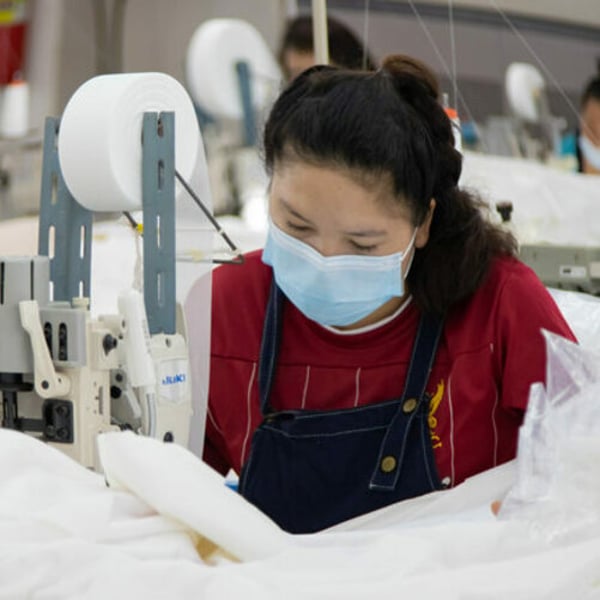
Rasphone said that if US customers pull back, 35 to 40 factories may face disruption. “Finding alternative markets takes time, negotiation and a lot of effort. It could take years.”
Like neighboring Cambodia and Vietnam, Laos is a regional base for garment manufacturing, supplying many Western brands, including Dr. Martens.
“A 40% surtax is simply a nail in the coffin for any sector trying to export to the US,” said John F. Somers of Diep Vu Co, a garment manufacturer.
In Vientiane, a local saleswoman who declined to be named said she was “living from day to day.” She added, “For the moment, I still have my business and the factory is running as usual,” though she expressed uncertainty about what the US will ultimately decide.
From photovoltaics to textiles
Production of mattresses, silicone products, and solar panels could also be affected by the tariffs.
The solar sector has expanded rapidly in Laos since 2023, fueled in part by Washington’s earlier 50% tariff on Chinese solar products. But according to Casey Tolzman, president of the Association of American-Laotian Businesses, this solar “boom” may have raised suspicions in Washington.
US trade authorities have increasingly targeted transshipment schemes—where countries repackage goods made in China for export to the US, bypassing tariffs.
A temporary truce, due to expire on August 12, currently sets US tariffs on Chinese products at 30%, while China’s tariffs on American goods remain at 10%.
The Laotian textile sector is also closely watching the developments. Although the European Union—especially Germany—has been the main destination for Laotian textiles, the US has long been among the top five export markets.
In this country of 7.6 million people, the garment industry employs nearly 30,000 workers and represents around 13% of export earnings, excluding natural resources.
“Real question”
“One of the big questions for countries like Cambodia and Laos is: what can they offer that’s attractive enough to the US to secure a deal?” said Tolzman.
“Any deal would probably require Laos to enforce stricter rules on transshipment and product origin, to ensure that Chinese-made goods aren’t simply relabeled as Laotian.”
Tolzman added that Washington may also demand action against cybercrime operations targeting American citizens, or ask for greater market access for US products in Laos.
Both the National Chamber of Commerce and Industry and the Lao American Business Association are reportedly helping Vientiane draft a formal appeal to the US government, requesting the surtax be reduced to previous levels—or capped at 20%.
But Somers warned of a deeper threat, regardless of whether a deal is reached.
Laos is expected to graduate from the UN list of least developed countries in 2026, which would result in the loss of its duty-free access to the European Union.
“We’ll be at a competitive disadvantage; our industry will probably collapse within a few years,” said Somers. “The real issue is the EU’s relationship with Laos, not just what the US does.”
(with AFP)
This article is an automatic translation. Click here to read the original article.
Specialist outdoor clothing producer Dryrobe has won a trademark case against a smaller label. The win for the business, which produces waterproof towel-lined robes used by cold water swimmers, means the offending rival must now stop selling items under the D-Robe brand within a week.
Image: Dryrobe
A judge at the high court in London ruled the company was guilty of passing off its D-Robe changing robes and other goods as Dryrobe products and knew it was infringing its bigger rival’s trademark reports, The Guardian newspaper.
The company said it has rigorously defended its brand against being used generically by publications and makers of similar clothing and is expected to seek compensation from D-Robe’s owners for trademark infringement.
Dryrobe was created by the former financier Gideon Bright as an outdoor changing robe for surfers in 2010 and became the signature brand of the wild swimming craze.
Sales increased from £1.3 million in 2017 to £20.3 million in 2021 and it made profits of £8 million. However, by 2023 sales had fallen back to £18 million as the passion for outdoor sports waned and the brand faced more competition.
Bright told the newspaper the legal win was a “great result” for Dryrobe as there were “quite a lot of copycat products and [the owners] immediately try to refer to them using our brand name”.
He said the company was now expanding overseas and moving into a broader range of products, adding that sales were similar to 2023 as “a lot of competition has come in”.
On Friday, France demanded a series of measures from Shein to demonstrate that the products sold on its website comply with the law, but dropped its initial request for a total three-month suspension of the online platform, which had been based on the sale of child-like sex dolls and prohibited weapons.
Shutterstock
At a hearing before the Paris court, a lawyer representing the state said that Shein must implement controls on its website, including age verification and filtering, to ensure that minors cannot access pornographic content. The state asked the court to impose a suspension of Shein’s marketplace until Shein has provided proof to Arcom, the French communications regulator, that these controls have been implemented.
Shein deactivated its marketplace- where third-party sellers offer their products- in France on November 5, after authorities discovered illegal items for sale, but its site selling Shein-branded clothing remains accessible. The state invoked Article 6.3 of France’s Digital Economy Act, which empowers judges to order measures to prevent or halt harm caused by online content.
“We don’t claim to be here to replace the European Commission,” the state’s lawyer said. “We are not here today to regulate; we are here to prevent harm, in the face of things that are unacceptable.” At the time of writing, the hearing is still ongoing.
In a statement issued last week, the Paris public prosecutor’s office said that a three-month suspension could be deemed “disproportionate” in light of European Court of Human Rights case law if Shein could prove that it had ceased all sales of illegal products. However, the public prosecutor’s office said it “fully supported” the government’s request that Shein provide evidence of the measures taken to stop such sales.
France’s decision comes against a backdrop of heightened scrutiny of Chinese giants such as Shein and Temu under the EU’s Digital Services Act, reflecting concerns about consumer safety, the sale of illegal products, and unfair competition. In the US, Texas Attorney General Ken Paxton said on Monday that he was investigating Shein to determine whether the fast-fashion retailer had violated state law relating to unethical labour practices and the sale of dangerous consumer products.
This article is an automatic translation. Click here to read the original article.
BasicNet’s Kappa turns back the sporting clock for its new AW25 collection, which celebrates “local heroes in football” with a community-focused campaign “honouring the places and people that inspire a lifelong love of the game”.
Image: Kappa
The campaign shines a light on local talent Tyrone Marsh in his hometown of Bedford, revisiting the streets, pitches and community spots “that shaped his football journey”.
Local photographer Simon Gill, who had pictured Marsh during many home and away games, not only “captures the Bedford Town player in the spaces that helped define his skill”, but also highlights the brand’s “rich football heritage with contemporary streetwear energy, creating visuals that pay tribute to community, culture and grassroots football”.
The journey includes Hartwell Drive, the early days of his after-school kickabouts, Hillgrounds Road, synonymous with Bedford football culture, and then onto Faraday Square, locally identified by the concrete pitches and community spirit.
To reflect that journey, the AW25 collection “offers a sense of nostalgia” with Kappa’s long-standing history in fashion and sports “seen through the Omini logo placements and 222 Banda strip”.
The campaign sees Marsh wearing Kappa styles including the Lyman and Uriah Track Tops paired with the Ulrich Track Pants in classic colourways including navy and light blue.
The wider collection includes track tops, track pants, shorts, polos, sweatshirts and T-shirts, available at select retailers across the UK including 80s Casual Classics, Terraces Menswear and RD1 Clothing.