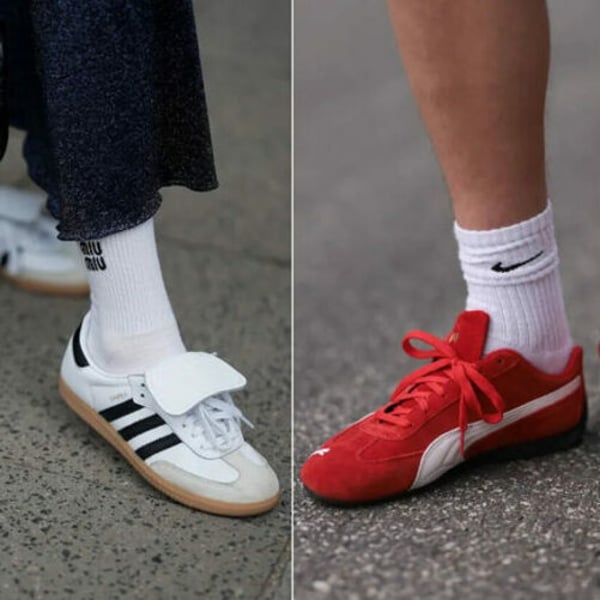
Adidas AG, the German sportswear giant known for turning its three-striped sneakers into a global fashion staple, reported weaker-than-expected sales growth for the three months ending June 30. The announcement triggered a 10% drop in its share price, echoing a similar downturn at rival Puma SE. The latter’s shares plunged as much as 21% last week following a warning about slowing demand and the impact of U.S. tariffs, which Puma estimates will reduce gross profit by approximately €80 million ($92 million) this year.
Adidas cools off as Samba loses heat and Puma struggles – Getty Images
Adidas Chief Executive Officer Bjørn Gulden also flagged the financial burden of tariffs, which he expects could cost the company up to €200 million. Despite the pressures, Gulden maintained Adidas’s full-year operating profit forecast of €1.7 billion to €1.8 billion—up from €1.3 billion in 2024 but still below analyst expectations of €2 billion. While the company has managed to retain most of its Chinese-made products for local sale, added costs are hitting sneakers and apparel produced in major sourcing hubs like Vietnam, which accounts for about 30% of Adidas’s U.S. imports.
Gulden added that inflation-driven weakness in U.S. consumer spending is another major concern.
Although U.S. sales held steady in the second quarter, Adidas’s European revenue took a hit due to unusually hot weather in June and tough comparisons with last year’s boost from the UEFA Euro 2024 tournament. The cooling trend, combined with a cautious outlook, has raised doubts about Adidas’s continued dominance—especially in terrace-style sneakers such as the Samba, Gazelle, and Handball Spezial. Meanwhile, Puma’s Speedcat line has struggled to gain traction with sneaker enthusiasts.
Trends on the street are shifting. Retro styles from Nike Inc., like the Killshot and Cortez, are making a comeback. Asics Corp.’s Onitsuka Tiger sneakers are also rising in popularity. Even in casual weekend settings, the Japanese brand is being spotted frequently—mirroring the Samba’s past ubiquity. Unsurprisingly, Asics shares have outperformed competitors this year. Vans, too, appear to be mounting a resurgence, with shares of parent VF Corp. rising by as much as 24% on Wednesday amid signs of a successful turnaround.
Gulden acknowledged that demand for the Samba has slowed, though he attributed this partly to previous supply constraints. He noted that the style remains popular in some markets, especially when introduced in updated finishes like metallics and animal prints.
Still, the broader deceleration and heavier discounting in the U.S.—as noted by Stacey Widlitz at SW Retail Advisors—pose a challenge.
Another shift affecting Adidas is the growing consumer focus on performance over fashion. Sport-led brands such as On Holding AG are gaining momentum. This pivot toward athletic function has also stalled Puma’s turnaround. Meanwhile, Nike CEO Elliott Hill has refocused on performance as the company’s strategic core. Despite Nike’s ongoing struggle with surplus fashion sneakers, its renewed emphasis on sport is yielding results. The Vomero running shoe, for instance, generated $100 million in sales since its February launch.
Gulden now faces two critical challenges.
First, he must identify the next breakout sneaker to follow the Samba’s success. He has made strides with relaunches like the Superstar and by embracing martial arts–inspired low-rise styles. According to Gulden, models like the Taekwondo are starting to gain popularity, especially in Japan and South Korea, and may expand further in 2025. Following the Samba and Superstar, the next icon to be refreshed is the Stan Smith, the classic white tennis shoe that debuted over 40 years ago.
Second, Adidas must amplify its presence in performance running. Sales in this segment rose by 25% in the second quarter, although the brand is still struggling to meet demand for top-selling models. The company is preparing to introduce new running shoes that aim to combine everyday comfort with track-level performance—a territory currently dominated by On and Hoka, a brand owned by Deckers Outdoor Corp. The ideal outcome? One of these technical models becomes a cultural hit, too. Encouraging signs include the rising trend of wearing football boots casually—a category where Adidas already holds strong ground.
Gulden’s product intuition remains a strategic asset. His ability to tap into cultural relevance, seen in collaborations like Oasis-themed apparel, continues to resonate. However, he now faces headwinds including tariffs, shifting consumer preferences, and a reinvigorated Nike. The upcoming World Cup in North America could help boost visibility—but it’s Nike’s home turf, and its newer sport-driven products will be widely available by then.
Puma’s stock has more than halved in 2024, while Adidas shares have fallen over 30% since February. Nike, by contrast, has rebounded more than 40% since its April low, with investors optimistic about the brand’s recovery. To keep pace with Nike and a wave of agile new rivals, Gulden must craft a fresh hit—possibly a new-generation Dad sneaker, built for both comfort and mass appeal.
Ferragamo appoints Alberto Tomba as a brand ambassador. The collaboration with the Italian skiing legend celebrates values shared by the Florentine fashion house: dedication, perseverance, resilience and attention to detail.
Alberto Tomba
Born in 1966, Tomba is the quintessential emblem of an Italy that invests in talent, commitment and the ability to push beyond one’s limits. His career is marked by major international successes, including three Olympic gold medals and two silver medals, two World Championship gold medals and two bronze medals, and 50 World Cup victories.
The Bologna-born skier is also the only athlete to have won races in 11 consecutive seasons (1987-1998) and to have claimed four World Cup discipline titles in giant slalom and four in slalom.
“Tomba’s sporting journey perfectly reflects Ferragamo’s philosophy: every achievement comes from sacrifice, every result from dedication. We share with him a deep sense of authenticity and a love of excellence, values that continue to inspire our daily work,” said Leonardo Ferragamo.
“Being chosen by Ferragamo is an honour,” Tomba commented. “I have always believed that sport and style share a common language: that of passion, rigour and the desire to improve every day. Representing a brand that embodies all this, and that brings Italian beauty and craftsmanship to the world, is a source of great pride.”
This article is an automatic translation. Click here to read the original article.
New York–based fashion brand Guizio is expanding its retail footprint with the opening of its second store, at Aventura Mall in Miami, this month.
Guizio expands retail footprint with Miami store opening. – Guizio
Designed in collaboration with Brandi Howe, the new Miami store reflects the brand’s refined aesthetic and contemporary edge, while introducing elements inspired by Miami’s vibrant energy.
It opens with a robust assortment of womenswear, along with an exclusive, limited-edition Puma sneaker available only at the Miami location.
“Opening a Guizio store in Aventura Mall is such a special moment for me,” said Danielle Guizio, founder and designer. “It allows us to connect with our community here and share the brand’s energy in a new way. Bringing our world to Miami felt like a natural next step in growing Guizio, and we’re so excited for what’s ahead.”
Guizio founded her namesake womenswear label in 2014 and continues to offer ready-to-wear collections that celebrate the modern-day woman.
Through her collections, woven knits, structured suiting, and signature corsets are emboldened with asymmetrical details, purposeful cut-outs, ruching and custom hardware. The label has become a favorite among talent such as Sabrina Carpenter, Olivia Rodrigo, Rosalia, and more.
The opening follows the success of the brand’s SoHo flagship in New York, which opened in September 2024.
In October, this was not necessarily the frontrunner in the race to take over the IKKS Group. The French premium ready-to-wear specialist, owner of the eponymous brand as well as One Step and I.Code, attracted around a dozen bidders after being placed in receivership at the start of autumn, including the respective owners of The Kooples, Pimkie, Morgan and Caroll.
But in the home stretch, the duo of Michaël Benabou, co-founder of VeePee (then called Vente Privée) and head of the investment company Financière Saint James, and Santiago Cucci, a specialist in premium ready-to-wear and former head of the Levi’s and Dockers brands, who for a time supported the leadership of Dutch label G-Star, strengthened their bid. The entrepreneur, a sports enthusiast who knows the case well, having taken over as chairman of the HoldIKKS holding company last year, knows that competitions are decided right up to the last minute. Despite the loss of almost half the workforce, their offer, which safeguards 546 jobs and includes 119 directly operated stores, won the backing of the group’s works council (CSE) and was formally approved by the Paris Court for Economic Activities.
A few hours after the decision was made official, Cucci outlined his roadmap for IKKS to FashionNetwork.com.
Santiago Cucci headed Levi’s in the United States and set a new tone at Dockers – Archive Dockers
FashionNetwork.com: What was your reaction to the announcement of the court’s decision?
Santiago Cucci: We’re delighted to be taking over this iconic brand. I think it’s a brand that touches the hearts of the French. We all have a history with IKKS, whether from our younger years or through our children, often tied to festive moments. This means there’s a whole generation entering adulthood already very familiar with the brand and feeling positively towards it. That’s the capital we’re taking on today. And this affinity extends well beyond end consumers: of the 118 affiliates we contacted, 116 said yes.
FNW: Because beyond the 119 directly operated stores, you had to convince partners to come on board…
SC: Whether with affiliates, suppliers we had to renegotiate with, or across the entire value chain through to consumers, I believe the whole ecosystem still holds the brand in very high regard. Our job now is to make the brand desirable, using digital tools that deliver a strong and seamless customer experience.
FNW: You’re keeping 546 jobs, many of them in stores. What are the next steps, particularly on the social front?
SC: As we’re taking over the company, on Monday I’ll be in Saint-Macaire to meet the employees who are part of the project. We’ll be putting together a new management team across most functions over the next few weeks. I would like to thank the management team, who have done their utmost to steer the company through difficult conditions in recent years. In our takeover plan, we have committed to investing 700,000 euros to acquire the brand’s assets and inventories, and 700,000 euros to contribute to the PSE. Matters concerning those who are leaving will be handled by the court-appointed liquidator. However, we intend to rehire a few people to help secure the path forward over the coming months.
FNW: In your plan, a number of activities were to be discontinued. Where are you going to focus your efforts?
SC: We’re refocusing on IKKS’s adult business. We’re putting the junior business on hold. Even though that’s the brand’s roots, in France the leading player in the junior market is the second-hand segment. We have to accept that reality. But those consumers who were juniors are now adults and already have a relationship with the brand. At the same time, the group had been managing I.Code and One Step. It’s time to refocus on the flagship and discontinue the two brands and childrenswear. It’s important to note that the junior segment accounts for 82% of IKKS’s losses.
The IKKS Junior line will be put on hold – IKKS
=
FNW: Does this mean that you think the adult part of IKKS, the core on which you’re refocusing, could be profitable fairly quickly?
SC: You’re right. As early as the first year—2026, which will be a transitional year—we have a profitable business model, with reinvestment back into the company.
FNW: Alongside the buyout, you announced a 16 million euro investment package. What are your investment priorities?
SC: We’ve budgeted almost 17 million euros to get the supply chain engine up and running again. It’s a real machine. We’re going to invest in boosting the brand’s desirability, and in IT infrastructure that is from another era, which we’ll upgrade in the first quarter. In my experience, I’ve always been quick to transform companies.
FNW: What will you bring over from your experience at Levi’s and Dockers? What do you think is essential to the successful evolution of a brand?
SC: We’re going to clarify the brand’s identity and values. We’ll enhance the customer experience, particularly by engaging more meaningfully with our community and relying a little less on promotions alone. To do this, we’ll invest in infrastructure and in our go-to-market. We’ll invest in production capabilities so we can be more flexible and hold inventory that matches market needs. We want to be less dependent on promotional periods.
FNW: Is the idea also to reduce the share of revenue coming from markdowns?
SC: You have to be clear about prices. You can’t set a price and then run permanent promotions afterwards. So we’re going to bring more clarity for consumers to the pricing structure, especially at the start of the season. By the way, the design team has done a great job, which is why we’re keeping them on. Now we’re going to make this offer more visible, with a pricing structure that has to be logical. Encouragingly, the results for this reworked adult offer are positive.
This article is an automatic translation. Click here to read the original article.