Politics
How Americans’ views of racial discrimination have shifted since 2021, according to AP-NORC polling
Published
4 months agoon
By
May Greene
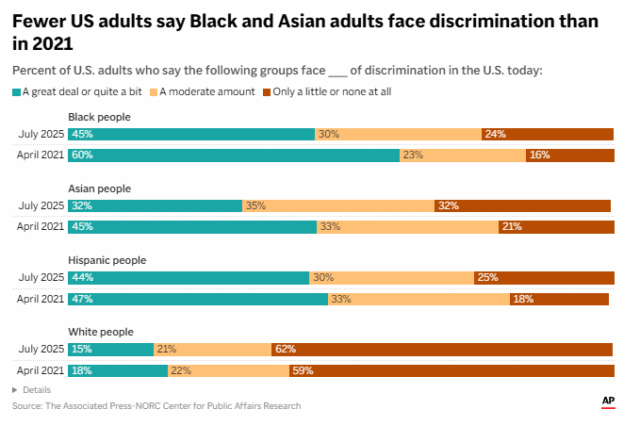
Slightly less than half of U.S. adults believe that Black people face “a great deal” or “quite a bit” of discrimination in the United States, according to a new poll. That’s a decline from the solid majority, 60%, who thought Black Americans faced high levels of discrimination in the spring of 2021, months after racial reckoning protests in response to the police killing of George Floyd.
Significant numbers of Americans also think diversity, equity and inclusion efforts, also known as DEI, are backfiring against the groups they’re intended to help, according to the survey from The Associated Press-NORC Center for Public Affairs Research, including many people who belong to those groups.
The findings suggest Americans’ views on racial discrimination have shifted substantially since four years ago, when many companies launched efforts to promote diversity within their workforces and the products they sold.
Since then, many of those companies have reversed themselves and retreated from their diversity practices, a trend that’s accelerated this year under pressure from President Donald Trump, a Republican who has sought to withhold federal money from schools and companies that promote DEI.
Now, it’s clear that views are changing as well as company policies.
Claudine Brider, a 48-year-old Black Democrat in Compton, California, says the concept of DEI has made the workplace difficult for Black people and women in new ways.
“Anytime they’re in a space that they’re not expected to be, like seeing a Black girl in an engineering course … they are seen as only getting there because of those factors,” Brider said. “It’s all negated by someone saying, ‘You’re only here to meet a quota.’”
Reversal in views of racial discrimination
The new poll finds 45% of U.S. adults think Black people face high levels of discrimination, down from 60% in the spring of 2021. There was a similar drop in views about the prevalence of serious discrimination against Asian people, which fell from 45% in the 2021 poll — conducted a month after the Atlanta spa shootings, which killed eight people, including six women of Asian descent — to 32% in the current survey.
There’s no question the country has backtracked from its “so-called racial reckoning” and the experiences of particular groups such as Black people are being downplayed, said Phillipe Copeland, a professor at Boston University School of Social Work.

Americans’ views about discrimination haven’t shifted when it comes to all groups, though. Just under half of U.S. adults, 44%, now say Hispanic people face at least “quite a bit of discrimination,” and only 15% say this about White people. Both numbers are similar to when the question was last asked in April 2021.
Divisions on the impact of DEI on Black and Hispanic people
The poll indicates that less than half of Americans think DEI has a benefit for the people it’s intended to help.
About 4 in 10 U.S. adults say DEI reduces discrimination against Black people, while about one-third say this about Hispanic people, women and Asian people. Many — between 33% and 41% — don’t think DEI makes a difference either way. About one-quarter of U.S. adults believe that DEI actually increases discrimination against these groups.
Black and Hispanic people are more likely than White people to think DEI efforts end up increasing discrimination against people like them.
About 4 in 10 Black adults and about one-third of Hispanic adults say DEI increases discrimination against Black people, compared with about one-quarter of White adults. There is a similar split between White adults and Black and Hispanic adults on assessments of discrimination against Hispanic people.
Among White people, it’s mostly Democrats who think DEI efforts reduce discrimination against Black and Hispanic people. Only about one-quarter of White independents and Republicans say the same.
Pete Parra, a 59-year-old resident of Gilbert, Arizona, thinks that DEI is making things harder for racial minorities now. He worries about how his two adult Hispanic sons will be treated when they apply for work.
“I’m not saying automatically just give it to my sons,” said Parra, who leans toward the Democratic Party. But he’s concerned that now factors other than merit may take priority.
“If they get passed over for something,” he said, “they’re not going to know (why).”
About 3 in 10 say DEI increases discrimination against White people
The new poll shows that Americans aren’t any more likely to think White people face discrimination than they were in 2021. And more than half think DEI doesn’t make a difference when it comes to White people or men.
But a substantial minority — about 3 in 10 U.S. adults — think DEI increases discrimination against White people. Even more White adults, 39%, hold that view, compared with 21% of Hispanic adults and 13% of Black adults.
The recent political focus on DEI has included the idea that White people are more often overlooked for career and educational opportunities because of their race.
John Bartus, a 66-year-old registered Republican in Twin Falls, Idaho, says that DEI might have been “a good thing for all races of people, but it seems like it’s gone far left.” It’s his impression that DEI compels companies to hire people based on their race or if they identify as LGBTQ+.
“The most qualified person ought to get a job based on their merit or based on their educational status,” said Bartus, who’s White.
Brider, the Black California resident, objects to the notion that White people face the same level of discrimination as Black people. But while she thinks the aims of DEI are admirable, she also sees the reality as flawed.
“I do think there needs to be something that ensures that there is a good cross-section of people in the workplace,” Brider said. “I just don’t know what that would look like, to be honest.”
The AP-NORC poll of 1,437 adults was conducted July 10-14, using a sample drawn from NORC’s probability-based AmeriSpeak Panel, which is designed to be representative of the U.S. population. The margin of sampling error for adults overall is plus or minus 3.6 percentage points.
___
Republished with permission of The Associated Press.
Post Views: 0
You may like
Politics
Full stop — FEMA — crypto — path to consensus — online safety
Published
3 minutes agoon
December 5, 2025By
May Greene
‘NOT ONE’: Immigration shutdown
U.S. Citizenship and Immigration Services paused all green card and asylum applications from 19 countries. That list of “high-risk countries” includes Cuba, Haiti and Venezuela.
Florida is home to the highest concentration of foreign nationals in the country, with many claiming it as their nation of origin.
An agency memo cites an executive order signed by President Donald Trump to justify effectively shutting down legal immigration from those countries. Homeland Security Secretary Kristi Noem defended the move in a charged social media post.
“I am recommending a full travel ban on every damn country that’s been flooding our nation with killers, leeches and entitlement junkies,” she posted on X. “Our forefathers built this nation on blood, sweat and the unyielding love of freedom — not for foreign invaders to slaughter our heroes, suck dry our hard-earned tax dollars or snatch the benefits owed to AMERICANS. WE DON’T WANT THEM. NOT ONE.”
In Florida, the move drew sharp, partisan reactions.
Reps. Mario Díaz-Balart and Carlos Giménez, both South Florida Republicans representing heavy immigrant constituencies, issued a joint statement defending the controversial move and asserting it was forced by lax immigration enforcement under former Democratic President Joe Biden. They argued that Trump inherited a “broken immigration system” and that Trump had little choice but to strengthen vetting.
“The chaos that unfolded at our southern border allowed over 300 known terrorists to enter the country, enabled hostile foreign operatives — including Cuban regime pilot Luis Raul Gonzalez-Pardo Rodriguez, recently indicted on a charge of immigration fraud — and led to the preventable murders of Americans in their own communities,” the Miami-Dade Republicans said.
“The tragic deaths of Georgia nursing student Laken Riley and Texas 12-year-old Jocelyn Nungaray, the foiled Election Day 2024 terrorist plot by Afghan national Nasir Ahmad Tawhedi, and the murder of a U.S. National Guard soldier in our nation’s capital by another Afghan national, Rahmanullah Lakanwal, are not isolated incidents — they are direct consequences of Biden’s incompetence and failed leadership. Criminals applied for and exploited U.S. immigration privileges under an administration that simply stopped enforcing the rule of law.”
Notably, Giménez immigrated to the U.S. from Cuba as a child. Díaz-Balart is the son of Cuban immigrants.
But Rep. Sheila Cherfilus-McCormick slammed the decision and posted on social media that it would hurt the U.S. economically. The Miramar Democrat is the daughter of Haitian immigrants, making her the only Haitian American serving in Congress.
“A blanket ban on 19 countries is not security — it’s self-sabotage,” she wrote. “We’re blocking students, nurses, engineers and future innovators. Canada and Europe are happy to take the talent we’re pushing away.”
And Rep. Frederica Wilson, a Miami-Dade Democrat, suggested the harsh rhetoric and policies would not play well in immigrant-rich South Florida. “Immigrants strengthen our nation. In South Florida, we know this firsthand,” she posted. “We should support our immigrant communities, NOT antagonize them!”
But the Republicans in South Florida suggested the pause was only a first step toward comprehensive reform. “We remain fully committed to permanently fixing our immigration system once and for all,” Díaz-Balart and Giménez’s statement reads. “We also hope this process is thorough and done quickly so that individuals with legitimate asylum claims have the opportunity to have their cases adjudicated expeditiously, something that did not happen under the Biden administration.”
Tracking FEMA claims
One thing both parties in Congress agree on is the need for efficient disaster response. Sen. Ashley Moody this week announced a bipartisan effort to increase transparency in aid.
The Plant City Republican introduced the Transparency in Recovery Assistance and Claims Knowledge (TRACK) Act with Sen. Angela Alsobrooks, a Maryland Democrat, that would make a status tracker on the Federal Emergency Management Agency’s (FEMA) website accessible to individuals with claims.

“While this hurricane season we all in Florida got lucky, our state is no stranger to destructive weather. As I travel around the state, one thing I continue to hear is that folks want more transparency and insight to the aid process when they are recovering from catastrophes,” Moody said.
“While FEMA is making great strides under President Trump’s leadership, the TRACK Act will bring more sunshine and transparency. After disaster strikes, the most important thing is to get help to those who need it as soon as possible, and this bill will help us do just that.”
Added Alsobrooks, “After a disaster, no community should ever feel left behind — this bill ensures every American will know just how much support they are receiving from the federal government.”
The legislation also drew endorsements from several local officials in Florida.
“Transparency and accountability are cornerstones of Hillsborough County government,” said Hillsborough County Administrator Bonnie Wise. “Our departments strive daily to uphold these values. Every level of government should seek to uphold these same standards.”
Democratic leaders in the state were among those praising the bill.
“As the Orange County Commissioner for District 2 since 2018, hurricanes and other emergencies routinely upend lives and overwhelm local systems; our residents deserve clear and immediate insight into how federal assistance is progressing,” said Orange County Commissioner Christine Moore.
“A FEMA transparency dashboard would let families, local officials and emergency managers see real-time data so we can target help where it’s needed most. Ultimately, this level of visibility strengthens trust, speeds recovery and our communities.”
Crypto stability
Many of Florida’s political class traveled to Washington for a wide-ranging Rescuing the American Dream summit headlined by Sen. Rick Scott. The event touched on a range of topics, including health care and foreign policy.
Scott also spotlighted the contrast between cryptocurrency regulation under Trump and the previous status quo under Biden. Scott suggested the prior administration was using “lawfare” to go after companies pushing digital currencies.

The Naples Republican condemned that, but said he was more focused on developing technology for new currencies.
“I do believe there’s a value with blockchain, and the value of blockchain can dramatically reduce the cost of things for us,” he said. “What can government do to help drive down the cost? Typically, the way — the only way — government does that is, they throw money. This is not something you throw money at.”
He was generally supportive of the GENIUS Act and the STABLE Act, signed by Trump this year, though he still wanted to see stablecoins able to earn interest, something that didn’t make it into statute.
Scott’s summit featured Faryar Shirzad, chief policy officer for Coinbase, and Sen. Cynthia Lummis, a Wyoming Republican. Lummis said she has seen both the private and public sectors restrict access to individuals’ finances too often, sometimes for overtly political reasons, and that blockchain could protect consumers.
“It’s very difficult for the government to surveil,” she said.
East Pass illumination
Lights on the markers for East Pass in Destin haven’t operated properly since 2021, and Rep. Jimmy Patronis said it’s time for the Coast Guard to fix them.
The Fort Walton Republican sent a letter to acting Coast Guard Commandant Kevin Lunday, urging attention to the matter. He noted that the recently signed “One Big Beautiful Bill” includes more than $4 billion provided for shore facilities. The Congressman said the poor upkeep poses both a safety risk for voters and a compromise to national security.

“These deficiencies pose serious safety and economic risks to Destin’s gateway to the GOA (Gulf of America, which sees extensive vessel traffic,” Patronis said.
“Destin’s Harbor, along East Pass, saw daily entry and exits of more than 1,500 vessels on weekdays and more than 2,000 vessels on weekends. For perspective, the busiest port in the Western Hemisphere, the Port of Los Angeles, handled only 1,807 vessel arrivals during calendar year 2024, and the Port of Mobile handled only 312 vessels in calendar year 2022. Beyond the more than 29,000 saltwater fishing licenses issued to addresses in Okaloosa County, countywide tourism generates $3.3 billion in direct visitor spending and supports 51,000 jobs.”
The risks aren’t just hypothetical. The Florida Fish and Wildlife Commission reports that the boating accident rate in Okaloosa County is 530% higher than in Miami-Dade County, which is much more populous.
“Unfortunately, the number of accidents near East Pass increased by 100% from 2021 to 2024, and approximately 70% of reported accidents in Okaloosa County occurred near East Pass,” he said.
Patronis suggested that the right course of action is to replace both markers.
Finding consensus
A summit on health care hosted by Rep. Aaron Bean may be the first of many in his “Path to Consensus” series in Washington.
The Fernandina Beach Republican said his first event focused explicitly on health care, but it wasn’t just about finding a plan that could pass with a GOP majority.

“What will it look like if we were to build a health care plan that we can afford, the American people can afford, but as a country that we can afford? What does it look like?” he asked. “What components does it have? How do we make it more affordable?”
But he made sure to invite representatives from America’s Health Insurance Plans, a trade group that includes Florida Blue, to defend some form of tax credits, as well as the reform-focused Paragon Health Institute, which wants more free-market solutions.
Bean said he doesn’t want insurance subsidies extended forever in their current form but didn’t rule out tax credits entirely.
“The more money we’ve put in there, they’re driving inflation,” he said of the existing credits. “So, we need reform.”
San Juan health care
Whatever happens with the federal health care program, Rep. Darren Soto wants to address an inequity that has left one group of American citizens without benefits. The Kissimmee Democrat filed the Puerto Rico Affordable Care Act, a bill co-sponsored by Puerto Rico Resident Commissioner Pablo José Hernández, to establish an Affordable Care Act exchange in the U.S. territory.

“For far too long, Puerto Ricans have been treated as second-class citizens — despite being part of the United States. I’m proud to partner with Resident Commissioner Hernández on this initiative to allow those on the island to receive equal treatment when it comes to health care access,” Soto said. “Our hope is that this bill will open the door to key reforms and lead to a system in which Puerto Ricans have access to tiered plans, tax premiums, and cost-sharing reductions.”
Hernández, a Caguas Democrat, said Puerto Ricans deserve the same access to health care as any citizen.
“Too many families in Puerto Rico navigate a system without the cost-saving tools available elsewhere,” he said. “Establishing an ACA exchange gives the island the federal support to expand coverage, lower costs, and strengthen our health care network. This bill brings Puerto Rico into the proven framework that serves millions of Americans.”
Veteran education
A pair of Florida lawmakers is working across the aisle to ensure veterans have the resources to transition from military service into higher education.
Reps. Gus Bilirakis, a Palm Harbor Republican, and Lois Frankel, a West Palm Beach Democrat, introduced the Veteran Education Empowerment Act, which would reauthorize the Centers of Excellence for Veteran Student Success grant program through at least 2033. That program has awarded $50 million to more than 100 schools to help educate veterans, including eight Florida institutions.

“I have personally visited many schools that offer Student Veteran Centers and spoken with the veterans who utilize them,” Bilirakis said. “The veterans confirm that the enhanced services and specialized resources provided through the centers are invaluable as they seek to successfully reintegrate into civilian society. I hope my colleagues will join us in expediting passage of this important initiative.”
The program also provides support to veteran students who may face added challenges like post-traumatic stress disorder or may already have started families.
“As the mother of a U.S. Marine War Veteran, I know how demanding the transition from military to civilian life can be,” Frankel said. “Our veterans are patriots who have served our country-they deserve every tool to succeed in their next chapter. Student Veteran Success Centers provide the academic support, mentorship, and community that help them thrive.”
Hiring warriors
Meanwhile, Rep. Greg Steube turned his attention to ensuring veterans have work lined up when their education and tours of duty are through.
The Sarasota Republican filed the Hire Student Veterans Act, which would expand the Work Opportunity Tax Credit for employers who hire eligible student veterans.

“America owes a debt of gratitude to the men and women of our military for their service,” Steube said. “No veteran should ever be left to languish on the unemployment line. I am grateful to join with Congresswoman (Susie) Lee and Sens. (Jerry) Moran and (Jacky) Rosen on this bill that will expand opportunity and financial security for our student veterans. It is only right that we provide our heroes with every possible option to earn a reliable income while attending school.”
He introduced the legislation with Rep. Lee, a Nevada Democrat. His Office noted that 12% of student veterans end up unable to find work. The bill seeks to remedy that by including part-time work and paid internships for the tax credits for education covered by the GI Bill.
Fighting child cancer
The House just unanimously passed an initiative to fund pediatric cancer research, championed in part by Florida lawmakers. The Mikaela Naylon ‘Give Kids A Chance’ Act cleared the chamber through unanimous consent and now heads to the Senate.
Both Bilirakis and Rep. Kathy Castor, a Tampa Democrat, were among the bill’s introducing sponsors.
“By passing the bipartisan Give Kids a Chance Act, the House has taken a meaningful step forward in improving health outcomes for kids fighting cancer and rare diseases,” Castor said.

“This bipartisan legislation eliminates unnecessary red tape, prioritizes lifesaving pediatric therapies and re-energizes pediatric drug research at no additional cost to taxpayers. As co-chair of the Childhood Cancer Caucus, I’m pleased to see the House come together to remove barriers to care. Working together is how we strengthen families, expand opportunity and build a healthier, more hopeful future for our young neighbors in Florida and across the country.”
The bill is named for Mikaela Naylon, a child advocate who died from osteosarcoma at age 16 and donated her body to science.
“By strengthening incentives for pediatric drug development, restoring essential programs such as the FDA Rare Pediatric Disease Priority Review Voucher, and ensuring that lifesaving therapies reach the children who need them most, we are making meaningful progress,” Bilirakis said. “I am proud to have contributed to this important work and will continue fighting for children and families across our nation.”
Safer internet
Another bipartisan bill championed by Florida lawmakers could make online spaces safer in the future.
Reps. Laurel Lee and Soto filed the Promoting a Safe Internet for Minors Act, which would direct the Federal Trade Commission to launch a nationwide public awareness and education campaign to equip families, educators and stakeholders with the latest best practices for protecting minors online.

“Families deserve to know that their children are protected in an increasingly complex digital environment. My legislation will help ensure parents, teachers, and community leaders have the tools they need to navigate online risks and promote safe, healthy internet use for the next generation,” said Lee, a Thonotosassa Republican. “The digital landscape is constantly evolving, and our approach to online safety must evolve with it.”
The bill also requires the Commission on the efforts to protect minors online to submit annual reports to Congress.
“As lawmakers, it is our responsibility to review common sense reforms that will help make the internet safer for everyone,” Soto said.
Standing with firefighters
Giménez started his career in public service as a firefighter. Now, he wants Congress to recognize the sacrifices made by those decked out in bunker gear, including the compromise of their own personal health.
“Our firefighters are courageous public servants who put their lives on the line every single day,” he said.

“Our first responders go above and beyond the call of duty to protect the communities they serve, and this legislation will ensure that their families receive the benefits they rightfully deserve. The Senate has already acted unanimously, and we have strong bipartisan support in the House. Now we must finish the job. By including this provision in the final NDAA, Congress will honor the sacrifice of our fallen firefighters, protect their families, and reaffirm our unwavering commitment to those who stand watch over our communities.”
The Miami-Dade Republican co-led a letter with Rep. Nick LaLota, a New York Republican, asking leadership in the House and Senate to include the Honoring Our Fallen Heroes Act in this year’s National Defense Authorization Act. That would qualify career-long carcinogenic exposures for the Public Safety Officer Benefits program, which now only covers health instances stemming from specific emergencies.
“We cannot continue to turn a blind eye to our nation’s fallen heroes when we know job-related exposures are causing many to die from cancer at rates far higher than the general public,” the letter reads.
On this day
Dec. 5, 1933 — “Prohibition ends” via History.com — The 21st Amendment to the U.S. Constitution was ratified, repealing the 18th Amendment and bringing an end to the era of national prohibition of alcohol in America. Utah became the 36th state to ratify the amendment, achieving the requisite three-fourths majority of states’ approval. The movement to prohibit alcohol began in the early 19th century. Prohibition, failing to enforce sobriety and costing billions, rapidly lost popular support in the early 1930s. After the repeal, some states continued Prohibition by maintaining statewide temperance laws. Mississippi, the last dry state in the Union, ended Prohibition in 1966.
Dec. 5, 2019 — “Nancy Pelosi announces articles of impeachment against Trump” via NBC News — The House Speaker announced she was asking the House Judiciary Committee and Chairs of other Committees to proceed with drafting articles of impeachment, saying “the President leaves us no choice but to act.” “Sadly, but with confidence and humility, with allegiance to our founders and our heart full of love for America, today, I am asking our Chairmen to proceed with articles of impeachment,” Pelosi said in a brief televised statement from the Capitol, speaking directly to the American people. The facts of Trump’s alleged wrongdoing involving Ukraine, she said, “are uncontested.”
___
Peter Schorsch publishes Delegation, compiled by Jacob Ogles, edited and assembled by Phil Ammann and Ryan Nicol.
Politics
Michael Yaworsky says insurance costs are finally stabilizing for Floridians
Published
35 minutes agoon
December 5, 2025By
May Greene
Florida Insurance Commissioner Michael Yaworsky said he believes the state’s insurance industry has stabilized, adding consumers “are finding relief” and have more options “than we’ve had in decades.”
“If you were in this meeting three years ago, it was like the equivalent of a funeral. It was very depressing; it was dark. Everyone thought the end was coming,” he said Friday during the Florida Chamber of Commerce’s annual insurance summit. “And two years later, we are in a fantastic place, seeing nothing but success on the horizon.”
In an interview this week with Florida Politics, Yaworsky said consumers went from “massive rate hikes year-over-year to very modest rate hikes.”
In some cases, people are seeking decreases, he added.
“Over 100 carriers have filed for a 0% increase or decrease,” he said.
But it’s clear Floridians are still worried about rising property insurance costs.
“The Invading Sea’s Florida Climate Survey also found that most Floridians – 54% – are worried about being able to afford and maintain homeowners insurance due to climate change,” Florida Atlantic University said in a press release this Spring. “According to a 2023 report by LexisNexis Risk Solutions, the average premiums for Florida homeowners rose nearly 60% between 2015 and 2023, the largest increase in any state.”
Yaworsky also touted reforms that would lower auto insurance costs.
“We’ve seen a $1 billion return to policyholders because despite the best actuarially sound estimates of just how good the reforms would be and how much of an impact that would have on rate making … It has exceeded all expectations,” he said.
In October, the state announced that the average Progressive auto insurance policyholder will receive a $300 rebate.
“A billion-dollar return from Progressive is just one of the first of what will likely be others,” Yaworsky told Florida Politics. “Those consumers will be getting additional money back in addition to rate reduction to make sure that insurers aren’t overcharging people because of the reforms.”
Politics
Ron DeSantis says GOP must go on offense ahead of Midterms to bring back ‘complacent’ voters
Published
1 hour agoon
December 5, 2025By
May Greene
Gov. Ron DeSantis is continuing to warn Republicans that next year’s Midterm contests may not go their way if the party doesn’t change course.
He recommends that Republicans make a strong case for what they will do if they somehow retain control of Congress next year, given that “in an off-year Midterm, the party in power’s voters tend to be more complacent.”
But DeSantis, who himself served nearly three terms in Congress before resigning to focus on his campaign for Governor in 2018, says House Republicans haven’t accomplished much, and they need to be proactive in the time that’s left.
“I just think you’ve got to be bold. I think you’ve got to be strong. And I think one of the frustrations with the Congress is, what have they done since August till now? They really haven’t done anything, right?” DeSantis explained on “Fox & Friends.”
“I’d be like, every day, coming out with something new and make the Democrats go on the record, show the contrast.”
The Governor said the economy and immigration are two issues that would resonate with voters.
On immigration, DeSantis believes his party should remind voters that President Donald Trump stopped the “influx” of illegal border crossers given passage when Joe Biden was in power.
After providing contrast to some of his policy wins through the end of 2023 in Florida, DeSantis suggested that the GOP needs to blame the opposition party regarding continued economic struggles.
“Democrats, they caused a lot of this with the inflation and now they’re acting like … they had nothing to do with it,” he said.
DeSantis’ latest comments come after Tuesday’s narrow GOP victory in deep-red Tennessee, in yet another election where a candidate for Congress underperformed President Donald Trump.
Republican Matt Van Epps defeated Democrat Aftyn Behn by roughly 9 points in the Nashville area seat. That’s less than half the margin by which Trump bested Kamala Harris in 2024. This is after U.S. Reps. Randy Fine and Jimmy Patronis won by smaller margins than expected in Special Elections in Florida earlier this year.
Though partisan maps protect the GOP in many cases, with just a seven-vote advantage over Democrats in Congress there is scant room for error.
Bettors seem to believe the House will flip, with Democratic odds of victory at 78% on Polymarket on Friday morning.
Full stop — FEMA — crypto — path to consensus — online safety
Mark Zuckerberg renamed Facebook for the metaverse. 4 years and $70B in losses later, he’s moving on
Tara Reid Hotel Bar Surveillance Video Shows Her Guzzling Wine
Trending
-
Politics8 years agoCongress rolls out ‘Better Deal,’ new economic agenda
-
Entertainment8 years agoNew Season 8 Walking Dead trailer flashes forward in time
-
Politics8 years agoPoll: Virginia governor’s race in dead heat
-
Entertainment8 years agoThe final 6 ‘Game of Thrones’ episodes might feel like a full season
-
Entertainment8 years agoMeet Superman’s grandfather in new trailer for Krypton
-
Politics8 years agoIllinois’ financial crisis could bring the state to a halt
-
Business8 years ago6 Stunning new co-working spaces around the globe
-
Tech8 years agoHulu hires Google marketing veteran Kelly Campbell as CMO


