Connect with us

Fashion

“Roberto Cavalli is not for sale” says owner as it moves to quash speculation

Published

on


There have been rumours lately that the Roberto Cavalli business is up for sale but its owner quashed them with an official statement on Thursday.

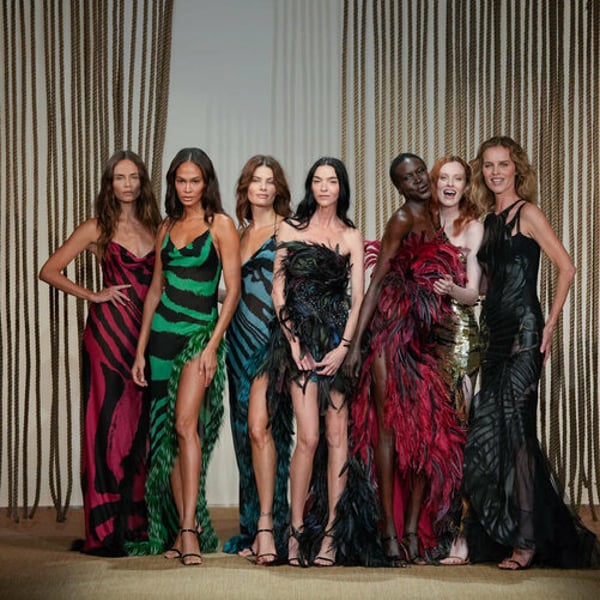
Roberto Cavalli – Spring-Summer2025 – Womenswear – Italie – Milan – ©Launchmetrics/spotlight

Owner DAMAC Group, said it was “addressing recent speculation in the press about Roberto Cavalli” and wanted to give a “clear assurance about the future of the business”.

It added: “Since acquiring the Roberto Cavalli business in 2019, DAMAC have invested significantly in the growth and success of the company. Roberto Cavalli is not for sale. As before, we remain interested in strategic partners who can add value to the business.”

The statement came after the company last month said it was assessing the “strategic partnerships” referred to in today’s statement as part of its growth options as Italian media began to speculate about a potential sale.

Cavalli has faced the same challenges that have hit the rest of the luxury sector in recent years but has been busy this year opening new boutiques and launching regular collections as well as collaborations. This year alone those new stores have included Ibiza, Dubai Mall and Los Angeles, while collabs have included SKIMS and LeSportsac.

Launched in 1970, the label’s founder died a little over a year ago. The company had been bought just before the pandemic by DAMAC, which is a multi-billion-dollar business conglomerate founded and headquarted in the UAE by Hussain Sajwani. The parent company also invests in luxury real estate, capital markets, hotels/resorts, manufacturing, catering, and data centres. 

Copyright © 2025 FashionNetwork.com All rights reserved.


Source link

Continue Reading

Fashion

Hydroponic cotton cultivation begins in Portugal

Published

on


By

Portugal Textil

Published


December 5, 2025

A partnership between Agromethod Labs and CITEVE is advancing hydroponic cotton cultivation, a project that could make Portugal the only country in Europe to host the entire cotton value chain, from fibre to clothing.

©CITEVE

Agromethod Labs was founded earlier this year with the mission of developing more sustainable, future-oriented agricultural solutions. Its founder, Raquel Maria, a chemist by training with a long track record in academic research, explains that the impetus to create the start-up stemmed from a personal concern.

“Academia allows us to change the world on a small scale. I felt it was time to bring that knowledge into the real world and have a greater impact on future generations,” she told Portugal Têxtil.

Although Agromethod Labs works across several fields, cotton quickly stood out, building on previous research, notably by researcher Filipe Natálio, currently at the Applied Biomolecular Sciences Unit (UCIBIO) of the School of Science and Technology at Universidade Nova de Lisboa (NOVA FCT). “But we want to continue working on other types of crops and other seeds. Agromethod Labs is bigger than cotton,” she says.

Approaching CITEVE marked a turning point. According to the founder, the hydroponic cotton project “was very much on paper” and required initial investment and a solid technological partner. “CITEVE was decisive. It came along at the right time and finally gave us the opportunity to get started with something that we had already thought about extensively, but which was not yet in a position to move forward,” she says.

The collaboration has made it possible to implement a functional mini pilot, already with measurable results, and to prepare the next phase: a larger-scale pilot that will incorporate vertical farming to maximise the production area.

Advantages and challenges

Hydroponic cultivation offers significant advantages, notes Raquel Maria. “We can grow anywhere in the world, without reliance on sunlight and without geographical limitations,” she explains. It also enables continuous production. “We are no longer limited to a single annual harvest. We can get three or four harvests a year,” she says.

Early results also show improvements in the fibre. “We have obtained cotton with better mechanical properties and greater whiteness, which can reduce some stages in textile processing,” says Raquel Maria.

Even so, the founder of Agromethod Labs recognises that there are challenges, particularly in terms of costs, since this cultivation technique is more expensive. However, incorporating vertical farming in the new pilot could help. “If we double the production area, we can get closer to the economic viability we want,” she believes. Considering the higher costs and added value of the fibre, the raw material produced “in the initial phase will be directed to specialised markets,” she says.

The small-scale production carried out in a room at CITEVE has already made it possible to produce yarn from hydroponic cotton. The next symbolic goal will be “to make a T-shirt and be able to say that it was made with cotton produced in Portugal would be wonderful,” confesses Raquel Maria.

With expansion planned for the next six months, the aim will be to significantly increase production and take an important step closer to the market. According to the founder of Agromethod Labs, the Portuguese textile industry has already started to show enthusiasm. “There have been several expressions of interest. We are completely open to collaborating with Portuguese companies,” she says.

However, the ambition goes beyond fibre production. “Portugal could be the only country in Europe to have the entire value chain- from raw material to end product- in a single territory. That would be a milestone for the country,” concludes Raquel Maria.

This article is an automatic translation.
Click here to read the original article.


Source link

Continue Reading

Fashion

Cloud Dancer white is Pantone’s 2026 Colour of the Year

Published

on


By

Ansa

Published


December 5, 2025

Dancing in the Clouds: the 2026 colour designated by the Pantone Color Institute is Pantone 11-4201 Cloud Dancer: “A neutral shade of white that fosters calm, clarity, and a creative breathing space in a world full of noise.”

Pantone 2026

Pantone’s website crashed as the countdown ended, while the announcement on social media showed a woman dressed in white, gazing dreamily at a cloud-filled sky.

Since 1999, beginning with Cerulean Blue, Pantone’s global experts have been naming the Color of the Year, the shade they believe will become prevalent across fashion, food, design, and entertainment; in 2026, that mantle falls to Cloud Dancer.

Cloud Dancer is a blank canvas on which to begin anew, explained Leatrice Eiseman, executive director of the Pantone Color Institute: “An invitation to open new paths and new ways of thinking.”

The mood is clearly one of serenity and an invitation to open new chapters; the election in New York of the young mayor Zohran Mamdani could be an example of this new philosophy. And yet, given the recent political climate in the US under Donald Trump, some, such as New York Times fashion editor Vanessa Friedman, have raised the possibility of MAGA and anti-DEI instrumentalisation, since the white of 2026 has ‘wiped out’ the 2025 colour, Mocha Mousse, a light brown between cappuccino and chocolate.

“Skin tones did not influence this at all,” Laurie Pressman, president of the Pantone Institute, was quick to point out, noting that Pantone has already received similar questions about other recent choices. “With Peach Fuzz in 2024 and then with Mocha Mousse 2025, we were asked whether the choice had anything to do with race or ethnicity. That’s not how it works. We try to understand what people are looking for and which colour can hopefully provide an answer.” And so Pressman invites us to look beyond metaphors: “It’s a softer white,” she said, describing the hue. “It isn’t a pure white, it isn’t a technical white, it isn’t that optically very bright white that, if we think back to the post-Covid period, people were seeking. This is deliberately an unbleached white, a very natural-looking white.”

Meanwhile, the launch of Cloud Dancer has attracted a host of brands eager to keep pace: Hasbro’s Play-Doh has created a tub of Play-Doh in this hue, while Post-it has released pads in the same shade as part of its Neutrality Collection; and the Mandarin Oriental luxury hotel chain will centre its afternoon tea and spa experiences on this minimalist colour. Spotify has also come on board, in its first collaboration with Pantone, creating a multisensory experience that translates “the emotion of colour” into sound through personalised playlists.

This article is an automatic translation.
Click here to read the original article.

Copyright © 2025 ANSA. All rights reserved.


Source link

Continue Reading

Fashion

Samsara Eco and European Outdoor Group aim to become springboard for recycled nylon through the Nylon Materials Collective

Published

on


Published


December 5, 2025

This is encouraging news for the European outdoor industry. On November 25, Australian biotechnology company Samsara Eco and the European Outdoor Group (EOG) launched the Nylon Materials Collective, a collaboration designed to make high-performance recycled nylon more accessible to outdoor brands. The initiative forms part of a broader drive to accelerate the sector’s transition to a circular textile economy.

Samsara Eco and EOG launch a collective to pool orders for recycled nylon – Samsara Eco

The Nylon Materials Collective is open to all EOG members and will be officially launched ahead of ISPO Munich 2025, where Samsara Eco will showcase its recycled nylon samples. But why did the EOG choose Samsara Eco? Founded in 2021, the Australian company specialises in recycling nylon 6,6 and polyester using enzymatic technologies- a strategy that has set it apart from direct competitors such as Matter, Recycling Technologies and ReCircle.

A collective of small and medium-sized enterprises

The high-performance recycled nylon produced by Samsara Eco is indistinguishable from virgin nylon, a material highly prized by outdoor brands. Despite their environmental ambitions, small and medium-sized players in the outdoor sector still find recycled nylon hard to access. That is why the EOG has joined forces with Samsara Eco: the Nylon Materials Collective is a collaborative demand-aggregation system that enables brands to participate collectively and access recycled materials.

The EOG represents more than 150 European brands
The EOG represents more than 150 European brands – Gore-Tex

And to keep the collective running smoothly, participating companies must share “similar performance requirements, supply chain partners, and material specifications,” in the words of both parties.

Preparing for future regulations

“We want to do everything we can to help more brands access our materials so we can all reap the benefits of the circular economy,” said Sarah Cook, Samsara Eco’s commercial director. “The Nylon Materials Collective will make it easier for outdoor brands of all sizes to access and integrate recycled materials that are identical to the virgin material into future product ranges, whether they have more modest material needs or typically purchase at the fabric level,” she added.

Samsara Eco's recycled nylon is identical to virgin nylon
Samsara Eco’s recycled nylon is identical to virgin nylon – Maloja

This partnership also helps brands strengthen their position ahead of forthcoming European regulations on the circular economy, concerning “extended producer responsibility and minimum recycled content obligations.”

Focus on circular materials

Katy Stevens, CSR and Sustainability Manager at the EOG, says: “The Nylon Materials Collective represents an opportunity for our members to work together with innovators like Samsara Eco to facilitate access to recycled nylon and accelerate the industry’s transition to circular materials.”

Samsara Eco uses enzymatic technologies to recycle nylon and polyester
Samsara Eco uses enzymatic technologies to recycle nylon and polyester – Samsara Eco

For the European Outdoor Group, which represents around 150 brands, retailers, associations, and organisations along the value chain, this partnership is a concrete step to support the sector in its activities, so that it can “give more than it receives”.

This article is an automatic translation.
Click here to read the original article.

Copyright © 2025 FashionNetwork.com All rights reserved.


Source link

Continue Reading

Trending

Copyright © Miami Select.