Connect with us

Business

Europe surrenders to Trump (and thus secures a victory by the back door)

Published

on


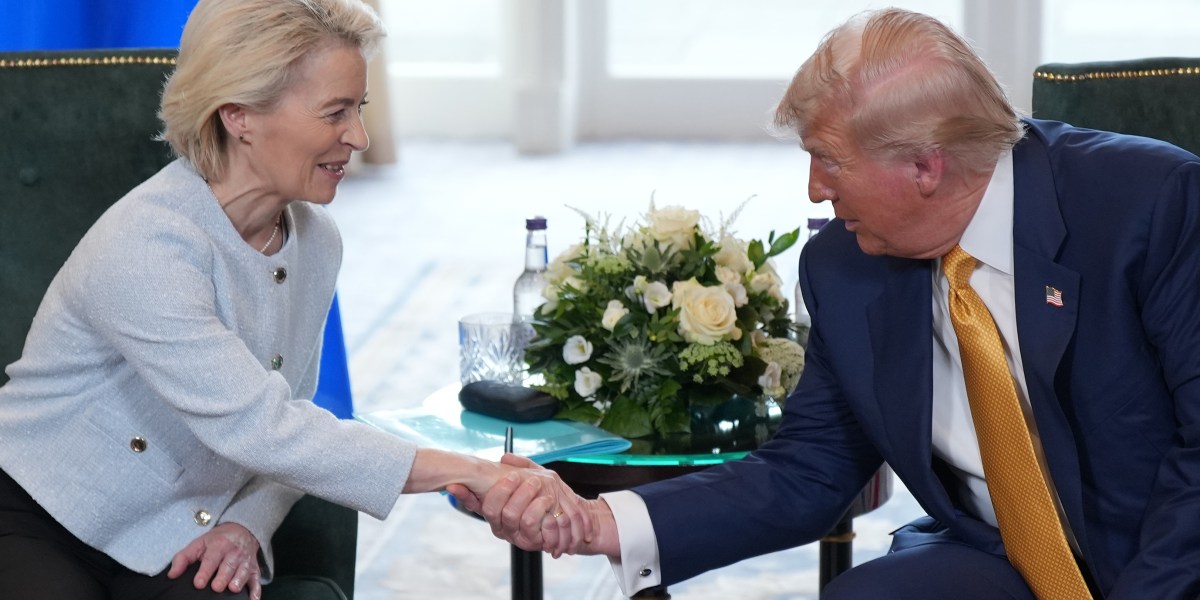
Stocks are up this morning on the certainty of a new trade deal between the U.S. and the EU. American businesses and consumers will now face a 15% tariff on all imports from Europe, while President Trump confirmed the EU tariff level has been reduced to zero. Previously, the tariff level on both sides was just under 3%.

President Trump, visiting his golf courses in Scotland, is positioning the deal as a win. The agreement includes a large amount of direct investment into the U.S. by Europe, including: $750 billion of energy purchases, $600 billion in extra direct investment, and the purchase of “a vast amount of military equipment,” the president said.

S&P 500 futures moved up 0.27% this morning but the STOXX Europe 600 rose by more than double that in early trading.

Why are investors in Europe so happy about Trump’s great victory over them? The devil is in the details, and the pact seems to contain several advantages for the EU. 

The auto tariffs, for instance, now benefit European manufacturers over North American competitors. The 15% level is lower than that faced by Canada and Mexico, which are much nearer the U.S. auto market. “How can the administration square a 15% tariff on cars from Europe and Japan, while manufacturers in the U.S., Canada and Mexico are laboring under 25% tariffs?” Patrick Anderson, CEO of the Anderson Economic Group, told The New York Times.

The deal does not require the EU to alter its digital services tax on large tech companies.

There is also no current change in drug pricing rules. The pharma industry is one of Europe’s biggest, and Trump has long complained that Europeans get drugs cheap because companies inflate pricing in the U.S.

Meanwhile the “new” direct investment and military purchases may likely have happened anyway—Europe is fighting a war against Russia on its Eastern flank, after all.  

“Europe is already the largest foreign investor in the U.S., with European direct investment increasing by roughly $200 billion from 2023 to 2024. Three times that over an undefined period is hardly a great coup,” The Wall Street Journal’s editorial board noted.

Simon Nixon, who writes the Wealth of Nations Substack, said: “The real win from the EU’s perspective is that it has successfully fended off Trump’s demands that it rewrite its regulatory rulebook to benefit U.S. companies. In particular, Trump had been demanding changes to EU digital services rules, agricultural rules and pharmaceutical pricing.

“The irony is that this is the one thing that U.S. companies would have most wanted out of any trade deal. Instead, they have been hit with a massive hike in tariffs on imports … without any increase in EU market access.”

In Europe, analysts seem to be concluding that deal is mostly Scotch mist. The tariff level itself is much lower than what Trump previously threatened, and the accompanying investment will get lost in the mail.

“The EU and the U.S. agreed that U.S. consumers should pay more tax—levied at 15% for imports from the EU. EU President von der Leyen made vague pledges to buy stuff from and invest in the U.S., without the necessary authority to make those pledges reality. Pharmaceuticals and steel seem to be excluded from this deal. The result is better for the U.S. economy than the worst-case scenario, but worse for the U.S. economy than the situation in January this year,” UBS’s Paul Donovan told clients this morning.

Here’s a snapshot of the action prior to the opening bell in New York:

  • S&P 500 futures were up 0.3% this morning, premarket, after the index closed up 0.4% on Friday, hitting a new all-time high at 6,388.64. 
  • STOXX Europe 600 was up 0.67% in early trading. 
  • The U.K.’s FTSE 100 was up 0.14% in early trading. 
  • Japan’s Nikkei 225 was down 1.10%. 
  • China’s CSI 300 Index was up 0.21%. 
  • The South Korea KOSPI was up 0.42%. 
  • India’s Nifty 50 was down 0.6%. 
  • Bitcoin was flat at just under $119K.


Source link

Continue Reading

Business

Twelve people killed in Bondi Beach Hanukkah terror attack

Published

on


Twelve people have been killed in Australia’s worst terrorist attack, as gunmen opened fire on Jewish people who had gathered to celebrate the first day of Hanukkah at Sydney’s iconic Bondi Beach on Sunday evening. 

The shooting was a “targeted attack” on the Jewish community, Australian Prime Minister Anthony Albanese said at a late-night press conference. He described the incident as an “act of evil anti-Semitism, terrorism that has struck the heart of our nation,” and flagged an uncompromising crackdown on anti-Semitism. 

“We will eradicate it,” he said. 

Australia’s Jewish population was estimated to be 116,967 in 2021, one of the world’s 10 largest. Bondi, in Sydney’s eastern suburbs, is among key Jewish communities in the nation. 

One of the gunmen is dead and a second is in a critical condition in the hospital, New South Wales Police Commissioner Mal Lanyon told reporters at a media conference, where he designated the incident as a terrorist attack. At least 29 people, including two police officers, were injured and taken to hospitals across Sydney, he added. 

The incident is Australia’s deadliest mass-shooting since a lone gunman killed 35 people at Port Arthur in Tasmania on April 28, 1996.  

“There are nights that tear at our nation’s soul,” Albanese said. “In this moment of darkness, we must be each other’s light.”

The gunmen opened fire just after 6:45 p.m. local time as more than 1,000 people attended the Chanukah by the Sea event on a warm summer evening. 

One of the victims said he only arrived in Australia in recent days from Israel, where he had lived for 13 years, to help the Jewish community in Sydney cope with anti-Semitic incidents. Speaking with Channel Nine television, his face bloodied and head swathed in bandages, he said the community would pull even closer together in the wake of the shootings.

The Australian Broadcasting Corp. showed footage of two black-clad gunmen firing on people from a footbridge near the beach. In another unconfirmed clip, a bystander is shown tackling and disarming one of the gunmen — actions that New South Wales Premier Chris Minns described as genuinely heroic, saying the intervention likely saved many lives. 

An improvised explosive device was found in a car linked to the dead offender, Police Commissioner Lanyon said. Police are also investigating whether there was a third offender, he said. 

Mike Burgess, director-general of the Australian Security Intelligence Organisation, said the national terror level rating remains at “probable” despite Sunday’s incident.

Israeli Foreign Affairs Minister Gideon Sa’ar said the shootings “are the results of the anti-Semitic rampage in the streets of Australia over the past two years,” adding that “the Australian government, which received countless warning signs, must come to its senses!” 

Speaking at an event recognizing the extraordinary achievements of immigrants to Israel at the President’s Residence in Jerusalem, Israeli President Isaac Herzog said the shooting was a “cruel attack on Jews who went to light the first candle of Chanukah on Bondi Beach.”

Several synagogues in Australia, along with Jewish businesses and homeowners, have been targeted following the outbreak of the conflict in Gaza triggered by Hamas’s Oct. 7, 2023, attack on Israel. 

In October last year, two masked men torched Lewis’ Continental Kitchen in Bondi after dousing it with accelerant. The following month, assailants sprayed anti-Israel graffiti and set a vehicle alight in Woollahra — a suburb with a large Jewish community — damaging more than 10 cars and several buildings.

Last December, offenders broke into the Adass Israel Synagogue in Ripponlea, Victoria, and spread accelerant in what police described as a probable terrorist attack. Days later, another graffiti-and-arson attack targeted a street in Woollahra that perpetrators selected because it was considered a Jewish area.

Around the same time, about 20 members of a neo-Nazi group gathered outside a Melbourne government building with a banner reading “Jews hate freedom.”

This year, Albanese said Australia uncovered intelligence that Iran’s Islamic Revolutionary Guard Corps directed at least two of last year’s arson attacks — including the Bondi restaurant and Melbourne synagogue incidents — prompting Canberra to expel Iran’s ambassador, its first such move since World War II.

Gun Crimes

The Bondi attack has refocused attention on gaps in Australia’s gun-control framework, a system often cited internationally as a model. However, it’s still marked by uneven implementation.

A January report from the Australia Institute found that all states and territories fell short on core benchmarks for effective oversight, including transparent data reporting and limits on how many firearms an individual can legally own.

The Australia Institute report also showed how concentrated gun ownership has become: the average license holder owns more than four firearms, and two residents in suburban Sydney hold upward of 300 each.

Using scorecards to rank jurisdictions on measures such as ownership caps and data availability, the Institute assessed New South Wales — home to Sydney — as the strongest performer on transparency, even as broader national shortcomings persist.


Source link

Continue Reading

Business

U.S. troops have been in Syria for over a decade. Here’s what to know after deadly IS attack

Published

on


The death of two U.S. service members and one American civilian in an attack in Syria by an alleged member of the Islamic State group has drawn new attention to the presence of American forces in the country.

Saturday’s attack was the first with fatalities since the fall of Syrian President Bashar Assad a year ago.

The United States has had troops on the ground in Syria for over a decade, with a stated mission of fighting IS. While not part of its official mission, the U.S. presence has also been seen as a means to hinder the flow of Iranian and Iran-backed fighters and weapons into Syria from neighboring Iraq.

The number of U.S. troops in the country has fluctuated and currently stands at around 900. They are mainly posted in the Kurdish-controlled northeast and at the al-Tanf base in the southeastern desert near the borders with Iraq and Jordan.

Here’s the back story and present situation of the U.S. military force in Syria:

What U.S. forces are doing in Syria

In 2011, mass protests in Syria against the Assad government were met by a brutal crackdown and spiraled into a civil war that lasted nearly 14 years before he was ousted in December 2024.

Wary of getting bogged down in another costly and politically unpopular war in the Middle East after its experience in Iraq and Afghanistan, Washington sent support to rebel groups but at first avoided direct military intervention.

That changed after the rise of the IS, which carried out sporadic attacks in the U.S. and Europe, while in Iraq and Syria, it seized territory that was at one point half the size of the United Kingdom. In the areas the group controlled, it was notorious for its brutality against religious minorities, as well as Muslims whom it considered to be apostates.

In 2014, the administration of then-U.S. President Barack Obama launched an air campaign against IS in Iraq and Syria. The following year, the first U.S. ground troops entered Syria, where they partnered with the Kurdish-led Syrian Democratic Forces in the country’s northeast.

By 2019, IS had lost control of all the territory it once held, but sleeper cells have continued to launch attacks.

The US military and Syrian forces

Before Assad’s ouster, Washington had no diplomatic relations with Damascus and the U.S. military did not work directly with the Syrian army.

That has changed over the past year. Ties have warmed between the administrations of U.S. President Donald Trump and Syrian interim President Ahmad al-Sharaa, the former leader of an Islamist insurgent group Hayat Tahrir al-Sham that used to be listed by Washington as a terrorist organization.

In November, al-Sharaa became the first Syrian president to visit Washington since the country’s independence in 1946. During his visit, Syria announced its entry into the global coalition against the Islamic State, joining 89 other countries that have committed to combating the group.

While the entry into the coalition signals a move toward greater coordination between the Syrian and U.S. militaries, the Syrian security forces have not officially joined Operation Inherent Resolve, the U.S.-led military mission against IS in Iraq and Syria, which has for years partnered with the Kurdish-led Syrian Democratic Forces in northeast Syria.

The future US footprint in Syria

The number of U.S. troops posted in Syria has changed over the years.

Trump tried to withdraw all forces from Syria during his first term, but he met opposition from the Pentagon because it was seen as abandoning Washington’s Kurdish allies, leaving them open to a Turkish offensive.

Turkey considers the SDF a terrorist organization because of its association with the Kurdistan Workers’ Party, or PKK, which has waged a long-running insurgency in Turkey.

The number of U.S. troops increased to more than 2,000 after the Oct. 7, 2023, attack by Hamas in Israel, as Iranian-backed militants targeted American troops and interests in the region in response to Israel’s bombardment of Gaza.

The force has since been drawn back down to around 900, but Trump has given no indication that he is planning a full withdrawal in the near future.

After Saturday’s attack, U.S. envoy to Syria Tom Barrack posted on X: “A limited number of U.S. forces remain deployed in Syria solely to finish the job of defeating ISIS once and for all.”

The U.S. presence “empowers capable local Syrian partners to take the fight to these terrorists on the ground, ensuring that American forces do not have to engage in another costly, large-scale war in the Middle East,” he said, adding, “We will not waver in this mission until ISIS is utterly destroyed.”


Source link

Continue Reading

Business

Trump’s demolition of East Wing of White House challenged by National Trust for Historic Preservation

Published

on


President Donald Trump was sued on Friday by preservationists asking a federal court to halt his White House ballroom project until it goes through multiple independent reviews and wins approval from Congress.

The National Trust for Historic Preservation, a privately funded group, is asking the U.S. District Court to block Trump’s White House ballroom addition, which already has involved razing the East Wing, until it goes through comprehensive design reviews, environmental assessments, public comments and congressional debate and ratification.

The project has prompted criticism in the historic preservation and architectural communities, and among his political adversaries, but the lawsuit is the most tangible effort thus far to alter or stop the president’s plans for an addition that itself would be nearly twice the size of the White House before the East Wing’s demolition.

“No president is legally allowed to tear down portions of the White House without any review whatsoever — not President Trump, not President Biden, and not anyone else,” the lawsuit states. “And no president is legally allowed to construct a ballroom on public property without giving the public the opportunity to weigh in.”

Additionally, the Trust wants the court to declare that Trump, by fast-tracking the project, has committed multiple violations of the Administrative Procedures Act and the National Environmental Policy Act, while also exceeding his constitutional authority by not consulting lawmakers.

No more work should be done, the Trust argues, until administration officials “complete the required reviews — reviews that should have taken place before the Defendants demolished the East Wing, and before they began construction of the Ballroom.”

White House maintains that Trump has ‘full legal authority’ over the building

Asked questions about the lawsuit, White House spokesman David Ingle responded with a blanket assertion that Trump is within his “full legal authority to modernize, renovate and beautify the White House — just like all of his predecessors did.”

Ingle did not specifically address an Associated Press question asking whether the president would consult Congress at any point.

The White House response correctly notes that essentially every president makes some changes to the White House. But Trump’s efforts are the most sweeping since a nearly complete gutting of the decaying interior of the oldest portion of the mansion during President Harry Truman’s tenure. Truman sought and received explicit authorization from Congress, along with appropriations. Further, he consulted the American Society of Engineers and the Commission on Fine Arts, and he appointed a bipartisan commission to oversee the project.

Trump, a Republican, has emphasized since announcing the project that he’s doing it with private money, including his own. But that would not necessarily change how federal laws and procedures apply to what is still a U.S. government project.

The president already has bypassed the federal government’s usual building practices and historical reviews with the East Wing demolition. He recently added another architectural firm to the project.

Trump has long said a White House ballroom is overdue, complaining that events were held outside under a tent because the East Room and the State Dining Room could not accommodate bigger crowds. Trump, among other complaints, said guests get their feet wet if it rains during such events.

The White House is expected to submit plans for Trump’s new ballroom to a federal planning commission before the year ends, about three months after construction began.

Will Scharf, who was named by Trump as chairman of the National Capital Planning Commission, said at the panel’s monthly meeting last week that he was told by colleagues at the White House that the long-awaited plans would be filed in December.

“Once plans are submitted, that’s really when the role of this commission, and its professional staff, will begin,” said Scharf, who also is one of the Republican president’s top White House aides.

He said the review process would happen at a “normal and deliberative pace.”

Besides being too late, the Trust argues, that’s not nearly enough.

Federal law cites ‘express authority of Congress’ over D.C. projects

The Trust asserts that plans should have been submitted to the National Capital Planning Commission, the Commission of Fine Arts and Congress before any action. The lawsuit notes that the Trust wrote to those entities and the National Park Service on Oct. 21, after East Wing demolition began, urging a stop to the project and asking the administration to comply with federal law.

“The National Trust received no response,” the lawsuit said.

The lawsuit cites a litany of federal statutes and rules detailing the role the planning and fine arts commission and lawmakers play in U.S. government construction projects.

Among them is a statute: “A building or structure shall not be erected on any reservation, park, or public grounds of the Federal Government in the District of Columbia without express authority of Congress.”

The Trust notes also that the range design and environmental reviews, along with congressional deliberation, would involve public input.

“This public involvement, while important in all preservation matters, is particularly critical here, where the structure at issue is perhaps the most recognizable and historically significant building in the country,” the complaint says.

Besides the president, the lawsuit names as defendants the National Parks Service, the Department of the Interior, and the General Services Administration, along with leaders of those federal agencies.


Source link

Continue Reading

Trending

Copyright © Miami Select.