
Business
Amazon’s new Alexa+ is pretty good — but is that enough in the ChatGPT age?
I’m going to start with a caveat from the top: This is not a formal product review. That’s not my background nor expertise, and if that’s what you are looking for, you are likely to walk away at least a little bit disappointed.
What this is, is a first impression based on hands-on experience with the new Alexa from someone who was once a consistent user of Amazon’s original voice assistant. Back then, I relied on Alexa for the kind of straightforward things many of us did every day: playing music, checking the weather, requesting sports scores, setting timers, and answering the types of questions that grade-school kids would get a kick out of (“Alexa, who would win a battle between a lion and a snow leopard?”). But over the years, Alexa’s performance seemed to deteriorate– it had more trouble understanding basic requests and definitely could not hold a conversation like popular AI chatbots could. Eventually, my family’s interest—and patience—waned.
So I’ve been waiting for a new and improved Alexa for quite some time, and when I recently received an invitation offering “early access” to the beta version of Alexa+, I was eager to take it for a verbal spin.
It’s worth noting that Amazon first announced what would become Alexa+ back in September of 2023, but the launch has been repeatedly held up amid “structural dysfunction and technological challenges,” as Fortune reported last June, and later by issues related to how slow the assistant was to respond to commands or complete actions. In February, Amazon finally unveiled details of Alexa+ at a splashy launch event, but did not launch the service widely at the time; instead, it’s been rolling out Alexa+ little by little, in a phased approach (Amazon says that millions of people now have access to Alexa+). Prime members don’t pay anything for the Alexa upgrade, but non-members will pay around $20 a month after the official launch, the company has said. For now, early access is free to Prime and non-Prime members alike. The company has not formally announced an official full public launch date.
I’ve spent some time over the last few weeks using Alexa+ for some of the same things we used its predecessor for, as well as trying out some of the new actions, like booking an Uber and restaurant reservation, that Amazon is pushing. My first impression, in short, is that the service is pretty good. If it had launched shortly after Amazon first announced an updated version of Alexa in the fall of 2023, I might have said it was very good. Its conversational abilities are real and mostly very fluid. Does it blow away voice modes from LLM-based AI assistants like ChatGPT and Perplexity? Not in my experience. But it is vastly superior in that way to the original Alexa so will likely come as a delightful surprise to those who haven’t spent much time with those competitor services. On several occasions, though, I had to re-prompt Alexa by name in the middle of a back-and-forth conversation—I thought I had just taken a normal, mid-speaking pause but Alexa thought differently. If such instances continue to occur at public launch, it might not be a deal breaker for regular usage, but would certainly frustrate me – and I assume some others too.
Can you hear the music playing?
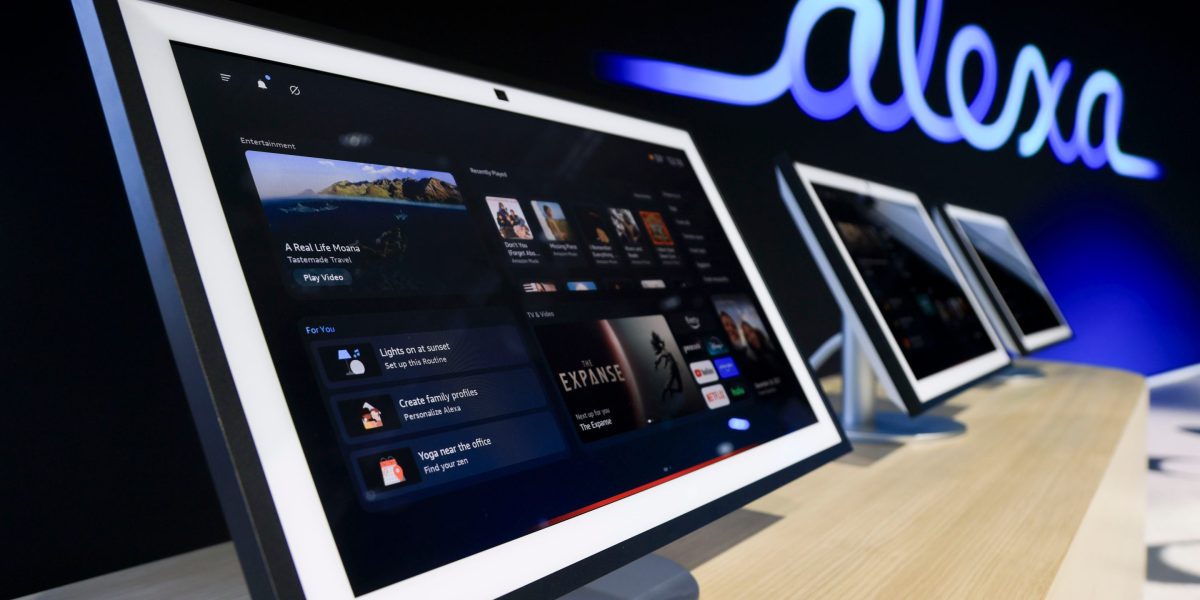
I also had some issues with playing Spotify using the new Alexa, unless I specified that I wanted it played on the specific Alexa device in front of me. The gadget in question was an 8-inch Echo Show device (the Echo device with a screen) to test out Alexa+ because the technology isn’t available on some of Amazon’s older speakers, including the original Pringles-box-shaped Echo speakers, one of which still sits on a shelf in our dining room. (If you don’t have an Echo device, you’ll still be able to use the new Alexa+ from the Alexa app.)
Cayce Clifford/Bloomberg via Getty Images
The new Alexa told me Spotify was playing, when it actually wasn’t. I thought perhaps it was somehow playing on the old Pringles-tube Echo downstairs, but that wasn’t the case. A spokesperson recommended I change the default device for Spotify in the Alexa app but honestly, the Alexa app isn’t the most intuitive and I gave up after about 10 minutes. Considering that playing music is one of the basic and common tasks for a smart speaker, this didn’t inspire a lot of confidence, but I am not ruling out the possibility that I’m overlooking a setting that would fix the issue.
The other flaws I ran into ranged from comical to frustrating. An on-screen prompt on the Echo Show advertised that Alexa could help me choose a new lunch spot, but when I queried Alexa about it the first time, she claimed she couldn’t carry out that task.
I also made the mistake, apparently, of asking Alexa to slow down her speaking cadence at some point so I could take some hand-written notes. That simple command kicked off a minutes-long bizarro-world exchange in which I would ask Alexa to speed up or slow down her cadence, she’d reply that she had—but at a speed which was even more drastically opposite of what I had been asking. It took several minutes, but what felt like an eternity, to rectify.
On another occasion, Alexa got snippy with me when I seemed astonished that she had instructed me to simply unplug and then reconnect my Echo device to try to solve the aforementioned Spotify issue. “It’s your problem not mine” was essentially the gist of the response. Can an AI offend me? I mean, that’d be pretty silly. But the exchange was a bit off-putting, though admittedly mildly amusing as well.
On this point, Panos Panay, the longtime Microsoft executive who joined Amazon in late 2023 to head up Alexa and its broad array of devices from Echos to Kindles to Fire TV sticks, seemed intrigued.
“We’re testing a few of the boundaries,” he told me in an interview at the company’s New York City headquarters in early July. “Like, yeah, you want a little personality out of your assistant, and you want it to feel or be personal. I think that’s okay. Where is that boundary is an interesting question.”
Alexa’s new tricks
For my daughter, Alexa+’s ability to generate images and “paintings” based on voice commands was a treat. I also tried some of the advertised “actions” that Panay and Amazon believe will set Alexa apart from competitors and transform it into more of an agent than an assistant. I asked Alexa to book a reservation for me and my wife at a new local sushi restaurant we’ve been meaning to try – and finally could with our kids staying the weekend with a relative. Disappointingly, though, Alexa replied that she couldn’t make a reservation at that restaurant – the restaurant doesn’t use OpenTable for its reservations and that’s the only current partner that Alexa+ has in the space. Alexa instead simply offered me the restaurant’s phone number which….was not exactly what i was looking for. It’s possible that Amazon ends up cutting a deal with Resy, the restaurant reservation service that the restaurant in question uses. While Panay said more partnerships were in the works, neither he nor a spokesperson would confirm specifics.
That said, ordering an Uber by voice worked seamlessly (once I agreed to provide access to my Uber account), though I do wonder how often people will opt for this experience versus simply pulling out their phone. Browsing and homing in on the cheapest soccer tickets at a nearby stadium also worked quite well though, again, I wonder if talking out loud to a virtual ticket assistant for 4 minutes is actually any better or more efficient than searching for the tickets on my phone or computer.
Panay told me beta feedback so far is “overwhelmingly positive,” and that the “conversational aspect” of Alexa+ alone—versus the prompt and response mode of the original—is delighting customers. “It’s just a part of the kitchen conversation at this point,” he noted, emphasizing his point with an anecdote about his family settling debates or open questions by querying Alexa+ rather than pulling out a phone and falling prey to all the distractions that come with it.
“It’s the idea of being engaged with each other and having an ambient assistant there, where I’m not turning on my phone, I’m not opening an app, I’m not being distracted by whatever it is that is on my notifications,” he said.
One major caveat is that I wasn’t able to try out everything that Amazon is excited about. Panay stressed that while engagement with “traditional features” like playing music are increasing, household-management capabilities of Alexa+ are a hit with early users and he believes they’ll continue to be. In one example, he discussed giving Alexa access to a family’s calendar and then prompting it for the best weekend to get away. I haven’t tried that feature mainly because you can’t yet link work email accounts from Google or Microsoft to Alexa+, and because our kids’ sports calendars are spread across several apps that I’m frankly too lazy to consolidate (yes, embarrassing).
“Please don’t underestimate the power of this”

Andrej Sokolow/picture alliance via Getty Images
Panay also highlighted shopping tools powered by Alexa+ that notify you when a certain product goes on sale. And he stressed the ease with which Alexa users who have outfitted their home with smart devices—think smart lights and smart locks —will be able to speak into existence complex routines.
“Alexa, every night at 8:30, start dimming the lights in the house and then lock the doors,” he said by way of example.
That’s four separate commands in one sentence, versus what would have taken at least a dozen and a half steps within the Alexa app previously, Panos said.
“Jason, please don’t underestimate the power of this,” Panay urged me.
One approach Amazon and Panay could take would be to set expectations a bit low and then overdeliver after such a long wait. After all, the introduction of the original Alexa occurred in a really understated way; it was buried within a larger announcement unveiling a surprise device called the Echo.
But that could be dangerous in its own right, especially amid the realization that former famed Apple designer Jony Ive is now helping ChatGPT-maker OpenAI invent their own AI-powered device.
“I hope others make great devices,” Panay said when asked about competitors.
Perhaps in response, though, Amazon recently said it would buy an AI wearable startup called Bee.
Panay, for his part, acknowledged that there is still work to do before the new Alexa is ready to be used by hundreds of millions of existing users. And after such a long wait—with Panay himself setting expectations high—it’s fair to wonder if “pretty good” is anywhere good enough in the new world that Amazon’s famed voice assistant is now reentering. Clearly, there’s more work to do.