Connect with us

Business

Inside the world of ‘timepiece tourists,’ who spend tens of thousands of dollars on luxury watch-themed vacations
Published

on


The seven switchbacks up to the top of Bürgenstock mountain are emotional for Dr. Pablo Richard. “My grandfather fell in love with this place,” he said, steering his new black Range Rover Sport along the curves. “I was little when he told me, ‘This is one of the most amazing spots in Switzerland, or in the world.’”

That assertion is hard to argue with. Opened in 1873, Bürgenstock Resort sits cantilevered 1,600 feet over Lake Lucerne. The Richards would celebrate with a weekend here every August. “It was a tradition,” Richard said. “I knew every waiter.”

So it was a full-circle moment when Bürgenstock approached Richard to curate a guest experience around Cyrus, the high-end watch brand he started with his father, Dr. Hans Peter Richard, and master watchmaker Jean-François Mojon, in 2010. Bürgenstock guests get a two-night stay, a roundtrip helicopter to Cyrus’s workshop to customize their own timepiece, and a return stay in six months to collect their finished watch.

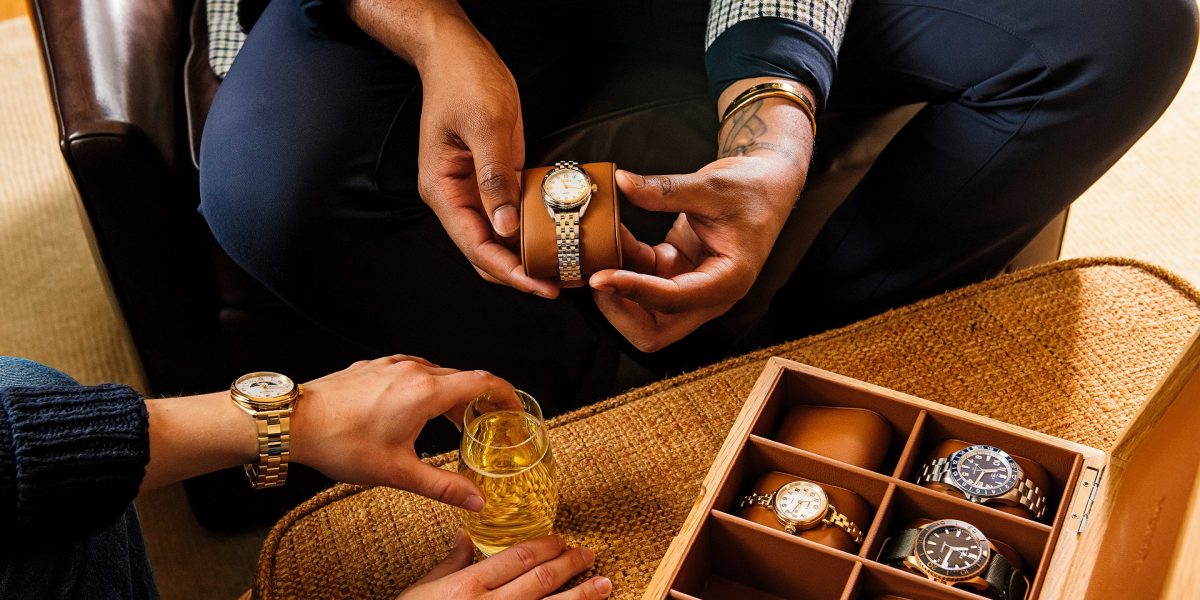
The package starts at about $27,700—and given that Cyrus’s entry-level watch is $10,000, that’s not a bad deal for an ardent horophile. Industry insiders say there are more of these timepiece tourists than ever, willing to spend big for behind-the-scenes access to a storied craft and to rare and custom pieces.

Despite the malaise and (literal) pearl clutching in the luxury-goods market, timepieces have proved a bit stickier; Chase Travel reports year-over-year increases in its American customers spending on high-end watches in France (+13%) and in Switzerland (+18%) between 2023 and 2024.

Courtesy of Initium

“You can buy high-end commercial watches almost everywhere, but for anyone who’s a true connoisseur, they go to Switzerland,” said Livia Angelini of the luxury travel agency Scott Dunn.

Scott Dunn’s Watchmaker’s Switzerland itinerary is a nine-night romp (from $1,200 per person, per night) that includes a Phillips auction in Geneva, where a record-breaking F.P. Journe Platinum Tourbillon Souverain fetched $8.4 million last year; a master class at Patek Philippe in Zurich; and a behind-the-scenes visit to the Audemars Piguet workshop in the ancestral center of watchmaking, Vallée de Joux.

Audemars Piguet opened the Hôtel des Horlogers there in 2022. The hotel, which cuts a hill-hugging zigzag silhouette from the road down to the forest floor, occupies the site of the valley’s former post office, where 19th-century craftsmen would catch up while shipping their mechanisms to Geneva.

Prior to the hotel’s opening, general manager André Cheminade told me when I stayed there in 2023, collectors would come to the valley to pick up their pieces, then retreat to the palace hotels of Geneva and Lausanne. “Now they stay here,” he said.

Other brands in the valley include De Bethune and Jaeger-LeCoultre. GMT (Great Magazine of Timepieces) will bring 18 travelers there this fall during its second annual weeklong Watch Safari (from $5,045).

Several brands, including Patek Philippe and Audemars Piguet, have opened museums showcasing their history and craft. And the Switzerlandbased Initium recently expanded into Paris with watchmaking experiences at its new atelier near Place Vendôme. “Paris is the main place of luxury in the world,” said the shop’s manager, Pablo Quaglia, whom I found sipping tea and sporting a salmon-face Baltic MR Classic.

Eight stations flank the petite workshop. A weathered pine apothecary cabinet conceals semiprecious gems in its tiny drawers. Bands and bracelets—coral crocodile, stitched leather, rose-gold mesh—rest one atop another, while crystals, dials, cases, and movements catch the sunlight in the front window. There are over a million possibilities you can put together during a half-day (from $2,890) or full-day (from $3,490) with one of Initium’s master watchmakers. The tourbillon class—named for the intricate mechanism that keeps a watch’s guts constantly in motion—starts at $19,190.

Courtesy of Bürgenstock Resort Lake Lucerne

Back at Cyrus in Switzerland, in the watchmaking town of Le Locle, Richard held up the Klepcys Vertical Tourbillon encased in black titanium. An arched bridge ran down the center of the face, with a vertical wheel displaying the seconds perpetually turning in increments of five. “We just do crazy stuff,” Richard said, popping out the crown and winding the watch forward. When the hour hand and minute hand cross midnight, they simultaneously snap backward to their starting positions, a feature known as double retrograde. Cyrus produces only 38 vertical-tourbillon watches annually, which range from $120,000 to $250,000.

Michelle, a Cyrus technician, showed me how to polish tiny brass pieces under a microscope. She sat me down on a stool and handed me her micromotor, a tool that looks like a more complex version of what a manicurist uses to buff fingernails. After a few minutes of tentative strokes, I got the hang of it, grinding away the gritty surface until the brass was smooth and shiny as honey.

Cyrus blends the exquisite craftsmanship of a legacy house with the joie de vivre of an upstart, which is reflected in the exuberant shades of the strap and dial details. If you’ve got your gold watch, your platinum, your leather, Richard said, it’s time for your lime, your cherry, your tangerine.

I wear my dad’s Patek, but did wonder if I could pull off Cyrus’s fuchsia gator strap. Letting your individuality shine is part of the point, Richard said: “People traveling to see the watchmaker already have a Rolex, an Audemars, a Patek; for the fifth or sixth watch, they want something different—a watch no one else in the world has.”

This article appears in the August/September issue of Fortune with the headline “For the watch lover who has everything, a visit to the sources.”


Hands-on horology

Those seeking exquisite timepieces can now indulge in a range of luxe experiences exploring the craft of watchmaking

  1. Bürgenstock Bespoke: Cyrus Watches
    The iconic Swiss Alps resort whisks guests by hekicopter to Cyrus’s workshop to design their perfect watch. (Packages start at $27,700).
  2. Great Magazine of Timepieces Watch Safari
    This weeklong tour, with 18 spots, sets off in October and stops at several renowned Swiss maisons. (The all-inclusive rate is around $5,000.)
  3. Initium Workshops
    At the Swiss brand’s Paris atelier, workshops with master watchmakers range from $2,890 for a half-day session to $19,190 for the tourbillon class.
  4. Shinola Hotel Lending Program
    For those who just want to experience a high-end watch, Detroit’s Shinola Hotel offers guests a selection of the brand’s top timepieces to wear during their stay.


Source link

Continue Reading

Business

JetBlue flight near Venezuela avoids midair collision with U.S. Air Force tanker

Published

on


A JetBlue flight from the small Caribbean nation of Curaçao halted its ascent to avoid colliding with a U.S. Air Force refueling tanker on Friday, and the pilot blamed the military plane for crossing his path.

“We almost had a midair collision up here,” the JetBlue pilot said, according to a recording of his conversation with air traffic control. “They passed directly in our flight path. … They don’t have their transponder turned on, it’s outrageous.”

The incident involved JetBlue Flight 1112 from Curaçao, which is just off the coast of Venezuela, en route to New York City’s JFK airport. It comes as the U.S. military has stepped up its drug interdiction activities in the Caribbean and is also seeking to increase pressure on Venezuela’s government.

“We just had traffic pass directly in front of us within 5 miles of us — maybe 2 or 3 miles — but it was an air-to air-refueler from the United States Air Force and he was at our altitude,” the pilot said. “We had to stop our climb.” The pilot said the Air Force plane then headed into Venezuelan air space.

Derek Dombrowski, a spokesman for JetBlue, said Sunday: “We have reported this incident to federal authorities and will participate in any investigation.” He added, “Our crewmembers are trained on proper procedures for various flight situations, and we appreciate our crew for promptly reporting this situation to our leadership team.”

The Pentagon referred The Associated Press to the Air Force for comment. The Air Force didn’t immediately respond to a request for comment.

The Federal Aviation Administration last month issued a warning to U.S. aircraft urging them to “exercise caution” when in Venezuelan airspace, “due to the worsening security situation and heightened military activity in or around Venezuela.”

According to the air traffic recording, the controller responded to the pilot, “It has been outrageous with the unidentified aircraft within our air.”

Join us at the Fortune Workplace Innovation Summit May 19–20, 2026, in Atlanta. The next era of workplace innovation is here—and the old playbook is being rewritten. At this exclusive, high-energy event, the world’s most innovative leaders will convene to explore how AI, humanity, and strategy converge to redefine, again, the future of work. Register now.


Source link

Continue Reading

Business

Trump admits he can’t tell if the GOP will keep the House despite massive investment pledges

Published

on


President Donald Trump admitted that he’s not sure if his economic policies will pay off for Republicans at the ballot box in 2026.

In an interview with the Wall Street Journal that was published late Saturday, he pointed to massive investment pledges that he’s secured since returning to the White House.

But when asked if Republicans will lose control of the House in next year’s midterm elections, Trump replied, “I can’t tell you. I don’t know when all of this money is going to kick in,” adding that forecasts say the second quarter.

Trump has previously touted as much as $21 trillion of investments pouring into the U.S., though recent commitments don’t come close to adding up to such levels.

Still, under trade deals Trump has negotiated, the European Union has vowed $600 billion in investment, Japan $550 billion, and South Korea $350 billion. Separately, Saudi Arabia has promised $1 trillion. Companies have also announced plans to invest hundreds of billions of dollars, though some of that includes money planned during the Biden administration.

While the timing of all the money is uncertain, not to mention how much will actually be spent, companies have expressed the need to diversify supply chains with more domestic production. Apple has said its $600 billion pledge to build U.S. factories will create a “domino effect” that ignites manufacturing across the country.

At the same time, Wall Street expects Trump’s tax cuts from his One Big Beautiful Bill Act to deliver a significant jolt of fiscal stimulus to the economy next year, potentially reaccelerating GDP growth.

That would come as voters made clear in last month’s off-year elections that affordability is their top priority. Inflation has cooled from its 2022 high, but prices are up sharply from pre-pandemic levels, and consumers are revolting over higher insurance, electricity and grocery bills. Even most Trump voters say the cost of living is bad.

Trump has dismissed the affordability issue as a Democratic “hoax” and insists prices are down. He told the Journal that he will lower prices.

“I think by the time we have to talk about the election, which is in another few months, I think our prices are in good shape,” Trump said.

“I’ve created the greatest economy in history. But it may take people a while to figure all these things out,” he added. “All this money that’s pouring into our country is building things right now—car plants, AI, lots of stuff. I cannot tell you how that’s going to equate to the voter, all I can do is do my job.”

Trump has floated some ideas to appease voters on affordability, including a 50-year mortgage to lower monthly payments and $2,000 “dividend” checks. He also continues to pressure the Federal Reserve to lower rates, even though it could worsen inflation, and rolled back tariffs on some food imports.

In his interview with the Journal, Trump didn’t say if he would cut tariffs on other goods. He also warned that if the Supreme Court strikes down his global tariffs, his alternatives are not as “nimble, not as quick.”

 “I can do other things, but it’s not as fast. It’s not as good for national security,” Trump added. 


Source link

Continue Reading

Business

Nicotine pouches can be a better alternative to cigarettes says CEO

Published

on


Smoking is one of the clearest public-health failures of our time. More than 500,000 Americans still die each year from smoking-related illnesses, and globally the picture is even more alarming. In the United States, anti-smoking campaigns have reduced the number of new cigarette users, but the effectiveness of these measures may be fading. Indeed, the headline of a widely-shared news story notes “Celebrities Are Making Smoking Cigarettes Cool Again”. Yikes. Meanwhile, a quick trip to Mexico, Europe, or Asia is enough to see that cigarettes remain very much in style.

Reducing cigarette use, and preventing a new generation from getting hooked on nicotine, is a noble goal. That is one reason James Monsees and Adam Bowen founded the vape company JUUL Labs, as a potentially less harmful alternative for adult smokers. But a mix of regulatory missteps by a hostile FDA and market loopholes opened the door to a wave of counterfeit and bootleg vapes, often imported from China, sold in local stores, highly addictive, and completely unregulated. Many people became sick from using vapes with unknown ingredients. Teenagers were easily able to access bootleg vapes from China in youth-friendly flavors. What began as an idealistic goal—moving adult smokers off of cigarettes—turned into a new epidemic. 

Now we have two problems: cigarettes and vapes.

I believe science and technology can solve both. I was a tobacco user who became addicted to vaping. I tried everything to quit and cut down my nicotine use. Eventually, I discovered Swedish-style white pouches. That experience led me to create Sesh+, a premium, tobacco-free nicotine pouch made with transparent ingredients. It has been life-changing for me personally: I haven’t picked up a vape since switching to pouches. In Sweden, where oral nicotine products have been widely used for decades, smoking rates are among the lowest in Europe and smoking-related disease is correspondingly lower.

There is growing evidence that nicotine itself, while addictive, is not what primarily causes smoking-related disease; it’s the toxic byproducts of combustion that kill. With vaping, the concern is different: it’s the lack of transparency and quality standards that should alarm us. As a health-conscious consumer, I want to know exactly what I’m putting into my body. That’s why our pouches are independently lab-tested for contaminants like heavy metals and are manufactured in the United States under strict quality controls. 

Fake nicotine pouches are already in the U.S. market. Sofia Hamilton writes for Reason that her favorite convenience store unknowingly sells counterfeit nicotine pouches, and how only someone deeply familiar with FDA nicotine rules could tell the difference. No one should have to be a nicotine policy expert just to know whether a product is safe.

Important questions remain. We do not want to create a product that attracts people who don’t already use nicotine. The average Sesh+ customer is over 35, and I’m very proud of that. Early data is encouraging: a recent Rutgers study found that new nicotine users taking up pouches remains very low. Government has a responsibility to keep black-market and counterfeit pouches out of consumers’ hands. Industry must ensure retailers are educated and know what they’re selling. And we need strong youth prevention laws.

Nicotine pouches will only be effective if industry and government work together to ensure we are not attracting youth or non-nicotine users.

In the U.K., the proposed Tobacco and Vapes Bill would ban people born in or after 2009 from ever purchasing nicotine products. In the United States, we have already raised the legal age to buy tobacco to 21. These are the kinds of measures our industry should support. If the legislation in the U.K. passes, I hope other countries will adopt similar policies to prevent youth from accessing nicotine products. I also hope to see product-verification technology adopted as an industry standard so counterfeit nicotine products never reach consumers. Age verification is not enough; we must ensure a market for counterfeit and bootleg nicotine pouches does not emerge.

If companies in the nicotine pouch space work together, we can learn from JUUL’s experience and avoid repeating the same mistakes. Our responsibility is clear: help adult smokers move to potentially less harmful alternatives, without creating a new generation of nicotine users. If we get this right, a world free from tobacco is not just aspirational. It’s achievable.

Max Cunningham is the CEO of Sesh+, a nicotine pouch company based in Austin, Texas and backed by 8VC. The opinions expressed in Fortune.com commentary pieces are solely the views of their authors and do not necessarily reflect the opinions and beliefs of Fortune.


Source link

Continue Reading

Trending

Copyright © Miami Select.