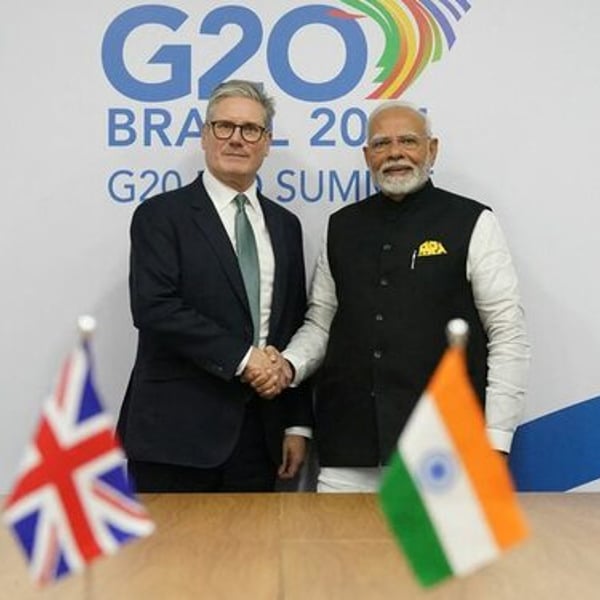
India and Britain will sign a free trade agreement on Thursday during Prime Minister Narendra Modi’s UK visit, officials said, with New Delhi to ease tariffs on British whisky, cars and some food items, and the UK offering duty-free access to Indian textiles and electric vehicles.
India and Britain are expected to sign a free trade agreement on Thursday – Reuters
The pact, concluded in May after three years of stop-start talks, should boost bilateral trade by removing numerous barriers and granting each country greater market access to the other. It will take effect after the British parliament and India’s federal cabinet approve it, likely within a year.
“This is a significant agreement,” Vikram Misri, India’s foreign secretary, told reporters on Tuesday, adding that legal vetting of the deal was near completion ahead of Modi’s four-day trip to the UK and Maldives.
Trade minister Piyush Goyal will accompany Modi for the formal signing, a commerce ministry official said. This will be Modi’s fourth visit to the UK since he took office in 2014 and he is scheduled to meet Prime Minister Keir Starmer.
Bilateral trade between the two countries reached $55 billion in 2023/24, while the UK has become India’s sixth-largest investor, with cumulative investments of nearly $36 billion, Misri said. Around 1,000 Indian companies operate in the UK, employing 100,000 people, and they have invested about $20 billion there, he added.
The ministry has said 99% of Indian exports to Britain would benefit from zero duties under the deal, including textiles, while Britain will see reductions on 90% of its tariff lines.
“The UK is an important market for Indian exporters,” said Ajay Sahai, director general of the Federation of Indian Export Organisations, adding that the trade pact will boost bilateral trade and provide access for Indian sectors such as textiles, footwear, marine and engineering products.
Japanese footwear and sportswear brand Onitsuka Tiger is entering the fragrance world with its first collection of four scents, simply named ‘One,’ ‘Two,’ ‘Three,’ and ‘Four.’
Onitsuka Tiger “One”
Named ‘Wearing Quiet Radiance,’ the eau de parfum line symbolises the beauty of contrast and was conceived by world-renowned perfumer Mark Buxton. The fragrances draw inspiration from the fusion of tradition and modern innovation, combining craftsmanship with contemporary design- elements that have defined Onitsuka Tiger’s heritage, according to a statement.
The entire process of creating the fragrance line, from the selection and extraction of materials to blending and bottling, takes place exclusively in Grasse, in Provence, the world’s perfume capital.
The four fragrances, designed to evoke a sense of stillness that allows one to reconnect with one’s essence, are encased in elegant, bright-yellow bottles that reflect the brand’s distinctive colour, and are available in Onitsuka Tiger stores and on the Japanese brand’s official website.
Onitsuka Tiger One is built around green and mint notes, followed by lemon and mandarin. White florals and jasmine form the heart, while patchouli, leather, and guaiac wood add depth and resonance to the fragrance. Onitsuka Tiger Two opens with bergamot and lemon, joined by geranium and frankincense. Finally, velvety musk and sandalwood envelop the skin.
Onitsuka Tiger Three showcases the spicy, citrus nuances of angelica, followed by violet and marine notes. Smoky and spicy nuances then gently unfurl. In Onitsuka Tiger Four, peppermint and bergamot make an immediate impression, while absinthe and nutmeg add a bold accent. As the fragrance evolves, vanilla and vetiver add depth, and the scent ends with the crystalline clarity of citrus notes.
Founded in Kobe in 1949 by Kihachiro Onitsuka, the Japanese label originally produced only basketball shoes before becoming a lifestyle brand within the Asics group following a 1977 merger.
Europe is gaining momentum in Onitsuka Tiger’s business, as is the US, but the brand continues to rely mainly on its Asian operations, particularly in China and Japan. According to company president Ryoji Shoda, the brand generated revenue of 120 billion yen last year (705 million euros), almost double the figure from six years ago, with sales of its heritage range still accounting for the bulk of its revenue and generating substantial profitability.
This article is an automatic translation. Click here to read the original article.
Pandora has brought its leadership transition forward to January. The Danish jewellery brand announced on Monday that the Spanish executive Berta de Pablos-Barbier, until now the company’s chief marketing officer, will assume the role of CEO on January 1, taking over from Alexander Lacik. The company announced this change in leadership in September and it had initially been scheduled for completion in March, at its annual general meeting.
Berta de Pablos-Barbier will take over as CEO of Pandora on 1 January 2026. – Pandora
Pandora has opted to accelerate this transition thanks to “a smooth handover by the current CEO, Alexander Lacik, and the appointment of Jennie Farmer as the new chief marketing officer,” the jewellery brand said in a statement.
In this regard, the chairman of Pandora’s board of directors, Peter Ruzicka, commented: “The handover from Alexander to Berta has been exceptionally smooth. With the addition of Jennie Farmer as CMO, we are pleased to be able to carry out the leadership transition faster than anticipated.”
The Spanish executive Pablos-Barbier, for her part, said it would be “an honour” to lead Pandora in its next stage.
“In recent years we have consolidated a strong brand with a unique position in the accessible jewellery market. My immediate priority will be to navigate the current market turbulence as we prepare to take advantage of our untapped opportunities as a comprehensive jewellery brand and drive long-term growth. We are building a bigger Pandora,” she added.
The current CEO, Lacik, will retire after nearly seven years as chief executive and president of the brand, although he will remain with Pandora as a special adviser to the board of directors and the executive committee until the company’s annual general meeting, which will be held on March 11 next year.
On Lacik’s contribution, Ruzicka thanked him for “his exceptional leadership.”
“Since his arrival, Pandora’s revenue has grown by 45% and total shareholder return has exceeded 200%. He leaves the company with a solid foundation and significant growth potential,” he concluded.
Starting next year, Jennie Farmer will replace Pablos-Barbier as chief marketing officer. Currently senior vice-president of brand experience and channels, she joined Pandora in January 2025 and has more than 25 years of experience with luxury and FMCG brands, from Procter & Gamble to LVMH.
“Pandora is an iconic brand with a track record of redefining the jewellery industry. I look forward to building on the strong direction set by Berta and driving bold, creative marketing that connects with consumers across all our segments and channels,” she said.
After nearly two decades of collections, womenswear brand Heimstone will close its doors, founder and artistic director Alix Petit announced on December 15. The decision comes amid diminished purchasing power and an increasingly tough market. The closure is planned in two stages: its physical boutique, located at 23 Rue du Cherche-Midi in the 6th arrondissement of Paris, will close on December 20, and its e-commerce platform will cease operating on December 30.
Heimstone is currently selling its final collection – Heimstone
“For nineteen years, I have poured immense energy, total dedication and passion into Heimstone, which has shaped me as much as I have shaped Heimstone. But a life is never made up of a single chapter, and I now feel naturally guided towards the end of a cycle,” said Petit in a press release.
An “exhausting” French system
“I am turning the page with clarity, pride and serenity,” she continued. “I feel neither nostalgia nor regret, only the profound certainty that it is time to close one door to open another. Above all, thank you. You have been committed, loyal and dynamic year after year. This community of women is without a doubt the greatest achievement of this adventure.”
The Heimstone adventure draws to a close after nineteen years – Heimstone
The designer also spoke candidly in a video posted on social media, thanking her community as well as her long-standing partners, while criticising a French system that “wears down” industry players, far removed from its “official line.”
A brand with international reach
Heimstone made a name for itself with collections featuring flowing cuts and colourful prints, as well as numerous pop-up stores. The label made appearances in Marseille, Lyon, Lille and Bordeaux, as well as in Brussels and London. With Heimstone, Petit placed a strong emphasis on in-store concepts, regularly innovating. Collaborations included Damart, Catimini, Spartoo, Bocage, Bugaboo and Olivia Dar.
The brand enjoyed international recognition and sales – Heimstone
For sales, Heimstone relies on eight stockists, including Featsy by Piccadilly Circus in Annecy, By Mahe in Megève and Frimousse le Drugstore in Rennes. A graduate of Atelier Chardon Savard, Petit made Heimstone an internationally sought-after brand at the height of its recognition, with sales in the United States, the United Arab Emirates and across Asia.
This article is an automatic translation. Click here to read the original article.