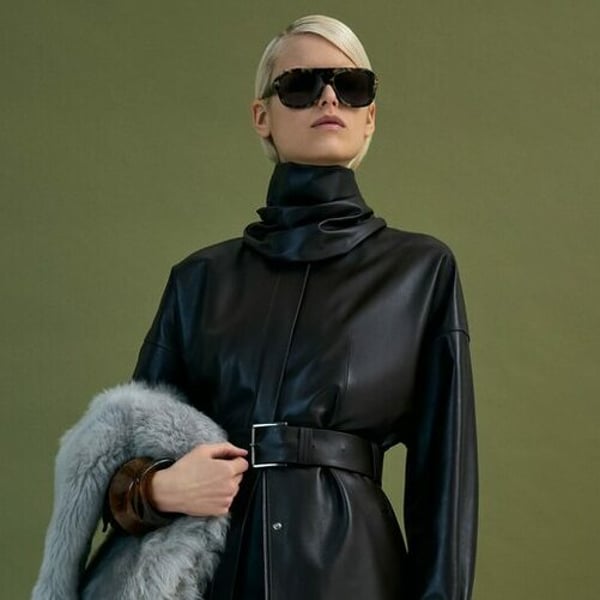
With its elegant ready-to-wear fashioned in supple, colourful leathers, 1972 Desa is little known to the general public, yet finds itself on par with the more prominent luxury labels. The brand was launched in 2014 by Turkish leather goods group Desa, which supplies luxury brands including Prada. Today, the premium men’s and women’s label is accelerating its development and refining its offering under the impetus of Croatian designer Ivana Omazić.
A look from Desa’s autumn-winter 2025-26 collection – 1972 Desa
Omazić has enjoyed a flawless career which has taken her from Romeo Gigli to Miu Miu and Jil Sander via Céline, whose styling she helmed before the Phoebe Philo era. The designer has also worked for Maison Margiela, where she was stationed until the arrival of John Galliano. Omazić debuted at 1972 Desa for spring-summer 2025. However, it was with her autumn-winter 2025-2026 collection of over 100 pieces that she really made her mark, infusing her knowledge of innovative leather treatments, from braiding techniques to laser engraving, into the designs. “All leathers come from the food industry,” said Omazić about her designs.
The label stands out for its use of beautiful materials, notably incredibly supple nappa and plunged lambskin leathers. 1972 Desa also offers a wide range of colours with up to 16 different shades of leather. Outerwear naturally dominates its offering, with coats made from sheepskin and ultra-soft pile as well as striking jackets, such as a model featuring fine leather details reminiscent of feathers and a fully reversible parka in smooth leather on one side and lining on the other.
Omazić often reimagines wardrobe classics through a minimalist lens, but always with a sophisticated touch. She has also enriched the brand’s product range with dresses, skirts, pants, and tops. Moreover, her designs play with construction, such as a trench coat that can be broken down into a sleeveless dress and a bolero.
1972 Desa is distributed through 120 multi-brand retailers worldwide, including Harvey Nichols in Hong Kong, Gio Moretti in Milan, August Pfüller in Frankfurt, Jacques Loup in Cannes, and Nérée in Nice. Europe, helmed by Italy, is the brand’s leading market, followed by Asia (South Korea and Japan), the US, and Canada. The brand offers good value for money, with jackets priced between 800 and 1,400 euros, produced entirely in-house through a fully vertical structure based in Turkey, with a smaller site in Italy.
The label is known for its wide range of leather colours – 1972 Desa
The Desa group has a 20,000-square-metre tannery and an 18,000-square-metre garment factory in Istanbul. It also counts a 10,000-square-metre factory in Düzce, located 200 kilometres east of the Turkish capital, which produces bags for brands in the luxury segment, and has a 2,000-square-metre leather workshop in Poppi near Arezzo, Tuscany.
The business also markets its more accessible ‘Desa’ brand of ready-to-wear, bags, and shoes, through around 100 mono-brand boutiques. The business has a joint-venture partnership with Samsonite Group for distribution in Turkey, along with other countries.
Listed on the Istanbul Stock Exchange since 2004, the group was founded in Istanbul in 1972 by the Çelet family, who still own 80% of the business, which is led by Burak Çelet, the founder’s son. Desa employs over 2,000 people and reported sales of 63.5 million euros in 2024.
This article is an automatic translation. Click here to read the original article.
Rebag’s Clair report, which studies the value retention of bags on the resale firm’s platform, said Hermès has reclaimed the top position in 2025, reaching an average 138% value retention—a 38% year-over-year increase.
Rebag
The New York-based Rebag’s report also said that a ten-year analysis of Birkin data shows resale values have surged 92% since 2015, outpacing Hermès’ own retail price growth of 43%.
Behind Hermès, Goyard logged 132% retention in 2025, up 28% from 2024; The Row recorded 97% value retention, while Miu Miu climbed to 104% average retention, according to the report.
In fine jewellery, Van Cleef & Arpels extended its lead, with 112% retention led by the Sweet Alhambra collection, while in the watches category, Rolex remained steady at 104%, with standout models like the Submariner Hulk reaching 244% of their original retail price. Comparatively, Cartier witnessed 87% retention.
Louis Vuitton x Takashi Murakami‘s return boosted search demand and pushed top styles above 130% resale value, the report added, while renewed interest in Balenciaga‘s Le City, Celine‘s Phantom, and Chloé‘s Paddington saw an increased demand for early-2000s bags.
Rebag’s 2025 Clair Report, which analyses millions of data points across the primary and secondary markets to reveal the brands, styles, and investment opportunities shaping the luxury landscape, said that global tariff shifts and changing consumer behaviours have made 2025 a “defining year for luxury resale.”
“Higher primary prices pushed more consumers to the secondary market, reaffirming its stability. The 2025 Clair Report highlights the brands demonstrating lasting long-term value,” said Charles Gorra, CEO and founder of Rebag.
In June, Rebag reported its launch on Luxury Stores at Amazon, bringing its pre-loved designer handbags, jewelry, watches, and more to the platform.
Lululemon Athletica’s CEO shake-up has put the spotlight on the once-dominant yoga pants maker’s race to wrest back younger and affluent shoppers from rivals and revive its sagging U.S. business.
Calvin McDonald – Reuters
Its shares, which have halved in value this year, rose 10% on Friday following the departure of CEO Calvin McDonald after about seven years in the role.
An athleisure pioneer known for its premium yoga apparel, Lululemon lost ground as newer rivals such as Alo Yoga and Vuori weaned away its core younger shoppers with trendier styles, marketing campaigns and celebrity partnerships.
Meanwhile, established players like Nike and Gap also entered the market with lower-priced styles.
Lululemon “caught the perfect wave in fashion, becoming the trend for the last five years,” said Brian Mulberry, senior client portfolio manager at Zacks Investment Management.
“But as its core customers graduate college and face tighter budgets, affordability is a challenge and a new outfit at Lulu can cost as much as a month’s groceries.”
Lululemon sells a range of yoga, running and training apparel such as Align yoga pants priced at $108 and men’s joggers at $128.
The slow refresh to core styles and product missteps, such as its decision to pull its $98 “Breezethrough” leggings from shelves last year, have led to heavy discounting to clear aged inventory.
At an earnings call late on Thursday, company executives said the board is “focused on a leader with experience and growth and transformation”.
“It’s understandable to think that a strategic overhaul with a new leader at the helm will be a positive, but this opens the door to more questions as to what direction the board will go with a replacement,” said Jay Woods, chief market strategist at Freedom Capital Markets.
Lululemon is the latest global consumer company facing leadership churn as macroeconomic uncertainty fuels increasingly divergent spending patterns.
Lululemon is making efforts to speed up product development, launch fresh styles and drive company-wide efficiencies to offset cost inflation and protect margins.
The company beat third-quarter results, lifted by strong China sales, but issued a weaker-than-expected holiday forecast as higher promotions and increased spending on marketing weigh on margins.
Founder Chip Wilson, who is also Lululemon’s largest independent shareholder, in a statement on Friday slammed the board for “poor succession planning” and value erosion.
He called for an urgent CEO search led by new, independent directors with deep company knowledge to restore a product-first focus. Lululemon did not immediately respond to a Reuters request for comment on Wilson’s statement.
The company’s forward price-to-earnings multiple, a common benchmark for valuing stocks, is 14.66, compared to 31.26 for Nike and Abercrombie & Fitch‘s ratio of 10.8, according to LSEG data.
“The main challenge I foresee for the new leadership is not how consumers see Lulu, but how does it see itself?” said Mulberry.
Ferragamo appoints Alberto Tomba as a brand ambassador. The collaboration with the Italian skiing legend celebrates values shared by the Florentine fashion house: dedication, perseverance, resilience and attention to detail.
Alberto Tomba
Born in 1966, Tomba is the quintessential emblem of an Italy that invests in talent, commitment and the ability to push beyond one’s limits. His career is marked by major international successes, including three Olympic gold medals and two silver medals, two World Championship gold medals and two bronze medals, and 50 World Cup victories.
The Bologna-born skier is also the only athlete to have won races in 11 consecutive seasons (1987-1998) and to have claimed four World Cup discipline titles in giant slalom and four in slalom.
“Tomba’s sporting journey perfectly reflects Ferragamo’s philosophy: every achievement comes from sacrifice, every result from dedication. We share with him a deep sense of authenticity and a love of excellence, values that continue to inspire our daily work,” said Leonardo Ferragamo.
“Being chosen by Ferragamo is an honour,” Tomba commented. “I have always believed that sport and style share a common language: that of passion, rigour and the desire to improve every day. Representing a brand that embodies all this, and that brings Italian beauty and craftsmanship to the world, is a source of great pride.”
This article is an automatic translation. Click here to read the original article.