Connect with us

Politics

Last Call for 7.22.25 – A prime-time read of what’s going down in Florida

Published

on


Last Call – A prime-time read of what’s going down in Florida politics.

First Shot

Gov. Ron DeSantis and his “warrior” Chief Financial Officer Blaise Ingoglia are taking their Department of Government Efficiency (DOGE) show on the road.

Appearing in Fort Lauderdale and Gainesville, the Governor and his latest appointment rolled out probes starting July 31 on pay, contracts and socially progressive policies taking taxpayer funds.

DeSantis noted in Broward that this swing to announce “on-site inspections and audits” of local and county governments was part of the “DOGE’ing of local government” and an effort to look at “problems in local governments” amid “complaints” he has heard.

At both stops, DeSantis promised changes.

In Gainesville, he joked that left-leaning Zohran Mamdani, a New York mayoral candidate, “probably could get elected” in the liberal college town. DeSantis then pointed out purportedly profligate spending that will be spotted by “real auditors on the ground” in a “thorough review.”

Gainesville has increased its operating budget by $90 million a year off the strength of an 86% ad valorem increase since 2020, DeSantis said.

He noted in Fort Lauderdale that “taxpayers here in Broward have watched their county government (increase) property tax burdens by the tune of $450 million in addition to ad valorem collections. So that’s an increase of close to 50%, just since 2020.”

Read more on Florida Politics.

Evening Reads

—”From Truth Social to bitcoin empire: Donald Trump’s $2 billion pivot” via Judd Legum, Rebecca Crosby and Noel Sims of Popular Information

—“Just when you thought the Jeffrey Epstein story was dying out …” via Chris Cillizza of So What

—”Trump’s student arrests, and the lawsuit fighting them, tread new ground” via Zach Montague of The New York Times

—”The hype man of Trump’s mass deportations” via Nick Miroff of The Atlantic

—”Everything is a ‘false flag’ now” David Gilbert of WIRED

—“Gov. Ron DeSantis says he doesn’t know whether Alligator Alcatraz inmates are being denied access to lawyers” via A.G. Gancarski of Florida Politics

—“A health care tax credit that powers Florida’s small businesses is going away” via Riya Sharma of the Tampa Bay Times

—“UF breaks own record on spending for research projects in FY 2025” via Drew Dixon of Florida Politics

—“Mary had schizophrenia — then suddenly she didn’t” via Rachel Aviv of The New Yorker

Quote of the Day

“There is a new era of accountability in Florida when it comes to wasteful spending.”

— CFO Blaise Ingoglia, during his and Ron DeSantis’ DOGE roadshow.

Put it on the Tab

Look to your left, then look to your right. If you see one of these people at your happy hour haunt, flag down the bartender and put one of these on your tab. Recipes included, just in case the Cocktail Codex fell into the well.

It’s another round of Suffering Bastards for Gainesville residents because if this latest stunt is anything like when GRU became “Governor Ron Utilities,” they’re about to be paying more and getting less.

A certain AI has apparently been hitting the Grok Juice pretty hard of late — it can’t even remember that the Gators are the reigning NCAA champs.

Something tells us Attorney General James Uthmeier wouldn’t react well if you ordered him one of the tasty concoctions in Dragtails.

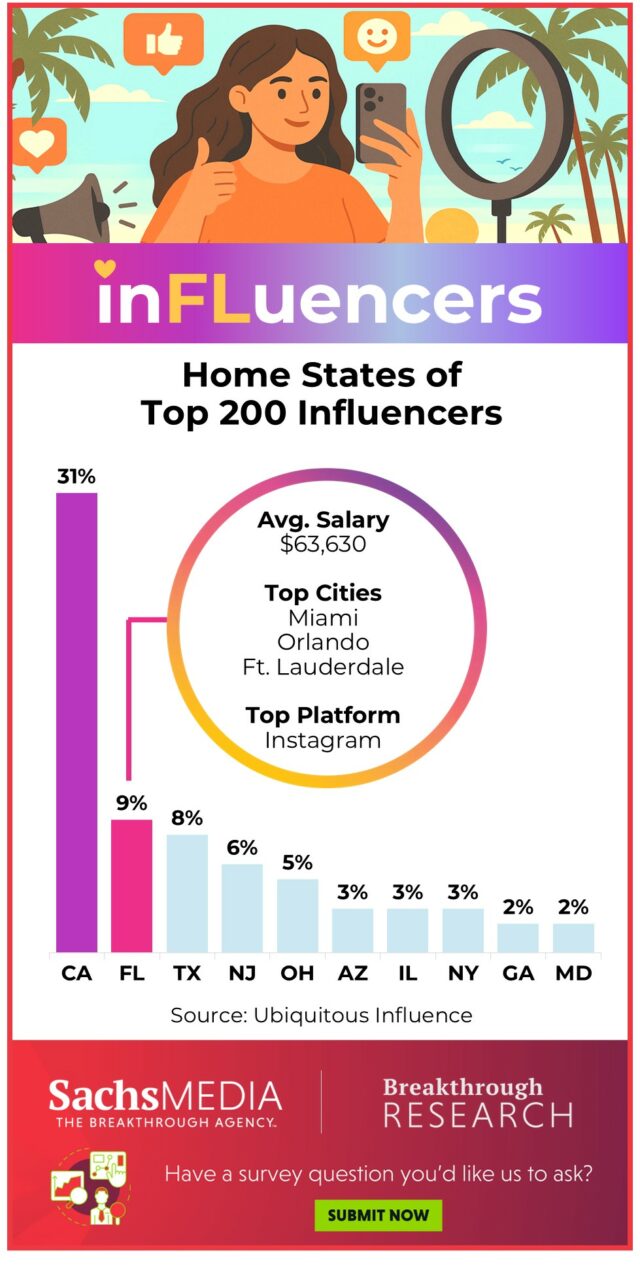
Breakthrough Insights
Tune In

Rays continue hunt for playoff spot

The Tampa Bay Rays continue to chase a wild card spot as they continue a three-game series against the Chicago White Sox tonight (7:05 p.m. ET, FanDuel Sports Network Sun)

After winning the first two games after the All-Star break, Tampa Bay dropped the final game of a three-game series against the Baltimore Orioles and then lost the series opener against Chicago last night.

The Rays stand 1.5 games out of the final wild card spot in the American League, trailing the Seattle Mariners and Boston Red Sox, who would have the final two spots if the season ended today.

Tampa Bay has been a respectable 22-22 on the road but only three games above .500 in their temporary home, Steinbrenner Field. The schedule makers have not been kind to the Rays, who have played the last 10 games and 16 of the last 19 on the road before the All-Star break. After the Rays wrap up the series against the White Sox, the team will play three games on the road in Cincinnati and four in New York against the Yankees.

The Rays are scheduled to send Drew Rasmussen (7-5, 2.86 ERA) to the mound against Chicago’s Davis Martin (2-7, 3.79).

___

Last Call is published by Peter Schorsch, assembled and edited by Phil Ammann and Drew Wilson, with contributions from the staff of Florida Politics.


Post Views: 0


Source link

Continue Reading

Politics

National poll shows broad support for family-first K-12 education policies

Published

on


A new national survey finds Americans across demographic and partisan lines continue to support policies that expand parental control and education choice in K-12 schools, including open enrollment, education savings accounts, and education tax credits.

The polling, conducted by YouGov on behalf of yes. every kid. foundation., found that 64% of respondents support allowing students to attend any public school in their state regardless of where they live. And 63% back education savings accounts that allow families to direct public education funding toward tuition, tutoring, or other education-related expenses. Support for education tax credits reached 58%.

The findings show consistent backing for education choice policies across key demographic groups, including majorities of K-12 parents, Black voters, Hispanic voters, and voters in both major political parties.

Support for greater parental accountability also emerged as a central theme in the survey. More than three-quarters of respondents said K-12 schools need to be more accountable to parents, and 61% agreed schools would be more accountable if families could leave a school and take their education funding with them.

“Americans across the country are united behind education freedom. They want to give families more authority, more flexibility, and more options than the current system offers, and the data shows they are far ahead of the political debate,” said Matt Frendewey, Vice President of strategy at yes. every kid. foundation.

The poll surveyed 1,000 registered voters nationwide between Nov. 19 and Nov. 24 and carries a margin of error of plus or minus 3.6 percentage points.

The polling also found education remains a high-priority issue for voters heading into the 2026 election cycle. A majority of respondents rated education as highly important to their vote for Congress next year, with education registering a net positive impact on ballot decisions across party lines.

While respondents expressed confidence in parents and state governments to make education decisions, the federal government ranked lowest in trust. Nearly two-thirds of voters said K-12 education decisions should be controlled by those closest to students — families, teachers, and local communities — rather than national experts.

“For the third year in a row, our survey demonstrates that Americans are demanding a new direction in education, one that respects the needs of every child, shifts accountability to families, and expands opportunities to empower all children to succeed,” Frendewey said.


Source link

Continue Reading

Politics

Let’s unlock education data’s full potential to make Florida talent strong

Published

on


Skills are the new currency of economic development. This mantra is repeated in boardrooms throughout the country. Florida leaders have responded with a growing portfolio of policies designed to make the state the #1 state in the nation for workforce education.

Yet skills gaps remain a persistent workforce challenge. The mismatch between workers’ skills and workplace needs is a conundrum for many employers. The problem is exacerbated by today’s rapid rate of technological change. We live in an age when artificial intelligence and machine learning are transforming our world at a pace unprecedented since the dawn of the industrial era. By some estimates, nearly 40% of workers’ core skills will change dramatically or become obsolete by 2030.

How can Florida’s education systems nimbly adapt to this rapid rate of change to ensure students develop the skills to thrive in our dynamic economy? We believe the answer lies in Florida’s expansive education data system. Much like businesses mine data to improve ROI, Florida can optimize its data system to unlock student potential. By gleaning insights on student performance from preschool to employment and applying those insights to real-time improvements, Florida can build a resilient workforce that powers growth, attracts business, and drives future economic prosperity.

To Florida’s credit, our state has long been recognized as a national leader for our comprehensive data system that integrates across early education, K-12, postsecondary, and workforce. This data system has successfully enabled Florida to track student progress, support evidence-based decision-making, and ensure public accountability. It is the system that helps Florida assess our schools and track the performance of our colleges and universities. It has arguably helped earn Florida the #1 ranking in the nation for higher education.

Yet even Florida can strengthen its use of data to meet the evolving needs of the workforce. Florida College Access Network recently published research comparing Florida’s education data system with those of seven peer states, identifying leading-edge practices Florida can employ to improve student success and workforce outcomes. Through strategic investments, increased research capacity, improved access and usability, and collaboration, Florida can harness the power of data for unprecedented improvements to our education-to-workforce pipeline.

For example, we can invest in leading-edge technologies that leverage artificial intelligence to glean timely insights and cybersecurity to protect student privacy. We can enlist leaders in education, economic and workforce development, and industry to provide data system oversight, leveraging their expertise to foster greater alignment across the education-to-workforce continuum. We can partner with Florida’s best minds to research opportunities for real-time improvements. We can make data publicly accessible, especially for students and parents, empowering them with the intelligence to inform future career paths. And we can incentivize data collaboration between education institutions and industries to prepare students for careers in high-demand fields of critical regional importance.

A data partnership in Central Florida demonstrates the promise of these strategies. Called the Central Florida Educational Ecosystem Database (CFEED), the collaboration among the Orange County and Osceola County School Districts, Valencia College, and the University of Central Florida uses data and AI to generate insights to improve practices, remove barriers, and support students at scale. Through state-of-the-art data technologies and dozens of joint research projects each year, CFEED has driven significant improvements.

For example, CFEED learned that Valencia students who completed at least three courses relevant to their majors before transferring to UCF were more likely to complete their degrees, prompting the development of a new advising and scholarship program. CFEED also unlocked data to identify students ready for advanced coursework such as AP and dual enrollment, empowering school counselors to proactively advise students to enroll, giving them a head start on college. CFEED will soon use workforce data to track graduates into the labor market, enabling the partners to refine education programs to meet industry needs.

Imagine if every region in Florida could, like CFEED, collaboratively harness the power of data to build tomorrow’s workforce. Florida has this opportunity. Smart investments and strengthened policies would yield a tremendous return on investment. According to the Helios Education Foundation, increasing college enrollment by 10% would generate $8.38 billion in additional annual revenue for Florida, and increasing college completion by 20% would generate an extra $7.59 billion.

Let’s unlock the full potential of Florida’s education data system. Our state will reap the rewards for decades to come.

___

Braulio Colon, executive director of the Florida College Access Network, was recently named one of Florida’s 500 most influential business leaders by Florida Trend magazine. To read FCAN’s report “Insights into Action: The Next Phase of Florida’s Statewide Longitudinal Data System,” visit floridacollegeaccess.org.


Source link

Continue Reading

Politics

Commemorative 250th U.S. anniversary license plates available this week in Florida

Published

on


The commemorative America 250 license plate will cost as much as regular license plates in Florida.

As the U.S. prepares to celebrate its 250th birthday in 2026, the Florida Department of Highway Safety and Motor Vehicles (DHSMV) is releasing a commemorative license plate for motorists in the state.

The U.S. officially celebrates the “semiquincentennial” on July 4, marking the 250th year since the Declaration of Independence. Beginning this week, Floridians can get a commemorative license plate for the anniversary that they can attach to their motor vehicles.

“The Florida Department of Highway Safety and Motor Vehicles is honored to give Floridians a meaningful way to participate in our nation’s 250th anniversary,” said DHSMV Executive Director Dave Kerner. “This commemorative plate reflects our shared pride in America’s history and is a symbol of our state’s connection to America’s past.”

The license plate displays a white background with blue lettering in the “Florida” state banner, along with the identifying letters and numbers for the tag itself. In the middle of the plate is an arch with red, white and blue stripes and stars with “America 250, Florida” as the focal point of the plate.

“Florida’s rich history continues to shape the American story,” said Secretary of State Cord Byrd, who is also the Chair of Florida’s Semiquincentennial Commission.

“The America250FL license plate is a public way for Floridians to honor this legacy and participate in the America250FL celebration. Visit America250FL.com and follow America250FL on X, Facebook, and Instagram to stay informed about ways to commemorate America250FL and our history.”

That Commission Cord chairs will engage in efforts throughout 2026 to remind Floridians and Americans at large the role Florida has played in American history. The commemorative plate is a way for Floridians to participate in that effort, officials said.

But the plate is not like so-called “specialty plates” that Florida motorists have to purchase at an extra price. The America 250 license plate serves as an alternative to regular license plates with only regular fees. Florida motorists can request the America 250 plates when they file their vehicle registration or seek renewal at Tax Collector’s offices and other authorized tag agencies.


Source link

Continue Reading

Trending

Copyright © Miami Select.