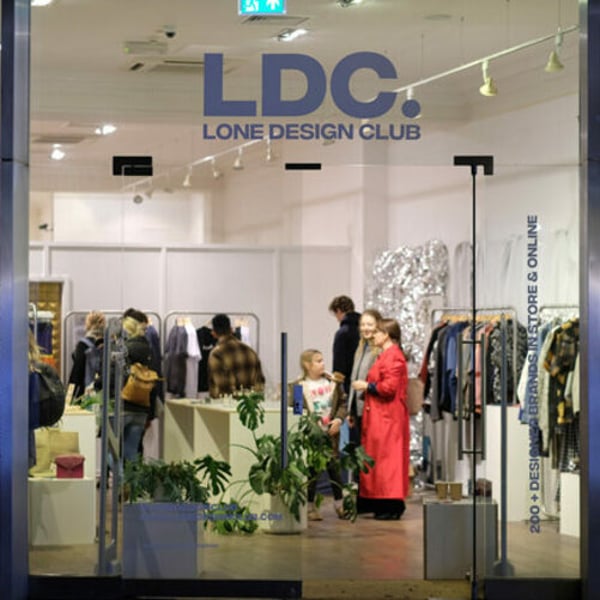
Known for its inventive ways of providing fledgling or digital centric businesses with a first taste of physical retail, Lone Design Club has now launched Revolving Spaces, a tech-driven, Airbnb-style letting platform that “simplifies and scales short-term retail”.
Now in its sixth year and with over 110 curated pop-ups and 10,000+ brand activations under its belt, LDC said the new “landlord-first tech platform” is built to “unlock the hidden potential of underutilised commercial space from vacant units and rooftops to foyers and media zones”.
It’s a purpose-built SaaS platform that automates lead generation, leasing, onboarding, payments, and brand engagement through a central, landlord-branded portal.”What once took hours of manual outreach is now streamlined through a tech-powered, white-label system”, LDC said.
Noting that one in three brands are now using pop-ups in a market on track to hit £80 billion by 2028, Revolving Spaces “opens doors for brands to activate high street spaces faster, smarter, and on their own terms”.
It’s quick to point out that this “isn’t another listing marketplace… Revolving Spaces is a fully branded, automated lead generation and commercialisation engine designed to help landlords activate assets hands-free, while giving brands seamless access to prime real estate”.
Built out of Lone Design Club’s own need (it was running up to five pop-ups a month with 80+ brands), Revolving Spaces “cuts operational effort by 80% and boosts booking speed by 50%”, it claims.
Integrated messaging, automated bookings, and CRM functionality “simplify brand interactions”, while real-time performance analytics offer insights into sales, footfall, and engagement. The result is a claimed 30% revenue uplift in Year 1, 50% faster vacancy turnaround, and 45% less admin burden.
Hammerson, Ingka Centres (IKEA) and others have so far adopted the scheme.
The platform was initially piloted by commercial property giant Landsec at its St David’s Cardiff shopping centre under the leadership of then-head of Asset Management Nicholas Porter, who has since joined Lone Design Club as Strategic Advisor.
He said: “Revolving Spaces enhances landlords’ operational efficiency, enabling them to attract a diverse mix of brands creating a dynamic “revolving door” of relevant, rent-paying tenants that often exceed ERV. Managed via the platform, this boosts income, supports valuation growth, and supplies landlords with valuable R&D insights that pinpoint the next high-growth brands and unlocks further opportunities for store openings, pop-ups, brand activations, and media spend.
Rebecca Morter, CEO & founder of Lone Design Club, added: “Landlords today need smarter ways to unlock revenue without adding pressure to stretched teams. Built from the ground up by operators, it automates the messy, manual work of short-term leasing and connects landlords directly with a pipeline of 10,000+ ready-to-go brands. We’re not just simplifying the process we’re changing the model. This is about future-proofing portfolios, filling space faster, and reshaping how retail and real estate work together.”
The demerger of Unilever‘s ice cream division, to be named ‘The Magnum Ice Cream Company,’ which had been delayed in recent months by the US government shutdown, will finally go ahead on Saturday, the British group announced.
Reuters
Unilever said in a statement on Friday that the admission of the new entity’s shares to listing and trading in Amsterdam, London, and New York, as well as the commencement of trading… is expected to take place on Monday, December 8.
The longest federal government shutdown in US history, from October 1 to November 12, fully or partially affected many parts of the federal government, including the securities regulator, after weeks without an agreement between Donald Trump‘s Republicans and the Democratic opposition.
Unilever, which had previously aimed to complete the demerger by mid-November, warned in October that the US securities regulator (SEC) was “not in a position to declare effective” the registration of the new company’s shares. However, the group said it was “determined to implement in 2025” the separation of a division that also includes the Ben & Jerry’s and Cornetto brands, and which will have its primary listing in Amsterdam.
“The registration statement” for the shares in the US “became effective on Thursday, December 4,” Unilever said in its statement. Known for Dove soaps, Axe deodorants and Knorr soups, the group reported a slight decline in third-quarter sales at the end of October, but beat market expectations.
Under pressure from investors, including the activist fund Trian of US billionaire Nelson Peltz, to improve performance, the group last year unveiled a strategic plan to focus on 30 power brands. It then announced the demerger of its ice cream division and, to boost margins, launched a cost-saving plan involving 7,500 job cuts, nearly 6% of the workforce. Unilever’s shares on the London Stock Exchange were steady on Friday shortly after the market opened, at 4,429 pence.
This article is an automatic translation. Click here to read the original article.
Burberry has named a new chief operating and supply chain officer as well as a new chief customer officer. They’re both key roles at the recovering luxury giant and both are being promoted from within.
Matteo Calonaci becomes chief operating and supply chain officer, moving from his role as senior vice-president of strategy and transformation at the firm.
In his new role, he’ll be oversee supply chain and planning, strategy and transformation, and data and analytics. He succeeds Klaus Bierbrauer, who’s currently Burberry supply chain and industrial officer. Bierbrauer will be leaving the company following its winter show and a transition period.
Matteo Calonaci – Burberry
Meanwhile, Johnattan Leon steps up as chief customer officer. He’s currently currently Burberry’s senior vice-president of commercial and chief of staff. In his new role he’ll be leading Burberry’s customer, client engagement, customer service and retail excellence teams, while also overseeing its digital, outlet and commercial operations.
Both Calonaci and Leon will join the executive committee, reporting to Company CEO Joshua Schulman.
JohnattanLeon – Burberry
Schulman said of the two execs that the appointments “reflect the exceptional talent and leadership we have at Burberry. Both Matteo and Johnattan have been instrumental in strengthening our focus on executional excellence and elevating our customer experience. Their deep understanding of our business, our people, and our customers gives me full confidence that their leadership will help drive [our strategy] Burberry Forward”.
Traditional and occasion wear designer Puneet Gupta has stepped into the world of fine jewellery with the launch of ‘Deco Luméaura,’ a collection designed to blend heritage and contemporary aesthetics while taking inspiration from the dramatic landscapes of Ladakh.
Hints of Ladakh’s heritage can be seen in this sculptural evening bag – Puneet Gupta
“For me, Deco Luméaura is an exploration of transformation- of material, of story, of self,” said Puneet Gupta in a press release. “True luxury isn’t perfect; it is intentional. Every piece is crafted to be lived with and passed on.”
The jewellery collection features cocktail rings, bangles, chokers, necklaces, and statement evening bags made in recycled brass and finished with 24 carat gold. The stones used have been kept natural to highlight their imperfect and unique forms and each piece in the collection has been hammered, polished, and engraved by hand.
An eclectic mix of jewels from the collection – Puneet Gupta
Designed to function as wearable art pieces, the colourful jewellery echoes the geometry of Art Deco while incorporating distinctly South Asian imagery such as camels, butterflies, and tassels. Gupta divides his time between his stores in Hyderabad and Delhi and aims to bring Indian artistry to a global audience while crafting a dialogue between designer and artisan.