Mango kicked off 2025 on a strong note, reporting €1.73 billion ($2.01 billion) in turnover for the first half of the year—a 12% increase from the same period in 2024, and 14% growth at constant exchange rates. The Catalan fashion brand attributes the boost to a strong customer response across its collections and solid performance from all business lines.
Mango’s turnover hits €1.73B in H1 2025 – Mango
“Despite a challenging sector and global uncertainty, our first-half results confirm the strength of our business model and reinforce our long-term strategy,” said Toni Ruiz, Mango’s chairman and CEO. “We’re continuing to grow with a clear vision, a unique value proposition that resonates globally, and an ongoing focus on improving every customer touchpoint.”
Solid growth by market and channel
Mango’s international business continued to build momentum, generating 78% of the brand’s total turnover in the first half of 2025—highlighting its strong commitment to global expansion. The top five markets during this period were Spain, France, Turkey, Germany, and the United States. In the U.S., Mango is rolling out an ambitious growth strategy, having already crossed the 50-store mark, with plans to make the country one of its top three markets by 2026.
Online sales also remained steady as a key growth driver, now accounting for 31% of total revenue. The digital channel remains central to Mango’s business model, bolstered by recent moves such as appointing Marlies Hersbach as the new online and customer director—succeeding Elena Carasso—and launching Mango Stylist, an AI-powered tool that delivers personalized shopping recommendations.
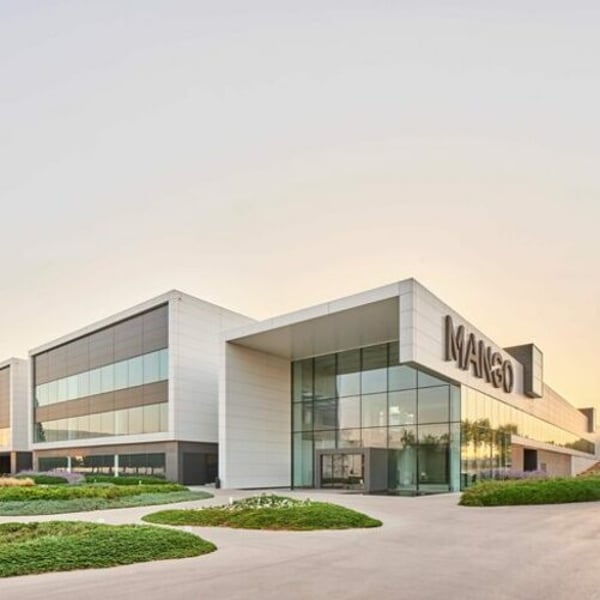
Mango invested around €110 million ($127.60 million) in strategic projects during the first half of the year, with roughly 70% allocated to opening new stores and upgrading existing locations. The remaining funds went toward completing the final phase of its Lliçà logistics hub, developing a new corporate campus, and advancing several major technology initiatives.
The brand’s global retail footprint continued to grow with 78 new store openings and 30 refurbishments, bringing the total number of points of sale to 2,925. This includes more than 1,800 company-owned and franchised locations, along with nearly 1,100 corners in multi-brand stores. Key highlights during the period included the launch of a new flagship on Avenida Diagonal in Barcelona, the reopening of its Paris flagship on Boulevard des Capucines with a refreshed aesthetic, and a wave of new openings across Italy as part of its growth strategy in the country.
Mango also expanded its category presence with several milestone launches: the first physical Mango Home store in Barcelona, standalone Mango Man boutiques in the United Kingdom and Italy, and its first dedicated Teen store in Portugal.
Changes in leadership and board structure
At the corporate level, the company introduced several leadership changes. In January, the board appointed Toni Ruiz as chairman and Jonathan Andic as vice-chairman, following the death of founder and former chairman Isak Andic. As part of an ongoing separation between ownership and executive management initiated by the founder, the company also reinforced its executive team.
Mango appointed Manel Adell and Helena Helmersson, former CEO of the H&M Group, as independent directors to help further professionalize governance and align with global best practices. Additionally, Eva Gallego was named head of the women’s category, and Josep Estol was appointed director of Mango Man, replacing Jonathan Andic, who left the position in June to manage the family’s asset management businesses.
As part of its transition into a public interest entity, the company also changed its legal name from Punto Fa, S.L. to Mango MNG, S.A.
(€1 = $1.16)
This article is an automatic translation. Click here to read the original article.
The demerger of Unilever‘s ice cream division, to be named ‘The Magnum Ice Cream Company,’ which had been delayed in recent months by the US government shutdown, will finally go ahead on Saturday, the British group announced.
Reuters
Unilever said in a statement on Friday that the admission of the new entity’s shares to listing and trading in Amsterdam, London, and New York, as well as the commencement of trading… is expected to take place on Monday, December 8.
The longest federal government shutdown in US history, from October 1 to November 12, fully or partially affected many parts of the federal government, including the securities regulator, after weeks without an agreement between Donald Trump‘s Republicans and the Democratic opposition.
Unilever, which had previously aimed to complete the demerger by mid-November, warned in October that the US securities regulator (SEC) was “not in a position to declare effective” the registration of the new company’s shares. However, the group said it was “determined to implement in 2025” the separation of a division that also includes the Ben & Jerry’s and Cornetto brands, and which will have its primary listing in Amsterdam.
“The registration statement” for the shares in the US “became effective on Thursday, December 4,” Unilever said in its statement. Known for Dove soaps, Axe deodorants and Knorr soups, the group reported a slight decline in third-quarter sales at the end of October, but beat market expectations.
Under pressure from investors, including the activist fund Trian of US billionaire Nelson Peltz, to improve performance, the group last year unveiled a strategic plan to focus on 30 power brands. It then announced the demerger of its ice cream division and, to boost margins, launched a cost-saving plan involving 7,500 job cuts, nearly 6% of the workforce. Unilever’s shares on the London Stock Exchange were steady on Friday shortly after the market opened, at 4,429 pence.
This article is an automatic translation. Click here to read the original article.
Burberry has named a new chief operating and supply chain officer as well as a new chief customer officer. They’re both key roles at the recovering luxury giant and both are being promoted from within.
Matteo Calonaci becomes chief operating and supply chain officer, moving from his role as senior vice-president of strategy and transformation at the firm.
In his new role, he’ll be oversee supply chain and planning, strategy and transformation, and data and analytics. He succeeds Klaus Bierbrauer, who’s currently Burberry supply chain and industrial officer. Bierbrauer will be leaving the company following its winter show and a transition period.
Matteo Calonaci – Burberry
Meanwhile, Johnattan Leon steps up as chief customer officer. He’s currently currently Burberry’s senior vice-president of commercial and chief of staff. In his new role he’ll be leading Burberry’s customer, client engagement, customer service and retail excellence teams, while also overseeing its digital, outlet and commercial operations.
Both Calonaci and Leon will join the executive committee, reporting to Company CEO Joshua Schulman.
JohnattanLeon – Burberry
Schulman said of the two execs that the appointments “reflect the exceptional talent and leadership we have at Burberry. Both Matteo and Johnattan have been instrumental in strengthening our focus on executional excellence and elevating our customer experience. Their deep understanding of our business, our people, and our customers gives me full confidence that their leadership will help drive [our strategy] Burberry Forward”.
Traditional and occasion wear designer Puneet Gupta has stepped into the world of fine jewellery with the launch of ‘Deco Luméaura,’ a collection designed to blend heritage and contemporary aesthetics while taking inspiration from the dramatic landscapes of Ladakh.
Hints of Ladakh’s heritage can be seen in this sculptural evening bag – Puneet Gupta
“For me, Deco Luméaura is an exploration of transformation- of material, of story, of self,” said Puneet Gupta in a press release. “True luxury isn’t perfect; it is intentional. Every piece is crafted to be lived with and passed on.”
The jewellery collection features cocktail rings, bangles, chokers, necklaces, and statement evening bags made in recycled brass and finished with 24 carat gold. The stones used have been kept natural to highlight their imperfect and unique forms and each piece in the collection has been hammered, polished, and engraved by hand.
An eclectic mix of jewels from the collection – Puneet Gupta
Designed to function as wearable art pieces, the colourful jewellery echoes the geometry of Art Deco while incorporating distinctly South Asian imagery such as camels, butterflies, and tassels. Gupta divides his time between his stores in Hyderabad and Delhi and aims to bring Indian artistry to a global audience while crafting a dialogue between designer and artisan.