Connect with us

Business

The attacks on Tim Cook are half-baked—despite Apple stumbling over AI 

Published

on


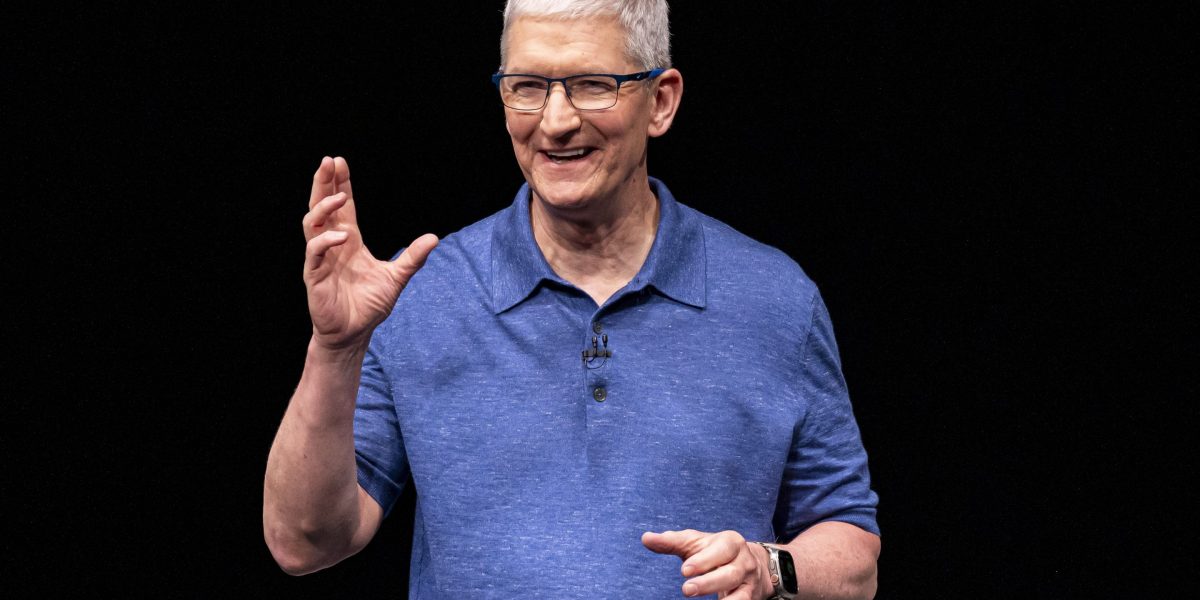
Apple received an unwanted spotlight last week when President Trump’s trade advisor, Peter Navarro, attacked CEO Tim Cook for not moving manufacturing out of China fast enough. In fact, having received similar pressure during Trump’s first term, Apple, in terms of what it sells in the U.S., now makes most iPhones in India and most laptops, AirPods, and other devices in Vietnam. Furthermore, Cook has committed over $500 billion to new U.S. manufacturing facilities and design centers that will employ about 20,000 Americans.

Nevertheless, by late last week attention had quickly shifted to Cook’s tenure as CEO.

Part of this may be seasonal. There is often debate during the hot midsummer months—after annual shareholder meetings—over whether CEO is turnover increasing or decreasing. CNBC anchor Carl Quintanilla has said that one factor behind this is an effort to create headlines during the “tape slump” of major business news. He suggested this behavior was behind a recent report by respected analysts Walter Piecyk and Joe Galone at Lightshed calling for Apple to consider replacing Cook amidst Apple’s struggles with artificial intelligence

We believe that such short-sighted attacks on an icon of American industry could not be more misguided. Cook’s leadership is still critically needed at Apple.

Apple and AI

While Apple hasn’t been a first mover in AI, it doesn’t need to be. In fact, it might benefit the company to not get sucked into the AI arms race amidst counterproductive and desperate moves from competitors—consider Meta offering cash bonuses of up to $100 million to poach AI engineers from rivals.

At our Yale CEO Summit last month, nearly 50% of CEOs polled believe that AI hype has already led to significant overinvestment within their companies. An equal proportion think that AI investments have been allocated inefficiently and profess disappointment with the return on investment.

While nobody doubts the importance of AI to Apple’s future, a critical management skill is finding the right balance on the make vs. buy tradeoff. Developing products in-house is not the only way to go. Despite Apple’s setbacks with Apple Intelligence, a potential partnership or outright acquisition of Perplexity could transform Apple into an AI leader practically overnight, as noted by many savvy analysts, including Wedbush’s Dan Ives.

There are many examples of companies successfully buying or partnering their way into new products or business lines: IBM’s visionary acquisition of RedHat in 2019 gave it a foothold in cloud computing—now a core business. Pfizer’s partnership with BioNTech during the pandemic allowed for the rapid production of the COVID vaccine. Merck’s acquisition of Schering-Plough brought in the blockbuster cancer drug Keytruda, which now powers about half of its sales.

Transforming Apple

Despite Apple’s AI stumbles, Cook deserves a long leash as one of the most revered chief executives of our time, with an unparalleled track record of accomplishment. A genuine tech visionary, he faced the daunting and unenviable task of succeeding the larger-than-life Steve Jobs. He assumed the reins with a rare blend of energy and humility, inspiring others to innovate without any personal grandiosity, transforming Apple into the world’s most valuable company.

Under Cook’s stewardship, Apple’s market value has soared from $350 billion in 2011 to more than $3 trillion today. Apple became the first U.S. company to achieve a $1 trillion market capitalization in 2018, doubling that figure in 2020 and tripling it just three years later.

Despite the echo-chamber accusations that Cook is nothing more than a supply chain guru and not a true product visionary, the truth is that Cook’s tenure has seen Apple revolutionize its product lineup, driving profound advancements for the iPhone, Mac, and iPad and introducing industry-leading devices such as the Apple Watch, AirPods, and Apple Vision Pro. His leadership has also expanded the Apple ecosystem, launching services like Apple Pay, which is growing every year, as well as Apple Music and Apple TV+.

Despite this unparalleled record of achievement, even supporters of Cook wonder if he may have lost his touch or his creativity. Though strongly supporting Cook, CNBC anchor David Faber wondered aloud, “sometimes, as people get older, they may not be taking in as much information, or their expertise may be in an area that is no longer as specific to needs of their business, and I’m curious as to whether there is somebody else out there who might be in a better position to do that.”  

Long leadership

The first author of this essay has closely studied age and work—once called industrial gerontology—since the founding of the field decades ago, and my book The Hero’s Farewell: What Happens when CEOs Retire provided the first empirical studies of leaders in late career. There is no correspondence between age and invention, or age and leadership.

Over 45 years of research on age and work, I have closely documented the effects of age and found potentially surprising results. Older workers tend to have greater sales skills and interpersonal savvy, with only modest declines in physical dexterity. Research on age and risk in engineering found that older managers were only mildly less willing to take risks. They took longer to make decisions, but they were better able to appreciate the value of new information.

Consider some of the startling examples through history. Benjamin Franklin helped draft the Declaration of Independence at 70, invented bifocal glasses in his late 70s, and negotiated an agreement to salvage the Constitutional Convention at 81. France relied upon Charles De Gaulle to unify the nation while he was in his late sixties and seventies. Averell Harriman, after leading Union Pacific and Brown Brothers Harriman, served as one of America’s greatest diplomats, unofficially advising presidents until his nineties.

Compared to these examples, at age 64, Cook is just getting started.

Of course, that doesn’t mean there aren’t some steps Cook can take to strengthen Apple’s positioning, even beyond doubling down on AI development. As CNBC’s Jim Cramer pointed out, it would not hurt with the Trump administration if Apple accelerated some of its $500 billion commitment for domestic manufacturing. Moving some spending forward and accelerating that planned four-year timeline would be a tangible political and patriotic signal to rectify Trump’s fears that he is being played via delays and long timeframes. Similarly, it may not hurt Apple to add a respected technologist with AI, software, or hardware expertise to its board.

But clearly, Apple has stayed ripe for growth and product innovation under Cook, and the attacks on him and the company are half-baked.

The opinions expressed in Fortune.com commentary pieces are solely the views of their authors and do not necessarily reflect the opinions and beliefs of Fortune.

Read more:


Source link

Continue Reading

Business

Why the timing was right for Salesforce’s $8 billion acquisition of Informatica — and for the opportunities ahead

Published

on


The must-haves for building a market-leading business include vision, talent, culture, product innovation and customer focus. But what’s the secret to success with a merger or acquisition? 

I was asked about this in the wake of Salesforce’s recently completed $8 billion acquisition of Informatica. In part, I believe that people are paying attention because deal-making is up in 2025. M&A volume reached $2.2 trillion in the first half of the year, a 27% increase compared to a year ago, according to JP Morgan. Notably, 72% of that volume involved deals greater than $1 billion. 

There will be thousands of mergers and acquisitions in the United States this year across industries and involving companies of all sizes. It’s not unusual for startups to position themselves to be snapped up. But Informatica, founded in 1993, didn’t fit that mold. We have been building, delivering, supporting and partnering for many years. Much of the value we bring to Salesforce and its customers is our long-earned experience and expertise in enterprise data management. 

Although, in other respects, a “legacy” software company like ours — founded well before cloud computing was mainstream — and early-stage startups aren’t so different. We all must move fast and differentiate. And established vendors and growth-oriented startups have a few things in common when it comes to M&A, as well. 

First and foremost is a need to ensure that the strategies of the two companies involved are in alignment. That seems obvious, but it’s easier said than done. Are their tech stacks based on open protocols and standards? Are they cloud-native by design? And, now more than ever, are they both AI-powered and AI-enabling? All of these came together in the case of Salesforce and Informatica, including our shared belief in agentic AI as the next major breakthrough in business technology.

Don’t take your foot off the gas

In the days after the acquisition was completed, I was asked during a media interview if good luck was a factor in bringing together these two tech industry stalwarts. Replace good luck with good timing, and the answer is a resounding, “Yes!”

As more businesses pursue the productivity and other benefits of agentic AI, they require high-quality data to be successful. These are two areas where Salesforce and Informatica excel, respectively. And the agentic AI opportunity — estimated to grow to $155 billion by 2030 — is here and now. So the timing of the acquisition was perfect. 

Tremendous effort goes into keeping an organization on track, leading up to an acquisition and then seeing it through to a smooth and successful completion. In the few months between the announcement of Salesforce’s intent to acquire Informatica and the close, we announced new partnerships and customer engagements and a fall product release that included autonomous AI agents, MCP servers and more. 

In other words, there’s no easing into the new future. We must maintain the pace of business because the competitive environment and our customers require it. That’s true whether you’re a small, venture-funded organization or, like us, an established firm with thousands of employees and customers. Going forward we plan to keep doing what we do best: help organizations connect, manage and unify their AI data. 

Out with the old, in with the new

It’s wrong to think of an acquisition as an end game. It’s a new chapter. 

Business leaders and employees in many organizations have demonstrated time and again that they are quite good at adapting to an ever-changing competitive landscape. A few years ago, we undertook a company-wide shift from on-premises software to cloud-first. There was short-term disruption but long-term advantage. It’s important to develop an organizational mindset that thrives on change and transformation, so when the time comes, you’re ready for these big steps. 

So, even as we take pride in all that we accomplished to get to this point, we now begin to take on a fresh identity as part of a larger whole. It’s an opportunity to engage new colleagues and flourish professionally. And importantly, customers will be the beneficiaries of these new collaborations and synergies. On the day Informatica was welcomed into the Salesforce family and ecosystem, I shared my feeling that “the best is yet to come.” That’s my North Star and one I recommend to every business leader forging ahead into an M&A evolution — because the truest measure of success ultimately will be what we accomplish next.

The opinions expressed in Fortune.com commentary pieces are solely the views of their authors and do not necessarily reflect the opinions and beliefs of Fortune.


Source link

Continue Reading

Business

The ‘Great Housing Reset’ is coming: Income growth will outpace home-price growth in 2026

Published

on


Homebuyers may experience a reprieve in 2026 as price normalization and an increase in home sales over the next year will take some pressure off the market—but don’t expect homebuying to be affordable in the short run for Gen Z and young families.

The “Great Housing Reset” will start next year, with income growth outpacing home-price growth for a prolonged period for the first time since the Great Recession era, according to a Redfin report released this week. 

The residential real estate brokerage sees mortgage rates in the low-6% range, down from down from the 2025 average of 6.6%; a median home sales price increase of just 1%, down from 2% this year; and monthly housing payments growth that will lag behind wage growth, which will remain steady at 4%.

These trends toward increased affordability will likely bring back some house hunters to the market, but many Gen Zers and young families will opt for nontraditional living situations, according to the report. 

More adult children will be living with their parents, as households continue to shift further away from a nuclear family structure, Redfin predicted.

“Picture a garage that’s converted into a second primary suite for adult children moving back in with their parents,” the report’s authors wrote. “Redfin agents in places like Los Angeles and Nashville say more homeowners are planning to tailor their homes to share with extended family.”

Gen Z and millennial homeownership rates plateaued last year, with no improvement expected. Just over one-quarter of Gen Zers owned their home in 2024, while the rate for millennial owners was 54.9% in the same year.

Meanwhile, about 6% of Americans who struggled to afford housing as of mid-2025 moved back in with their parents, while another 6% moved in with roommates. Both trends are expected to increase in 2026, according to the report.

Obstacles to home affordability 

Despite factors that could increase affordability for prospective homebuyers, C. Scott Schwefel, a real estate attorney at Shipman, Shaiken & Schwefel, LLC, told Fortune that income growth and home-price growth are just a few keys to sustainable homeownership. 

An improved income-to-price ratio is welcome, but unless tax bills stabilize, many households may not experience a net relief, Schwefel said.

“Prospective buyers need to recognize that affordability is not just price versus income…it’s price, mortgage rate and the annual bill for living in a place—and that bill includes property taxes,” he added.

In November, voters—especially young ones—showed lowering housing costs is their priority, the report said. But they also face high sale prices and mortgage rates, inflated insurance premiums, and potential utility costs hikes due to a data center construction boom that’s driving up energy bills. The report’s authors expect there to be a bipartisan push to help remedy the housing affordability crisis.

Still, an affordable housing market for first-time home buyers and young families still may be far away.

“The U.S. housing market should be considered moving from frozen to thawing,” Sergio Altomare, CEO of Hearthfire Holdings, a real estate private equity and development company, told Fortune

“Prices aren’t surging, but they’re no longer falling,” he added. “We are beginning to unlock some activity that’s been trapped for a couple of years.”


Source link

Continue Reading

Business

Nvidia’s CEO says AI adoption will be gradual, but we still may all end up making robot clothing

Published

on


Nvidia CEO Jensen Huang doesn’t foresee a sudden spike of AI-related layoffs, but that doesn’t mean the technology won’t drastically change the job market—or even create new roles like robot tailors.

The jobs that will be the most resistant to AI’s creeping effect will be those that consist of more than just routine tasks, Huang said during an interview with podcast host Joe Rogan this week. 

“If your job is just to chop vegetables, Cuisinart’s gonna replace you,” Huang said.

On the other hand, some jobs, such as radiologists, may be safe because their role isn’t just about taking scans, but rather interpreting those images to diagnose people.

“The image studying is simply a task in service of diagnosing the disease,” he said.

Huang allowed that some jobs will indeed go away, although he stopped short of using the drastic language from others like Geoffrey Hinton a.k.a. “the Godfather of AI” and Anthropic CEO Dario Amodei, both of whom have previously predicted massive unemployment thanks to the improvement of AI tools.

Yet, the potential, AI-dominated job market Huang imagines may also add some new jobs, he theorized. This includes the possibility that there will be a newfound demand for technicians to help build and maintain future AI assistants, Huang said, but also other industries that are harder to imagine.

“You’re gonna have robot apparel, so a whole industry of—isn’t that right? Because I want my robot to look different than your robot,” Huang said. “So you’re gonna have a whole apparel industry for robots.”

The idea of AI-powered robots dominating jobs once held by humans may sound like science fiction, and yet some of the world’s most important tech companies are already trying to make it a reality. 

Tesla CEO Elon Musk has made the company’s Optimus robot a central tenet of its future business strategy. Just last month, Musk predicted money will no longer exist in the future and work will be optional within the next 10 to 20 years thanks to a fully fledged robotic workforce. 

AI is also advancing so rapidly that it already has the potential to replace millions of jobs. AI can adequately complete work equating to about 12% of U.S. jobs, according to a Massachusetts Institute of Technology (MIT) report from last month. This represents about 151 million workers representing more than $1 trillion in pay, which is on the hook thanks to potential AI disruption, according to the study.

Even Huang’s potentially new job of AI robot clothesmaker may not last. When asked by Rogan whether robots could eventually make apparel for other robots, Huang replied: “Eventually. And then there’ll be something else.”


Source link

Continue Reading

Trending

Copyright © Miami Select.