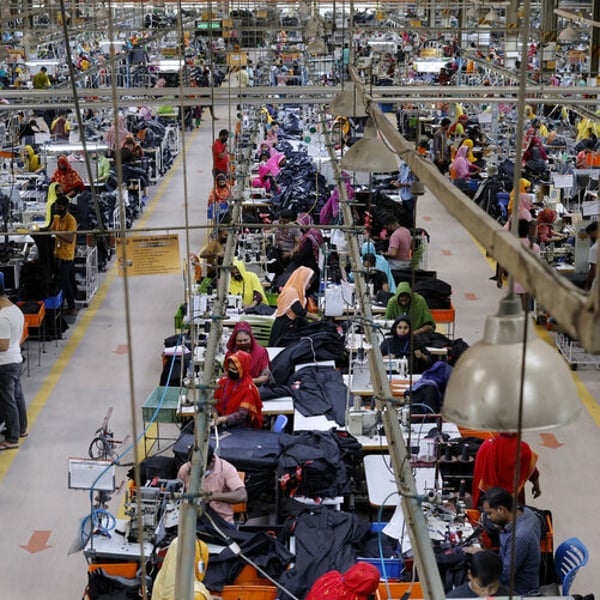
Across Asia, unions and industry groups are raising alarms over the impact of higher tariffs by the United States on garment workers.
Cambodia and Bangladesh face high tariffs from US – Reuters
High tariffs might force companies to shut down or relocate to neighboring countries that offer lower tariff rates, resulting in significant job losses, they warn.
“The potential loss of jobs will cut the income and ability for workers to sustain their daily lives,” said Ath Thorn, vice president of the Coalition of Cambodian Apparel Workers’ Democratic Union, which represents 80,000 workers across 40 factories.
Several countries in Asia have received notice of new tariff rates imposed by the United States, set to take effect August 1, following the end of a 90-day pause on tariffs.
Manufacturing hubs such as Bangladesh and Cambodia will face tariffs of 35% and 36% respectively, while neighboring countries are still negotiating with the U.S. government.
U.S. President Donald Trump announced the new tariffs through official letters posted on his social media platform, Truth Social, on July 8.
The U.S. remains the largest export destination for Bangladeshi garments. The country’s exports to the U.S. totaled $8.4 billion last year, with $7.34 billion coming from garments.
In 2024, Cambodia exported nearly $10 billion worth of goods to the U.S., accounting for almost 40% of the nation’s total exports, according to government customs statistics.
More than half of U.S. imports from Cambodia were garments, footwear and travel goods such as luggage and handbags—a sector that makes up nearly half of Cambodia’s export revenue and employs over 900,000 workers.
Unions and industry groups warn that workers could be hit hard if higher tariffs push companies to relocate or shut down operations.
While Cambodia is facing a reduction from the 49% rate imposed in April, anxiety persists in the country’s garment sector, one of the key pillars of its developing economy.
Meanwhile, the U.S. and Vietnam have reached a trade agreement that sets a 20% tariff on Vietnamese goods.
“With a neighbor next door enjoying significantly lower tariffs, many companies may choose to leave Cambodia,” said Yang Sophorn, president of the Cambodian Alliance of Trade Unions, which represents thousands of women garment workers who support their families.
This fear is echoed by experts in Bangladesh, where a 35% tariff is set to take effect.
Selim Raihan, professor of economics at Dhaka University, said Bangladesh risks losing competitiveness if countries like India, Indonesia and Vietnam receive more favorable trade terms.
Such disparities could complicate supply chain decision-making and undermine investor confidence, he said.
“As production costs rise and profit margins shrink due to the tariff, many garment factories may be forced to scale back operations or shut down entirely,” Raihan said.
The new 35% tariff on Bangladeshi goods is more than twice the current 15% rate.
“With more than doubled tariff rates, can you imagine how the cost of the products will rise?” said Mohiuddun Rubel, former director of the Bangladesh Garment Manufacturers and Exporters Association (BGMEA) and now additional managing director at textile firm Denim Expert Ltd.
“The question is what happens to the tariffs for main competitor countries like India and Pakistan,” Rubel added.
The U.S. is negotiating a trade deal with India, while reciprocal tariff rates for Pakistan have not yet been announced.
Outsized effect on women
Potential layoffs in the garment industry would have an outsized effect on women workers, which Sophorn said could cripple entire families.
“If these women lose their jobs because high tariffs force factories to shut, it will not only impact Cambodia’s economy, but now children may not be able to go to school and aging parents may not be able to afford medicine,” Sophorn said.
“The situation for women garment workers is already bad, but it will get worse if these tariffs were to come into effect.”
Many of the women she represents have taken bank loans to support their families and rely on garment industry jobs to repay debts.
“If they lose their job, it means they will lose everything,” Sophorn said.
Tariffs would directly impact a significant portion of Bangladesh’s four million garment workers, most of whom are women from low-income and rural backgrounds, Raihan said.
Thorn suggested that Cambodia continue negotiations to reduce the tariff burden or find alternative ways to expand exports and create jobs.
Lululemon Athletica’s CEO shake-up has put the spotlight on the once-dominant yoga pants maker’s race to wrest back younger and affluent shoppers from rivals and revive its sagging U.S. business.
Calvin McDonald – Reuters
Its shares, which have halved in value this year, rose 10% on Friday following the departure of CEO Calvin McDonald after about seven years in the role.
An athleisure pioneer known for its premium yoga apparel, Lululemon lost ground as newer rivals such as Alo Yoga and Vuori weaned away its core younger shoppers with trendier styles, marketing campaigns and celebrity partnerships.
Meanwhile, established players like Nike and Gap also entered the market with lower-priced styles.
Lululemon “caught the perfect wave in fashion, becoming the trend for the last five years,” said Brian Mulberry, senior client portfolio manager at Zacks Investment Management.
“But as its core customers graduate college and face tighter budgets, affordability is a challenge and a new outfit at Lulu can cost as much as a month’s groceries.”
Lululemon sells a range of yoga, running and training apparel such as Align yoga pants priced at $108 and men’s joggers at $128.
The slow refresh to core styles and product missteps, such as its decision to pull its $98 “Breezethrough” leggings from shelves last year, have led to heavy discounting to clear aged inventory.
At an earnings call late on Thursday, company executives said the board is “focused on a leader with experience and growth and transformation”.
“It’s understandable to think that a strategic overhaul with a new leader at the helm will be a positive, but this opens the door to more questions as to what direction the board will go with a replacement,” said Jay Woods, chief market strategist at Freedom Capital Markets.
Lululemon is the latest global consumer company facing leadership churn as macroeconomic uncertainty fuels increasingly divergent spending patterns.
Lululemon is making efforts to speed up product development, launch fresh styles and drive company-wide efficiencies to offset cost inflation and protect margins.
The company beat third-quarter results, lifted by strong China sales, but issued a weaker-than-expected holiday forecast as higher promotions and increased spending on marketing weigh on margins.
Founder Chip Wilson, who is also Lululemon’s largest independent shareholder, in a statement on Friday slammed the board for “poor succession planning” and value erosion.
He called for an urgent CEO search led by new, independent directors with deep company knowledge to restore a product-first focus. Lululemon did not immediately respond to a Reuters request for comment on Wilson’s statement.
The company’s forward price-to-earnings multiple, a common benchmark for valuing stocks, is 14.66, compared to 31.26 for Nike and Abercrombie & Fitch‘s ratio of 10.8, according to LSEG data.
“The main challenge I foresee for the new leadership is not how consumers see Lulu, but how does it see itself?” said Mulberry.
Ferragamo appoints Alberto Tomba as a brand ambassador. The collaboration with the Italian skiing legend celebrates values shared by the Florentine fashion house: dedication, perseverance, resilience and attention to detail.
Alberto Tomba
Born in 1966, Tomba is the quintessential emblem of an Italy that invests in talent, commitment and the ability to push beyond one’s limits. His career is marked by major international successes, including three Olympic gold medals and two silver medals, two World Championship gold medals and two bronze medals, and 50 World Cup victories.
The Bologna-born skier is also the only athlete to have won races in 11 consecutive seasons (1987-1998) and to have claimed four World Cup discipline titles in giant slalom and four in slalom.
“Tomba’s sporting journey perfectly reflects Ferragamo’s philosophy: every achievement comes from sacrifice, every result from dedication. We share with him a deep sense of authenticity and a love of excellence, values that continue to inspire our daily work,” said Leonardo Ferragamo.
“Being chosen by Ferragamo is an honour,” Tomba commented. “I have always believed that sport and style share a common language: that of passion, rigour and the desire to improve every day. Representing a brand that embodies all this, and that brings Italian beauty and craftsmanship to the world, is a source of great pride.”
This article is an automatic translation. Click here to read the original article.
New York–based fashion brand Guizio is expanding its retail footprint with the opening of its second store, at Aventura Mall in Miami, this month.
Guizio expands retail footprint with Miami store opening. – Guizio
Designed in collaboration with Brandi Howe, the new Miami store reflects the brand’s refined aesthetic and contemporary edge, while introducing elements inspired by Miami’s vibrant energy.
It opens with a robust assortment of womenswear, along with an exclusive, limited-edition Puma sneaker available only at the Miami location.
“Opening a Guizio store in Aventura Mall is such a special moment for me,” said Danielle Guizio, founder and designer. “It allows us to connect with our community here and share the brand’s energy in a new way. Bringing our world to Miami felt like a natural next step in growing Guizio, and we’re so excited for what’s ahead.”
Guizio founded her namesake womenswear label in 2014 and continues to offer ready-to-wear collections that celebrate the modern-day woman.
Through her collections, woven knits, structured suiting, and signature corsets are emboldened with asymmetrical details, purposeful cut-outs, ruching and custom hardware. The label has become a favorite among talent such as Sabrina Carpenter, Olivia Rodrigo, Rosalia, and more.
The opening follows the success of the brand’s SoHo flagship in New York, which opened in September 2024.