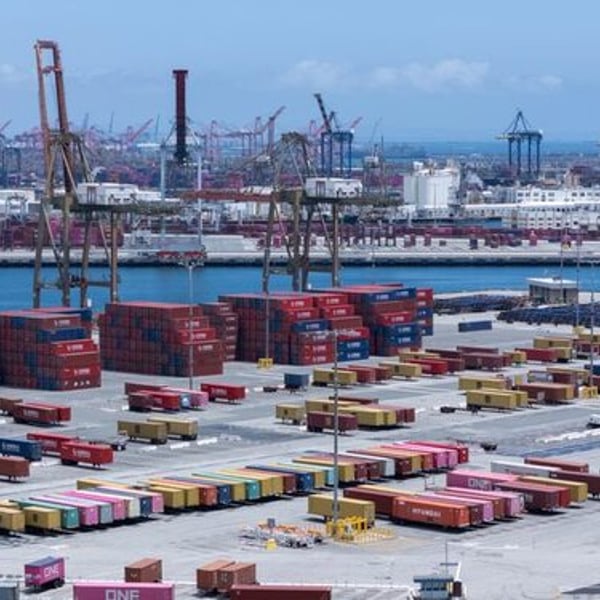
President Donald Trump said on Monday the U.S. would impose a 25% tariff on imports from Japan and South Korea beginning August 1 as he unveiled the first two of what he has said will be a wave of letters to trading partners outlining the new levies they face.
Reuters
“If for any reason you decide to raise your Tariffs, then, whatever the number you choose to raise them by, will be added onto the 25% that we charge,” Trump said in letters to the leaders of the two Asian countries, which he posted on his Truth Social platform.
The rate for South Korea is the same that Trump initially announced on April 2, while the rate for Japan is 1 point higher than first announced. Trump a week later capped all of the so-called reciprocal tariffs at 10% until July 9 to allow for negotiations. Only two agreements have so far been reached, with Britain and Vietnam.
U.S. stocks fell in response, the latest market ruction since Trump unleashed a global trade war on his return to office in January. His moves have repeatedly roiled financial markets and sent policymakers scrambling to protect their economies.
U.S.-listed shares of Japanese automotive companies fell, with Toyota Motor down 4.1% in early afternoon trading and Honda Motor off by 3.8%.
U.S. Treasury Secretary Scott Bessent said earlier on Monday he expected to make several trade announcements in the next 48 hours, adding that his inbox was full of last-ditch offers from countries to clinch a tariff deal before a July 9 deadline.
It was not immediately clear if other letters to leaders would be made public ahead of Wednesday’s deadline.
Bessent did not say which countries could get deals and what they might contain. Trump has kept much of the world guessing on the outcome of months of talks with countries hoping to avoid the hefty tariff hikes he has threatened.
“We’ve had a lot of people change their tune in terms of negotiations. So my mailbox was full last night with a lot of new offers, a lot of new proposals,” Bessent said in an interview with CNBC. “So it’s going to be a busy couple of days.”
For its part, the European Union still aims to reach a trade deal by July 9 after European Commission President Ursula von der Leyen and Trump had a “good exchange,” a Commission spokesperson said.
It was not immediately clear, however, whether there had been a meaningful breakthrough in talks to stave off tariff hikes on the United States’ largest trading partner.
Adding to the pressure, Trump threatened to impose a 17% tariff on EU food and agriculture exports, it emerged last week.
Trump had said on Sunday the U.S. was close to finalizing several trade pacts and would notify other countries by July 9 of higher tariff rates. He said they would not take effect until August 1, a three-week reprieve.
He also put members of the developing nations’ BRICS group in his sights as its leaders met in Brazil, threatening an additional 10% tariff on any BRICS countries aligning themselves with “anti-American” policies.
The BRICS group comprises Brazil, Russia, India and China and South Africa along with recent joiners Egypt, Ethiopia, Indonesia, Iran and the United Arab Emirates.
Trump’s comments hit the South African rand.
The EU has been torn over whether to push for a quick and light trade deal or back its own economic clout in trying to negotiate a better outcome. It had already dropped hopes for a comprehensive trade agreement before the July deadline.
“We want to reach a deal with the U.S. We want to avoid tariffs,” the spokesperson told reporters at a daily briefing. “We want to achieve win-win outcomes, not lose-lose outcomes.”
Without a preliminary agreement, broad U.S. tariffs on most imports would rise from their current 10% to the rates set out by Trump on April 2. In the EU’s case, that would be 20%.
Von der Leyen also held talks with the leaders of Germany, France and Italy at the weekend, Germany said. Chancellor Friedrich Merz has repeatedly stressed the need for a quick deal to protect industries vulnerable to tariffs ranging from cars to pharmaceuticals.
The German spokesperson said the parties should allow themselves “another 24 or 48 hours to come to a decision.”
Germany’s Mercedes-Benz said on Monday its second-quarter unit sales of cars and vans had fallen 9%, blaming tariffs.
Russia said BRICS was “a group of countries that share common approaches and a common world view on how to cooperate, based on their own interests.”
“And this cooperation within BRICS has never been and will never be directed against any third countries,” said Kremlin spokesman Dmitry Peskov.
The demerger of Unilever‘s ice cream division, to be named ‘The Magnum Ice Cream Company,’ which had been delayed in recent months by the US government shutdown, will finally go ahead on Saturday, the British group announced.
Reuters
Unilever said in a statement on Friday that the admission of the new entity’s shares to listing and trading in Amsterdam, London, and New York, as well as the commencement of trading… is expected to take place on Monday, December 8.
The longest federal government shutdown in US history, from October 1 to November 12, fully or partially affected many parts of the federal government, including the securities regulator, after weeks without an agreement between Donald Trump‘s Republicans and the Democratic opposition.
Unilever, which had previously aimed to complete the demerger by mid-November, warned in October that the US securities regulator (SEC) was “not in a position to declare effective” the registration of the new company’s shares. However, the group said it was “determined to implement in 2025” the separation of a division that also includes the Ben & Jerry’s and Cornetto brands, and which will have its primary listing in Amsterdam.
“The registration statement” for the shares in the US “became effective on Thursday, December 4,” Unilever said in its statement. Known for Dove soaps, Axe deodorants and Knorr soups, the group reported a slight decline in third-quarter sales at the end of October, but beat market expectations.
Under pressure from investors, including the activist fund Trian of US billionaire Nelson Peltz, to improve performance, the group last year unveiled a strategic plan to focus on 30 power brands. It then announced the demerger of its ice cream division and, to boost margins, launched a cost-saving plan involving 7,500 job cuts, nearly 6% of the workforce. Unilever’s shares on the London Stock Exchange were steady on Friday shortly after the market opened, at 4,429 pence.
This article is an automatic translation. Click here to read the original article.
Burberry has named a new chief operating and supply chain officer as well as a new chief customer officer. They’re both key roles at the recovering luxury giant and both are being promoted from within.
Matteo Calonaci becomes chief operating and supply chain officer, moving from his role as senior vice-president of strategy and transformation at the firm.
In his new role, he’ll be oversee supply chain and planning, strategy and transformation, and data and analytics. He succeeds Klaus Bierbrauer, who’s currently Burberry supply chain and industrial officer. Bierbrauer will be leaving the company following its winter show and a transition period.
Matteo Calonaci – Burberry
Meanwhile, Johnattan Leon steps up as chief customer officer. He’s currently currently Burberry’s senior vice-president of commercial and chief of staff. In his new role he’ll be leading Burberry’s customer, client engagement, customer service and retail excellence teams, while also overseeing its digital, outlet and commercial operations.
Both Calonaci and Leon will join the executive committee, reporting to Company CEO Joshua Schulman.
JohnattanLeon – Burberry
Schulman said of the two execs that the appointments “reflect the exceptional talent and leadership we have at Burberry. Both Matteo and Johnattan have been instrumental in strengthening our focus on executional excellence and elevating our customer experience. Their deep understanding of our business, our people, and our customers gives me full confidence that their leadership will help drive [our strategy] Burberry Forward”.
Traditional and occasion wear designer Puneet Gupta has stepped into the world of fine jewellery with the launch of ‘Deco Luméaura,’ a collection designed to blend heritage and contemporary aesthetics while taking inspiration from the dramatic landscapes of Ladakh.
Hints of Ladakh’s heritage can be seen in this sculptural evening bag – Puneet Gupta
“For me, Deco Luméaura is an exploration of transformation- of material, of story, of self,” said Puneet Gupta in a press release. “True luxury isn’t perfect; it is intentional. Every piece is crafted to be lived with and passed on.”
The jewellery collection features cocktail rings, bangles, chokers, necklaces, and statement evening bags made in recycled brass and finished with 24 carat gold. The stones used have been kept natural to highlight their imperfect and unique forms and each piece in the collection has been hammered, polished, and engraved by hand.
An eclectic mix of jewels from the collection – Puneet Gupta
Designed to function as wearable art pieces, the colourful jewellery echoes the geometry of Art Deco while incorporating distinctly South Asian imagery such as camels, butterflies, and tassels. Gupta divides his time between his stores in Hyderabad and Delhi and aims to bring Indian artistry to a global audience while crafting a dialogue between designer and artisan.