Business
Trump’s pressure on Apple to make All-American phones ignores the last tech giant that tried and failed
Published
5 months agoon
By
Jace Porter
The executives were well aware of the difficulties they would face in manufacturing a smartphone in the U.S. As with any great tech industry moonshot, the challenge was part of the appeal—and they embraced it.
“Conventional wisdom said it wasn’t possible,” the company crowed defiantly in a blog post announcing the new America-made smartphone. “Experts said that costs are too high in the US; that the US has lost its manufacturing capability; and that the US labor force is too inflexible.”
Soon, tens of thousands of shiny, new touchscreen phones began rolling off the assembly line at a plant in Fort Worth, Texas every day, and what seemed like a risky endeavor began to look like it could be a milestone—a bold bet on American manufacturing at a time when smartphone giant Apple relied on factories in China, home to cheap labor and legions of suppliers eager to produce electronic components.
That was 2013. And the company behind the bet was Google, which had acquired legacy phone maker Motorola Mobility and was leveraging its modern tech prowess and vast resources to make the Moto X smartphone a success.
Just a year later, it was all over. Google sold the Motorola phone business and pulled the plug on the U.S. manufacturing effort. It was the last time a major company tried to produce a U.S. made smartphone.
The story of Google’s short-lived on-shorting experiment has been largely forgotten, a footnote in the internet search giant’s nearly three-decade history of business initiatives and projects. But Google’s experience, particularly where it succeeded, where it discovered unexpected benefits, and where it stumbled, are newly relevant amid President Trump’s campaign to pressure Apple, and other tech companies, to build their gadgets on U.S. soil.
In just the past few weeks, the President has demanded that Apple reshore a big part of its iPhone production from Asia or face tariffs of at least 25%.
Mike Fuentes/Bloomberg via Getty Images
The Google Motorola case study provides critical lessons about U.S. smartphone manufacturing that are still applicable today, as well as numerous intriguing what ifs. Was the project doomed by the economic realities of globalization, the competitive landscape in the smartphone business, or were Google’s shifting corporate priorities ultimately to blame? Could more time, or more effective marketing, have made a difference?
To piece together the history, Fortune spoke with five former Motorola employees who were directly involved in the company’s U.S. assembly push, as well as numerous industry experts and analysts. “We felt scrappy and felt we could carve out a niche for ourselves,” recalled Steve Mills, who was Motorola Mobility’s chief information officer at the time and who is now chief operating officer at Foresite Cybersecurity.
Many of the former Google insiders described starting the effort with high hopes but quickly realized that some of the assumptions they went in with were flawed and that, for all the focus on manufacturing, sales simply weren’t strong enough to meet the company’s ambitious goals laid out by leadership.
Looking for an edge
The phone at the center of the plan, the Moto X, stood out from the pack not just because of where it would be produced. Motorola would offer consumers who purchased the phone directly on its website the option to customize the device, with dozens of colors and materials, eventually including bamboo and walnut backs, as well as special touches like personalized engraving.
The company hoped that offering customized phones would give it an edge over rivals Apple and Samsung, which sold only standardized lineups. And the customization was well-suited to the on-shoring plan: By making phones in the U.S., Motorola would be able to deliver them to domestic customers within four days, instead of making them wait, while also saving on shipping costs.
In its marketing, Motorola played up the device’s pedigree as a patriotic alternative to the foreign-produced competition. The plant’s opening celebration was such a big deal that then-Texas Gov. Rick Perry and billionaire Shark Tank investor Mark Cuban showed up.

Mike Fuentes/Bloomberg via Getty Images
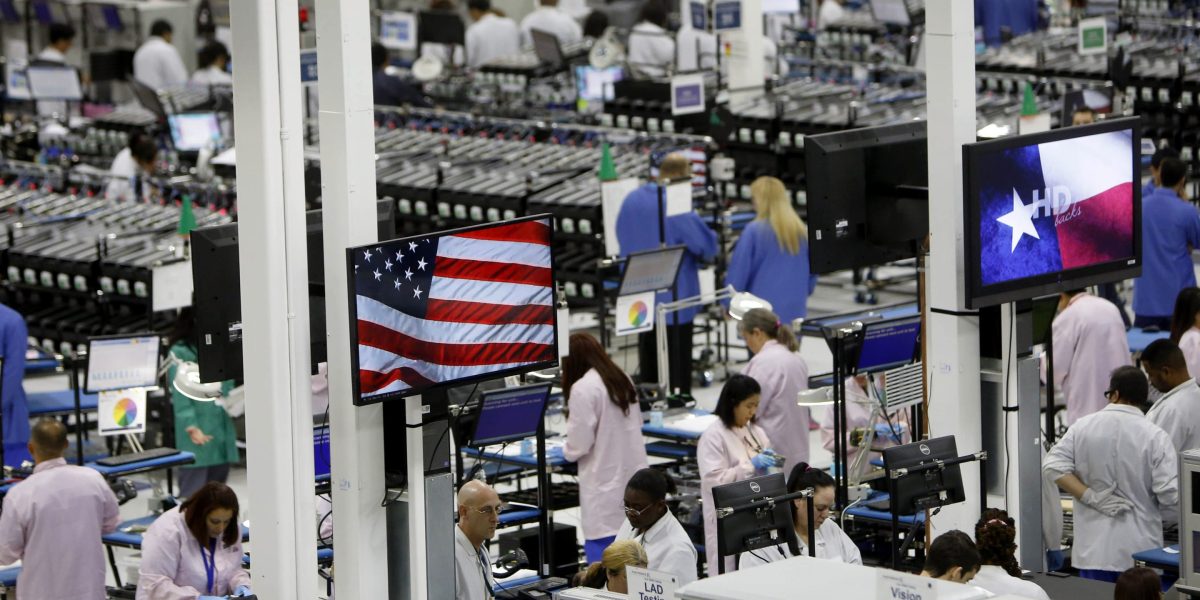
The factory in Fort Worth, about an hour’s drive from Dallas, was operated by Flextronics, a contract manufacturer now known as Flex. To save on costs, workers at the plant handled only final assembly, using components that were imported from Asia.
The cost of labor was of course higher than in China – workers were paid an hourly wage that was about three times more than in China, company executives said at the time. But it was an acceptable trade-off, given the other advantages. Dennis Woodside, who was then the CEO of Motorola Mobility, said in an interview at the time that the customized phones were being sold at a profit.
In addition to the customized models, Motorola sold standardized versions of the Moto X to wireless carriers – an arrangement that helped ensure a base level of demand and production at the factory.
Apple vs. Trump
While Apple does not produce customized versions of its iPhone, the company would likely face many of the same complications, plus new ones, if it quickly shifted iPhone manufacturing to the U.S. as Trump has called for. Higher labor costs are still a reality. And domestic suppliers are limited, with most based in China.
As a result, Apple would have to raise iPhone prices astronomically—at least initially—to make a profit, experts said. Instead of $1,000, U.S.-made phones would have to retail for as much as $3,500, Wedbush Securities analyst Dan Ives estimated in a recent research note, concluding that Apple ever producing the devices domestically is a “fairy tale.”
Over the past six months, to reduce its exposure to Trump’s tariffs, Apple has accelerated a years-long shift in its sourcing of iPhones. Rather than China, its main manufacturing hub and initially the target of Trump’s highest import taxes, the company now ships most of its U.S.-bound phones from India, where tariffs are lower.

MANDEL NGAN/AFP via Getty Images
How the trade war will ultimately play out is still in flux. Trump has delayed some of his import taxes and is still negotiating others.
But his comments in May on conservative social network Truth Social show he opposes Apple’s current workaround. In his message, he insisted Apple’s iPhones ‘must be built in the United States, not India, or anyplace else.”
Apple CEO Tim Cook has described Asia as better for manufacturing than the U.S. The reason has nothing to do with the difference in wages, he insisted in an interview at a Fortune conference in 2017. China stopped being a low-cost labor destination years ago, according to Cook. Rather, the country’s advantage is the far greater availability of skilled workers, such as the tooling engineers who create designs and molds for components, and who he praised for their precision.
“In the U.S., you could have a meeting of tooling engineers and I’m not sure we could fill the room,” Cook said on stage. “In China you could fill multiple football fields.”
In an effort to appease Trump, Apple this year promised to spend $500 billion in the U.S. over the next four years. Some of that money, the company said, will go to producing servers in Houston for its data centers. But Apple hasn’t mentioned anything about bringing iPhone manufacturing back home to the U.S.
Imported workers and equipment
When it came to the Moto X, Flextronics, from the outset, anticipated a shortage of skilled engineers in the U.S. To get around the problem, it drafted engineering talent from its factories across the globe, including from Hungary, Israel, Malaysia, Brazil, and China, and splurged on moving them to Fort Worth just to get the operation running as quickly as possible.
“We had to bring in a very cultural cast of characters,” said Mark Randall, who led Motorola’s supply chain and operations.
Rank and file assembly line workers, along with supervisors and managers, were easier to recruit locally because of the area’s status as a telecom manufacturing corridor, he added. Of the nearly 3,800 staffing the facility at its peak, most didn’t require intensive training.
Production at the plant, equivalent in size to nearly eight football fields, started in the summer of 2013. The operation was in a former Nokia phone factory, in an industrial park designated as a foreign trade zone and with its own airport for cargo. The location meant that Motorola would pay lower tariffs on certain components it imported from Asia. The savings would only kick in, however, if the company decided to export some of the phones it produced there to other countries.
Randall, who is now a supply chain consultant and startup board member, described Texas as a friendly home for manufacturing. In just one example of the warm welcome, the state gave Motorola a tax break for worker training, he said.

Mike Fuentes/Bloomberg via Getty Images
Setting up the Moto X plant required installing a massive amount of equipment, including conveyor belts and other machinery. Some, like certain testing machines, were shipped from China. Workers wearing smocks and gloves to protect the electronics from dirt and lint stood at blue tables set in neat rows while they went through the many steps required to finish a phone. Computer screens glowed above each station.
Fitting plastic parts, like the phone’s back cover, tended to be done by hand. Robotics was used for adding components like touch screens and for testing certain parts during assembly to make sure they worked properly.
As production ramped up, process engineers, who sometimes patrolled the assembly line with stopwatches, looked for bottlenecks and rejiggered the assembly line. Like with any plant, the effort to squeeze out more efficiency was a constant focus.
As the first Motorola phone designed under Google, Moto X generated considerable buzz. The Android device, which was priced at $579 for the unlocked entry version, had a rounded backside and pioneering voice control feature. Users merely had to say “Okay, Google now” to activate the feature, to set up reminders and get driving directions
“It was a cool sexy phone,” said Mills, the CIO. “I got it for my kids.”
The mobile network carriers were also excited by the Moto X, though at least partly for self-serving reasons, according to Randall, the supply chain guru. If the device sold well, it would provide the carriers more leverage over Apple in negotiating the wholesale prices they paid for future iPhones.
But ultimately, critics gave the Moto X mixed reviews. While they praised the ability to customize the device and its overall design, they dinged it for having underwhelming storage in the basic model (16GB) and inferior screen quality compared to the competition.
Made in America “wasn’t resonating“
As the Fort Worth plant revved up, workers quickly started pumping out up to 100,000 phones weekly. Initially, the plant’s staff was overwhelmed, forcing Motorola to briefly backtrack on its promise to deliver phones to customers within four days. But over time, the volume dipped considerably. In the first quarter of 2014, Motorola sold 900,000 Moto X handsets worldwide compared to Apple selling 26 million of its new iPhone 5s during the same period, according to Strategy Analytics.
Five months after Moto X debuted, Motorola slashed its price to $399. After nine months, the factory was down to 700 workers, or less than one-fifth of what it had earlier.
Within the first few weeks, Randall said it was clear to leadership that the Moto X was underperforming. The team had to ramp down production.
While not a complete failure in terms of sales, the phone wasn’t a huge success either. Employees said they expected future models to do better, after improving the phone’s design. Many blamed a limited marketing budget compared to the big money that Samsung and Apple spent on print ads and TV commercials. Because Moto X was a brand new model, they argued it needed a splashier ad campaign to get the word out or a more convincing message.
One of the company’s big assumptions about the phone had turned out to be wrong. After betting big on U.S. assembly, and waving the red, white, and blue in its marketing, the company realized that most consumers didn’t care where the phone was made.
“One of the learnings was that assembled in America wasn’t resonating,” said Mark Rose, a senior director of product management with Motorola at the time who now coaches product managers as a consultant.
Apple wouldn’t necessarily face the same challenges as Motorola, if it opened a U.S. smartphone plant. Their vast difference in size could make a big difference.
Because of sluggish demand, Motorola struggled to achieve the cost savings from making Moto X in huge numbers. Apple, on the other hand, with annual U.S. iPhone sales in the tens of millions, could more easily cash in on the economies of scale.
For Motorola, the challenge it faced was compounded by its decision to let shoppers customize their phones when ordering them online. Fully assembling those devices ahead of time, which would have helped make the plant run more smoothly, was impossible. It also led to higher return rates, an expensive problem for any company, because customers were more likely to be disappointed with the color scheme they chose. Apple, with its standardized lineup, doesn’t have the same worries.
Thanks to its successful track record, Apple also has significant control and leverage over its suppliers to negotiate lower prices for its iPhone components. Motorola, with its back-in-the-pack position and the uncertainty about whether its new Moto X phone would be a hit, had little sway in comparison.
Meanwhile, Motorola, along with most other Android phone makers, operate in an environment of intense competition that translates into low profit margins. Any extra costs, such as is the case with U.S. manufacturing from higher wages, can be financially painful. Apple’s iPhone, however, is a premium product that sells at a high margin. As a result, the company could more easily absorb the additional expense of producing it in the U.S.
12 years later…
Ultimately, Google’s changing priorities played a major role in its decision in January 2014 to sell Motorola to China-based Lenovo for $2.9 billion. A few months later, with the sale of the phone maker still pending, Google announced it would shut down its Moto X assembly line in Fort Worth and shift production entirely to China and Brazil, where production costs were lower. Instead of trying to compete with Apple, Motorola, under Lenovo, would focus on making cheaper phones aimed at customers in developing countries. “What we found was that the North American market was exceptionally tough,” Motorola president Rick Osterloh told the Wall Street Journal after announcing that the Fort Worth plant would close.
Selling would eliminate another problem for Google: Griping by phone makers that used Android software in their devices. They complained that Google, after buying Motorola, competed directly against them. Google had to take the rebellion seriously. If those partners bailed on Android, it would be a huge blow to Google because it would make it more difficult for handset users to access its services.
Another factor in the sale was Google’s rationale for acquiring Motorola in the first place. In addition to buying a phone business, Google had gotten Motorola’s huge patent portfolio that it hoped would help it fend off a growing number of lawsuits over Android. Apple, Microsoft, and other competitors had targeted Google and its phone making partners with claims that the operating system infringed on their intellectual property. In selling Motorola to Lenovo, Google kept most of the patents, tacitly acknowledging that they were more valuable to it than a handset business with disappointing sales.
In the end, Motorola’s failed U.S. adventure had little to do with where the Moto X was assembled, by all accounts. The phone simply didn’t sell well enough to justify a U.S. assembly line.
“If it had sold better off the jump, the whole story would have been different,” said Gabe Madway, who worked in Motorola’s public relations at the time and is now at online investment management service Wealthsimple.
artphone. Photographer:
Randall, meanwhile, put it even more bluntly, saying the phone’s failure “had very much zero” to do with U.S. manufacturing and everything to do with the iPhone being a better device with bigger brand recognition than the Moto X.
Of course, a lot has changed in 12 years that could make or break a new U.S. manufacturing push by a company like Apple. Factory automation, for example, has greatly improved, opening the door to more cost savings in any U.S. smartphone factory now compared to before.
But some things haven’t changed. Adding thousands of workers on short notice to speed up production of a device getting more sales than anticipated would be next to impossible to do in the U.S. In China, it’s routine.
“If there was a ramp that went super well, the ability to flex that workforce is insane” Randall said about China. “The ability to scale down that work workforce is insane.”
Also, there are relatively few U.S.-based suppliers that could produce enough electronic components for millions of phones. And expanding the pool would likely take years. Meanwhile, importing parts, the obvious alternative, may be prohibitively expensive if Trump’s “Liberation Day” tariffs, proposed in April, fully kick in. It doesn’t help that the president frequently changes his mind about the levies, making it difficult for companies to plan ahead for big investments like phone assembly plants.
Mills, the former Motorola CIO, said Trump giving phone makers like Apple some wiggle room would make it easier for them to set up U.S. manufacturing. Instead of producing their phones entirely in the U.S, they could avoid tariffs by doing merely final assembly domestically, like Motorola tried.
“A big thing comes down to what Trump means by Made in America,” said Mills.
Another idea is for Apple to set up a small operation domestically to produce a “prestige or limited edition” iPhone, said Ross Rubin, an analyst with Reticle Research. It could charge a premium for the device, say $2,000, he said, and let Trump declare victory, letting Apple avoid the much more expensive alternative to onshoring a huge chunk of its iPhone production.
What is clear is this: Motorola’s Made in America experiment lasted just over a year, and in more than a decade since, no other major smartphone maker has dared to try something similar again.
You may like
Business
Analyst says Netflix’s $72B bet on Warner Bros. isn’t about ‘Death of Hollywood.’ It’s about Google
Published
4 minutes agoon
December 5, 2025By
Jace Porter
Netflix’s $72 billion play for Warner Bros. is as much a bet on the future of artificial intelligence (AI) and chips as it is on movies and shows, according to a top Wall Street analyst, who said in an interview with Fortune the deal cannot be understood without looking at Google’s technology ambitions.
Amid cries from the jilted Ellison family about a “tainted” sale process and indie producers and theater owners of the “death of Hollywood,” Melissa Otto, Head of Research at S&P Global Visible Alpha, sees a different game being played. Otto said she thinks the tech angle of the industry is being overlooked.
“I think there’s this much bigger conversation that is being missed,” she said: Google and its TPU chips.
A key question for the future of entertainment, Otto told Fortune, is control over premium video at massive scale in an era when generative AI will increasingly create, remix, and personalize moving images. (Otto called it the “video corpus” that will train and power the next generation of AI models.) Over the long term, Otto added, that is a key part of the mystery behind why Netflix, long a builder rather than a buyer, would make Hollywood history by taking out one of its biggest rivals and one of the town’s prestige legacy studios.
Co-CEO Greg Peters was asked a blunt question about that same thing this morning on the call with analysts about the historic merger. Rich Greenfield of LightShed Partners cited Peters’ own previous statement at a Bloomberg conference about how there’s a long history of failed media mega-mergers, so he questioned: “Why is this going to end differently than every other media transaction essentially of this scale and history?”
Peters, while clarifying his remarks at the conference were a bit more nuanced, acknowledged “historically, many of these mergers haven’t worked, some have, but you really got to take a look at this on a case by case basis.” Still, Peters argued most previous big deals showed a lack of understanding about the underlying business, and Netflix understands these assets and has a “clear thesis about how the critical parts of Warner Brothers accelerate our progress.” He also acknowledged Netflix isn’t expert at doing large-scale M&A.
After all, this is expensive. “We are surprised that Netflix felt the need to spend $80bn+ and pay a premium for something Netflix disrupted,” Barclays analysts wrote in reaction to the deal, “and it is not clear what problem or opportunity Netflix is solving for that couldn’t have been achieved organically.”
In a statement emailed to Fortune, Dave Novosel, a Gimme Credit senior bond analyst, said the deal looks expensive to him as well, with Netflix assuming nearly $11 billion of debt.
“While the WBD assets bring an amazing amount of attractive content, NFLX is paying a steep EBITDA multiple of more than 25x, which seems extravagant,” Novosel wrote. Once it reaches the advertised synergies, he added, the resulting multiple of closer to 15x seems more reasonable. While those are pending, “the huge amount of debt that Netflix will need to raise to fund the deal will take leverage to well more than 4x initially.” Novosel wrote investors may need to be patient. Bloomberg’s credit team, meanwhile, reported the $59 billion bridge loan being taken out to finance this deal is among the biggest in corporate history.
Here’s what Otto sees happening in Northern California, far from Tinseltown, where the Warner deal is all anybody can talk about, and why Netflix took such a big swing.
Is the future of entertainment Northern or Southern California?
Part of Netflix’s thesis, according to Otto, is that it’s a tech company at heart and it recognizes Google’s rapid advancements in AI, particularly its advancements in TPU chips.
“What TPU chips do really, really well is in the modality of video in generative AI,” Otto said, as they essentially turn mathematical representations into moving pictures in much the same way GPUs revolutionized natural language AI by tokenizing and modeling text. Instead of ChatGPT and text, think Gemini 3 and YouTube videos.
Netflix already trails YouTube in total share of streaming time, with Bank of America Research recently citing Nielsen data showing YouTube held 28% of U.S. streaming, versus Netflix’s 18%. Otto said this threatens to go up another notch when and if Google’s TPU chips turbocharge content made with generative AI.
“I’m sure that it’s feeding into the strategy,” Otto said. “If I were Netflix and I knew that Google, one of their formidable competitors, had this chip technology and was essentially plowing billions and billions of dollars into developing the infrastructure so that they could carve out the corpus of the video modality in generative AI, I would want to build a moat around my business.”
On the surface, Netflix is buying a legacy studio with a deep library, beloved franchises, and a global brand—and paying up to do it. The combined streaming and studio business generates about $25 billion in revenue and roughly $4 billion to $5 billion in EBITDA, but margins on streaming remain thin, making the economics of the deal look tough in the near term. Executives have emphasized overlapping subscribers, obvious cost cuts and an expected $5.5 billion in efficiencies, the kind of “low‑hanging fruit” that can occupy management for the next 12 to 24 months, Otto said.
But in a world where TPUs can make high‑quality video “basically for free,” any player lacking both the chips and the content could find itself outgunned as AI reshapes how entertainment is produced and consumed. That makes Netflix’s big splash for Batman, Harry Potter, and the like a different kind of moat, and a different kind of game than the classic Hollywood rivalries of yore. Otto said it was plausible generative AI entertainment could be seen as an extension of the recent IP wars that saw Hollywood deluged by floods of superhero movies and sequels, with Disney’s Marvel Studios ushering in a computer generated revolution in the 21st century. “I think that’s not an outrageous assumption.”
By absorbing Warner Bros., Netflix increases the volume and diversity of content it can feed into recommendation systems, experimentation and, eventually, its own AI‑driven video tools. Otto also noted the deal potentially gives Netflix more exposure to advertising, an area in which Alphabet has dominated and where Warner Bros. still generates $6 billion–$7 billion in ad revenue. While the ultimate destination of that ad talent remains unclear, as they may go to the spinco that includes WBD’s cable assets such as CNN and TNT. (Netflix has only been active in ads since 2022, having been a premium subscription service since it pivoted from DVD rentals to streaming in the late 2000s.)
Imagine a world, Otto said, where you could create your own versions of the crime classic Columbo starring an AI-generated version of legendary actor Peter Falk, who died in 2011. (Columbo had several homes on TV on neither Warner Bros. nor Netflix, as it was first an NBC property in the 1970s, and then an ABC property from the late ’80s onward.) “In this day and age, boy, wouldn’t it be interesting?” Otto asked rhetorically.
In many ways, she added, this moment is remarkable because Netflix may end up neither a subscription nor an advertising business, but an AI-based one that doesn’t quite exist yet. “It’s kind of exciting because it means that it’s anybody’s game,” Otto said.
Otto also raised the spectre of TikTok, the social media giant partially under the control of Larry Ellison.
“They’re a formidable competitor as well,” she said. What’s likely, she added, is the future will be unpredictable. The rise of AI “could provide some really amazing innovation over the next couple of years.” She agreed it could create a bonanza for show business lawyers who wrangle over the rights of things like the likeness of Falk, which was a major issue in the recent Hollywood strikes.
“That may be the real story,” she said.
[Disclosure: The author worked internally at Netflix from June 2024 through July 2025.]
Business
Netflix to buy Warner Bros. in $72 billion cash, stock deal
Published
35 minutes agoon
December 5, 2025By
Jace Porter
Netflix Inc. agreed to buy Warner Bros. Discovery Inc., marking a seismic shift in the entertainment business as a Silicon Valley-bred streaming giant tries to swallow one of Hollywood’s oldest and most revered studios.
Under terms of the deal announced Friday, Warner Bros. shareholders will receive $27.75 a share in cash and stock in Netflix, valuing the business at $82.7 billion including debt. The total equity value of the deal is $72 billion. Warner Bros. will spin off cable networks such as CNN and TNT into a separate company before concluding the sale of its studio and HBO to Netflix.
Media mergers of this scale have a rocky history and this one is expected to bring intense regulatory scrutiny in the US and Europe. The deal combines two of the world’s biggest streaming providers with some 450 million subscribers. Warner Bros.’ deep library of programming gives Netflix content to sustain its lead over challengers like Walt Disney Co. and Paramount Skydance Corp.
The acquisition, which confirmed a Bloomberg report Thursday, presents a strategic pivot for Netflix, which has never made a deal of this scope in its 28-year history. With the purchase, Netflix becomes owner of the HBO network, along with its library of hit shows like The Sopranos and TheWhite Lotus. Warner Bros. assets also include its sprawling studios in Burbank, California, along with a vast film and TV archive that includes Harry Potter and Friends.
“I know some of you are surprised we are making this acquisition,” Netflix co-Chief Executive Officer Ted Sarandos said on a call with analysts Friday. He noted that Netflix has traditionally been known to be builders, not buyers. “But this is a rare opportunity that will help us achieve our mission to entertain the world.”
Netflix shares were down 3.5% Friday afternoon in New York. They have declined about 17% since the streaming leader emerged as an interested party in October. Some investors and analysts have interpreted this deal to mean Netflix was worried it couldn’t expand its current business, a theory co-CEO Greg Peters dismissed.
Warner Bros. stock was up about 5.2% midday in New York. It has almost doubled since reports of deal talks with Paramount emerged in September. Play Video
The news concludes a flurry of dealmaking over the past few months that began with a series of bids by Paramount. That prompted interest from Comcast Corp. and Netflix, who were both chasing just the studios and streaming business. All three submitted sweetened bids earlier this week, with Paramount ultimately offering $30 a share for all of Warner Bros. Discovery, arguing that its proposal offered a smoother path to regulatory approval. Netflix won out in the end although significant hurdles remain before the deal can close, which the company expects it can do in the next 18 months.
Paramount could still try to raise its bid, take its offer directly to shareholders or sue to try and block the Netflix deal. The company had no comment.
California Republican Darrell Issa wrote a note to US regulators objecting to any potential Netflix deal, saying it could result in harm to consumers. Netflix has argued that one of its biggest competitors, however, is Alphabet Inc.’s YouTube, and that bundling offerings could lower prices for subscribers. Netflix accounts for between 8% and 9% of TV viewing in the US each month, according to Nielsen. It accounts for closer to 20% or 25% of streaming consumption.
Analysts at Oppenheimer said platforms such as Reels, TikTok and YouTube competing for viewers’ time should help the deal pass antitrust review.
It was 15 years ago that Time Warner CEO Jeff Bewkes, who oversaw Warner Bros. and HBO, shrugged off the threat posed by Netflix, comparing the then fledgling company to the Albanian Army. As Netflix began to invest in original programming, Sarandos declared that Netflix wanted to become HBO before HBO figured out streaming.
Sarandos succeeded and Netflix led the streaming takeover of Hollywood while HBO struggled to respond to the rise of on demand viewing and the decline of cable. Bewkes agreed to sell Time Warner to AT&T in 2016, the beginning of a decade of turmoil for HBO and Warner Bros., storied brands that are about to have their fourth owner in a decade.
Warner Bros. put itself up for sale in October after receiving three acquisition offers from Paramount, which were rejected, opening the door for Netflix and Comcast. Peters said he didn’t see the logic of these big transactions at Bloomberg’s Screentime conference in October, but Sarandos privately pushed for the deal.
The bidding got contentious, with Paramount accusing Warner Bros. of operating an unfair process that favored Netflix. The Netflix offer topped Paramount’s when combining the money for the studio and streaming business with the estimated value of the networks. The two sides agreed to the deal Thursday night.
Under terms of the agreement, Warner Bros. shareholders will receive $23.25 in cash and $4.50 in Netflix common stock. Moelis & Co. is Netflix’s financial adviser. Wells Fargo is acting as an additional financial advisor and, along with BNP Paribas and HSBC Holdings, is providing $59 billion in debt financing, according to a regulatory filing, one of the largest ever loans of its kind. Allen & Co., JPMorgan Chase & Co. and Evercore are serving as financial advisers to Warner Bros. Discovery.
Netflix agreed to pay Warner Bros. a termination fee of $5.8 billion if the deal falls apart or fails to get regulatory approval. “We’re highly confident in the regulatory process,” Sarandos said Friday.
In addition to streaming overlap, regulators will also likely look at the impact on theatrical releases, which Netflix has traditionally eschewed in favor of prioritizing content on its platform.
Netflix said it will continue to release Warner Bros. movies in theaters and produce the studio’s TV shows for third parties — two major changes in how it does business. The company was a little short on details of exactly how it will integrate the different businesses, but Netflix said it expects to maintain Warner Bros.’ current operations and build on its strengths.
The deal will allow Netflix to “significantly expand” US production capacity and invest in original content, which will create jobs and strengthen the entertainment industry, the company said. The combination is also expected to create “at least $2 billion to $3 billion” in cost savings per year by the third year.
Warner Bros. Discovery CEO David Zaslav was the architect of combining Warner Bros. and Discovery in 2022, a deal he hoped would create a viable competitor to Netflix. But the company’s share price tanked in response to a series of public miscues and the continued decline of the cable network business.
While performance rebounded a bit over the last year, the company never quite became the streaming dynamo Zaslav envisioned. He’ll continue to run the company through its spinoff and sale. The two companies haven’t yet agreed on him having any role at Netflix.
The traditional TV business is in the midst of a major contraction as viewers shift to streaming, the world that Netflix dominates. In the most recent quarter, Warner Bros. cable TV networks division reported a 23% decline in revenue, as customers canceled their subscriptions and advertisers moved elsewhere.
Business
Mark Zuckerberg renamed Facebook for the metaverse. 4 years and $70B in losses later, he’s moving on
Published
1 hour agoon
December 5, 2025By
Jace Porter
In 2021, Mark Zuckerberg recast Facebook as Meta and declared the metaverse — a digital realm where people would work, socialize, and spend much of their lives — the company’s next great frontier. He framed it as the “successor to the mobile internet” and said Meta would be “metaverse-first.”
The hype wasn’t all him. Grayscale, the investment firm specializing in crypto, called the Metaverse a “trillion-dollar revenue opportunity.” Barbados even opened up an embassy in Decentraland, one of the worlds in the metaverse.
Five years later, that bet has become one of the most expensive misadventures in tech. Meta’s Reality Labs division has racked up more than $70 billion in losses since 2021, according to Bloomberg, burning through cash on blocky virtual environments, glitchy avatars, expensive headsets, and a user base of approximately 38 people as of 2022.
For many people, the problem is that the value proposition is unclear; the metaverse simply doesn’t yet deliver a must-have reason to ditch their phone or laptop. Despite years of investment, VR remains burdened by serious structural limitations, and for most users there’s simply not enough compelling content beyond niche gaming.
A 30% budget cut
Zuckerberg is now preparing to slash Reality Labs’ budget by as much as 30%, Bloomberg said. The cuts—which could translate to $4 billion to $6 billion in reduced spend—would hit everything from the Horizon Worlds virtual platform to the Quest hardware unit. Layoffs could come as early as January, though final decisions haven’t been made, according to Bloomberg.
The move follows a strategy meeting last month at Zuckerberg’s Hawaii compound, where he reviewed Meta’s 2026 budget and asked executives to find 10% cuts across the board, the report said. Reality Labs was told to go deeper. Competition in the broader VR market simply never took off the way Meta expected, one person said. The result: a division long viewed as a money sink is finally being reined in.
Wall Street cheered. Meta’s stock jumped more than 4% Thursday on the news, adding roughly $69 billion in market value.
“Smart move, just late,” Craig Huber of Huber Research told Reuters. Investors have been complaining for years that the metaverse effort was an expensive distraction, one that drained resources without producing meaningful revenue.
Metaverse out, AI in
Meta didn’t immediately respond to Fortune’s request for comment, but it insists it isn’t killing the metaverse outright. A spokesperson told the South China Morning Post that the company is “shifting some investment from Metaverse toward AI glasses and wearables,” pointing to momentum behind its Ray-Ban smart glasses, which Zuckerberg says have tripled in sales over the past year.
But there’s no avoiding the reality: AI is the new obsession, and the new money pit.
Meta expects to spend around $72 billion on AI this year, nearly matching everything it has lost on the metaverse since 2021. That includes massive outlays for data centers, model development, and new hardware. Investors are much more excited about AI burn than metaverse burn, but even they want clarity on how much Meta will ultimately be spending — and for how long.
Across tech, companies are evaluating anything that isn’t directly tied to AI. Apple is revamping its leadership structure, partially around AI concerns. Microsoft is rethinking the “economics of AI.” Amazon, Google, and Microsoft are pouring billions into cloud infrastructure to keep up with demand. Signs point to money-losing initiatives without a clear AI angle being on the chopping block, with Meta as a dramatic example.
On the company’s most recent earnings call, executives didn’t use the word “metaverse” once.
Analyst says Netflix’s $72B bet on Warner Bros. isn’t about ‘Death of Hollywood.’ It’s about Google
Bianca Censori Strips Off Spandex Shorts, Uses Them to Cover Face
Clarks fêtes 200th year, opens Milan pop-up with Candiani, expands global e-tail presence
Trending
-
Politics8 years agoCongress rolls out ‘Better Deal,’ new economic agenda
-
Entertainment8 years agoNew Season 8 Walking Dead trailer flashes forward in time
-
Politics8 years agoPoll: Virginia governor’s race in dead heat
-
Entertainment8 years agoThe final 6 ‘Game of Thrones’ episodes might feel like a full season
-
Entertainment8 years agoMeet Superman’s grandfather in new trailer for Krypton
-
Politics8 years agoIllinois’ financial crisis could bring the state to a halt
-
Business8 years ago6 Stunning new co-working spaces around the globe
-
Tech8 years agoHulu hires Google marketing veteran Kelly Campbell as CMO
