
Business
Trump’s Big Beautiful Bill will accelerate an American energy crisis—and it could cost the U.S. the AI race
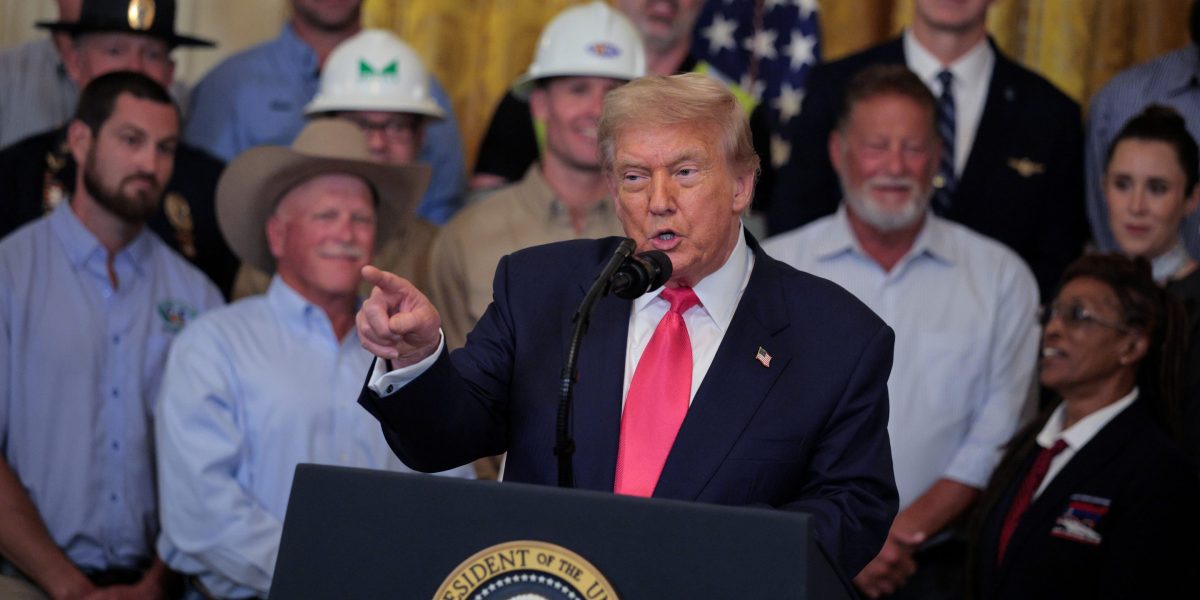
America is facing an energy imperative: Grow power from all sources or face potential failure.
That’s failure in the race against China for AI supremacy; failure to provide ample affordable power for its citizens; and failure to make energy as clean as possible as climate change woes mount with each passing year.
As President Donald Trump has touted American energy dominance, he has leaned on executive orders to expedite natural gas-fired power and new nuclear plants. But regulatory and supply-chain bottlenecks still put those projects several years out.
Meanwhile, Trump’s “One Big, Beautiful Bill” is intentionally handicapping more easily and faster-built wind, solar and battery storage projects that would help satiate the massive data center power demands of the large-scale cloud service providers known as hyperscalers. The final legislation approved by Congress on July 3 (the House concurred on a 218-214 vote) agrees to quickly unwind the clean energy tax credits that could have helped strengthen an already stretched electric grid.
The GOP is leaning on clean energy cuts to support fossil fuels, while channeling the president’s own anti-renewables sentiments: He has often decried the intermittent nature of wind and solar—even if that unpredictability is increasingly offset by the growth of battery storage for renewable energy. And of course cutting tax credits helps offset federal spending elsewhere in the bill.
Unsurprisingly, the clean energy industry is up in arms about the BBB legislation. Abigail Ross Hopper, president and CEO of the Solar Energy Industries Association, said it will increase electricity bills, shut down manufacturing facilities, cost many thousands of U.S. construction jobs, and weaken the grid.
“This legislation [will] set back America’s global competitiveness, destabilize our energy future, and weaken the very industries that power our economy and strengthen our national security—while surrendering the 21st-century tech race to China,” she said.
On the other hand, with money flowing from fossil fuel interests to support Trump and Republicans last year, oil and gas lobbyists—who frequently decry clean energy tax credits as unfair—praised the final bill.
Melissa Simpson, president of the oil and gas industry’s Western Energy Alliance, hailed the “monumental bill that’ll unleash the energy we need.” She specifically touted “provisions promoting oil and natural gas production on public lands” and the halting of the emissions-related “excessive tax on natural gas.”
“Energy dominance” or “energy abundance”?
The final legislation rapidly phases out tax credits for all clean energy projects not online by the end of 2027—exempting those that break ground by June 2026. The Senate’s original, less draconian language required starting construction by the end of 2027—a subtle but massive timeline difference for those scrambling to get projects up and running.
This isn’t just a problem for clean energy developers or environmental advocates; it could dramatically slow the country’s planned and much-needed rapid increases in power generation. In simple terms, that means less power for increasingly electricity-hungry tech and manufacturing sectors, and a growing population—meaning higher power bills for everyone, and possible shortfalls and brownouts.
“The bill doesn’t just burden families, it undermines our country,” said Ari Matusiak, CEO of the Rewiring America nonprofit. “We need low-cost, abundant energy to compete globally. We will become collectively poorer, less resilient, and less equipped to lead in a rapidly changing world.” After all, renewables accounted for almost 90% of new power generation installed in the U.S. last year, according to the Department of Energy.
Scott Olson—Getty Images
Cutting deadlines back to 2027 for completing most projects will result in about 20% fewer clean energy projects being built in the U.S. over the next 10 years, according to S&P Global Commodity Insights projections.
“That’s extremely meaningful,” said Roman Kramarchuk, head of climate market and policy analysis for S&P Global. “This isn’t 20% of a small share; this is 20% of the strong majority of the new deployments.
“That’s rough,” he added. “What it will do is increase costs for power.”
Instead of so-called energy dominance, there’s a growing plea from tech, utilities, and political moderates for scaled-up “energy abundance”—a stance that embraces all forms of power to more rapidly build capacity and help push down prices. But both political parties have been tripped up by ideology, failing to support a strategy that includes clean energy and natural gas—with the GOP targeting renewables and Democrats fighting fossil fuels.
That’s despite the urging of the Edison Electric Institute (EEI), an organization representing investor-owned electric utilities nationwide, and many others. “We’re in unprecedented times for our industry; we haven’t seen this type of load growth since the advent of air conditioning,” EEI chairman and Exelon CEO Calvin Butler told Fortune. “We have to get new power generation built. It’s going to take the all-of-the-above portfolio approach—nuclear, gas, wind, solar, and new technologies like battery storage.”
Butler said he would have supported the legislation if it allowed clean energy projects to break ground by 2027, although later was preferred. “We believe the tax credits are key,” he said. “We don’t believe we can get to the energy dominance without having renewables as part of the solution.”
Why do we need so much power?
After U.S. power demand has remained relatively stagnant for a couple of decades, domestic electricity consumption is expected to spike by 25% from 2023 to 2035 and roughly 60% from 2023 to 2050, according to the International Energy Agency.
A big part of that increase comes from the hyperscalers: Amazon, Google, and Microsoft are investing anywhere from $75 billion to $100 billion each into building data centers for 2025 alone.
To put those dollars in context, the entire market cap of Big Oil giant BP is $80 billion. A planned, super-sized Meta data center in Louisiana, for instance, would require twice the power used by the whole city of New Orleans.
John Ketchum, CEO of NextEra Energy (173 on the Fortune 500)—a massive utility and power developer—estimates that anticipated gas-fired generation cannot even meet 20% of the data center needs from now until 2030. Despite record volumes of shale gas produced domestically in recent years, the turbines required to turn that gas into electricity are getting more costly and there aren’t enough being manufactured because of supply chain challenges.
“If it’s not renewables, what is it going to be?” Ketchum said of the remaining 80% of data center power needs, while speaking at the Politico Energy Summit in June.
While the legislation does not cripple clean energy—a lot of utility-scale wind and solar will still be built—it does substantially weaken its access to tax breaks and increase costs.
A prior version of the bill didn’t just phase out the tax credits; it also placed a brand-new excise tax on clean energy projects—one that even renewable energy opponents bristled at. Some projections estimated the tax easily could have killed most pending clean energy projects, making them economically not viable. That tax was removed just before final Senate voting.
Another last-minute change exempted clean energy projects from losing the tax credit if they break ground by June 2026, even if they exceed the 2027 completion deadline—although these are still very tight timelines.
Likewise, the legislation keeps the “transferability” of tax credits—the removal of which was considered a backdoor “poison pill” meant to cripple the program. Transferability allows smaller developers to raise capital by transferring tax credits at a discount to larger buyers that can immediately take advantage of the tax benefits. The original House version of the bill had eliminated transferability.
The legislation also places new “foreign entity of concern” (FEOC) provisions on renewable energy projects. The FEOC rules, which only applied to electric vehicle tax credits in the Inflation Reduction Act, would now apply to all clean energy tax credits, essentially limiting needed supply-chain materials from China. The House bill placed arduous FEOC provisions on projects, but the final version takes a more measured, phased-in approach.
No matter how much new manufacturing is built in the U.S., many of the materials still only come from China and any delays or missteps cede more ground to China in the middle of a brawl for AI dominance as China rapidly builds more power from coal to wind and solar.
While China is currently more reliant on coal than the U.S., China now sources about one-third of its power from renewables—compared to about 22% in the U.S.—and China is currently installing more solar power, for instance, than the rest of the world combined. As China continues to rapidly build more generation, U.S. slowdowns in any forms of new electricity infrastructure will give China more of a power boost in the AI race to supremacy.

Justin Sullivan—Getty Images
The legislation also undoes a bevy of other clean energy and efficiency efforts. The electric vehicle tax credit is axed, as is the credit for residential solar projects and for other home energy efficiency efforts. The megabill also comes as the Trump administration aims to roll back energy efficiency standards for home appliances and more.
“Families will face rising electricity costs with fewer tools to do anything about it,” said Matusiak of Rewiring America. “As energy demand from AI, data centers, and manufacturing explodes, households are boxed in, expected to pay more while getting less.”
Residential electricity costs in the U.S. already have risen by 13% on average from 2022 until now, according to the Department of Energy. And they are projected to keep increasing with demand growth from data centers and higher natural gas prices as a wave of liquefied natural gas export projects come online between now and 2030.
What happens next?
Next up in the renewables sector is the continuation of a rabid race to break ground on clean energy projects to beat the tax credit deadlines. In a way, the more stringent the timelines, the bigger and faster the mad dash is to qualify for tax breaks—even if fewer will be built overall.
“This sector has done this before,” Kramarchuk said. “There’s always the rush to hit the deadlines.”
In the push for more fossil fuel-sourced power, new gas-fired turbines that aren’t already contracted will take five years or so to be built. In the meantime, that means increasing the utilization of existing gas-fired power plants and working to keep more coal plants open for longer. “It means running your existing gas or coal units harder,” Kramarchuk said. Not coincidentally, a tax break for coal exports was a late add to the legislation.
By 2028, 50 gigawatts of existing coal capacity are scheduled to be retired. Some of those plants must stay online for longer to bridge the gap, but how much longer is even possible is unclear. “A lot of those plants are very old and require significant capital investments to keep them going,” he said.
To be clear, the end of tax credits does not mean the death of renewables. The GOP-aligned super PAC ClearPath Action, which supports efforts to combat climate change, called the bill a much better draft than some earlier versions that would have imposed additional taxes on renewables and “devasted” the clean energy industry. “Senate Republicans and House allies rejected that approach and preserved some financial tools to accelerate American innovation and invest in American manufacturing,” said ClearPath CEO Jeremy Harrell.
It does mean, however, that wind and solar projects will become more expensive. A lot of regional utilities and smaller developers may kill the clean energy projects on their drawing boards. But the hyperscalers, of course, have bigger budgets.
“New wind and solar that would’ve been built, can be built. It’s just going to cost a lot more,” Kramarchuk said. “If you’re a hyperscaler, then you probably have more latitude to pay more.”
As for the rest of us? Our electricity and heating bills will likely rise too.