
Business
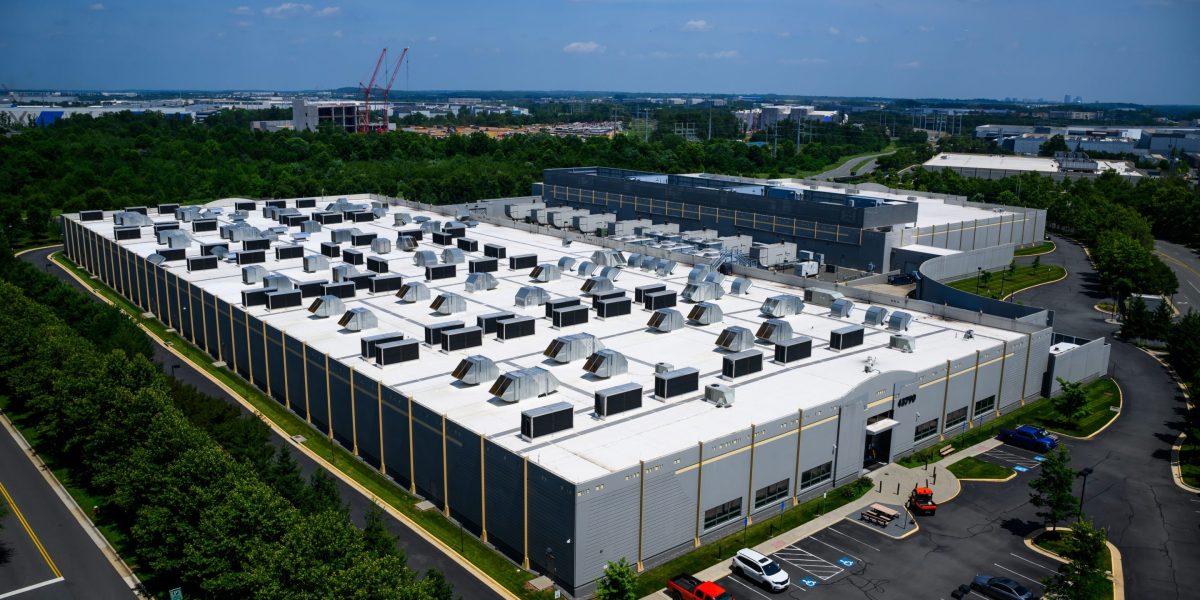
As Big Tech builds AI data centers at record pace, carbon emissions are set to skyrocket
Welcome to Eye on AI! In this edition...Ilya Sutskever says he is now CEO of Safe Superintelligence…Chinese AI companies erode U.S. dominance…Meta’s AI talent bidding war heats up…Microsoft’s sales overhaul goes all-in on AI.
As an early-summer heat wave blanketed my home state of New Jersey last week, it felt like perfect timing to stumble across a sobering new prediction from Accenture: AI data centers’ carbon emissions are on track to surge 11-fold by 2030.
The report estimates that over the next five years, AI data centers could consume 612 terawatt-hours of electricity—roughly equivalent to Canada’s total annual power consumption—driving a 3.4% increase in global carbon emissions.
And the strain doesn’t stop at the power grid. At a time when freshwater resources are already under severe pressure, AI data centers are also projected to consume more than 3 billion cubic meters of water per year—a volume that surpasses the annual freshwater withdrawals of entire countries like Norway or Sweden.
Unsurprisingly, the report—Powering Sustainable AI—offers recommendations for how to rein in the problem and prevent those numbers from becoming reality. But with near-daily headlines about Big Tech’s massive AI data center buildouts across the U.S. and worldwide, I can’t help but feel cynical. The urgent framing of an AI race against China doesn’t seem to leave much room—or time—for serious thinking about sustainability.
Just yesterday, for example, OpenAI agreed to rent a massive amount of computing power from Oracle data centers as part of its Stargate initiative, which intends to invest $500 billion over the next four years building new AI infrastructure for OpenAI in the United States. The additional capacity from Oracle totals about 4.5 gigawatts of data center power in the U.S., according to Bloomberg reporting. A gigawatt is akin to the capacity from one nuclear reactor and can provide electricity to roughly 750,000 houses.
And this week, Meta was reported to be seeking to raise $29 billion from private capital firms to build AI data centers in the U.S., while already building a $10 billion AI data center in Northeast Louisiana. As part of that deal, the local utility, Entergy, will supply three new power plants.
Meta CEO Mark Zuckerberg has made his intentions clear: The U.S. must rapidly expand AI data center construction or risk falling behind China in the race for AI dominance. Speaking on the Dwarkesh Podcast in May, he warned that America’s edge in artificial intelligence could erode unless it keeps pace with China’s aggressive build-out of data center capacity and factory-scale hardware.
“The U.S. really needs to focus on streamlining the ability to build data centers and produce energy,” Zuckerberg said. “Otherwise, we’ll be at a significant disadvantage.”
The U.S. government seems to be aligned with that sense of urgency. David Sacks, now serving as the White House AI and Crypto Czar, has also underscored that energy and data center expansion are central to America’s AI strategy—leaving little room for sustainability concerns.
On his All In podcast in February, Sacks argued that Washington’s “go-slow” approach to AI could strangle the industry. He emphasized that the U.S. needs to clear the way for infrastructure and energy development—including AI data centers—to keep pace with China.
In late May, he went further, saying that streamlining permitting and expanding power generation are essential for AI’s future—something he claimed has been “effectively impossible under the Biden administration.” His message: the U.S. needs to race to build faster.
Accenture, meanwhile, is urging its clients to responsibly grow and engineer its AI data centers in a bid to balance growth with environmental responsibility. It is offering a new metric, that it calls the Sustainable AI Quotient (SAIQ), to measure the true costs of AI in terms of money invested, megawatt-hours of energy consumed, tons of CO₂ emitted and cubic meters of water used. The firm’s report says the metric will help organizations answer a basic question: “What are we actually getting from the resources we’re investing in AI?” and allow that enterprise to measure its performance across time.
I spoke to Matthew Robinson, managing director of Accenture Research and co-author of the report, who emphasized that he hoped Accenture’s sobering predictions would be proven wrong. “They kind of take your breath away,” he said, explaining that Accenture modeled future energy consumption from the expected number of installed AI chips adjusted for utilization and the additional energy requirements of data centers. That data was combined with regional data on electricity generation, energy mix and emissions, while water use was assessed based on AI data center energy consumption and how much water is consumed per unit of electricity generated.
“The point really is to open the conversation around the actions that are available to avert this pathway—we don’t want to be right here,” he said. He would not comment on the actions of specific companies like OpenAI or Meta, but said that overall, clearly more effort is needed to avert the rise in carbonisation fueled by AI data centers while still allowing for growth.
Accenture’s recommendations certainly make sense: Optimize the power efficiency of AI workloads and data centers with everything from low-carbon energy options to cooling innovations. Use AI thoughtfully, by choosing smaller AI models, and better pricing models for incentivizing efficiency. And ensure better governance over AI sustainability initiatives.
It’s hard to imagine that the biggest players in the race for AI dominance—Big Tech giants and heavily funded startups—will hit the brakes long enough to seriously address these growing concerns. Not that it’s impossible. Take Google, for example: In its latest sustainability report released this week, the company revealed that its data centers are consuming more power than ever. In 2024, Google used approximately 32.1 million megawatt-hours (MWh) of electricity, with a staggering 95.8%—about 30.8 million MWh—consumed by its data centers. That’s more than double the energy its data centers used in 2020, just before the consumer AI boom.
Still, Google emphasized that it’s making meaningful strides toward cleaning up its energy supply, even as demand surges. The company said it cut its data center energy emissions by 12% in 2024, thanks to clean energy projects and efficiency upgrades. And it’s squeezing more out of every watt. Google reported that the amount of compute per unit of electricity has increased about six-fold over the past five years. Its power usage effectiveness (PUE)—a key measure of data center efficiency—is now approaching the theoretical minimum of 1.0, with a reported PUE of 1.09 in 2024.
“Just speaking personally, I’d be optimistic,” said Robinson.
Note: Check out this new Fortune video about my tour of IBM’s quantum computing test lab. I had a fabulous time hanging out at IBM’s Yorktown Heights campus (a midcentury modern marvel designed by the same guy as the St. Louis Arch and the classic TWA Flight Center at JFK Airport) in New York. The video was part of my coverage for this year’s Fortune 500 issue that included an article that dug deep into IBM’s recent rebound.
As I said in my piece, “walking through the IBM research center is like stepping into two worlds at once. There are the steel and glass curves of Saarinen’s design, punctuated by massive walls made of stones collected from the surrounding fields, with original Eames chairs dotting discussion nooks. But this 20th-century modernism contrasts starkly with the sleek, massive, refrigerator-like quantum computer—among the most advanced in the world—that anchors the collaboration area and working lab, where it whooshes with the steady hum of its cooling system.”
With that, here’s the rest of the AI news.
Sharon Goldman
sharon.goldman@fortune.com
@sharongoldman
AI IN THE NEWS
Ilya Sutskever says he is now CEO of Safe Superintelligence, after Daniel Gross steps down to join Meta. Ilya Sutskever, the former OpenAI chief scientist who founded Safe Superintelligence (SSI) with Daniel Gross and Daniel Levy a year ago, confirmed that he will now serve as SSI’s CEO after Daniel Gross stepped down. Sustkever posted on X saying: “Daniel Gross’s time with us has been winding down, and as of June 29 he is officially no longer a part of SSI. We are grateful for his early contributions to the company and wish him well in his next endeavor. I am now formally CEO of SSI, and Daniel Levy is President. The technical team continues to report to me. You might have heard rumors of companies looking to acquire us. We are flattered by their attention but are focused on seeing our work through.” Meta was rumored to have sought to acquire the $32 billion-valued SSI.
Chinese AI companies erode U.S. dominance. According to the Wall Street Journal, Chinese artificial intelligence companies are gaining ground globally, challenging U.S. supremacy and intensifying a potential AI arms race. Across Europe, the Middle East, Africa, and Asia, organizations—from multinational banks like HSBC and Standard Chartered to Saudi Aramco—are increasingly adopting large language models from Chinese firms such as DeepSeek and Alibaba as alternatives to U.S. offerings like ChatGPT. Even American cloud giants like Amazon Web Services, Microsoft, and Google now offer access to DeepSeek’s models, despite U.S. government security restrictions on the company’s apps. While OpenAI’s ChatGPT still leads in global adoption—with 910 million downloads versus DeepSeek’s 125 million—Chinese models are undercutting U.S. competition by offering nearly comparable performance at much lower prices.
Meta’s AI talent bidding war heats up. As Mark Zuckerberg rapidly staffs up Meta’s new superintelligence lab, his company has reportedly offered some OpenAI researchers eye-popping pay packages of up to $300 million over four years, with more than $100 million in first-year compensation, Wired reports. The offers, which include immediate stock vesting, have been extended to at least 10 OpenAI employees, according to sources familiar with the negotiations. While Meta’s aggressive recruiting tactics have caught the attention of top talent, some OpenAI staffers told Wired they’re weighing the massive payouts against their potential impact at Meta versus staying at OpenAI. A Meta spokesperson pushed back, claiming reports of the offer sizes are exaggerated. Still, even Meta’s senior engineers typically make around $850,000 per year, with those in higher pay bands earning over $1.5 million annually, according to Levels.FYI data.
Microsoft’s sales overhaul goes all-in on AI. Microsoft’s sales chief, Judson Althoff, is reshaping the company’s sales organization to double down on AI, according to an internal memo obtained by Business Insider. Althoff’s Microsoft Customer and Partner Solutions (MCAPS) unit will now focus on embedding Copilot across devices and roles, deepening Microsoft 365 and Dynamics 365 adoption, winning high-impact AI deals, expanding Azure cloud migration, and strengthening cybersecurity to support AI growth. The memo, sent just one day before Microsoft’s latest round of layoffs—many of which affected Althoff’s sales teams—outlined his vision to make Microsoft “the Frontier AI Firm.” According to Business Insider, this restructuring follows Althoff’s earlier plan to cut the number of sales solution areas in half starting this fiscal year.
FORTUNE ON AI
The new CEO flex: Bragging that AI handles exactly X% of the work —by Sharon Goldman
Sam Altman scoffs at Mark Zuckerberg’s AI recruitment drive and says Meta hasn’t even got their ‘top people’ —by Beatrice Nolan
Figma files for IPO nearly two years after $20 billion Adobe buyout fell through —by Allie Garfinkle
AI CALENDAR
July 8-11: AI for Good Global Summit, Geneva
July 13-19: International Conference on Machine Learning (ICML), Vancouver
July 22-23: Fortune Brainstorm AI Singapore. Apply to attend here.
July 26-28: World Artificial Intelligence Conference (WAIC), Shanghai.
Sept. 8-10: Fortune Brainstorm Tech, Park City, Utah. Apply to attend here.
Oct. 6-10: World AI Week, Amsterdam
Dec. 2-7: NeurIPS, San Diego
Dec. 8-9: Fortune Brainstorm AI San Francisco. Apply to attend here.
EYE ON AI NUMBERS
$65 Billion
That’s how much U.S. investment in AI companies soared to in the first quarter of this year—a 33% jump from the previous quarter and a staggering 550% increase compared to the quarter before ChatGPT’s 2022 debut, according to PitchBook.
The biggest price tag? Data centers.
The New York Times reports that Meta, Microsoft, Amazon, and Google plan to spend a combined $320 billion on infrastructure this year—more than double what they spent just two years ago. A huge chunk of that will go toward building new data centers to keep up with the exploding demand for AI.