Connect with us

Business

Trump touts a Vietnam trade deal victory—but details on transshipment and import pledges remain unclear

Published

on


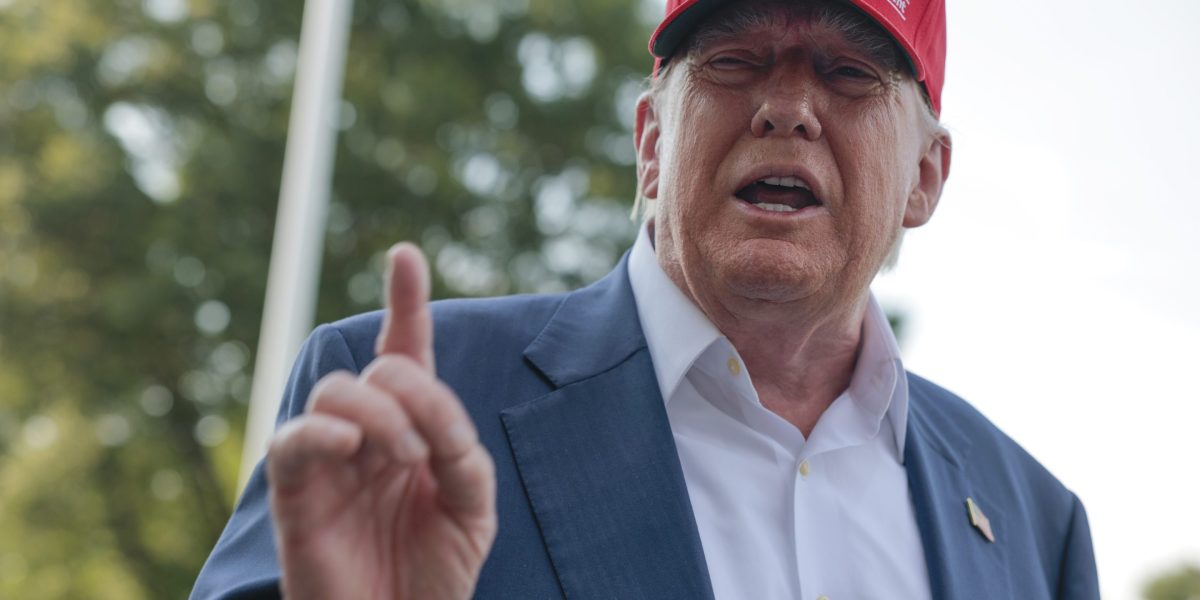
With less than a week to go before the U.S.-imposed July 9 deadline for new trade deals, U.S. President Donald Trump unveiled a new trade deal with Vietnam, a country that has rapidly become one of the largest exporters to the U.S.

On Wednesday, Trump announced on Truth Social, his social media platform, that the U.S. will impose a 20% tariff on Vietnamese exports to the U.S. Goods deemed to have been transshipped through Vietnam will get a 40% levy. 

In return, Trump claimed Vietnam will drop all tariffs on U.S. goods and “open their market to the United States,” pointing to U.S.-made SUVs as a “wonderful addition” to Vietnam’s roads. 

Vietnam’s benchmark VN-Index climbed by 0.5%, as of 1:00am Eastern. Shares of U.S. companies with a major manufacturing presence in Vietnam rose. Nike rose 4%, while Apple jumped by 2.2%. 

Vietnamese state media reports that To Lam, General Secretary of the Communist Party of Vietnam and the country’s leader, spoke with Trump on Wednesday to discuss the tariff negotiations. According to the report, the U.S. will “significantly reduce reciprocal tariffs on many Vietnamese imports,” and that Trump “highly valued” Vietnam’s pledge to grant preferential market access for U.S. goods, including large-engine vehicles. To Lam also reportedly urged Washington to lift export restrictions on certain high-tech goods. 

The deal makes Vietnam one of a few governments that has reached an accord with Washington since April 2, or “Liberation Day.” Trump struck a deal with the UK in early May, and reached a trade truce with Beijing last week.

Still, details of the U.S.-Vietnam trade agreement are murky. “The interpretation of transshipment is unclear,” DBS Bank wrote in a research note. 

Transshipment refers to a practice where goods are moved from one vessel to another before being shipped off to their final destination. Yet the Trump administration also accuses Vietnam of being a backdoor for Chinese goods to evade U.S. tariffs. 

Illegal transshipment typically involves changing the certificate of origin to a new country, without adding significant value. 

Vietnam has turned into a key manufacturing hub for global supply chains. Apple, Nintendo, and other electronics manufacturers moved final assembly of their products to Vietnam, both to avoid U.S. tariffs on China and to diversify their supply chains.

These components often come from Chinese suppliers, but Vietnam-based manufacturers are also adding value through final assembly, before the goods are shipped to the U.S.

“I suspect the terms are still being developed. This is likely to be more of a framework,” says Deborah Elms, head of trade policy at the Hinrich Foundation.

The details of the agreement can also shift between Trump’s announcement and when the deal is formalized through an executive order. That process could take weeks: the U.S. and U.K. announced their deal in early May, which wasn’t formalized until mid-June.

“The details will be extremely important,” Elms cautions. “Depending on the product and the manufacturing process, the rate could be lower or much higher, up to 40%. The uncertainty is set to continue for some time.”

A significant increase in purchases of American SUVs might also be a tall order for Vietnamese consumers. The average monthly income of a Vietnamese worker is about $320, significantly less than an average American worker. 

Vietnam’s biggest purchases from the U.S. were computers and electronic products, and machinery and instruments, according to Vietnam government data. The country likely imported these goods to support its electronics manufacturing. 

A 20% tariff is less severe than the 46% rate first proposed in early April. Yet it still makes a ramp up in trade frictions between the U.S. and Vietnam. It’s also double the baseline 10% tariff rate imposed on all imports.

Vietnam is highly exposed to the U.S., with 30% of its exports headed there, according to DBS.

DBS predicts a possible short-term rally in Vietnam’s stock markets ahead of the release of second quarter GDP, which the country’s deputy prime minister suggests will be a strong 7.6% year-over-year. “However, brace for signs of an economic slowdown should export front-loading dissipate,” the bank warns. 


Source link

Continue Reading

Business

Elon Musk and Bill Gates are wrong about AI imminently replacing all jobs. ‘That’s not what we’re seeing,’ LinkedIn exec slams

Published

on


The future of work as we know it is hanging by a thread—at least, that’s what many tech leaders consistently say. Elon Musk predicts AI will replace all jobs in less than 20 years. Bill Gates says even those who train to use AI tools may not be safe from its claws. And then there’s Klarna’s CEO, Sebastian Siemiatkowski, who is even warning workers that “tech bros” are sugarcoating just how badly it’s about to impact jobs.

But according to one LinkedIn exec, that’s simply not what the data is showing. 

With hundreds of millions of workers hunting for jobs and employers posting open roles in real time, LinkedIn acts as one of the clearest barometers of what’s actually happening on the ground—and its managing director for EMEA, Sue Duke, is not buying the AI apocalypse narrative.

“That’s not what we’re seeing,” Duke revealed at the Fortune CEO Forum in The Shard in London. When asked about an AI-induced hiring slowdown she insisted that the opposite is actually true. 

“What we’re seeing is that organizations who are adopting and integrating this technology, they’re actually going out and hiring more people to really take advantage of this technology,” Duke explained. 

“They’re going out and looking for more business development people, more technologically savvy people, and more sales people as they realize the business opportunities, the innovation possibilities, and ultimately the growth possibilities of this technology.”

For the millions of job seeking Gen Zers—who keep being told that entry-level jobs are about the get swallowed by AI and that a youth unemployment crisis is well underway—the news will be a welcome surprise.

LinkedIn exec breaks down exactly what employers are looking for from new hires in 2026

For those looking to make the most of the job market’s shift, Duke says there are two key areas to upskill in.

The first, no surprise one, is AI skills. Whether that’s literacy, tooling, prompt-writing, or more technical capabilities, “we continue to see those AI skills being red, red hot in the labor market,” she said. 

With companies racing to integrate automation into products and workflows, that demand isn’t cooling anytime soon—no matter what industry you’re looking to work in. “We see a huge demand for those skills across the board, economy-wide, across all sectors, and tons of companies looking for those,” Duke added.

As AI takes over many administrative tasks, it’s putting the spotlight on job functions that bots can’t do. “Those unique human skills,” Duke said, is the second area of focus for employers. “They remain rock solid, constant at the heart of hiring desires and demands out there. They’re not going away either.”

She called out communication, team building, and problem solving, as some of those human skills that will stand the test of time: “They’re the ones to invest in.”

And ultimately, the skill employers are zeroing in on most isn’t technical at all—it’s adaptability. Bosses know the tools will change faster than job titles. What they want is someone who can change with them.

“The most important thing for job seekers to think about is the mindset that you’re also bringing to the table,” Duke concluded. 

“What employers are really looking for is that growth mindset and understanding that this technology is moving very, very quickly, and we need adaptability. Adaptability is right at the top of those most in-demand skills, so making sure you’re bringing that mindset, bringing that agility with you, that’s going to be hugely important.”


Source link

Continue Reading

Business

Trump wants more health savings accounts. A catch: they can’t pay insurance premiums

Published

on


With the tax-free money in a health savings account, a person can pay for eyeglasses or medical exams, as well as a $1,700 baby bassinet or a $300 online parenting workshop.

Those same dollars can’t be used, though, to pay for most baby formulas, toothbrushes — or insurance premiums.

President Donald Trump and some Republicans are pitching the accounts as an alternative to expiring enhanced federal subsidies that have lowered insurance premium payments for most Americans with Affordable Care Act coverage. But legal limits on how HSAs can and can’t be used are prompting doubts that expanding their use would benefit the predominantly low-income people who rely on ACA plans.

The Republican proposals come on the heels of a White House-led change to extend HSA eligibility to more ACA enrollees. One group that would almost certainly benefit: a slew of companies selling expensive wellness items that can be purchased with tax-free dollars from the accounts.

There is also deep skepticism, even among conservatives who support the proposals, that the federal government can pull off such a major policy shift in just a few weeks. The enhanced ACA subsidies expire at the end of the year, and Republicans are still debating among themselves whether to simply extend them.

“The plans have been designed. The premiums have been set. Many people have already enrolled and made their selections,” Douglas Holtz-Eakin, the president of the American Action Forum, a conservative think tank, warned senators on Nov. 19. “There’s very little that this Congress can do to change the outlook.”

Cassidy’s Plan

With health savings accounts, people who pay high out-of-pocket costs for health insurance are able to set aside money, without paying taxes, for medical expenses.

For decades, Republicans have promoted these accounts as a way for people to save money for major or emergent medical expenses without spending more federal tax dollars on health care.

The latest GOP proposals would build on a change included in Republicans’ One Big Beautiful Bill Act, which makes millions more ACA enrollees eligible for health savings accounts. Starting Jan. 1, those enrolled in Obamacare’s cheapest coverage may open and contribute to HSAs.

Now Republicans are making the case that, in lieu of the pandemic-era enhanced ACA subsidies, patients would be better off being given money to cover some health costs — specifically through deposits to HSAs.

The White House has yet to release a formal proposal, though early reports suggested it could include HSA contributions as well as temporary, more restrictive premium subsidies.

Sen. Bill Cassidy — a Louisiana Republican who chairs the Senate Health, Education, Labor, and Pensions Committee and is facing a potentially tough reelection fight next year — has proposed loading HSAs with federal dollars sent directly to some ACA enrollees.

“The American people want something to pass, so let’s find something to pass,” Cassidy said on Dec. 3, pitching his plan for HSAs again. “Let’s give power to the patient, not profit to the insurance company.”

He has promised a deal can be struck in time for 2026 coverage.

Democrats, whose support Republicans will likely need to pass any health care measure, have widely panned the GOP’s ideas. They are calling instead for an extension of the enhanced subsidies to control premium costs for most of the nearly 24 million Americans enrolled in the ACA marketplace, a larger pool than the 7.3 million people the Trump administration estimates soon will be eligible for HSAs.

HSAs “can be a useful tool for very wealthy people,” said Sen. Ron Wyden of Oregon, the top Democrat on the Senate Finance Committee. “But I don’t see it as a comprehensive health insurance opportunity.”

Who Can Use HSAs?

The IRS sets restrictions on the use of HSAs, which are typically managed by banks or health insurance companies. For starters, on the ACA marketplace, they are available only to those with the highest-deductible health insurance plans — the bronze and catastrophic plans.

There are limits on how much can be deposited into an account each year. In 2026 it will be $4,400 for a single person and $8,750 for a family.

Flexible spending accounts, or FSAs — which are typically offered through employer coverage — work similarly but have lower savings limits and cannot be rolled over from year to year.

The law that established HSAs prohibits the accounts from being used to pay insurance premiums, meaning that without an overhaul, the GOP’s proposals are unlikely to alleviate the problem at hand: skyrocketing premium payments. Obamacare enrollees who receive subsidies are projected to pay 114% more out-of-pocket for their premiums next year on average, absent congressional action.

Even with the promise of the government depositing cash into an HSA, people may still opt to go without coverage next year once they see those premium costs, said Tom Buchmueller, an economics professor at the University of Michigan who worked in the Biden administration.

“For people who stay in the marketplace, they’re going to be paying a lot more money every month,” he said. “It doesn’t help them pay that monthly premium.”

Others, Buchmueller noted, might be pushed into skimpier insurance coverage. Obamacare bronze plans come with the highest out-of-pocket costs.

An HHS Official’s Interest

Health savings accounts can be used to pay for many routine medical supplies and services, such as medical and dental exams, as well as emergency room visits. In recent years, the government has expanded the list of applicable purchases to include over-the-counter products such as Tylenol and tampons.

Purchases for “general health” are not permissible, such as fees for dance or swim lessons. Food, gym memberships, or supplements are not allowed unless prescribed by a doctor for a medical condition or need.

Americans are investing more into these accounts as their insurance deductibles rise, according to Morningstar. The investment research firm found that assets in HSAs grew from $5 billion 20 years ago to $146 billion last year. President George W. Bush signed the law establishing health savings accounts in 2003, with the White House promising at the time that they would “help more American families get the health care they need at a price they can afford.”

Since then, the accounts have become most common for wealthier, white Americans who are healthy and have employer-sponsored health insurance, according to a report released by the nonpartisan Government Accountability Office in September.

Now, even more money is expected to flow into these accounts, because of the One Big Beautiful Bill Act. Companies are taking notice of the growing market for HSA-approved products, with major retailers such as Amazon, Walmart, and Target developing online storefronts dedicated to devices, medications, and supplies eligible to be purchased with money in the accounts.

Startups have popped up in recent years dedicated to helping people get quick approval from medical providers for various — and sometimes expensive — items, memberships, or fitness or health services.

Truemed — a company co-founded in 2022 by Calley Means, a close ally of Health and Human Services Secretary Robert F. Kennedy Jr. — has emerged as one of the biggest players in this niche space.

A $9,000 red cedar ice bath and a $2,000 hemlock sauna, for example, are available for purchase with HSA funds through Truemed. So, too, is the $1,700 bassinet, designed to automatically respond to the cries of a newborn by gently rocking the baby back to sleep.

Truemed’s executives say its most popular products are its smaller-dollar fitness offerings, which include kettlebells, supplements, treadmills, and gym memberships.

“What we’ve seen at Truemed is that, when given the choice, Americans choose to invest their health care dollars in these kinds of proven lifestyle interventions,” Truemed CEO Justin Mares told KFF Health News.

Means joined the Department of Health and Human Services in November after a stint earlier this year at the White House, where he worked when Trump signed the One Big Beautiful Bill Act into law in July. Truemed’s general counsel, Joe Vladeck, said Means left the company in August.

Asked about Means’ potential to benefit from the law’s expansion of HSAs, HHS spokeswoman Emily Hilliard said in a statement that “Calley Means will not personally benefit financially from this proposal as he will be divesting from his company since he has been hired at HHS as a senior advisor supporting food and nutrition policy.”

Truemed is privately held, not publicly traded, and details of how Means will go about divesting have not been disclosed.

KFF Health News is a national newsroom that produces in-depth journalism about health issues and is one of the core operating programs at KFF — the independent source for health policy research, polling, and journalism.


Source link

Continue Reading

Business

Netflix lines up $59 billion of debt for Warner Bros. deal

Published

on


Netflix Inc. has lined up $59 billion of financing from Wall Street banks to help support its planned acquisition of Warner Bros. Discovery Inc., which would make it one of the largest ever loans of its kind.

Wells Fargo & Co., BNP Paribas SA and HSBC Plc are providing the unsecured bridge loan, according to a statement Friday, a type of financing that is typically replaced with more permanent debt such as corporate bonds.

Under the deal announced Friday, Warner Bros. shareholders will receive $27.75 a share in cash and stock in Netflix. The total equity value of the deal is $72 billion, while the enterprise value of the deal is about $82.7 billion.

Bridge loans are a crucial step for banks in building relationships with companies to win higher-paying mandates down the road. 

A loan of $59 billion would rank among the biggest of its type, Anheuser-Busch InBev SA obtained $75 billion of loans to back its acquisition of SABMiller Plc in 2015, the largest ever bridge financing, according to data compiled by Bloomberg.


Source link

Continue Reading

Trending

Copyright © Miami Select.