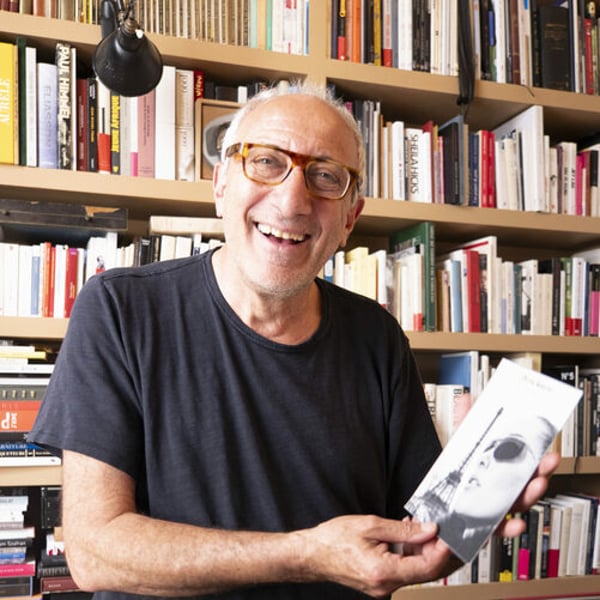
French eyewear label Solamor is gearing up for a long-anticipated relaunch, nearly four years after acclaimed designer Alain Miklitarian stepped in to take over the brand. Its first official collection under his creative direction will premiere this September at the Silmo Paris optics and eyewear trade show.
Alain Miklitarian has joined forces with Ludovic Edouard Dader to take over Solamor – Samuel Gut
Miklitarian has teamed up with Ludovic Edouard Dader, owner of the Paris-based boutique Eyeshowroom, to lead the revival. The project has been years in the making, shaped by trial and error. Before finalizing a concept they were proud of, the duo went through several rounds of prototype designs that never made it to production. Every step was guided by a shared goal: to bring Solamor back without compromising its legacy of craftsmanship. “I’ve always been drawn to this brand,” Miklitarian said. “It’s been on my radar for years, but the timing never aligned—until Ludovic reached out and brought the opportunity to life.”
A first look coming this September
Miklitarian initially hesitated to join the project, but in 2021, he committed fully, bringing financial backing and technical know-how. The early prototypes fell short of expectations, delaying the launch. From the outset, he and Dader made one thing non-negotiable: they wouldn’t attach the Solamor name to anything less than exceptional. They partnered with Japanese manufacturer Nakanishi to uphold the brand’s luxury standards and selected titanium for the frames.
The result is a Made in Japan collection, with two models set to preview at Silmo Paris. The full lineup includes twelve styles—offering both standard and customizable options—and will launch by the end of the year.
While developing the line, Miklitarian referenced Solamor’s archives but intentionally introduced modern design details. Still, he steers clear of leaning too heavily on vintage material. “If you dig into the archives too much, it starts to feel like plagiarism,” he said. He aims to honor the brand’s legacy while keeping the aesthetic relevant and forward-looking.
Customization plays a big role in the relaunch. The Sport 1000, one of the standout styles, will be available at different price points — from €450 to €1,000, and up to €2,000 for the gold-plated 2027 edition. Prices vary depending on the frame and lens quality.
Lens options range from durable polycarbonate with classic finishes to high-performance polyurethane that mimics mineral glass. The more advanced lenses offer better brightness and polarized glare reduction. “Solamor isn’t a sports brand,” Miklitarian added, “but I’m using every tool available.”
Target: Made in France by 2027
Although Miklitarian stands by the quality of the Japan-made collection, he admits the experience came with a bittersweet edge. “I had to adapt to Japanese production methods, but there’s still an aftertaste — the brand was born in the Jura region, and it misses that French système D spirit that gives it its charm,” he said.
He and Dader now plan to bring production back to France by 2027 — a move that would also allow Miklitarian to reconnect with long-standing industrial partners. “It’s not just about flying the Made in France flag,” he said. “It’s about working with manufacturers with the expertise to craft exceptional products.”
This approach is part of a bigger strategy. Although Italy continues to lead the global eyewear market — driven by giants like EssilorLuxottica, which reported €26.5 billion in revenue in 2024 — Miklitarian believes French craftsmanship still sets itself apart. “Walk into a French factory and you’ll see it — the way metal is worked, how materials are shaped and finished. That’s the kind of expertise we still have,” he said.
Reviving Solamor wasn’t a spur-of-the-moment decision. Miklitarian had been contemplating it for years. Now in his 70s, he brings decades of experience at the crossroads of design and social impact — from launching his namesake label and co-creating Starck Eyes to founding Mikli Diffusion, an initiative that made art more accessible to the visually impaired.
With this relaunch, he’s breathing new life into one of France’s heritage brands. Founded in 1946 by Georges Lissac, Solamor became a fixture in both cinema and fashion, worn by icons like Jean-Luc Godard, Michèle Morgan and Jean-Paul Belmondo.
The brand was founded in 1946 by Georges Lissac – Samuel Gut
Crafting a premium identity
Solamor is positioning itself as a high-end contender in a competitive market dominated by fashion houses such as Dior, Saint Laurent and Chanel. But Miklitarian insists the brand will stand out not for its name, but for its craftsmanship.
He’s well aware of the challenges ahead. “Luxury brands are slowing down. With unstable economies and global tensions, any brand without a solid foundation could be at risk,” he said. To stay agile, Miklitarian and Dader plan to keep operations lean — outsourcing most tasks and limiting the core team to just five people.
For now, Solamor does not plan to sell directly to consumers. Instead, it will distribute through opticians and operate under a B2B model, working only with what Miklitarian calls “committed and willing” partners. If direct-to-consumer sales are introduced later through the brand’s website, he emphasizes the platform must provide value and support — not serve purely as a sales channel.
While no direct data is available for the brand itself, industry publication Acuité reported a 0.9% increase in optician sales for 2024 — a positive sign for Solamor’s distribution strategy.
“It is with great pleasure that we announce Micaela Oliveira, the celebrated Portuguese designer, as one of the featured couturières at the Saudi Arabia Creative Women Forum 2025 Gala Dinner and Awards Ceremony,” the organisation declared on its social media channels, in a post also shared on the designer’s Instagram account, announcing the tribute at the event held on November 6 at the National Museum in Riyadh. The evening opened with an address by Princess Noura bint Saud bin Naif bin Abdulaziz Al Saud, patron of the Forum and founder of Saudi Fashion Week, followed by a runway show by the Portuguese designer, celebrating the rich traditions of this enchanted kingdom.
Lux
The publication further notes that the Trofa-born couturière “grew up surrounded by fabrics, prints, and creativity- a world that has shaped her lifelong devotion to fashion,” and that over the past 20 years she has “built an extraordinary career defined by elegance, daring, and refinement, consolidating her name among the leading designers of wedding dresses and haute couture,” the statement continues.
“Her creations- a harmonious blend of sophistication, sensuality, and femininity- embody her belief that each dress should tell a story, evoke emotion, and reflect the unique essence of the woman who wears it,” reads the message shared simultaneously on the Forum and the eponymous designer’s Instagram accounts.
“Guided by the values of exuberance, creativity, and impeccable craftsmanship, Micaela’s creations blend classic beauty with contemporary art, achieving a timeless charm,” the post adds, highlighting “a vision that transcends borders” that “continues to enchant the global fashion world, transforming dreams into haute couture masterpieces that celebrate individuality and the eternal elegance of femininity.”
Lux
For her part, Micaela Oliveira expressed her gratitude for the honour at the Saudi Arabia Creative Women Forum 2025 Gala Dinner and Awards Ceremony, which took place in Riyadh, the capital and principal financial centre of Saudi Arabia: “It was a privilege, as a designer, to travel to the Kingdom of Saudi Arabia, where I was honoured before members of international royalty and government representatives at a truly magnificent awards ceremony,” she said in a statement quoted by Lux.
“This prestigious award was presented to me by Her Royal Highness Princess Noura bint Saud bin Nayef bin Abdulaziz Al Saud, a pioneering woman and a leading figure in the Kingdom’s artistic community. I had the great honour of presenting a fashion show celebrating the rich traditions of this remarkable country during the Creative Women Forum 2025 Gala Dinner and Awards Ceremony.”
Instagram
“We are delighted to announce the return of the Creative Women Forum in Riyadh, which will take place from November 4–6, 2025, under the esteemed patronage of Her Royal Highness Princess Noura bint Saud bin Nayef Al Saud,” announced Creative Women Platform on Instagram. “This year’s forum will be held at the iconic Princess Nourah bint Abdulrahman University- the largest women’s university in the world.”
“A powerful stage for a global gathering of visionary women,” it continues. “Join us for three transformative days filled with innovative leadership, inspiration, and ground-breaking ideas, as we explore creativity, entrepreneurship, sustainability, and the future of women in leadership.”
This time, the experience culminated in a fabulous gala dinner and awards ceremony, “celebrating the brilliance of the women who shape our world,” concludes Creative Women Platform, on its social media.
This article is an automatic translation. Click here to read the original article.
British footwear brand Clarks is celebrating its 200th anniversary this year. In Italy, the brand is marking the bicentennial by opening a pop-up space within the Candiani Denim Store, in piazza Mentana 3 in Milan, where customers are able to personalise their Clarks shoes throughout December.
Clarks shoes can be personalised at the Candiani Denim Store in Milan – Clarks
From December 2 to 9, the Milanese store by Candiani, a premium Italian denim producer with its own jeans line, is hosting a Clarks pop-up shop. Visitors will have the opportunity to explore the British footwear brand’s history, its signature models, and learn about some of the leading figures who have worn Clarks and helped define its identity, influencing generations. A documentary about Clarks’s 200 years in business, entitled From Somerset to the World, will be screened inside the pop-up shop. The shop will showcase a selection of Clarks Originals models, including the Wallabee, Desert Boot and Desert Trek, as well as several items from the Fall/Winter 2025-26 collection, reinterpreting materials, shapes and colours with a contemporary feel.
In parallel with the pop-up shop (where a special event was staged on Thursday December 4), throughout December the Candiani Denim Store is giving Clarks customers the chance to create a personalised version of their shoes, choosing from two Clarks Originals models, the Wallabee and the Desert Boot. The limited-edition shoes will feature a personalised denim fob, and customers will be able to choose from an extensive library of patterns and designs. The motif chosen will be lasered directly on to the shoes at Candiani Custom, the denim brand’s urban micro-factory for bespoke jeans located next to the store.
FashionNetwork.com has had the opportunity to talk about Clarks’s distribution plans in Italy with Fabio Antonini, CEO of 3A, the company that has been distributing the British brand’s men’s and women’s lines since the Fall/Winter 2025-26 season.
FashionNetwork.com: Clarks has been busy overhauling its retail presence in Italy. What are the implementation steps, and what have the initial results been?
Fabio Antonini: Unlike the previous distributor, whose strategy was chiefly aimed at monobrand stores, we have rejigged Clarks’s distribution model by focusing on the wholesale channel and on a strong presence in multibrand stores. This is enabling us to rapidly extend our territorial footprint, making the brand more accessible and better integrated within the Italian market.
Fabio Antonini, CEO of 3A
FN: How many more Clarks corners are you planning to open in 2026 in Italy? And what about Clarks’s monobrand presence? Are you considering other initiatives like the one with Candiani?
FA: We currently don’t have any plans for new corners or monobrand stores. Our strategy is focused on the wholesale channel and multibrand retailers. The initiative with Candiani was developed as a special project to celebrate Clarks’s 200th anniversary. Over the next few years, we will assess new collaborations and special projects, in line with the brand’s future requirements. FN: In how many multibrand stores is Clarks currently distributed, and how many more are you planning to reach?
FA: In 2025, we have made Clarks available at 433 clients for a total of 619 doors [in Italy]. Next year, we’re expecting to grow the number of clients served by approximately 10%. FN: Clarks recently announced and deployed a strategy designed to boost its position in global e-marketplaces, is it also being implemented in Italy?
FA: Clarks’s new global strategy is set to make the brand even more accessible and reachable by online consumers. Its expanded presence on new global marketplaces is making Clarks easier to access in Italy too, strengthening its online presence and making it easier for consumers to buy. FN: What revenue result did 3A reach in fiscal 2024, how much did it grow by, and what is your forecast for 2025?
FA: In 2024, 3A generated a revenue of approximately €110.3 million, up 4.84% over the €105.2 million recorded in 2023. We’re expecting to grow at a similar rate in 2025.
Clarks
FN: Have there been new entries or other changes within 3A’s brand portfolio?
FA: Yes, there have been changes. Our portfolio includes underwear by Nike, Jordan, Calvin Klein and Tommy Hilfiger, as well as footwear and other products by Clarks, Converse Shoes, Nike Swim, Nike, Jordan, Converse Apparel Kids, Lacoste Kids, Huggies Apparel and Crep Protect.
We’re pursuing a strategy aimed at introducing new lines with a distribution exclusive, to further enrich our portfolio also in terms of brand quality. Some new lines will feature as early as spring 2026.
Brand background
Clarks was founded in Street, Somerset, in 1825, when Cyrus Clark opened a tannery with his brother James. It began shoemaking by using leather offcuts to create slippers. In 1950, Clarks created the revolutionary Desert Boot shoes. Since then, Clarks has built an archive of over 22,000 models that have been worn across generations all over the world.
In fiscal 2024, Clarks’s parent company C&J Clark Ltd reported a revenue drop of 9.4%, to £901.3 million (approximately €1.07 billion), and a pre-tax loss of £39.3 million. This led the company to overhaul the Clarks brand, cutting overheads, modifying the marketing approach, and repositioning the range. The brand’s retail strategy too has been reappraised, streamlining the store fleet and developing initiatives like the Milanese pop-up store.
Clarks, in typically innovative fashion, is also expanding its online presence with several new launches on global e-tailers like Shein, Walmart, Target, Secret Sales and TikTok Shop. In the UK, Clarks has recently been introduced on Shein and Secret Sales, while in Europe it will be available at Secret Sales Netherlands and Dress for Less later this year. In the Americas, it has been featured on eBay for the last five years, and has recently reached Shop Simon, Shein and Walmart, while it will be available on Target this month.
Clarks has recently returned to Tottenham Court Road in London, with a new retail concept – Clarks
Clarks is also aiming to consolidate its presence on TikTok Shop. It launched on the Chinese social shopping channel in Singapore and Malaysia last year, and this year it has reached the UK and the Americas, with Europe set to follow in 2026. This expansion drive follows the September announcement of the first Clarks-owned digital marketplace, which is set to be launched in the UK in early 2026.
Candiani is an Italian family company founded in 1938 and based in Robecchetto con Induno, near Milan, in the Ticino Park Nature Reserve. Besides owning the store in piazza Mentana in Milan, with the Candiani Custom micro-factory for bespoke jeans, Candiani owns among others the patent for Coreva, the first and only biodegradable and compostable stretch denim available on the market.
Another creative director departure at a major brand is shaking up the fashion industry. It is now the turn of Austrian designer Norbert Stumpfl to leave Brioni. The label has just confirmed the end of its collaboration with the designer in a statement. Stumpfl had designed Brioni’s collections for the past seven years.
The fashion house founded in 1945, which in 1952 became the first menswear brand to stage a fashion show (in Florence’s legendary Sala Bianca), has expressed its “deep gratitude for the contribution he has made over the years. During his tenure at Brioni, Norbert interpreted with precision the concepts of lightness and discretion, contributing to the evolution of the men’s wardrobe with a modern approach that pays homage to tradition,” Brioni said.
Federico Arrigoni, CEO of Brioni, said, “Our journey continues, and the Maison will continue to consolidate its tradition- perfection of craftsmanship, exceptional materials, and innovation in tailoring techniques- to create true masterpieces, from formalwear to leisurewear and accessories. Brioni pursues its mission of defining the contemporary codes of Italian elegance, while elevating its mastery of high tailoring and bespoke craftsmanship for those who lead and accept nothing but the exceptional.”
Since 2011, Brioni has been part of the Paris-based French luxury group Kering. From 2018 until his departure, the brand’s collections were designed by Norbert Stumpfl, the acclaimed Austrian menswear couturier, celebrated for his blend of impeccable tailoring and cutting-edge fabrics- among his creations were dinner jackets woven with 24-carat gold threads and enzyme-treated silk-linen blends with a soft, distinctive handle. During his tenure, Brioni also expanded masterfully into womenswear, expressing discreet luxury with rare aplomb.
A pinnacle of Roman sartorial luxury, the Italian label marked its 80th anniversary in late November with an exhibition of its superb tailoring and a gala dinner at the Chiostro del Bramante in Rome.
This article is an automatic translation. Click here to read the original article.