Last week, Louis Vuitton unveiled a significant new space in Shanghai, “The Louis,” which seamlessly integrates retail, Le Café Louis Vuitton, and the “Louis Vuitton Visionary Journeys” exhibition within a magnificent boat-like facade.
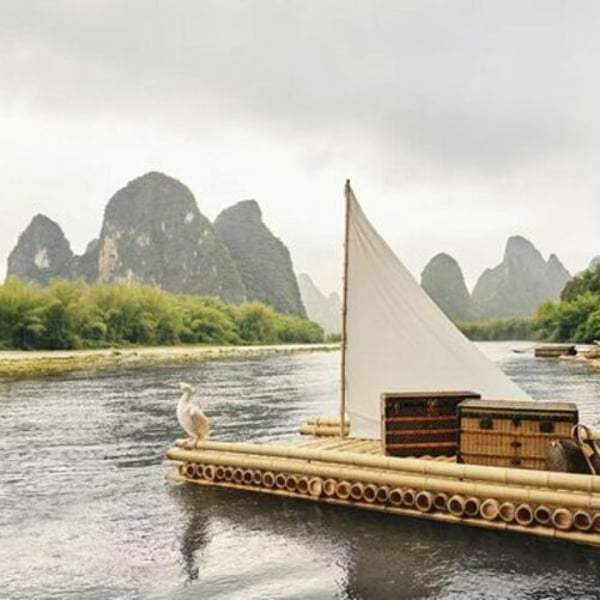
Louis Vuitton’s new travel campaign captures the serene beauty of the Lijiang River, blending iconic trunks and the Soft Keepall with traditional bamboo rafts to reflect a harmonious dialogue between heritage and nature. – Credit by LV
Since the opening of the brand’s first store in Beijing’s Palace Hotel in 1992, Louis Vuitton embarked on its journey into the Chinese market with its iconic Monogram symbol. It wasn’t until the “Louis Vuitton: Voyages” exhibition at the National Museum of China in Beijing in 2009 that the brand’s design philosophy and historical heritage were systematically communicated to Chinese consumers for the first time, marking the completion of Louis Vuitton’s journey of cultural integration with the East.
Later, Louis Vuitton’s “City Guides” series—featuring 32 themed editions—blended its travel philosophy with urban cultural heritage, creating “portable city memories.” In 2022, the Louis Vuitton show in Anaya and the House of Louis Vuitton in Chengdu each became recognized cultural landmarks.
Luxury groups in China are increasingly embracing “cultural long-termism.” LVMH, Louis Vuitton’s parent company, outlined its 2024 China strategy as a shift from short-term traffic tactics to a long-term cultural approach. During the Q1 2025 earnings call, CFO Jean-Jacques Guiony reinforced this direction, emphasizing that sustainable growth in China relies on deeply understanding cultural consumption cycles—not merely reacting to technological trends.
Now, more than three decades later, the brand exemplifies the core principles of Chinese business wisdom through three major events.
Right time (天时 Tiānshí)
At the beginning of June, Louis Vuitton, in collaboration with China Post and DeepSeek AI, launched a pop-up store at the Shanghai Post Museum. This initiative transforms the brand’s travel philosophy into digital art and co-branded stamps, aiming to revitalize traditional letter culture amidst the resurgence of cultural tourism and the digital “Guócháo(国潮)” trend.
From June 7 to 15, 2025, Louis Vuitton opened a pop-up space at the Shanghai Postal Museum, showcasing its book series and stationery collections. – Credit by LV
Since its inception, “The Art of Travel” has been central to Louis Vuitton’s identity. Through publications such as the “City Guide,” which explores urban landscapes, the “Fashion Eye” series featuring evocative photography, and the “Travel Book” with its artistic reflections on destinations, the brand has crafted a narrative universe centered on exploration. These works embody the belief that “Life is a Journey,” inviting readers to embark on inspiring odysseys through each page. This collaboration has opened new channels of dialogue with the brand’s next generation of target consumers.
Right place (地利 Dìlì)
At the end of June, “The Louis” was completed at Taikoo Hui on Wujiang Road. This ship-shaped structure pays homage to Louis Vuitton’s nautical heritage and Shanghai’s port culture. Inside, a 1,200 sq. m. exhibition, a collaboration with OMA, and localized dining options—including Monogram dumplings—deeply integrate the spatial narrative with the city’s spirit. This integration of “spiritual symbols” demonstrates Louis Vuitton’s profound understanding of local culture, signifying that a fragmented, symbolic approach is obsolete in favor of a cohesive cultural interpretation.
Right people (人和 Rénhé)
Starting from July, the new travel campaign—beginning along the legendary Lijiang River landscape, captured by American photographer Alec Soth—showcases the Soft Keepall bag on a bamboo raft and Monogram Horizon suitcases with a convoy. Through an international lens, this campaign sheds the “Western gaze” and aims to evoke widespread emotional resonance with Eastern natural aesthetics.
Following Guilin, the travel campaign will continue to explore China’s diverse landscapes. Together with the other two major events, this initiative aims to seize timely opportunities, deepen urban connections, and cultivate cultural empathy.
More than a journey, Louis Vuitton’s new travel campaign captures the contemplative essence while travel becomes a transformative odyssey, and an invitation to uncover hidden beauty. – Credit by LV
As Louis Vuitton’s presence in the Chinese market quietly extends beyond three decades, it has transcended its origins as a Western luxury symbol to become a cultural and commercial touchstone—growing in tandem with China’s ’90s-born generation of consumers.
This intergenerational brand evolution can be understood through the dimensions of time, place, and people—navigating market cycles, integrating into the local market, and solidifying consumer perception. This strategic progression, mirroring the ancient Chinese wisdom of “Right Time, Right Place, and Right People,” has propelled Louis Vuitton’s transformation from a mere “top luxury leather goods” brand to a “culturally beloved entity in China,” showcasing the brand’s enduring power of continuous evolution beneath its classic heritage.
Artificial intelligence (AI) continues its march to transform businesses’/consumers’ lives with customer advocacy platform Mention Me launching ‘AI Discovery IQ’, a free-to-use tool that “helps brands reach target consumers in the new age of generative AI search”.
Kirill KUDRYAVTSEV / AFP/Archives
It claims to allow brands to “instantly audit how discoverable they are within popular AI systems” such as ChatGPT, Claude, Gemini and Perplexity.
According to Mention Me, 62% of UK consumers now turn to generative AI tools for product recommendations, brand discovery and comparisons, “bypassing traditional search engines entirely [so] businesses are under pressure to respond to this behaviour change,” said the platform’s CEO Wojtek Kokoszka whose platform works with firms including Charlotte Tilbury, Huel and Puma, “helping marketing teams to boost consumer awareness and sales”.
With AI, it says the modern customer journey, powered by natural language prompts instead of outdated keyword strings, means consumers are 4.4 times more likely to convert if they find a brand through a large language model (LLM).
“The rise of ‘agent-mode’ assistants and AI-driven voice search has pushed brands into a new world of digital visibility. Despite this, most brands have little to no insight into how they appear in AI-generated answers”, said Kokoszka.
AI Discoverability IQ claims to give brands an overall LLM discoverability score, specific details on areas such as technical website elements, content and structured data, and actionable recommendations to improve their AI discoverability.
Its tool generates “measurable, trackable outputs” like AI Visibility Score, brands’ prompt-based results, and a side-by-side comparisons with their competitive set. This means brands “can react quickly to improve their discoverability scores” with Mention Me’s wider suite of products and unique first-party data.
It’s also “innovating and evolving” its platform to include more capabilities, such as the ability to benchmark against competitors, to drive further improvements for marketing leaders in the age of AI.
Mention Me CMO Neha Mantri said: “AI Discoverability is not yet a named practice within most marketing teams; the same way SEO wasn’t in the early 2000s. But when up to 31% of consumers say they’re more likely to trust responses from generative AI than traditional search results, this needs to change. Mention Me is naming the problem and providing a solution at just the right time.”
A host of celebrities and high-end brands have donating goods to ensure Savile Row’s latest annual ‘Pop-Up Crisis’ store will continue to support the Crisis charity event that has so far raised over £650,000 since 2018.
Image: Crisis charity
Across 8-13 December, the pop-up store at 18-19 Savile Row in London’s Mayfair will sell a curated selection of designer clothing, past stock and samples from luxury brands.
Celebs donating goods include Rosie Huntington-Whiteley, Naomie Harris, David Gandy, Jarvis Cocker, Louis Partridge, Jamie Redknapp and Emma Corrin, among others, for a week-long event and raffle with all proceeds going to help end homelessness across Britain.
Hosted by landlord The Pollen Estate, the temporary shop is also selling designer goods donated by Savile Row tailors including Mr Porter, Wales Bonner, Crockett & Jones and many other luxury brands from Barbour, Tod’s to Manolo Blahnik and Watches of Switzerland Group.
This year, celebrity model and fashion entrepreneur David Gandy will also be curating an exclusive online edit on shopfromcrisis.com, including donations from his own wardrobe as well as items from friends including Redknapp’s brand Sandbanks, Hackett and Aspinal of London.
Gandy said: “Having supported Crisis for a number of years, I’m delighted to have had the opportunity to curate my own online edit this year with the help of some of my close friends. It means a lot to know that donations from my own wardrobe are going towards such an important cause. Whether you’re looking for the perfect Christmas gift or to treat yourself, your purchase can help make a real difference to people facing homelessness this Christmas.”
Liz Choonara, executive director of Commerce and Enterprise at Crisis, added: “Pop-Up Crisis is such an iconic event in the Crisis calendar and one that we look forward to every year. We’re thrilled to be partnering with the team once again for another week celebrating the iconic craftsmanship and style of Savile Row – with all proceeds going towards our crucial work to end homelessness.”
Specialist outdoor clothing producer Dryrobe has won a trademark case against a smaller label. The win for the business, which produces waterproof towel-lined robes used by cold water swimmers, means the offending rival must now stop selling items under the D-Robe brand within a week.
Image: Dryrobe
A judge at the high court in London ruled the company was guilty of passing off its D-Robe changing robes and other goods as Dryrobe products and knew it was infringing its bigger rival’s trademark reports, The Guardian newspaper.
The company said it has rigorously defended its brand against being used generically by publications and makers of similar clothing and is expected to seek compensation from D-Robe’s owners for trademark infringement.
Dryrobe was created by the former financier Gideon Bright as an outdoor changing robe for surfers in 2010 and became the signature brand of the wild swimming craze.
Sales increased from £1.3 million in 2017 to £20.3 million in 2021 and it made profits of £8 million. However, by 2023 sales had fallen back to £18 million as the passion for outdoor sports waned and the brand faced more competition.
Bright told the newspaper the legal win was a “great result” for Dryrobe as there were “quite a lot of copycat products and [the owners] immediately try to refer to them using our brand name”.
He said the company was now expanding overseas and moving into a broader range of products, adding that sales were similar to 2023 as “a lot of competition has come in”.