Connect with us

Business

Trump’s ‘Big Beautiful Bill’ may end clean energy credits. Critics warn it could send utility bills ‘through the roof’

Published

on


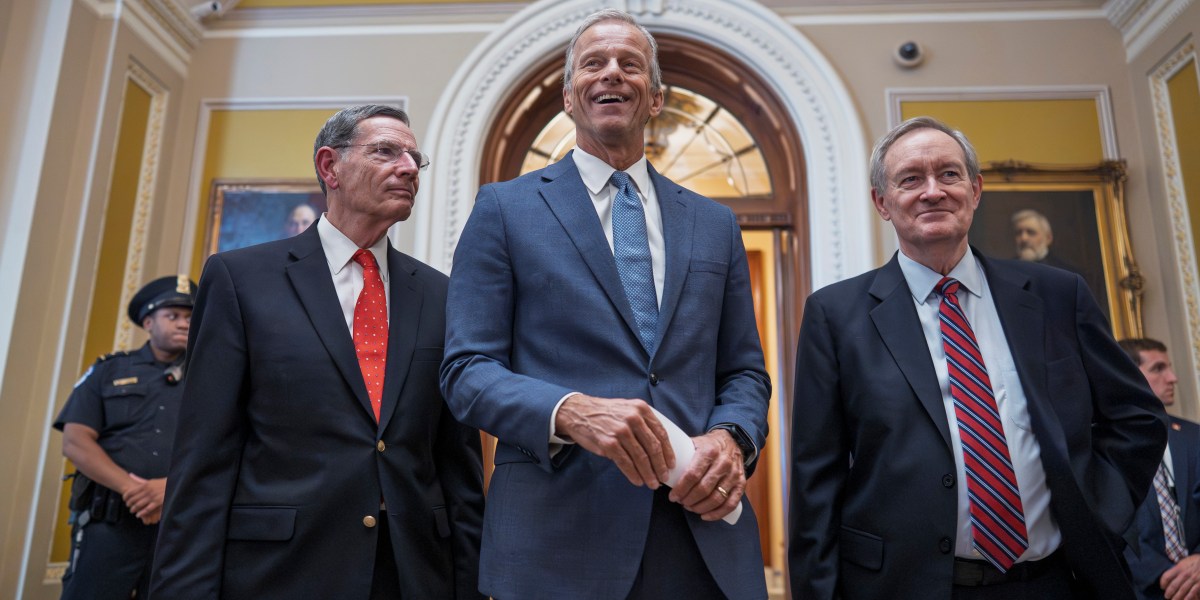
The sprawling Republican budget bill approved by the Senate Tuesday removes a proposed tax on solar and wind energy projects but quickly phases out tax credits for wind, solar and other renewable energy.

The Senate approved the bill 51-50 as President Donald Trump and GOP lawmakers move to dismantle the 2022 climate law passed by Democrats under former President Joe Biden. Vice President JD Vance broke a tie after three Republican senators voted no.

The bill now moves to the House for final legislative approval.

The excise tax on solar and wind generation projects was added to the Senate bill over the weekend, prompting bipartisan pushback from lawmakers as well as clean energy developers and advocates.

The final bill removes the tax but mostly sticks with legislative language released late Friday night and would end incentives for clean energy sooner than a draft version unveiled two weeks ago.

Some warn of spike in utility bills

Democrats and environmental groups said the GOP plan would crush growth in the wind and solar industry and lead to a spike in Americans’ utility bills. The measure jeopardizes hundreds of renewable energy projects slated to boost the nation’s electric grid, they said.

“Despite limited improvements, this legislation undermines the very foundation of America’s manufacturing comeback and global energy leadership,” said Abigail Ross Hopper, president and CEO of the Solar Energy Industries Association. If the bill becomes law, “families will face higher electric bills, factories will shut down, Americans will lose their jobs, and our electric grid will grow weaker,” she said.

The American Petroleum Institute, the top lobbying group for the oil and gas industry, applauded the bill’s passage.

“This historic legislation will help usher in a new era of energy dominance by unlocking opportunities for investment, opening lease sales and expanding access to oil and natural gas development,” said Mike Sommers, the group’s president and CEO.

While Democrats complained that the bill would make it harder to get renewable energy to the electric grid, Republicans said the measure represents historic savings for taxpayers and supports production of traditional energy sources such as oil, natural gas and coal, as well as nuclear power, increasing reliability.

In a compromise approved overnight, the bill allows wind and solar projects that begin construction within a year of the law’s enactment to get a full tax credit without a deadline for when the projects are “placed in service,” or plugged into the grid. Wind and solar projects that begin later must be placed in service by the end of 2027 to get a credit.

The bill retains incentives for technologies such as advanced nuclear, geothermal and hydropower through 2032.

Changes to the renewable energy language — including removal of the excise tax on wind and solar — were negotiated by a group of Republican senators, including Alaska Sen. Lisa Murkowski and Iowa Sens. Joni Ernst and Chuck Grassley. Iowa is a top producer of wind power, while Murkowski is a longtime supporter of renewable energy as crucial for achieving energy independence, particularly for isolated rural communities in Alaska.

Murkowski, who voted in favor of the final bill, called her decision-making process “agonizing.”

“I had to look on balance, because the people in my state are the ones that I put first,” she told reporters after Tuesday’s vote. “We do not have a perfect bill by any stretch of the imagination.”

GOP bill said to be ‘massively destructive’

Rhode Island Sen. Sheldon Whitehouse, the top Democrat on the Senate Environment and Public Works Committee, called the bill a “massively destructive piece of legislation” that “increases costs for everyone by walloping the health care system, making families go hungry and sending utility bills through the roof.”

The bill “saddles our children and grandchildren with trillions and trillions of dollars in debt — all to serve giant corporations, fossil fuel polluters and billionaire Republican megadonors who are already among the richest people on the planet,” Whitehouse said.

Wyoming Sen. John Barrasso, a Republican and former chairman of the Senate Energy panel, hailed the bill for rescinding many elements of what he called the Biden administration’s “green new scam,” including electric vehicle tax credits that have allowed car owners to lower the purchase price of EVs by $7,500. The bill also blocks a first-ever fee on excess methane emissions from oil and gas production that industry groups fiercely opposed, increases oil and gas leases on public lands and revives coal leasing in Wyoming and other states.

“Today, the Senate moved President Trump’s agenda forward,” said West Virginia Sen. Shelley Moore Capito, a Republican who chairs the Senate environment committee.

Clean energy advocates were deeply disappointed by the bill, which they argue undoes much of the 2022 climate law approved by Democrats.

“By eliminating a number of clean energy incentives and slashing others, this bill represents a significant step backward for America’s energy future,” said Nathaniel Keohane, president of the Center for Climate and Energy Solutions, a nonprofit that seeks to accelerate the global transition to net-zero greenhouse gas emissions.

“Curtailing incentives for electricity generated from wind and solar power is particularly shortsighted” and will raise energy prices for households and businesses and threaten reliability of the electric grid, Keohane said.


Source link

Continue Reading

Business

Robert F. Kennedy Jr. turns to AI to make America healthy again

Published

on


HHS billed the plan as a “first step” focused largely on making its work more efficient and coordinating AI adoption across divisions. But the 20-page document also teased some grander plans to promote AI innovation, including in the analysis of patient health data and in drug development.

“For too long, our Department has been bogged down by bureaucracy and busy-work,” Deputy HHS Secretary Jim O’Neill wrote in an introduction to the strategy. “It is time to tear down these barriers to progress and unite in our use of technology to Make America Healthy Again.”

The new strategy signals how leaders across the Trump administration have embraced AI innovation, encouraging employees across the federal workforce to use chatbots and AI assistants for their daily tasks. As generative AI technology made significant leaps under President Joe Biden’s administration, he issued an executive order to establish guardrails for their use. But when President Donald Trump came into office, he repealed that order and his administration has sought to remove barriers to the use of AI across the federal government.

Experts said the administration’s willingness to modernize government operations presents both opportunities and risks. Some said that AI innovation within HHS demanded rigorous standards because it was dealing with sensitive data and questioned whether those would be met under the leadership of Health Secretary Robert F. Kennedy Jr. Some in Kennedy’s own “Make America Health Again” movement have also voiced concerns about tech companies having access to people’s personal information.

Strategy encourages AI use across the department

HHS’s new plan calls for embracing a “try-first” culture to help staff become more productive and capable through the use of AI. Earlier this year, HHS made the popular AI model ChatGPT available to every employee in the department.

The document identifies five key pillars for its AI strategy moving forward, including creating a governance structure that manages risk, designing a suite of AI resources for use across the department, empowering employees to use AI tools, funding programs to set standards for the use of AI in research and development and incorporating AI in public health and patient care.

It says HHS divisions are already working on promoting the use of AI “to deliver personalized, context-aware health guidance to patients by securely accessing and interpreting their medical records in real time.” Some in Kennedy’s Make America Healthy Again movement have expressed concerns about the use of AI tools to analyze health data and say they aren’t comfortable with the U.S. health department working with big tech companies to access people’s personal information.

HHS previously faced criticism for pushing legal boundaries in its sharing of sensitive data when it handed over Medicaid recipients’ personal health data to Immigration and Customs Enforcement officials.

Experts question how the department will ensure sensitive medical data is protected

Oren Etzioni, an artificial intelligence expert who founded a nonprofit to fight political deepfakes, said HHS’s enthusiasm for using AI in health care was worth celebrating but warned that speed shouldn’t come at the expense of safety.

“The HHS strategy lays out ambitious goals — centralized data infrastructure, rapid deployment of AI tools, and an AI-enabled workforce — but ambition brings risk when dealing with the most sensitive data Americans have: their health information,” he said.

Etzioni said the strategy’s call for “gold standard science,” risk assessments and transparency in AI development appear to be positive signs. But he said he doubted whether HHS could meet those standards under the leadership of Kennedy, who he said has often flouted rigor and scientific principles.

Darrell West, senior fellow in the Brooking Institution’s Center for Technology Innovation, noted the document promises to strengthen risk management but doesn’t include detailed information about how that will be done.

“There are a lot of unanswered questions about how sensitive medical information will be handled and the way data will be shared,” he said. “There are clear safeguards in place for individual records, but not as many protections for aggregated information being analyzed by AI tools. I would like to understand how officials plan to balance the use of medical information to improve operations with privacy protections that safeguard people’s personal information.”

Still, West, said, if done carefully, “this could become a transformative example of a modernized agency that performs at a much higher level than before.”

The strategy says HHS had 271 active or planned AI implementations in the 2024 financial year, a number it projects will increase by 70% in 2025.


Source link

Continue Reading

Business

Construction workers are earning up to 30% more in the data center boom

Published

on


Big Tech’s AI arms race is fueling a massive investment surge in data centers with construction worker labor valued at a premium. 

Despite some concerns of an AI bubble, data center hyperscalers like Google, Amazon, and Meta continue to invest heavily into AI infrastructure. In effect, construction workers’ salaries are being inflated to satisfy a seemingly insatiable AI demand, experts tell Fortune.

In 2026 alone, upwards of $100 billion could be invested by tech companies into the data center buildout in the U.S., Raul Martynek, the CEO of DataBank, a company that contracts with tech giants to construct data centers, told Fortune.

In November, Bank of Americaestimated global hyperscale spending is rising 67% in 2025 and another 31% in 2026, totaling a massive $611 billion investment for the AI buildout in just two years.

Given the high demand, construction workers are experiencing a pay bump for data center projects.

Construction projects generally operate on tight margins, with clients being very cost-conscious, Fraser Patterson, CEO of Skillit, an AI-powered hiring platform for construction workers, told Fortune.

But some of the top 50 contractors by size in the country have seen their revenue double in a 12-month period based on data center construction, which is allowing them to pay their workers more, according to Patterson.

“Because of the huge demand and the nature of this construction work, which is fueling the arms race of AI… the budgets are not as tight,” he said. “I would say they’re a little more frothy.”

On Skillit, the average salary for construction projects that aren’t building data centers is $62,000, or $29.80 an hour, Patterson said. The workers that use the platform comprise 40 different trades and have a wide range of experience from heavy equipment operators to electricians, with eight years as the average years of experience.

But when it comes to data centers, the same workers make an average salary of $81,800 or $39.33 per hour, Patterson said, increasing salaries by just under 32% on average.

Some construction workers are even hitting the six-figure mark after their salaries rose for data center projects, according to The Wall Street Journal. And the data center boom doesn’t show any signs it’s slowing down anytime soon.

Tech companies like Google, Amazon, and Microsoft operate 522 data centers and are developing 411 more, according to The Wall Street Journal, citing data from Synergy Research Group. 

Patterson said construction workers are being paid more to work on building data centers in part due to condensed project timelines, which require complex coordination or machinery and skilled labor.

Projects that would usually take a couple of years to finish are being completed—in some instances—as quickly as six months, he said.

It is unclear how long the data center boom might last, but Patterson said it has in part convinced a growing number of Gen Z workers and recent college grads to choose construction trades as their career path.

“AI is creating a lot of job anxiety around knowledge workers,” Patterson said. “Construction work is, by definition, very hard to automate.”

“I think you’re starting to see a change in the labor market,” he added.


Source link

Continue Reading

Business

Netflix cofounder started his career selling vacuums door-to-door before college—now, his $440 billion streaming giant is buying Warner Bros. and HBO

Published

on


Reed Hastings may soon pull off one of the biggest deals in entertainment history. On Thursday, Netflix announced plans to acquire Warner Bros.—home to franchises like Dune, Harry Potter, and DC Universe, along with streamer HBO Max—in a total enterprise value deal of $83 billion. The move is set to cement Netflix as a media juggernaut that now rivals the legacy Hollywood giants it once disrupted.

It’s a remarkable trajectory for Netflix’s cofounder, Hastings—a self-made billionaire who found a love for business starting as a teenage door-to-door salesperson.

“I took a year off between high school and college and sold Rainbow vacuum cleaners door to door,” Hastings recalled to The New York Timesin 2006. “I started it as a summer job and found I liked it. As a sales pitch, I cleaned the carpet with the vacuum the customer had and then cleaned it with the Rainbow.”

That scrappy sales job was the first exposure to how to properly read customers—an instinct that would later shape Netflix’s user-obsessed culture. After graduating from Bowdoin College in 1983, Hastings considered joining the Marine Corps but ultimately joined the Peace Corps, teaching math in Eswatini for two years. When he returned to the U.S., he obtained a master’s in computer science from Stanford and began his career in tech.

The idea for Netflix reportedly came a few years later in the late 1990s. After misplacing a VHS copy of Apollo 13 and getting hit with a $40 late fee at Blockbuster, Hastings began exploring a mail-order rental service. While it’s an origin story that has since been debated, it marked the start of a company that would reshape global entertainment.

Hastings stepped back as CEO in 2023 and now serves as Netflix’s chairman of the board. He has amassed a net worth of about $5.6 billion. He’d be even richer if he didn’t keep offloading his shares in the company and making record-breaking charitable donations.

Netflix’s secret for success: finding the right people

Hastings has long said that one of the biggest drivers of Netflix’s success is its focus on hiring and keeping exceptional talent.

“If you’re going to win the championship, you got to have incredible talent in every position. And that’s how we think about it,” he told CNBC in 2020. “We encourage people to focus on who of your employees would you fight hard to keep if they were going to another company? And those are the ones we want to hold onto.”

To secure top performers, Hastings said he was more than willing to pay for above-market rates. 

“With a fixed amount of money for salaries and a project I needed to complete, I had a choice: Hire 10 to 25 average engineers, or hire one ‘rock-star’ and pay significantly more than what I’d pay the others, if necessary,” Hastings wrote. “Over the years, I’ve come to see that the best programmer doesn’t add 10 times the value. He or she adds more like a 100 times.”

That mindset also guided Netflix’s leadership transition. When Hastings stepped back from the C-suite, the company didn’t pick a single successor—it picked two. Greg Peters joined Ted Sarandos as co-CEO in 2023.

“It’s a high-performance technique,” Hastings said, speaking about the co-CEO model. “It’s not for most situations and most companies. But if you’ve got two people that work really well together and complement and extend and trust each other, then it’s worth doing.”

Netflix’s stock has soared more than 80,000% since its IPO in 2002, adjusting for stock splits.

Netflix brought unlimited PTO into the mainstream

Netflix’s flexible workplace culture has also played a key role in its success, with Hastings often known for prioritizing time off to recharge. 

“I take a lot of vacation, and I’m hoping that certainly sets an example,” the former CEO said in 2015. “It is helpful. You often do your best thinking when you’re off hiking in some mountain or something. You get a different perspective on things.”

The company was one of the first to introduce unlimited PTO, a policy that many firms have since adopted. About 57% of retail investors have said it could improve overall company performance, according to a survey by Bloomberg. Critics have argued that such policies can backfire when employees feel guilty taking time off, but Hastings has maintained that freedom is core to Netflix’s identity. 

“We are fundamentally dedicated to employee freedom because that makes us more flexible, and we’ve had to adapt so much back from DVD by mail to leading streaming today,” Hastings said. “If you give employees freedom you’ve got a better chance at that success.”

Netflix’s other cofounder, Marc Randolph, embraced a similar philosophy of valuing work-life balance.

“For over thirty years, I had a hard cut-off on Tuesdays. Rain or shine, I left at exactly 5 p.m. and spent the evening with my best friend. We would go to a movie, have dinner, or just go window-shopping downtown together,” Randolph wrote in a LinkedIn post.

“Those Tuesday nights kept me sane. And they put the rest of my work in perspective.”


Source link

Continue Reading

Trending

Copyright © Miami Select.