Connect with us

Business

US attacks three nuclear sites in Iran, widening conflict

Published

on


US President Donald Trump said American bombers struck Iran’s three main nuclear sites and threatened more attacks if Tehran doesn’t capitulate, pulling the US directly into the country’s conflict despite his longtime promises to avoid new wars.

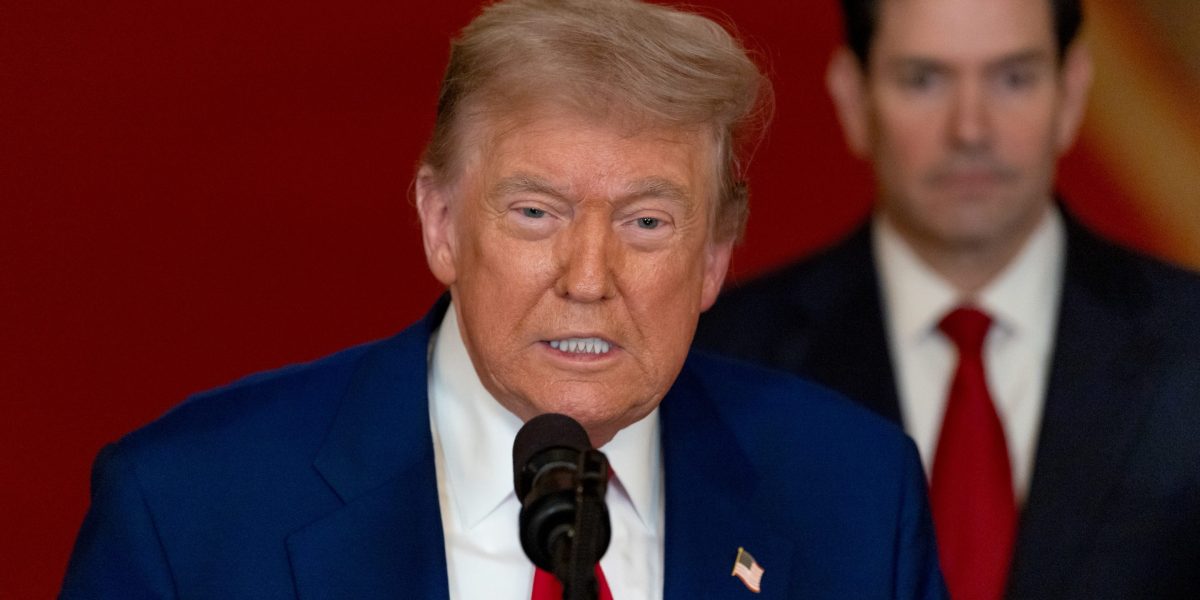
Addressing the nation in a televised speech, Trump said Iran’s “key nuclear enrichment facilities have been completely and totally obliterated.” He threatened “far greater” attacks if Iran doesn’t now make peace, raising the specter of even deeper US involvement.

Trump had said earlier in a social media post that a “payload of BOMBS” was dropped on Fordow, the uranium-enrichment site buried deep under a mountain and seen as vulnerable only to “bunker buster” munitions that the US possesses. Natanz and Isfahan, two other sites, were also struck.

“Our objective was the destruction of Iran’s nuclear enrichment capacity and a stop to the nuclear threat posed by the world’s No. 1 state sponsor of terror,” Trump said. “Iran, the bully of the Middle East, must now make peace. If they do not, future attacks will be far greater — and a lot easier.”

The move marks an extraordinary escalation by the president in the week since Israel began airstrikes across Iran and amounts to the most serious foreign-policy decision of his two terms so far. 

Live Blog: US Says It Launched Airstrikes on Iran Nuclear Sites

It goes against the advice of US allies in Europe as well as the United Nations’ International Atomic Energy Agency, which has repeatedly warned that nuclear facilities must never be attacked given the potential threat to nuclear safety — not to mention radiation leaks.

Iran has said it doesn’t want a nuclear bomb, and Trump’s own intelligence agencies had assessed recently it still hadn’t committed to developing such a weapon. Trump, however, had dismissed those findings and had declined to rule out joining the Israeli strikes, which had also killed several prominent Iranian military officials and nuclear scientists.

Sign up for our breaking news alerts, and get the biggest stories from around the world delivered to your inbox as they happen.

The US strikes could immediately open American assets in the Middle East to attack since Iran had warned it would retaliate if Trump ordered an attack. Trump’s combative language in the last couple of days had also triggered new threats from the Iran-backed Houthi rebels in Yemen and led Iranian officials to call the US Israel’s “partner in crime.”

Iran’s retaliation could also come in the form of cyber attacks against American or Israeli interests by hackers linked to the regime in Tehran. In a statement, the country’s nuclear agency, the Atomic Energy Organization of Iran, said its atomic-energy industry would not be halted. 

Earlier Saturday, the State Department said the US had begun evacuating US citizens from Israel. The agency organized two flights to Athens from Tel Aviv with about 70 US citizens, family members and permanent residents, it said.

“I hope that the Iranians are measured in their response but there will be a response — this is an act of war by the United States against a foreign country, which has not attacked us lately,” said Barbara Slavin, a distinguished fellow at the Stimson Center. “Americans are at risk all over the Middle East, all over the world.”

Iran’s official Islamic Republic News Agency reported that authorities in Isfahan confirmed multiple simultaneous explosions in Natanz and Isfahan early Sunday, describing them as “aggressions” near the two nuclear facilities.

Israel was notified in advance of the strikes, according to a person familiar with the matter who asked not to be identified discussing private deliberations. Trump spoke to Israeli Prime Minister Benjamin Netanyahu after the strikes, a senior White House official said.

Fears of an impending strike had eased after Trump’s team said on Thursday he would make a decision within two weeks. On Friday, the foreign ministers of France, Germany and the UK had met with Iranian officials  Geneva in a bid to prevent a US attack.

The continued fighting has evoked fears of a regional conflict that results in massive civilian casualties, and disrupts the flow of energy and other trade through the region. About a fifth of the world’s daily oil supply goes through the Strait of Hormuz, which lies between Iran and its Gulf Arab neighbors such as Saudi Arabia.

For days, Trump had faced conflicting advice from his supporters, after he campaigned for president on promises to keep the US out of foreign wars, pointing to American involvement in Afghanistan and Iraq. MAGA allies including longtime Trump supporter Steve Bannon, have warned against any US intervention, insisting this is Israel’s fight to finish.

Read More: Trump’s Iran War Talk Testing His Ties With MAGA Loyalists

Other Republicans had been urging Trump to join the fight against Iran, arguing that Tehran was more vulnerable after days of air strikes by Israel, and there was an opportunity to deliver on the president’s long insistence the regime cannot be allowed to have a nuclear weapon.

Trump and his advisers had suggested in recent days that any strike would be limited. Trump briefed Senate Majority Leader John Thune and House Speaker Mike Johnson, according to people familiar with the matter.

“This is not the start of a forever war,” Senator Jim Risch, the Idaho Republican and chairman of the Senate Foreign Relations Committee, said on X. “There will not be American boots on the ground in Iran. This was a precise, limited strike, which was necessary and by all accounts was very successful.”

Energy experts have raised concerns that crude flows in the region could be imperiled if Iran and its proxies retaliate in response to a US attack. Fears have focused on the Strait of Hormuz, a narrow waterway at the mouth of the Persian Gulf that is a key transit point for 26% of the world’s oil trade. Houthis have previously disrupted Red Sea shipping, with attacks on ships in the Bab el Mandeb strait forcing vessels to reroute around Africa.

A broader attack — including potentially planting naval mines — on the Strait of Hormuz could have even wider consequences, since it’s such a vital artery for the region’s oil and gas output.

What If Iran Tries to Close the Strait of Hormuz?: QuickTake

US ally Israel had launched a surprise attack on Iran on June 13, saying the imminent threat of the regime in Tehran securing nuclear weapons had to be neutralized. Iran’s military infrastructure was seriously damaged and a number of its top generals and atomic scientists were killed. But Israel lacked the heavy bombs and B-2 stealth jets believed to be required to destroy nuclear sites buried deep underground.  

Tehran had responded to Israel’s strikes by firing waves of ballistic missiles and drones, breaching aerial defenses, striking several cities and causing unprecedented damage. But the number of projectiles launched by Iran dropped markedly after the first few days of the conflict, raising questions about the number of missiles left in its arsenal and its ability to launch them.

“Iran is going to be facing a real dilemma, because they’ve already been dramatically weakened,” said Dennis Ross, who served as President Bill Clinton’s Middle East envoy and is now a fellow at the Washington Institute for Near East Policy. “They will try to do something to show they didn’t just capitulate or submit, but they have their own interest in trying to limit this.”


Source link

Continue Reading

Business

Netflix cofounder started his career selling vacuums door-to-door before college—now, his $440 billion streaming giant is buying Warner Bros. and HBO

Published

on


Reed Hastings may soon pull off one of the biggest deals in entertainment history. On Thursday, Netflix announced plans to acquire Warner Bros.—home to franchises like Dune, Harry Potter, and DC Universe, along with streamer HBO Max—in a total enterprise value deal of $83 billion. The move is set to cement Netflix as a media juggernaut that now rivals the legacy Hollywood giants it once disrupted.

It’s a remarkable trajectory for Netflix’s cofounder, Hastings—a self-made billionaire who found a love for business starting as a teenage door-to-door salesperson.

“I took a year off between high school and college and sold Rainbow vacuum cleaners door to door,” Hastings recalled to The New York Timesin 2006. “I started it as a summer job and found I liked it. As a sales pitch, I cleaned the carpet with the vacuum the customer had and then cleaned it with the Rainbow.”

That scrappy sales job was the first exposure to how to properly read customers—an instinct that would later shape Netflix’s user-obsessed culture. After graduating from Bowdoin College in 1983, Hastings considered joining the Marine Corps but ultimately joined the Peace Corps, teaching math in Eswatini for two years. When he returned to the U.S., he obtained a master’s in computer science from Stanford and began his career in tech.

The idea for Netflix reportedly came a few years later in the late 1990s. After misplacing a VHS copy of Apollo 13 and getting hit with a $40 late fee at Blockbuster, Hastings began exploring a mail-order rental service. While it’s an origin story that has since been debated, it marked the start of a company that would reshape global entertainment.

Hastings stepped back as CEO in 2023 and now serves as Netflix’s chairman of the board. He has amassed a net worth of about $5.6 billion. He’d be even richer if he didn’t keep offloading his shares in the company and making record-breaking charitable donations.

Netflix’s secret for success: finding the right people

Hastings has long said that one of the biggest drivers of Netflix’s success is its focus on hiring and keeping exceptional talent.

“If you’re going to win the championship, you got to have incredible talent in every position. And that’s how we think about it,” he told CNBC in 2020. “We encourage people to focus on who of your employees would you fight hard to keep if they were going to another company? And those are the ones we want to hold onto.”

To secure top performers, Hastings said he was more than willing to pay for above-market rates. 

“With a fixed amount of money for salaries and a project I needed to complete, I had a choice: Hire 10 to 25 average engineers, or hire one ‘rock-star’ and pay significantly more than what I’d pay the others, if necessary,” Hastings wrote. “Over the years, I’ve come to see that the best programmer doesn’t add 10 times the value. He or she adds more like a 100 times.”

That mindset also guided Netflix’s leadership transition. When Hastings stepped back from the C-suite, the company didn’t pick a single successor—it picked two. Greg Peters joined Ted Sarandos as co-CEO in 2023.

“It’s a high-performance technique,” Hastings said, speaking about the co-CEO model. “It’s not for most situations and most companies. But if you’ve got two people that work really well together and complement and extend and trust each other, then it’s worth doing.”

Netflix’s stock has soared more than 80,000% since its IPO in 2002, adjusting for stock splits.

Netflix brought unlimited PTO into the mainstream

Netflix’s flexible workplace culture has also played a key role in its success, with Hastings often known for prioritizing time off to recharge. 

“I take a lot of vacation, and I’m hoping that certainly sets an example,” the former CEO said in 2015. “It is helpful. You often do your best thinking when you’re off hiking in some mountain or something. You get a different perspective on things.”

The company was one of the first to introduce unlimited PTO, a policy that many firms have since adopted. About 57% of retail investors have said it could improve overall company performance, according to a survey by Bloomberg. Critics have argued that such policies can backfire when employees feel guilty taking time off, but Hastings has maintained that freedom is core to Netflix’s identity. 

“We are fundamentally dedicated to employee freedom because that makes us more flexible, and we’ve had to adapt so much back from DVD by mail to leading streaming today,” Hastings said. “If you give employees freedom you’ve got a better chance at that success.”

Netflix’s other cofounder, Marc Randolph, embraced a similar philosophy of valuing work-life balance.

“For over thirty years, I had a hard cut-off on Tuesdays. Rain or shine, I left at exactly 5 p.m. and spent the evening with my best friend. We would go to a movie, have dinner, or just go window-shopping downtown together,” Randolph wrote in a LinkedIn post.

“Those Tuesday nights kept me sane. And they put the rest of my work in perspective.”


Source link

Continue Reading

Business

‘This species is recovering’: Jaguar spotted in Arizona, far from Central and South American core

Published

on


The spots gave it away. Just like a human fingerprint, the rosette pattern on each jaguar is unique so researchers knew they had a new animal on their hands after reviewing images captured by a remote camera in southern Arizona.

The University of Arizona Wild Cat Research and Conservation Center says it’s the fifth big cat over the last 15 years to be spotted in the area after crossing the U.S.-Mexico border. The animal was captured by the camera as it visited a watering hole in November, its distinctive spots setting it apart from previous sightings.

“We’re very excited. It signifies this edge population of jaguars continues to come here because they’re finding what they need,” Susan Malusa, director of the center’s jaguar and ocelot project, said during an interview Thursday.

The team is now working to collect scat samples to conduct genetic analysis and determine the sex and other details about the new jaguar, including what it likes to eat. The menu can include everything from skunks and javelina to small deer.

As an indicator species, Malusa said the continued presence of big cats in the region suggests a healthy landscape but that climate change and border barriers can threaten migratory corridors. She explained that warming temperatures and significant drought increase the urgency to ensure connectivity for jaguars with their historic range in Arizona.

More than 99% of the jaguar’s range is found in Central and South America, and the few male jaguars that have been spotted in the U.S. are believed to have dispersed from core populations in Mexico, according to the U.S. Fish and Wildlife Service. Officials have said that jaguar breeding in the U.S. has not been documented in more than 100 years.

Federal biologists have listed primary threats to the endangered species as habitat loss and fragmentation along with the animals being targeted for trophies and illegal trade.

The Fish and Wildlife Service issued a final rule in 2024, revising the habitat set aside for jaguars in response to a legal challenge. The area was reduced to about 1,000 square miles (2,590 square kilometers) in Arizona’s Pima, Santa Cruz and Cochise counties.

Recent detection data supports findings that a jaguar appears every few years, Malusa said, with movement often tied to the availability of water. When food and water are plentiful, there’s less movement.

In the case of Jaguar #5, she said it was remarkable that the cat kept returning to the area over a 10-day period. Otherwise, she described the animals as quite elusive.

“That’s the message — that this species is recovering,” Malusa said. “We want people to know that and that we still do have a chance to get it right and keep these corridors open.”


Source link

Continue Reading

Business

MacKenzie Scott tries to close the higher ed DEI gap, giving away $155 million this week alone

Published

on


MacKenzie Scott has arguably been the biggest name in philanthropy this year—and has nonstop been making major gifts to organizations focused on education, DEI, disaster recovery, and many other causes.

This week alone, several higher education institutions announced major gifts from the billionaire philanthropist and ex-wife of Amazon founder Jeff Bezos—donations totaling well over $100 million. In true Scott fashion, many of these donations are the largest single donations these schools have ever received.

The donations announced this week include: 

  • $50 million to California State University-East Bay
  • $50 million to Lehman College (part of the City University of New York system)
  • $38 million to Texas A&M University-Kingsville
  • $17 million to Seminole State College

All four institutions are public, access-oriented colleges that enroll large shares of low‑income, first‑generation, and racially diverse students and function as minority‑serving institutions or similar engines of social mobility. They fit MacKenzie Scott’s broader pattern of directing large, unrestricted gifts to colleges that serve “chronically underserved” communities rather than already wealthy, highly selective universities.

Scott, who is worth about $40 billion and has donated over $20 billion in the past five years, has doubled down this year on causes that the Trump administration has cut deeply, such as education, DEI, and disaster recovery.

“As higher education, in general, works to find its way in an uncertain environment, this gift is a major source of encouragement that we are on the right path,” Lehman College President Fernando Delgado said in a statement. 

Scott also made one of the largest donations in HBCU Howard University’s 158-year history with an $80 million gift earlier this fall, and a $60 million donation to the Center for Disaster Philanthropy after Trump administration’s cuts to the Federal Emergency Management Agency (FEMA)—an organization Americans rely on for help during and after hurricanes, wildfires, tornadoes, and floods.

“All sectors of society—public, private, and social—share responsibility for helping communities thrive after a disaster,” CDP president and CEO Patricia McIlreavy previously told Fortune. “Philanthropy plays a critical role in providing communities with resources to rebuild stronger, but it cannot—and should not—replace government and its essential responsibilities.”

Trust-based philanthropy

Scott accumulated the vast majority of her wealth from her 2019 divorce from Bezos, but is dedicated to giving away most of her fortune. She’s considered a unique philanthropist in today’s environment because her gifts are typically unrestricted, meaning the organizations can use the funding however they choose. 

“She practices trust-based philanthropy,” Anne Marie Dougherty, CEO of the Bob Woodruff Foundation previously told Fortune. Scott has donated $15 million to the veteran-focused nonprofit organization in 2022, and made a subsequent $20 million donation this fall.

Scott is also considered one of the most generous philanthropists, and credits acts of kindness for inspiring her to give back.

“It was the local dentist who offered me free dental work when he saw me securing a broken tooth with denture glue in college,” Scott wrote of her inspiration for philanthropy in an Oct. 15 essay published to her Yield Giving site. “It was the college roommate who found me crying, and acted on her urge to loan me a thousand dollars to keep me from having to drop out in my sophomore year.”


Source link

Continue Reading

Trending

Copyright © Miami Select.