Connect with us

Business

Wall Street gets rude shock as Bessent plays second fiddle on tariffs

Published

on


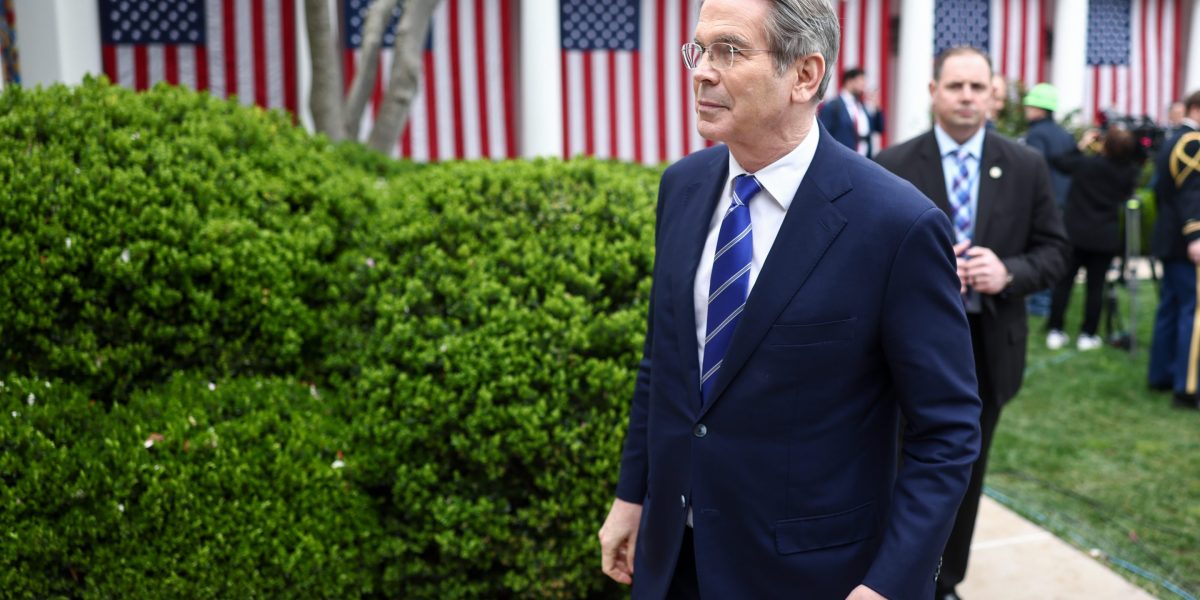
From the moment President Donald Trump unveiled his sweeping tariffs Wednesday through the ensuing market mayhem the following day, Treasury Secretary Scott Bessent’s phone lit up with text messages from executives tied to his former industry.

Multiple hedge fund managers and finance executives reached out, seeking his help in swaying Trump on the levies, according to people familiar with the matter. After all, as the former chief investment officer of Soros Fund Management, Bessent was a potential ally. He was seen as someone who could explain to the president that extreme new levies would damage the economy and continue to wreak havoc on markets.

But, in fact, Bessent wasn’t the primary driver of the tariff announcement, according to a person familiar with the matter. He used his role in Oval Office meetings to lay out potential scenarios for markets and the economy based on different tariff levels, the person said.

The tariffs were largely shaped by a small group within Trump’s inner circle, with critical decisions about the duties’ structure going down to the wire before the president’s announcement. A Treasury spokesperson declined to comment.

Now, Trump’s bid to remake the US economy and boost made-in-America products is at odds with a Wall Street establishment that has profited for decades from the idea that international trade drives the world order. And even some Republican lawmakers are sounding the alarm. 

For the past two days at least, the market carnage that Wall Street feared has come to pass, wiping out $5.4 trillion in value and dragging down the S&P 500 to the lowest level in 11 months. Recession fears are growing around the globe. And executives who had rallied behind the Trump administration’s promises to cut taxes and ease regulation are now contending with an economic agenda that stands to roil their businesses.

Private equity firms are calling off initial public offerings and tempering expectations of a deal comeback that they hoped would help juice fundraising. Hedge funds are weighing whether Trump’s next move is too unpredictable to even wager on. Bank leaders who had forecast a more pro-growth agenda are having to peel back expectations, with JPMorgan Chase & Co. economists predicting a US recession this year.

The market plunge has even caused some of Trump’s most ardent backers in the political world to predict broader fallout: Texas Senator Ted Cruz said tariffs everywhere “would destroy jobs here at home and do real damage to the US economy.” On his podcast, he warned the levies make Republicans vulnerable to a “bloodbath” in 2026 midterms elections.

Trump — who in his first administration paid close attention to the stock market’s performance — has shown that he won’t be easily persuaded to change course by the tariff-induced plunge. He said Friday that the policy will remain and that large corporations are unconcerned by the tariff plan. As markets slid the most in five years, the president was at his West Palm Beach golf club.

Within the administration, the market fallout has caused nervousness, and officials will be eyeing whether the market fallout extends into a third session on Monday. Yet there’s a sense that any shift in policy would have to come from the president alone. And Trump is focused on the long term with tariffs, a person familiar with the matter said. He has stressed the need to revive the US manufacturing base, secure supply chains and reduce reliance on rivals.

“The only special interest guiding President Trump’s decisions is the interest of the American people,” White House spokesman Kush Desai said. “The entire administration is aligned on addressing the national emergency that President Trump has rightfully identified is posed by our country running regular trade deficits.”

Tariff Roll Out 

A Trump adviser who isn’t part of the administration criticized how the levies were rolled out and the White House’s communication strategy as markets were crashing. It should have had teams of economists, business leaders and union workers explaining the plan on TV, this person said.

In the weeks leading up to the tariff announcement, some Wall Street executives had already started to appeal to the Treasury secretary for help. Others went public with their warnings. Citadel founder Ken Griffin repeatedly criticized planned tariffs, saying they would dull the US’s competitive edge, while Warren Buffett called tariffs “an act of war, to some degree.”

Bessent remains a key member of Trump’s economic team, according to an administration official. But senior counselor Peter Navarro and Commerce Secretary Howard Lutnick dominated the president’s attention on tariffs, said a person close to the matter. US Trade Representative Jamieson Greer was also an integral part of the team.

Bessent, in an interview with Bloomberg Television after the tariffs were announced Wednesday, said he wasn’t a part of negotiations with other countries and has been focused on the administration’s tax agenda. 

Private equity firms had seen Trump’s arrival heralding the return of IPOs that had been largely dormant the past three years and looser strictures on attracting wealthy individuals as clients. Instead, this week left them scrambling to determine how portfolio companies would be affected by the tariffs and are nursing painful stock slides. Shares of Apollo and KKR & Co. notched the biggest two-day slumps in their history.

Dealmakers note that some sectors — like domestic manufacturing — could still be poised for big boosts under the Trump administration. But they have expressed concerns to acquaintances that prolonged uncertainty and a slumping market will make it harder to exit bets at the prices they hoped. Already, companies including Klarna Group Plc and StubHub Holdings Inc. have paused their IPOs.

They’ve avoided airing their views publicly for fear of drawing the president’s wrath, and instead are trying to backchannel their concerns through proxies and lobbyists instead.

There are signs of some pushback among Trump loyalists on Capitol Hill as well. Senator Chuck Grassley and three other Republicans co-sponsored a bipartisan bill that intends to bring back tariff power to Congress, requiring approval of most new tariffs within 60 days. Majority Leader John Thune, who ultimately has the power to decide whether to bring the bill up for a floor vote, said he plans to look at the legislation.

“I know there is some interest in it,” Thune said on Friday. He acknowledged that the party was watching Wall Street carefully, and said he hoped they would see results from Trump’s plan “fairly quickly.”

Meanwhile on Saturday — as traders and executives across Wall Street and corporate America were still reeling from the market mayhem — White House aides issued an announcement: Trump had won the second round of the Senior Golf Championship at his Jupiter, Florida club.

He’d be advancing to the championship on Sunday.

This story was originally featured on Fortune.com


Source link

Continue Reading

Business

Kevin Hassett says Trump’s opinion would have ‘no weight’ on the FOMC

Published

on

National Economic Council Director Kevin Hassett, one of the top contenders to replace Jerome Powell as Federal Reserve chair, downplayed any role that President Donald Trump’s opinion would have in setting interest rates.

That’s despite Trump repeatedly insisting that he ought to have some say on monetary policy. Most recently, he said Friday his voice should be heard because “I’ve made a lot of money.”

In an interview Sunday on CBS’ Face the Nation, Hassett said Trump has “very strong and well founded views” but pointed out that the Fed is independent, with the chairman tasked with driving consensus among other policymakers on the rate-setting Federal Open Market Committee.

“But in the end, it’s a committee that votes,” he added. “And I’d be happy to talk to the president every day until both of us are dead because it’s so much fun to talk, even if I were Fed chair of if I wasn’t Fed chair.”

Hassett said he hopes Kevin Warsh, a former Fed governor who is also being considered for the chairmanship, would talk to the president as well if he becomes Fed chief.

Trump told the Wall Street Journal on Friday that Warsh was at the top of his list and said “the two Kevins are great.”

The comment surprised Wall Street, which had overwhelming odds on Hassett as the favorite. On the prediction market Kalshi, the probability that he will be nominated as Fed chair has plunged to 50% from 80.6% earlier this month, while Warsh’s odds shot up to 41% from 11%.

Trump has said he will nominate a Fed chair in early 2026, with Powell’s term due to expire in May. Until then, the contenders have time to make their case. According to the Journal, Trump met Warsh on Wednesday at the White House and pressed him on whether he could be trusted to back rate cuts. 

When asked on Sunday if Trump’s voice would have equal weighting to the voting members on the FOMC, Hassett replied, “no, he would have no weight.”

“His opinion matters if it’s good, if it’s based on data,” he explained. “And then if you go to the committee and you say, ‘well the president made this argument, and that’s a really sound argument, I think. What do you think?’ If they reject it, then they’ll vote in a different way.”

For his part, Hassett has regularly supported more easing and is one of Trump’s fiercest economic surrogates. But since joining Trump’s second administration, some of Hassett’s previous colleagues have expressed alarm over signs he’s serving more as a political loyalist.

He has become a regular presence on cable news, defending Trump’s policy priorities, downplaying unfavorable data, and echoing the White House line on everything from inflation to the legitimacy of federal statistics.

Meanwhile, the Fed’s early reappointment of its regional bank presidents eased concerns the central bank would soon lose its independence as Trump continues demanding steeper rate cuts.

That’s after the administration floated a district residency requirement for Fed presidents—an idea Hassett backed—raising fears it was seeking a wider leadership shake-up.

“If I’m reading this properly, they just Trump-proofed the Fed,” Justin Wolfers, a professor of public policy and economics at the University of Michigan, wrote in a post on X about the reappointment announcement.


Source link

Continue Reading

Business

Police have person of interest in custody over Brown Univ. shooting that killed 2, wounded 9

Published

on

Police in Rhode Island said early Sunday that they had a person of interest in custody after a shooting that rocked the Brown University campus during final exams, leaving two people dead and nine others wounded.

Col. Oscar Perez, chief of the Providence police, confirmed at a news conference that the detained person was in their 30s and that authorities are not currently searching for anyone else. He declined to say whether the person was connected to the university.

Separately, an FBI agent said that the arrest occurred at a Hampton Inn hotel in Coventry, about 20 miles (32 kilometers) from Providence. Officers remained on the scene there, with police tape blocking off a hallway.

The shooting erupted Saturday afternoon in the engineering building of the Ivy League school in Providence, Rhode Island, during final exams. Hundreds of police officers had scoured the Brown University campus along with nearby neighborhoods and pored over video in pursuit of a shooter who opened fire in a classroom.

Armed with a handgun, the shooter fired more than 40 9mm rounds, according to a law enforcement official. Authorities as of Sunday morning hadn’t recovered a gun but did recover two loaded 30-round magazines, said the official, who spoke on the condition of anonymity because they were not authorized to publicly discuss the investigation.

University officials on Sunday canceled all classes, exams, papers and projects for the remainder of the fall semester and said students were free to leave. Those who remain on campus will have access to services and support, Provost Francis Doyle said in a statement.

“At this time, it is essential that we focus our efforts on providing care and support to the members of our community as we grapple with the sorrow, fear and anxiety that is impacting all of us right now,” Doyle wrote.

Providence leaders warned that residents will notice a heavier police presence on Sunday. Many local businesses announced they would remain closed and expressed shock and heartbreak as the community continued to process the news of the shooting.

“Everybody’s reeling, and we have a lot of recovery ahead of us,” Brown University President Christina Paxson said at the news conference. “Our community’s strong and we’ll get through it, but it’s devastating.”

Surveillance video released by police showed a suspect, dressed in black, calmly walking away from the scene.

Earlier, Paxson said she was told 10 people who were shot were students. Another person was injured by fragments from the shooting but it was not clear if the victim was a student, she said.

The search for the shooter paralyzed the campus, the nearby neighborhoods filled with stately brick homes and the downtown in Rhode Island’s capital city until a shelter-in-place order was lifted early Sunday. Streets normally bustling with activity on weekends were eerily quiet. Officers in tactical gear led students out of some campus buildings and into a fitness center where they waited. Others arrived at the shelter on buses without jackets or any belongings.

Mayor advised people to stay home

Investigators were not immediately sure how the shooter got inside the first-floor classroom. Outer doors of the building were unlocked but rooms being used for final exams required badge access, Providence Mayor Brett Smiley said.

Smiley was emotional as he discussed the city’s efforts to prepare for a mass shooting.

“We all, intellectually, knew it could happen anywhere, including here, but that’s not the same as it happening in our community, and so this is an incredibly upsetting and emotional time for Providence, for Brown, for all of us,” he said. “It’s not something that we should have to train for, but we have.”

Nine people with gunshot wounds were taken to Rhode Island Hospital, where one was in critical condition. Six required intensive care but were not getting worse and two were stable, hospital spokesperson Kelly Brennan said.

Exams were underway during shooting

Engineering design exams were underway when the shooting occurred in the Barus & Holley building, a seven-story complex that houses the School of Engineering and physics department. The building includes more than 100 laboratories, dozens of classrooms and offices, according to the university’s website.

Emma Ferraro, a chemical engineering student, was in the building’s lobby working on a final project when she heard loud pops coming from the east side. Once she realized they were gunshots, she darted for the door and ran to a nearby building where she sheltered for several hours.

Former ‘Survivor’ contestant just left the building

Eva Erickson, a doctoral candidate who was the runner-up earlier this year on the CBS reality competition show “Survivor,” said she left her lab in the engineering building 15 minutes before shots rang out.

The engineering and thermal science student shared candid moments on “Survivor” as the show’s first openly autistic contestant. She was locked down in the campus gym following the shooting and shared on social media that the only other member of her lab who was present was safely evacuated.

Brown senior biochemistry student Alex Bruce was working on a final research project in his dorm directly across the street from the building when he heard sirens outside.

“I’m just in here shaking,” he said, watching through the window as armed officers surrounded his dorm.

Students hid under desks

Students in a nearby lab turned off the lights and hid under desks after receiving an alert about the shooting, said Chiangheng Chien, a doctoral student in engineering who was about a block away from the scene.

Mari Camara, 20, a junior from New York City, was coming out of the library and rushed inside a taqueria to seek shelter. She spent more than three hours there, texting friends while police searched the campus.

“Everyone is the same as me, shocked and terrified that something like this happened,” she said.

Brown, the seventh oldest higher education institution in the U.S., is one of the nation’s most prestigious colleges with roughly 7,300 undergraduates and more than 3,000 graduate students. Tuition, housing and other fees run to nearly $100,000 per year, according to the university.


Source link

Continue Reading

Business

Congressman leading GOP’s mid-term House campaign says Trump is intimately involved in recruitment

Published

on

Even though Republican Brian Jack is only a first-term congressman, he has become a regular in the Oval Office these days. As the top recruiter for his party’s House campaign team, the Georgia native is often reviewing polling and biographies of potential candidates with President Donald Trump.

Lauren Underwood, an Illinois congresswoman who does similar work for Democrats, has no such West Wing invitation. She is at the other end of Pennsylvania Avenue working the phones to identify and counsel candidates she hopes can erase Republicans’ slim House majority in November’s midterm elections.

Although they have little in common, both lawmakers were forged by the lessons of 2018, when Democrats flipped dozens of Republican-held seats to turn the rest of Trump’s first term into a political crucible. Underwood won her race that year, and Jack became responsible for dealing with the fallout when he became White House political director a few months later.

Underwood wants a repeat in 2026, and Jack is trying to stand in her way.

For Republicans, that means going all-in on Trump and his “Make American Great Again” agenda, gambling that durable enthusiasm from his base will overcome broader dissatisfaction with his leadership.

“You’re seeing a lot of people very inspired by President Trump,” Jack said about his party’s House candidates. “They’re excited to serve in this body alongside him and the White House. That’s been a tool and a motivating factor for so many people who want to run.”

Underwood said she is looking for candidates with community involvement and public service beyond Washington politics. A registered nurse, she was a health care advocate before she ran in 2018, joining a cadre of Democratic newcomers that included military veterans, educators, activists and business owners.

“It’s about having ordinary Americans step up” in a way that “draws a sharp contrast with the actions of these MAGA extremists,” she said.

Trump’s involvement is more direct than in 2018

It’s routine for a president’s party to lose ground in Congress during the first midterms after winning the White House. Trump, however, is in the rare position to test that historical trend with a second, nonconsecutive presidency.

Neither party has released its list of favored candidates in targeted seats. But Jack said Oval Office discussions with Trump focus on who can align with the White House in a way that can win.

Jack highlighted former Maine Gov. Paul LePage as an example. LePage is running in a GOP-leaning district where Democrats face the challenge of replacing Rep. Jared Golden, another member of the party’s 2018 class who recently announced he would not seek reelection.

Trump’s involvement contrasts with 2017, when he was not as tied to House leadership, including then-Speaker Paul Ryan, R-Wis., on details of the midterm campaign as he is now. Jack, who got his start with Trump by managing delegate outreach before the 2016 convention, was White House deputy political director during that span. He was promoted to political director after the 2018 losses.

Jack continued advising the president, especially on his endorsements, between Trump’s 2021 departure for the White House and Jack’s own congressional campaign in 2024. He described Trump as intimately involved in recruitment decisions and open to advice on his endorsements since those 2018 defeats.

Trump loyalty will not always be easy to measure, especially in first-time candidates.

But Jack said Republicans have quality options. He pointed to Albuquerque, New Mexico, where Republicans could have a competitive primary that includes Jose Orozco, a former Drug Enforcement Administration contractor, and Greg Cunningham, a former Marine and police officer.

“They both have very inspirational stories,” Jack said.

Orozco has asked voters to “give President Trump an ally in Congress.” Cunningham did not focus on Trump in his campaign launch.

Democrats describe a district-by-district approach

Underwood said Democrats are replicating a district-by-district approach of 2018. Recruiting in the Trump era, she said, is more often about talking with prospective candidates who raised their hands to run than about coaxing them into politics.

The notable numbers of women and combat veterans in her first-term class, Underwood said, was not a top-down strategy but the result of candidates who saw Trump and Republicans as threats to functional government and democracy.

Underwood, who at age 32 became the youngest Black woman ever to serve in Congress after her 2018 election, recalled that Republicans’ efforts to repeal the Affordable Care Act spurred her to run because of her training as a nurse. She shares those experiences with recruits, sharpening how they can connect their ideas and background to the job of a congressperson.

Underwood said she also regularly fields questions about serving in an era of political violence and about the day-to-day balance of being a candidate or congressperson, especially from recruits who have children.

National security is again a draw for Democrat. Former Marine JoAnna Mendoza is running in a largely rural southern Arizona seat and former Rep. Elaine Luria, another Underwood classmate and former naval officer, is running again in Virginia after losing her seat in 2022. Luria was among the lead House investigators of the Jan. 6, 2021, Capitol riot.

Underwood said there are clear parallels to 2018, when successful congressional candidates included Mikie Sherrill, a former Navy helicopter pilot who is now New Jersey governor-elect; Jason Crow, a former Army Ranger who is one of her recruiting co-chairs; and Virginia Gov.-elect Abigail Spanberger, a former CIA case officer.

Democrats also noted the need to find candidates who reflect a district’s cultural sensibilities, meaning a candidate who can withstand Republican accusations that national Democrats are out of touch with many voters.

For instance, in a South Texas district, the top potential Democratic challenger is Tejano music star Bobby Pulido. The five-time Latin Grammy nominee has criticized progressive Rep. Alexandria Ocasio-Cortez of New York for using the term “Latinx” rather than “Latino” or “Latina.”

Trump’s gerrymandering fight causes uncertainty

Mid-decade gerrymandering, mostly in Republican-led states at Trump’s behest, leaves the state of the 435 House districts in flux. Even with the changes, Democrats identify more than three dozen Republican-held seats they believe will be competitive. Republicans counter with about two dozen Democratic-held seats they think can flip.

In the Southwest, Democrats are targeting all three Republican seats in Arizona. The GOP is aiming at three Democratic seats in Nevada. From the Midwest across to the Philadelphia suburbs, Democrats want to flip two Iowa seats, two in Wisconsin three in Michigan, three in Ohio and four in Pennsylvania. Republicans are targeting four Democratic seats in New York.

Nearly all Democratic targets were within a 15-percentage point margin in 2024, many of them much closer than that. Democratic candidates in 2025 special elections typically managed double-digit gains compared with Trump’s margins in 2024, including a recent special House election in Tennessee, when Democrats came within 9 points in a district Trump won by 22 points.

“It’s the same kind of shifts that we saw in 2017 before the 2018 wins,” said Meredith Kelly, a top official at the Democratic Congressional Campaign Committee during Trump’s first presidency. “So, it becomes a mix of that national environment and finding the right candidates who fit a district and can take advantage.”


Source link

Continue Reading

Trending

Copyright © Miami Select.