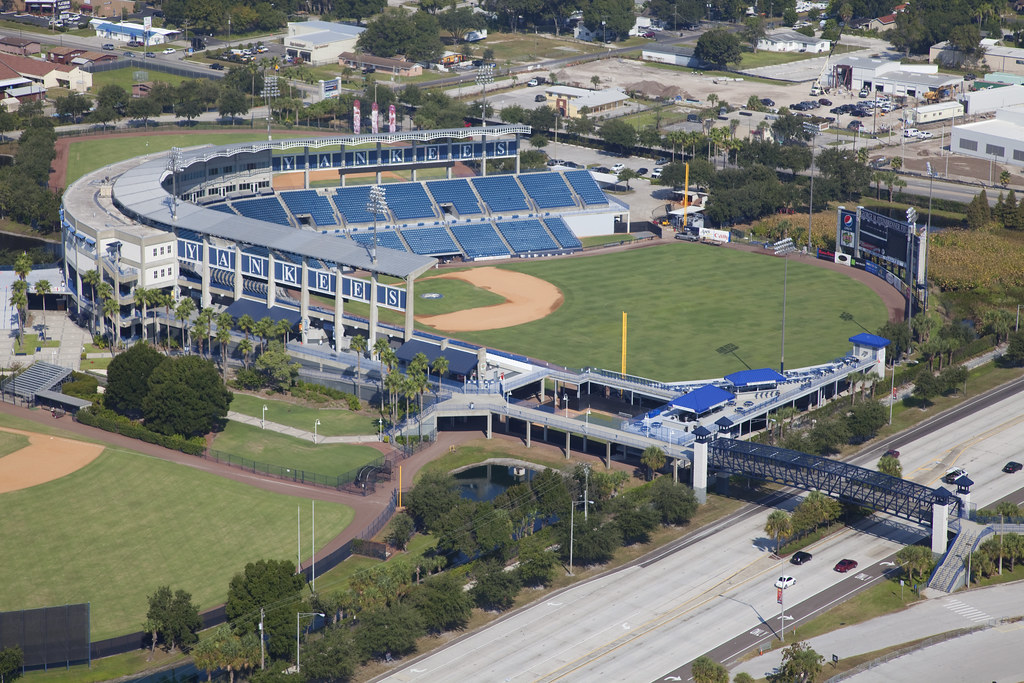
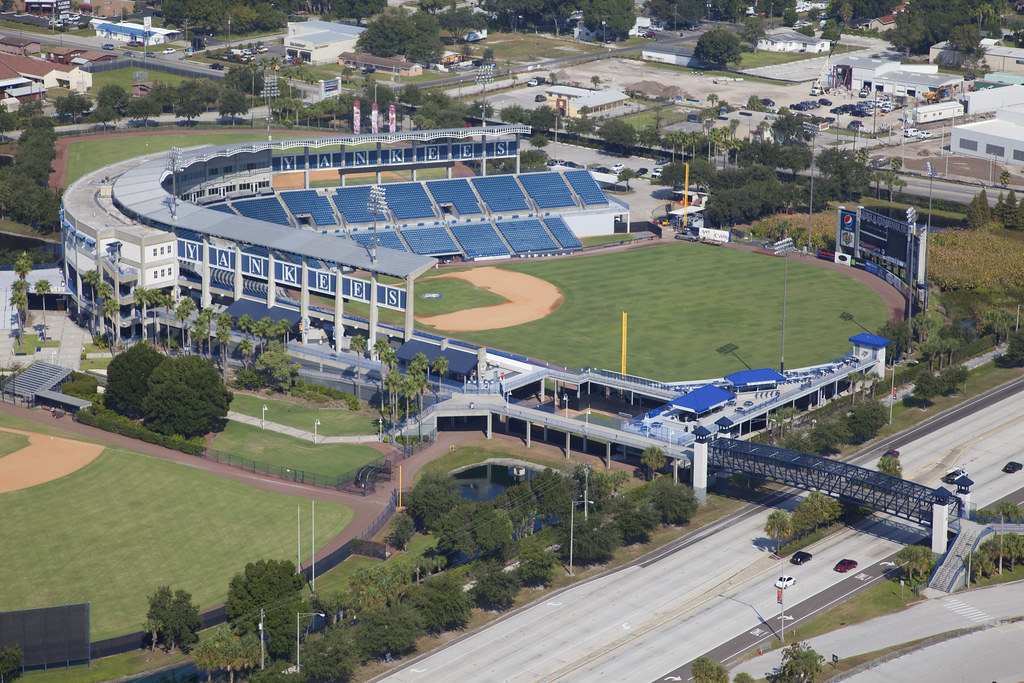
The Rays are used to uncertainty as they prepare for a regular season with home games at Tampa’s Steinbrenner Field, the spring training base of the New York Yankees. It will mark the Tampa Bay Rays first ever season in Tampa.
“For us, this is what we’ve known,” Rays president of baseball operations Erik Neander said Tuesday at the team’s spring training complex.
Hurricane Milton ripped the roof off St. Petersburg’s Tropicana Field on Oct. 9, leaving the stadium unusable for at least 2025. In addition, the Rays have until March 31 to commit with the city of St. Petersburg on a planned $1.3 billion stadium that likely would open in 2029 at the earliest.
Here is the latest on the Rays from our Locked On Rays be sure to subscribe today.
“We’ve had different types of uncertainty and questions hanging over our franchise for the entirety of the Rays era,” Neander said. “And we found a way to win the third most games in baseball and appear in a couple World Series. This is what we do. I think we do it pretty well.”
Pitchers and catchers report Wednesday, and manager Kevin Cash said his team will be ready for the March 28 opener against Colorado. Steinbrenner, which has about 11,000 seats, is exposed to weather, unlike the Trop.
“There is an added element to it,” Cash said. “I’d like to think we’re going to have some time to build into that. Generally speaking, we’re going to have some pretty beautiful weather for the first month or two. We’ll have a little better understanding of who we are as a pitching group and as a team going into some of those hot summer months.
“Our players, I give them a lot of credit. They’re very aware. They’ve done a lot of work this offseason having that in the back of their mind. We’ve probably thrown more outdoor bullpens this year coming into camp than maybe we have in the past. We’ll do everything we can to adjust on the fly as needed.”
Tampa Bay was 28th among the 30 teams in home attendance last year at 1.3 million, ahead of only Oakland and Miami.
“From what I’ve heard with ticket sales, I know it’s a smaller venue, but it will be fun to see some packed houses,” Cash said. “Our players are going to appreciate that. Very thankful for the Yankees, the Steinbrenner family, Hal (Steinbrenner). Top to bottom, that organization has been front line with the way they’ve communicated with every bit of our staff.”
Cash was sadden by the condition of Tropicana Field after Hurricane Milton ravaged the area.
“First time I saw it, I was driving on (Interstate) 75. It was surreal,” Cash said. “When I saw it happen in the middle of the night, I didn’t think it was real. Your mind races a little bit, ‘What now? What now?’”
Tampa Bay went 80-82 last season, ending a streak of five straight postseason appearances.
“Our focus can stay very much right in front of us,” Neander said. “For our group, it’s an opportunity to galvanize ourselves around the circumstances and what’s in front of us. Our players are ready to go and they’re excited about it.”
NFL and COLLEGE FOOTBALL – THE sec How Sports Is Saving Broadcast TV: The Rise of Live Programming in a Streaming-Dominated Era
Escalating costs of NFL and MLB renewals, combined with cable decline and streaming fragmentation, are likely to make ESPN, Amazon, Apple, CBS, NBC, Fox, and YouTube more cautious about paying significantly higher college football rights fees. This financial pressure could slow down aggressive expansion and reduce the incentive to add ACC schools like Florida State, Clemson, North Carolina, and Miami, especially since their recent on-field performance has weakened their market value.
NFL & MLB renewals dominate budgets: The NFL’s Thanksgiving 2025 ratings shattered records, proving why networks will commit billions more to retain rights. MLB’s upcoming renewal adds another heavy obligation.
Streaming entrants already stretched: Amazon, Apple, and YouTube are investing heavily in NFL packages and global sports, limiting their appetite for additional college conference deals.
Cable volatility: Cord-cutting erodes traditional revenue streams, forcing networks to be more selective with rights investments.
College Conference Dynamics
Big Ten & SEC remain secure: Their multibillion-dollar deals ($8B+ for Big Ten, $3B for SEC) ensure stability and make them the only conferences positioned to expand further but only if there is more money to get from the media partners.
ACC locked in: ESPN extended its deal through 2036, giving the conference stability but limiting renegotiation. This makes poaching ACC schools less financially attractive unless ESPN adjusts terms.
Big 12 opportunism: Benefited from Pac-12’s collapse, but future expansion depends on whether networks see value in adding mid-tier programs.
Risks for ACC Schools
Performance matters: Florida State, Clemson, UNC, and Miami have struggled with subpar seasons, reducing their bargaining power. Networks are less likely to pay premiums for underperforming brands.
Revenue-sharing pressures: Following the House v. NCAA settlement, schools must share revenue with athletes, increasing the need for higher payouts. If networks won’t pay more, weaker conferences risk losing schools without replacement value.
Exposure vs. payout trade-off: Streaming platforms may prefer cherry-picking marquee matchups rather than funding entire conferences, further reducing incentives to add schools.
Likely Outcomes
Slower expansion: Networks will prioritize retaining NFL/MLB rights over funding new college realignment.
Selective poaching: Big Ten and SEC may still target top ACC schools if they rebound competitively, but only if the economics justify it.
ACC stability (for now): ESPN’s long-term deal through 2036 makes immediate exits difficult, though lawsuits from FSU and Clemson could test that structure.
Bottom Line
The financial strain of NFL and MLB renewals means networks are unlikely to pay dramatically more for college football in the near term. That reduces the incentive for conferences to expand aggressively, making another Pac-12-style collapse less likely in the short run — but leaving underperforming ACC schools vulnerable if their value doesn’t rebound.
The Breeders’ Cup starts today, and Let ’em Run is on site.
Rear View Mirror Segment Introduction
Let ’em Run continues to improve our product, and we are rolling out our “Rear View Mirror” segment in today’s edition for Sports Talk Florida, where we look back on races we broke down and see where we missed a possible pick and why, and also how we landed on a good pick. In life they say “the windshield is bigger than the rear view mirror so you look ahead, instead of back”. We think in handicapping, a good idea occasionally to look back!!
Friday 11/28 — Churchill Downs
Race 10 – The Mrs. Revere Stakes Looking back on our Podcast, John and I both landed on #4 Classic Q as an upset winner over big favorite #1 Lush Lips. The favorite proved her class and just nipped Classic Q. and a fast closing #10 Pretty Picture.
Race 11 – The Clark Stakes The “Rear View Mirror” told us we should have given a long look at the #9 Magnitude, who took it to the field with the highest U.S. Timeform early pace figure. John made a strong case for #5 Chunk of Gold, who had more company up front than expected. My pick #4 Gosger, had many Brisnet angles that made him strong in my book, but never fired. Keep an eye on this runner next out, odds will surely be worth a look.
Saturday 11/29 — Del Mar
Race 5 – The Seabiscuit Handicap In this race, the “Rear View Mirror” told us the only way (in our opinion) the #4 Call Sign Seven could have been used, was if you used a dart board, no offense to those who picked him!! John and I both landed on #3 Almanderes, who ran in 4th place, as the leader ran away from all in the field.
Race 7 – The Jimmy Durante Stakes Some redemption here as John laid out a Trifecta Key for $20 (4/1,5,6,8,9/1,5,6,8,9) and returned $61.50. Hey, a win is a win. I dropped anchor on the #5 La Ville Lumiere, a long shot at 8-1, with a lot of Brisnet angles to work with. She ran a nice race, but only managed a 3rd place finish.
Race 9 – The Hollywood Stakes Using the “Rear View Mirror”, a case could have been made for winner #4 Salamis. Leading rider Umberto Rispoli jumped aboard for trainer Chad Brown. In the last race he was a tough load, and closed, but too late. He ran back to the 2 back race and took the top spot, not an impossible pick with a closer look.
Looking Ahead
Moving forward, Let’emRun is looking to run multiple Podcasts each week in the New Year. Coming up on Friday 12/5/25 Happy Hour at 3PM, we will dive into 2 races being run on Saturday 12/6/25… Race 6 at Laurel Park, The Maryland Juvenile. We will then jump over to Race 7 at Turfway Park, The Boone County. Some interesting races, at some interesting venues.
Upcoming Coverage
On Saturday 12/6/25, we will get back to East Coast racing at Aqueduct, where we will cover Races 7 thru 11, including Race 9 The Remsen Stakes (Kentucky Derby Prep), and Race 10, The Cigar Mile. Two big races each year at the Big A, so be sure to tune in for both shows, and as always Let ’em Run.
Paris Saint-Germain legend Jay-Jay Okocha has rankked Serbian coach Dragoslav Stepanovic as the manager with the most significant impact on his career.
Okocha credited Stepanovic for guiding him during his formative years at Eintracht Frankfurt which shaped him in becom of the most skillful players during his active career.
Okocha joined Frankfurt from Borussia Neunkirchen in December 1991, a move that marked the beginning of his rise in European football.
He spent four years at the club, four defining seasons that helped shape his playing style and future success.
Those early years in the Bundesliga showcased Okocha’s incredible talent, as he quickly built a reputation for his mesmerizing footwork, flair, and creativity.
One of his most iconic moments in Germany remains his unforgettable solo goal against Karlsruher SC, where he famously dribbled past multiple defenders, including goalkeeper Oliver Kahn before slotting the ball into the net.
The goal is still regarded as one of the greatest in German Bundesliga history.
Despite his strong start in Germany, Okocha’s time at Frankfurt came to an unexpected end. In 1995, he fell out of favour under new coach Jupp Heynckes, but he has explained why Stepanovic stood out above all other coaches in his career.
“The coach who influenced me the most was my first manager at Eintracht Frankfurt, Dragoslav Stepanovic,” Okocha told R.org.
“It was short, but he influenced me the most throughout my career. Stepanovic is the type of coach every young player deserves to encounter.”
Okocha credited the Serbian coach for giving him both confidence and freedom, qualities that helped him fully express his unique style of play.
“I did not just feel at home at Frankfurt,” he added. “His guidance pushed me to bring the best out of myself.”
After Frankfurt were relegated to the German second division, Okocha moved to Fenerbahce in 1996.
His transfer to Turkey marked the beginning of another electrifying chapter, where his performances attracted international attention and eventually paved the way for his high-profile move to Paris Saint-Germain in 1998.