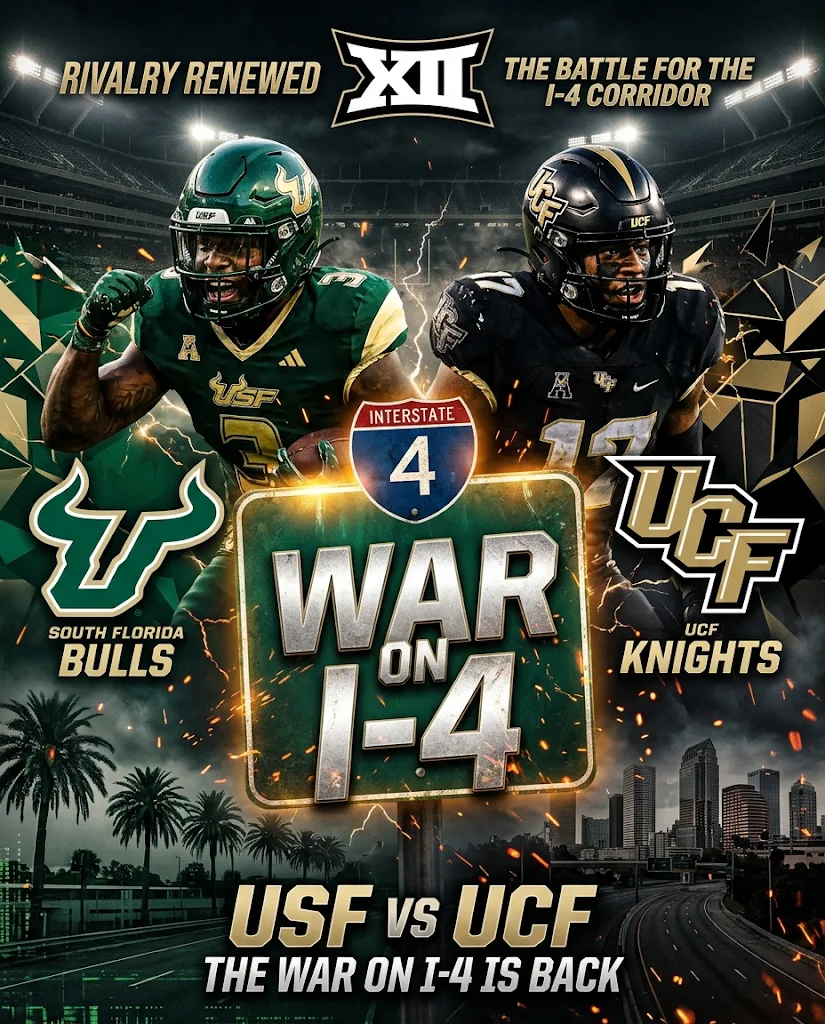
As college athletics realignment continues to reshape the Power Four landscape in November 2026, the Big 12 Conference faces a pivotal question regarding its long-term television strategy. With the league preparing for a leadership transition following outgoing Commissioner Brett Yormark’s departure and looking ahead to its 2031 media rights negotiations, adding the University of South Florida to revive the War on I-4 against UCF stands out as one of the most compelling television inventory plays available.
Since UCF departed the American Conference for the Big 12 following the 2022 season, college football has been deprived of one of its fiercest, highest-scoring regional rivalries. Reuniting the Knights and the Bulls under the Big 12 banner would not only solve a glaring geographic and travel headache for Orlando’s program, but it would also hand the conference’s broadcast partners a proven, ratings-generating rivalry window right in the heart of Florida’s massive I-4 corridor.
Proven Television Ratings That Rival the Big 12’s Best
In the post-Texas and Oklahoma era, the Big 12 lost its marquee 9-to-10-million-viewer national showcase in the Red River Rivalry. Today, the conference’s top intra-conference rivalries—such as BYU versus Utah’s Holy War and Iowa State versus Kansas State’s Farmageddon—typically ceiling out around the 4.0 to 4.4 million viewer mark when placed in prime network windows.
The War on I-4 has already demonstrated it can exceed that threshold. During its peak 2017 Black Friday showdown on ABC, UCF’s thrilling 49-42 victory over USF drew 4.6 to 4.7 million viewers, establishing an all-time record for intra-conference broadcasts in the American Conference. Even more importantly for network executives, that game pulled an 11.1 local rating in Orlando and a 10.1 local rating in Tampa, proving that a competitive matchup between these two programs dominates two of the nation’s top 15 television markets simultaneously.
Locking Down the I-4 Media Corridor and Recruiting Pipeline
Adding South Florida allows the Big 12 to pair Tampa-St. Petersburg, the nation’s 11th-largest media market, directly with Orlando, the 15th-largest market. Instead of leaving UCF on an isolated geographic island more than 1,000 miles away from most conference opponents, bringing USF into the fold creates an instant, built-in travel partner across all Olympic sports and anchors the league’s southeastern recruiting footprint.
Television networks consistently pay a premium for genuine regional animosity, especially during Thanksgiving weekend when Rivalry Week programming drives peak regular-season viewership. Giving ESPN and Fox a revived UCF-USF Black Friday or Rivalry Week clash provides immediate, high-stakes inventory that outperforms generic late-November cross-country matchups.
Two Programs Positioned for a Prime-Time Revival
The timing for a reunion aligns seamlessly with both programs’ trajectories as of mid-November 2026. Under head coach Scott Frost, UCF sits at 5-5 in the middle of a competitive Big 12 campaign highlighted by a double-overtime upset of BYU. Meanwhile, in Tampa, first-year head coach Brian Hartline has guided USF to a 6-4 record after bringing in the top transfer portal class among Group of Six programs, building momentum ahead of the opening of South Florida’s new 35,000-seat on-campus stadium in 2027.
By the time the Big 12 heads to the negotiating table for its next television contract in 2031, USF will have an established on-campus venue, elite research credentials as an Association of American Universities member, and a revitalized football program. Bringing back the War on I-4 gives the Big 12 a rare expansion addition that actually increases per-game television appeal rather than diluting it.