
Politics
How a undocumented immigrant rose to become Orlando’s state representative
His mother warned him: if they ask any questions, tell them you are going to Disney World.
The 14-year-old boy boarded the airplane alone from Brazil to Florida, intending to overstay his tourist visa.
The boy spoke no English. The airport immigration official who stopped him spoke no Portuguese.
“Mickey Mouse,” the boy said in the confusion.
It was enough.
The officer stamped the boy’s passport and allowed him to enter the United States.
Twenty-five years later, that boy, now a U.S. citizen, was elected to the Florida House of Representatives in District 42 in Tuesday’s election.
“I’m going to become the very first Brazilian ever elected to the floor of the Legislature, the very first Dreamer ever elected to the floor of the Legislature,” Felipe Sousa-Lazaballet said.

Sousa-Lazaballet grew up in the slums on the outskirts of Rio de Janeiro. His mom, a single mother, left at 5 a.m. every day to clean a clinic and wealthy homes. Small and mighty at 4’8”, his mother only had a second-grade education and could barely read or write, but she was proud of her work making people’s homes look nice. She returned home at midnight and cooked beans and rice — the family couldn’t afford much meat — to feed her children the next day. The smell of garlic woke Sousa-Lazaballet, and she spent a few minutes with her.
“We didn’t have electricity. We didn’t have pavement in the streets. … There was almost like a river of sewage that would run right by my house. And that’s how we lived,” Sousa-Lazaballet said. “But even though we were very poor, we were very rich in love. My mom always loved me and my sisters, and they always made me feel I could be whoever and whatever I wanted.”
Sousa-Lazaballet devoured “The Little Prince” and “Catcher in the Rye” that his older sister brought home from college. He told his family he wanted to be President someday.
“That was me as a kid, a curious kid, who wanted to be more than my circumstances, but not necessarily knowing what that meant,” he said.
When Sousa-Lazaballet was eight, his sister moved to the United States to break the cycle of poverty. She promised to bring him over someday.
She didn’t forget that promise.
At 14, he flew over under the guise of a Disney World vacation. He cried on the airplane because he didn’t know when he would see his mother again. He didn’t know it would take four years to be reunited. The American Airlines flight attendants couldn’t communicate with him, so they fed him cookies to cheer him up.

He entered a whole new world in Miami.
The Publix store was huge. The bridges moved. The school was air-conditioned and cool. He picked up Spanish quickly. English took longer.
He translated his entire American history book word by word to pass a test.
His ESOL (English as a Second Language) teacher helped him learn the language, and so did watching “Barney” and “Sesame Street” with his young niece.
“Once I was able to start communicating, then life got a lot better, but that process, that moment that I didn’t know the language, I just felt so trapped because I couldn’t talk to people and I couldn’t really explain who I was, what I am about,” he said.
In his ESOL class, he became good friends with others who spoke Portuguese and Spanish too.
“I wasn’t necessarily missing Brazil, but I was really missing my mom,” Sousa-Lazaballet said.
He wrote her letters since international phone calls were too expensive.
He was so young, he didn’t understand what being undocumented meant until his guidance counselor informed him he couldn’t go to college without a Social Security number.
“That broke my heart. It shattered me. I was so incredibly sad, depressed,” Sousa-Lazaballet said. “It just felt like I faced a wall that I couldn’t overcome.”
But a narrow path forward remained. It wasn’t entirely hopeless, even if he had to pay soaring out-of-state tuition without government financial aid.
He enrolled at Miami Dade College, which offered him a privately funded scholarship to cover about one-third of tuition.
To pay the rest, Sousa-Lazaballet bussed tables at a Venezuelan fusion restaurant in Aventura. His shift ended around 2 a.m.; then he woke up at 6 a.m. for a two-hour bus ride to get to class and fulfill his student body president duties on campus. He finished his homework on the bus.
“When you are a kid, and you’re in school, they tell you that if you work hard, all your dreams can come true. And I didn’t feel like that was for me and everything was so much harder,” he said. “But I also persevered because I really wanted to finish my bachelor’s degree. That was my whole goal. I wanted to get it done — partly because I wanted to make my mom proud, but also because I really like to go to school.”
He was, after all, the kind of person who looked up geography facts for fun.
Sousa-Lazaballet’s intelligence and drive would not go unnoticed. He was named Florida’s best community college student and ranked among the nation’s top 20. He graduated with an associate’s degree in international relations.
St. Thomas University, a private South Florida school, offered him a scholarship to cover half his tuition. So Sousa-Lazaballet took a gap year to work and save up, then finished his education, graduating in 2012 with a bachelor’s degree in business studies and a minor in economics.
Florida eventually passed a bipartisan 2014 law to allow undocumented students to pay in-state tuition. In 2025, the Florida Legislature overturned it and now requires them to pay out-of-state tuition.

Sousa-Lazaballet found his voice.
In 2010, he co-organized a march from Miami to Washington, D.C., with the Dreamer movement to advocate for more protections for young people like him.
“The young activists walked 15 to 18 miles per day, six days a week, enduring heat, rain and snow,” the Miami Herald reported. “Throughout 42 stops across the southeastern parts of the country, they received support from churches and community coalitions and encountered Ku Klux Klan members.”
Immigration rights and LGBTQ rights became intertwined for the young activist. Until same-sex marriage was legal, Sousa-Lazaballet, who is gay, couldn’t marry a U.S. citizen.
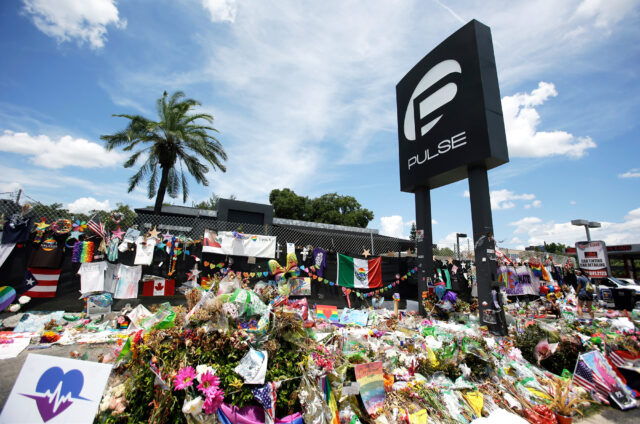
In 2016, a crowd was dancing at an LGBTQ+ club’s Latin Night in downtown Orlando when a shooter murdered 49 people.
The Pulse nightclub shooting happened while Sousa-Lazaballet worked in New York City after he had gotten his green card.
“I remember thinking to myself, ‘Oh my God. I am out here trying to save the world, but my own home is on fire. I got to go home,’” Sousa-Lazaballet said.
He returned to Florida to speak with 150 people hurt by the Pulse tragedy and then write a community assessment. He helped raise $2 million to start what’s now called the Contigo Fund, which means “with you” in Spanish. The Contigo Fund gives grants in Central Florida to queer communities of color and the organizations fighting to support them.
Orlando Mayor Buddy Dyer reached out to Sousa-Lazaballet and asked him to help the city in the Pulse aftermath.
Within days, Sousa-Lazaballet packed his belongings in a van and moved to Orlando. He would never leave. He built a life in Central Florida and eventually married his husband, Luis Sousa-Lazaballet, an operations director for the AdventHealth Credit Union.
Sousa-Lazaballet began working with the city to partner with the Heart of Florida United Way.
“We didn’t have enough mental health folks who spoke Spanish. We didn’t have training on LGBTQ+ competence. There were so many gaps, and my job was to remove barriers,” Sousa-Lazaballet said. “We built the whole network that ultimately served the 49 families and the hundreds of survivors. And then once that first kind of layer of people beginning to be taken care of, I started working more around community healing.”
In 2022, Sousa-Lazaballet became Executive Director for the Hope CommUnity Center in Apopka. The nonprofit runs everything from after-school programs for teens to a food pantry and legal services for immigrants.
“The work we do is very, very difficult, especially given the current immigration crisis,” said the Center’s interim Executive Director Meilyn Santana, who called Sousa-Lazaballet her mentor and friend. “He’s just somebody that you want to have close to you in your circle because he’s so kind-hearted, he’s so passionate and such a good fighter.”
In his new career, Sousa-Lazaballet gained a new power: he could vote in the 2022 Midterms after becoming a U.S. citizen in 2021.
His political activism kept growing.

Rep. Anna Eskamani and Orange County Democratic Party Chair Samuel Vilchez Santiago made their pitch in a bakery on Goldenrod Road just before Christmas in 2024.
They were recruiting Sousa-Lazaballet to run for term-limited Eskamani’s seat.
“Why me?” Sousa-Lazaballet asked, unsure.
That question convinced Eskamani he was the right one.
Vilchez Santiago told Florida Politics Sousa-Lazaballet was the “perfect match” because of his Pulse work with the city of Orlando. In a President Donald Trump administration, Democrats also wanted a strong pro-immigration candidate in the state Legislature.
By the end of the bakery meeting, Eskamani bought Sousa-Lazaballet a website URL.
Within months, Sousa-Lazaballet launched his campaign and began knocking doors to collect signatures to qualify for the ballot. At one house in Orlando’s North Colonialtown neighborhood, a friendly pit bull and three wild preschoolers escaped when the homeowner answered the door. Sousa-Lazaballet helped catch them.
HD 42 was heavily in his favor as a blue District, but Sousa-Lazaballet kept knocking on thousands of doors and attending community events, from parades to cleanups to contentious Orange County Commission meetings.
Election Night was almost anticlimactic.
After spending the day at the polls, Sousa-Lazaballet hurried home to feed his two miniature schnauzers when his campaign manager called with the news: he won HD 42. The rest of the energetic Orange County Democrats’ Election Night party went on without him, as Sousa-Lazaballet immediately called his mother back in Brazil to tell her he was now a state Representative.
The post How a undocumented immigrant rose to become Orlando’s state representative appeared first on Florida Politics – Campaigns & Elections. Lobbying & Government..